Mexico City street food isn't chaotic — it's highly organized by time, format, and neighborhood. Each type of street food has its own hour, its own ritual, and its own customer base. Tacos de canasta appear at dawn and disappear by noon. The tamale lady does her rounds between 7 and 9 a.m. The al pastor taquería opens mid-morning and goes until the trompo runs out. Understanding this schedule before you arrive is the difference between eating exactly what you came for and walking past an empty cart wondering where everyone went.
Payment is almost always cash — bring 20- and 50-peso bills. Ordering at a street stand is fast: state your protein or filling, watch the taquero build your taco, and step aside. Salsa goes on yourself from the communal salsera on the counter. There's no table service, no menu in your hands, and no tip expected at street-level spots. The entire transaction takes about forty-five seconds.
Each format has a specific time window — learn the schedule or you'll miss the good stuff
Cash only at almost all street stands — small bills essential
Salsa is self-serve from the counter; don't wait to be offered it
Tacos de canasta (basket tacos) are one of the most specific street food formats in Mexico City, and they're almost unknown outside of it. A vendor — usually on a bicycle — carries a large wicker basket insulated with a blanket or cloth. Inside are hundreds of pre-made tacos, stacked in layers, steaming themselves in the residual heat from the morning. The tortillas are small, soft, and slightly greasy from the steam and the fillings.
The classic options: chicharrón (crispy pork skin rehydrated in salsa verde), frijoles (black bean paste), papa con chorizo (potato and chorizo), and sometimes tinga (shredded chicken in chipotle). You pick your fillings by pointing, receive a small stack of tacos wrapped in paper, and eat standing up. They run extremely cheap — among the most affordable meals in the city.
Best time to find them: 7 to 11 a.m., near Metro stations and neighborhood markets. Look for the bicycle with the cloth-covered basket and the plastic container of agua fresca hanging off the handlebar. Near Metro Merced or any working-class colonia on a weekday morning, you'll have no trouble finding one.
Sold from insulated bicycle baskets — pre-made and steamed, not grilled
Classic fillings: chicharrón, frijoles, papa con chorizo, tinga
Peak window: 7 to 11 a.m. near Metro stations and markets
Get short, interactive stories that make each place easier to remember while you travel.
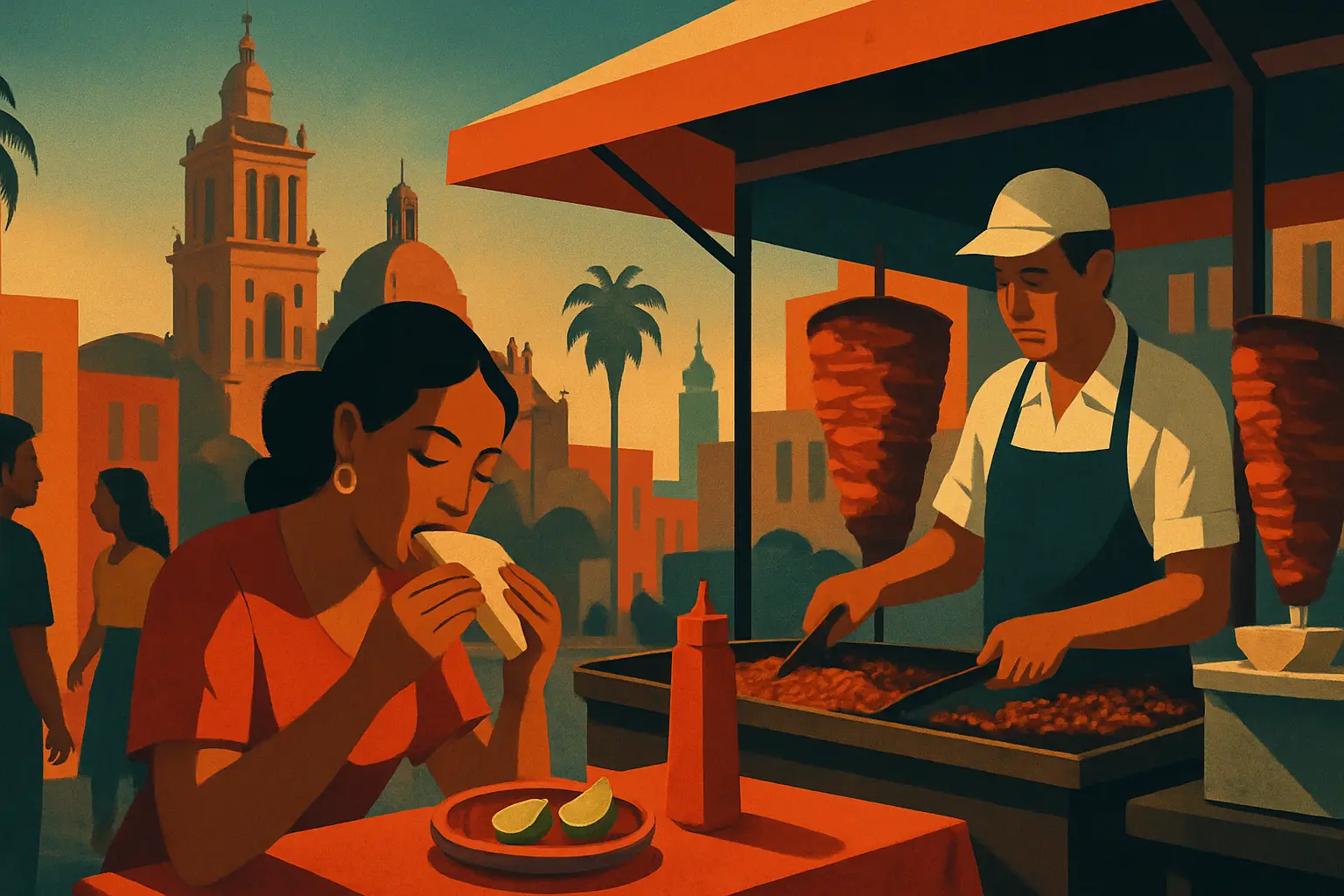
Al pastor is Mexico City's most famous taco style, and it arrived through a specific historical path: Lebanese immigrants brought the shawarma spit-roasting technique to Mexico in the 1930s, and Mexican cooks replaced the lamb with pork marinated in achiote paste, guajillo chiles, pineapple juice, and dried fruit. The result is the trompo — a vertical rotating spit of stacked marinated pork with a whole pineapple perched on top.
The taquero stands close to the trompo with a long knife, shaving thin slices of meat onto the griddle, then catching them in a small corn tortilla. The pineapple gets flicked off the top directly into the taco — a technique that requires both speed and accuracy and is deeply satisfying to watch.
The oldest al pastor taquería in Mexico City is El Huequito, which has operated on Ayuntamiento Street in Centro Histórico since 1959. For late-night pastor: El Vilsito in Narvarte is a Volkswagen mechanic shop by day that converts entirely into a taquería at night — open from around 9 p.m. to 4 a.m. with a line out the door on weekends. Tacos Los Cocuyos, also in Centro, runs until 6 a.m. and stacks al pastor alongside tacos de tripa and buche for the serious late-night crowd.
El Huequito (Centro, Ayuntamiento St.): oldest al pastor spot in the city, open since 1959
El Vilsito (Narvarte): mechanic shop by day, legendary taquería 9 p.m. to 4 a.m.
Tacos Los Cocuyos (Centro): open until 6 a.m., pastor plus offal cuts
If you eat only one format of Mexico City street food, make it tacos de guisado. The setup: a cook stands behind a row of deep earthenware pots containing eight to twelve different stewed fillings. You pick one or two, they go into corn tortillas — usually with a thin layer of beans underneath the guisado — and your taco is done.
Common guisados: tinga de pollo (shredded chicken in chipotle-tomato sauce), rajas con crema (roasted poblano strips in cream), nopalitos (sliced cactus with tomatoes and epazote), chicharrón en salsa verde (pork rinds stewed until soft in tomatillo sauce), picadillo (ground beef with potatoes, tomatoes, and herbs), and huevo con nopales (eggs scrambled with cactus). The format is democratic: one price regardless of filling, roughly 20–30 pesos per taco. You pick by pointing at whichever pot looks freshest.
The best guisado spots are in working-class colonias and near markets — Colonia Buenos Aires, the streets around La Merced, and in Guerrero near Tlatelolco. Weekday mornings from 7 to 11 a.m. are the prime window; guisados are replenished through the morning but start to dry out by noon.
Pick from 8–12 stewed fillings displayed in pots — same price regardless of choice
Rajas con crema, tinga, and chicharrón en salsa verde are the classics to start with
Best areas: Colonia Buenos Aires, La Merced, Guerrero — weekday mornings only
The guajolota is Mexico City's most specific morning ritual, and it sounds stranger than it tastes: a tamale — usually de rajas con queso or de mole negro — tucked inside a bolillo roll. The name is Mexico City slang for a female turkey, but in street food context it means this particular combination sold outside Metro stations on weekday mornings.
The texture contrast works in a way that's hard to explain until you've eaten one: the soft, masa-heavy tamale against the lightly crusty bolillo, usually eaten alongside a cup of atole (a warm corn-based drink thickened with masa and flavored with vanilla, guava, or strawberry) or café de olla (coffee brewed in a clay pot with cinnamon and piloncillo). The entire breakfast — guajolota plus drink — costs well under 50 pesos and carries you through a solid morning of walking.
The tamale culture behind this runs deep: tamales were served at the Tlatelolco market before the Spanish arrived, and colonial-era records describe more than 40 tamale varieties served to Moctezuma's court. The guajolota is just the most convenient modern delivery system for something extremely old. You read more about this lineage in the Mexico City food history post.
Guajolota = tamale inside a bolillo roll — sold outside Metro stations, weekday mornings
Pair with atole (warm corn drink) or café de olla for the full breakfast
Under 50 pesos for the full meal — one of the best-value breakfasts in the city
A few practical rules make street food ordering smooth rather than stressful.
Arrive early. The city eats breakfast between 7 and 10 a.m., and the best vendors sell out of specific fillings or run low on tortillas by late morning.
Watch what the person ahead of you ordered. If you don't recognize an item by name, point at the taco you just watched leave the counter.
Ask about heat. Mexico City salsa ranges from mild to brutally hot, and vendors rarely volunteer which is which. ¿Pica mucho? (Is it very spicy?) gets you an honest answer every time.
Don't overthink the drip. Some things are going to run down your hand. This is correct and expected. Paper napkins are decorative.
Pay as you receive. Pay for your tacos when they're handed to you, not at the end of a session. It keeps the flow clean and signals you know the format.
Squeeze the lime over everything. If there's a limón on the counter — and there will be — it belongs on your taco. No exceptions.
¿Pica mucho? — always ask before pouring an unknown salsa
Pay when you receive, not at the end — keeps the rhythm moving
Lime over everything, always
The honest answer: street food from busy vendors is safe. High turnover means nothing sits around. A vendor with twenty people in line is cooking fresher food than most sit-down restaurants. The specific risks that do exist are narrow: avoid cut fruit from vendors who don't refrigerate it during the hot months (June through August), be cautious about raw preparations from unfamiliar stalls, and skip any vendor without a visible water source — if you can't see where they're washing anything, that's your signal to move on.
The safest formats for first-timers are tacos al pastor (cooked on a high-heat rotating spit, fully visible process) and tacos de guisado (long-cooked stewed fillings). As with the cantinas guide, the rule is simple: busy means proven, empty means untested.
Montezuma's Revenge is real but almost always comes from tap water or ice made with tap water — not from the food itself. Stick to bottled water, eat from high-traffic vendors, and start with one or two tacos from a new spot before committing to a full session. Your stomach adjusts faster than you expect.
High-turnover vendors are safer than low-traffic sit-down spots — prioritize busy carts
Al pastor and guisados are the safest first choices — fully cooked, visible process
The real risk is water and ice, not the food — stick to bottled water