1. What the Tianguis del Chopo actually is
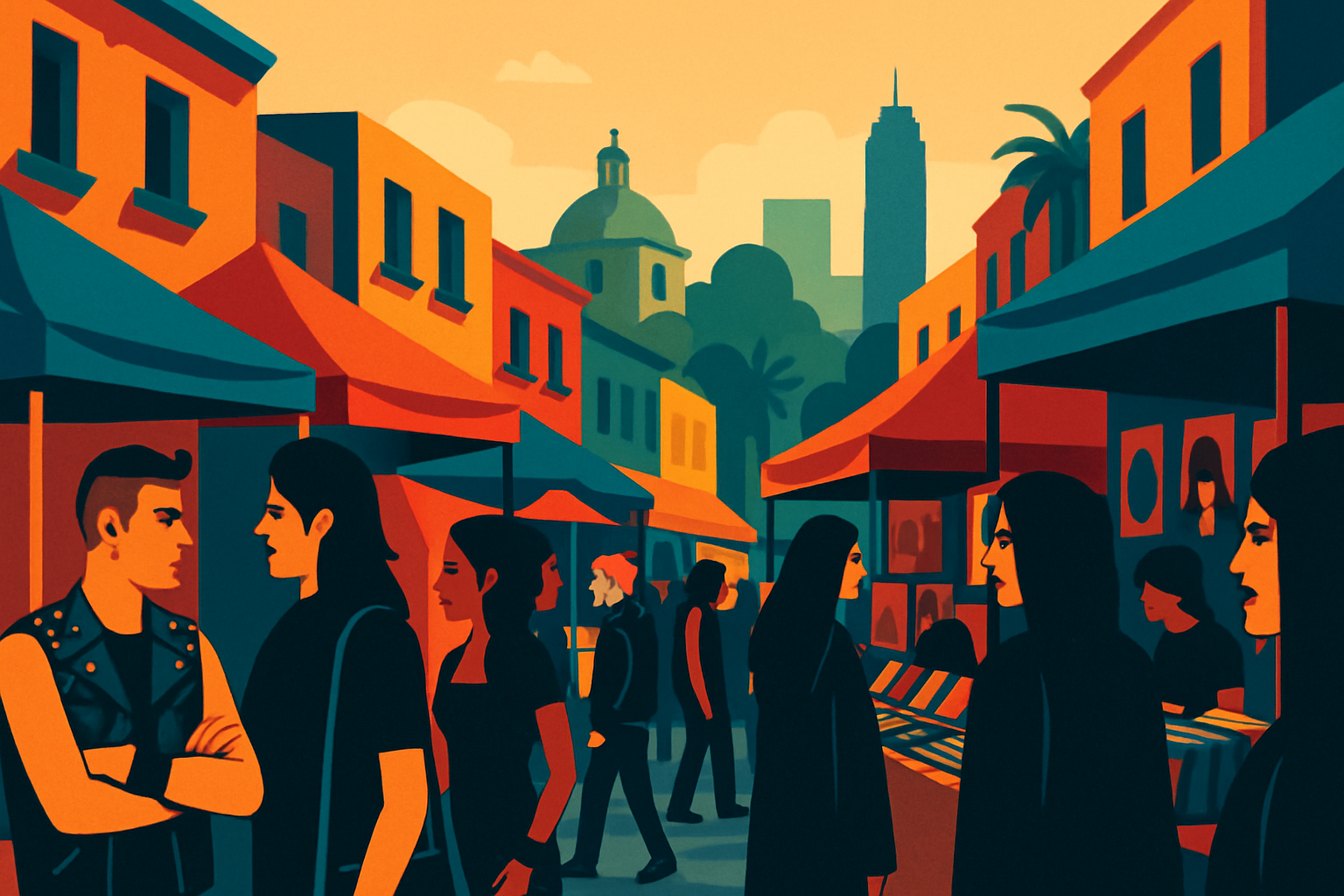
Tianguis Cultural del Chopo is a weekly open-air market held every Saturday on Calle Aldama in Colonia Guerrero, roughly 15 minutes north of the Zócalo by metro. About 200 vendors set up along two blocks of street, specializing in music, alternative fashion, and counterculture goods. You will find vinyl records spanning heavy metal, punk, goth, industrial, dark wave, psychedelic rock, Mexican underground, and cumbia; band t-shirts; leather jackets; studded belts; manga volumes; artisan jewelry; vintage cassettes and demo tapes; comic books; and stalls selling antojitos to the people who have been there since the market opened.
At the far end of the market, the Radio Chopo stage hosts free live sets — up to five bands and DJs perform every Saturday, giving the back of the tianguis a festival quality that most visitors don't expect. Local acts testing new material, cover bands working through classic sets, and occasional surprise appearances from established names in Mexico City's underground circuit all happen here, for free, while people flip through record crates a few meters away.
What distinguishes El Chopo from the city's other markets is that it functions simultaneously as a commercial space and a social one. People come to buy, but they also come because this is where their scene gathers. A 60-year-old who saw El Tri play Foro Sol in 1985 might sort through the same crate as a 17-year-old who found the market on Instagram. That coexistence — without friction, without gatekeeping — is something El Chopo has cultivated for more than four decades.
2. How it started: a UNAM university movement becomes a cultural institution
The market takes its name from the Museo Universitario del Chopo on Enrique González Martínez street — a UNAM-affiliated art space housed in a cast-iron and glass structure originally built in Germany in 1903 and reassembled in Mexico City in 1910 as part of the centenary of independence celebrations. The building looks like a Victorian botanical greenhouse: modular iron panels, an arched glass roof, and interior space designed for large-scale exhibitions.
In 1980, UNAM students began gathering near the museum to swap records, sell secondhand books, and trade the cultural material that Mexico City's formal retail sector wasn't carrying — imported LPs, fanzines, underground publications, political literature. The informal gathering formalized into a weekly market at the museum itself. As Mexico City's punk and heavy metal scenes grew through the early 1980s, El Chopo became their central node: the place to find bootleg recordings, hard-to-source imports, and information about shows. Bands pinned flyers to the market poles. Promoters distributed tickets by hand. People who had no other way to connect with the underground came on Saturday morning to find out what was happening.
In 1988, the market outgrew the museum space and moved to its current location on Calle Aldama, between Sol and Luna. The change of address didn't change the character — it expanded it. The street format allowed for more vendors, more categories of goods, and eventually the Radio Chopo stage. The Museo del Chopo maintained its relationship with the market as a cultural partner, hosting concerts, photography exhibitions, and program events that complement the Saturday gathering in the street outside. Both are worth visiting on the same trip.
•Founded 1980 near Museo Universitario del Chopo as a UNAM student exchange for books and records
•Moved to current Calle Aldama location in 1988 after outgrowing the museum space
•Museo Universitario del Chopo (Enrique González Martínez 10) still hosts complementary exhibitions and events — free or low-cost entry
3. What you'll find: a map of the stalls
The market organizes itself loosely but consistently. Vinyl and music stalls tend to concentrate toward the entrance, closest to the Sol end of Aldama. This is where the serious collectors go first. You will find imported LPs from the 1970s and 1980s, Mexican pressings of classic rock nacional — early Caifanes, Maldita Vecindad, El Tri, Fobia, Santa Sabina — alongside deep-cuts in black metal, death metal, goth, and industrial. Cassettes and demo tapes appear here in quantities that are increasingly rare in the streaming era: handwritten labels, photocopied sleeves, recordings that were never commercially released and exist only in this format.
Moving deeper into the market, the stalls shift toward fashion and accessories: band t-shirts (both licensed merch and the unlicensed screen-prints that have always been part of El Chopo's ecosystem), patches, pins, silver jewelry, platform boots, leather jackets with hand-painted backs, and gothic fashion in all its range. The crossover between heavy metal and anime communities in Mexico City is genuine and long-established — stalls selling manga volumes, cosplay supplies, and collectible figures sit naturally alongside the record crates without anyone finding it incongruous.
Toward the back, the Radio Chopo stage takes over. The live sets typically start around noon and run until mid-afternoon. Genre varies by week: punk one Saturday, metal the next, experimental or electronic the one after. The stage is visible from well back in the market and audible from the front — it gives El Chopo a quality that no outdoor market in Roma or Condesa replicates.
Food vendors run alongside the stalls throughout: tacos de guisado, quesadillas, elotes, aguas frescas. Several carts have been El Chopo regulars for years and are fixtures of the Saturday experience in the way that certain taqueros become fixtures of any tianguis in the city.
4. Who goes — the El Chopo crowd in 2026
The assumption that El Chopo is exclusively for punks, metalheads, and goths in full regalia is wrong in the most interesting way. The actual crowd is far wider: record collectors who care only about the vinyl and would show up even if everyone else were in business casual; teenagers in their first leather jacket trying to figure out where they belong; middle-aged Chilangos who came here for the first time in 1992 and have never stopped; couples treating it as a Saturday outing; people from the Guerrero neighborhood who wander through because it's right there.
The visual register skews dark — leather, black denim, long coats even in June heat, elaborate makeup on the goths who treat Saturday at El Chopo as an occasion to dress up — but it functions as a vernacular rather than a dress code. Arriving in whatever you're wearing is unremarkable. The LGBTQ+ community presence at El Chopo dates to its early years; today it's visible, diverse, and completely unremarkable in the best sense. The market's long-standing norm against harassment is enforced informally by the crowd itself, which has made El Chopo reliably safer than its location might initially suggest to visitors unfamiliar with the area.
•Crowd spans ages 14 to 65+, drawn from across Mexico City and occasionally from other cities — not exclusively a youth or punk scene
•LGBTQ+ presence is longstanding and visible; the market's community self-regulates against harassment
•Dress code is expressive but not mandatory — showing up in ordinary clothes is entirely normal
5. Combining El Chopo with the surrounding area
The Buenavista-Guerrero corridor where El Chopo sits is part of the northern Mexico City that most tourists skip. That's precisely why it's interesting. The Colonia Guerrero neighborhood around the market is a working-class barrio with a long history, its own food culture, and streets that look nothing like the polished restaurants of Roma Norte.
From El Chopo, a 20-minute walk south takes you to the Plaza de las Tres Culturas in Tlatelolco — where Aztec market ruins, a 16th-century colonial church built directly on top of them, and a 1960s housing complex create one of the most layered historical sites in the city. The contrast between a Saturday morning at El Chopo and an afternoon at Tlatelolco — counterculture present, pre-Columbian past, all within walking distance — is the kind of itinerary that Mexico City does better than almost anywhere.
For food immediately after the market, taqueros on the side streets off Aldama serve through Saturday afternoon. Calle Manuel González, a few blocks east, has solid pozole and caldo spots that cater to the Guerrero neighborhood crowd rather than any tourist market. Mercado de Buenavista, one block from the commuter rail station, has comida corrida available from noon onward for roughly 70–100 pesos a plate.
6. Is El Chopo safe? What first-time visitors should know
El Chopo is safe by the same standard that makes eating tacos from a busy street cart safe — established community, consistent turnover, and a crowd that has collectively decided this space is worth protecting. The market's 45-year history means that the surrounding neighborhood knows it, the city knows it, and the counterculture community that attends it treats it as something worth maintaining. Incidents that would disrupt that are quickly noticed and unwelcome.
Standard Mexico City precautions apply: keep your phone in a front pocket rather than a back one, don't carry more cash than you plan to spend, be conscious of your bag in dense crowd moments near the music stage. Beyond that, the advice is simply to act like a person at a market rather than like a tourist who has wandered somewhere unfamiliar, which is the correct approach everywhere in the city anyway.
•Standard pickpocket precautions apply in any dense outdoor crowd: front-pocket phone, limited cash on hand, bag awareness near the stage
•The community has enforced its own norms for decades — the crowd polices the space more effectively than any external security would
•Metro Line 2 to Revolución is the cleanest route in and out; Uber and taxis are readily available on Manuel González or Eje 1 Norte for the return trip
7. Best time to visit and what to expect in summer 2026
El Chopo runs every Saturday, every week of the year — with very occasional exceptions for major city-wide disruptions. Summer (June through August) means the Mexico City rainy season: mornings are clear and cool, afternoon showers typically hit between 3 and 6 p.m. The market operates 11 a.m. to 5 p.m., which puts the rain window exactly at closing time on most days. Arriving at 11 a.m. or noon and planning to leave by 3:30 p.m. means you beat both the midday heat and the afternoon rain comfortably.
The Radio Chopo stage typically hits its peak sets between noon and 3 p.m. in summer — if free live music is part of why you're coming, that's the window to be at the back of the market. Record and merchandise stalls are fully set up from 11 a.m. onward; vendors start packing as early as 4 p.m. on hot or rainy Saturdays, so late arrivals find a reduced market.
The market is busiest from March through October, with spring Saturdays (March–May) considered optimal for weather and vendor attendance. December is the thinnest month — cold, shorter days, lower turnout — but the market never closes, and the December edition occasionally features special events around the holiday season. Check Museo Universitario del Chopo's social accounts for any concert or exhibition programming that runs parallel to the market.
•Year-round Saturdays, 11 a.m. to 5 p.m. — in summer, plan to arrive at 11 a.m. and leave by 3:30 p.m. to avoid afternoon rain
•Radio Chopo stage peaks noon to 3 p.m. most Saturdays; vendors begin packing early on hot or wet afternoons
•Spring (March–May) is the sweet spot for weather and attendance; December runs lean but never closes