1. Four blocks that carry a century of hidden history
In San Francisco, New York, or Vancouver, Chinatowns sprawl across entire districts. Mexico City's Barrio Chino on Calle Dolores is compact precisely because the community that built it was small, embattled, and arrived not as a planned settlement but as a refuge. The story of why this particular stretch of one street in the Centro Historico became a Chinese commercial district is one of the stranger and less-told chapters of early 20th-century Latin American history. It involves Porfirian railroad contracts, a massacre in Coahuila, anti-Chinese state legislation, and the forced removal of an entire ethnic minority from Mexico's northern states. Understanding that story changes what those four blocks feel like to walk through — they stop being a curiosity and become evidence.
2. How Chinese workers came to Mexico in the first place (1876–1910)
Chinese immigration to Mexico began in earnest during the Porfiriato — the decades-long rule of President Porfirio Diaz stretching from 1876 to 1911. Diaz wanted to modernize Mexico's infrastructure rapidly, which meant building railroads across thousands of kilometers of difficult terrain. The Chinese workers who came — most from Guangdong Province, where emigration networks were already well established — were experienced and organized, and by the 1890s they were laying track across Sonora, Sinaloa, Chihuahua, and Baja California. As construction wound down, many stayed. They opened laundries, herb shops, grocery stores, and small restaurants in the northern cities and border towns where they had worked. By 1910, roughly 15,000 to 20,000 Chinese residents lived in Mexico, concentrated almost entirely in those northern states. This was not peaceful assimilation. Chinese workers were legally prohibited from marrying Mexican women in several states, were charged higher commercial taxes than other foreign nationals, and were increasingly targeted by labor unions who framed them as unfair competition. The north welcomed their labor and then turned against them for taking it.
3. The Torreon Massacre of 1911: when the violence began
The event that would accelerate Chinese migration to Mexico City happened in May 1911 in Torreon, Coahuila. Revolutionary forces aligned with Francisco Madero captured the city from federal troops, and in the chaos of the transition, a mob turned on the local Chinese community. Over two days, more than 300 Chinese residents were killed — shot in their laundries, pulled from their homes, executed in the streets — along with an estimated 5,000 pesos looted from their businesses. It remains the deadliest anti-Chinese event in Mexican history. Its reverberations changed the geography of where Chinese-Mexicans felt safe. The capital offered something the northern states did not: political complexity, urban anonymity, and physical distance from the violent nativism that had taken root in the border regions. By the 1920s, laundries, herb shops, and restaurants along Calle Dolores and Luis Moya in the Centro Historico had established the beginning of a distinct Chinese commercial neighborhood.
•More than 300 Chinese residents were killed in Torreon in May 1911 — the largest anti-Chinese massacre in Mexican history
•The violence accelerated migration from northern states toward Mexico City, where the Chinese community had more protection
•Calle Dolores became the center of Chinese commercial activity in the capital by the 1920s
4. The Sonora expulsions of 1929–1931: when a state removed 10,000 people
The worst chapter came with bureaucratic precision rather than sudden violence. Beginning in 1929, the state of Sonora — once home to Mexico's largest Chinese community — passed a series of laws targeting Chinese residents: one required that 80 percent of workers in any business be Mexican nationals; another explicitly banned Chinese men from employing Mexican women or marrying them, and barred them from working in agriculture. These were not quietly unenforced statutes. They were implemented with municipal expulsion orders, sustained pressure on landlords and business partners, and coordinated mob intimidation. By 1931, when the expulsion campaign reached its peak, an estimated 10,000 Chinese-Mexicans were removed from Sonora and Sinaloa — among them people born in Mexico of Chinese descent, and Mexican women who had married Chinese men and were categorized as traitors to the race by local authorities. Some were deported to China, a country many of them had never seen. Others crossed illegally into the United States. And others made their way to Mexico City. Barrio Chino, already established, became a receiving community for displaced families. What had been a quiet commercial stretch became something closer to a settlement of last resort.
•Sonora's 1929 law required 80% Mexican labor in all businesses — a direct mechanism to force Chinese residents out of commerce
•The 1931 expulsion removed an estimated 10,000 Chinese-Mexicans from Sonora and Sinaloa — including Mexican-born citizens and Mexican women married to Chinese men
•Mexico City's Barrio Chino absorbed many of the displaced families, establishing the neighborhood's permanent character as a refuge community
5. Walking Calle Dolores today: the arch, the shops, and what you'll find
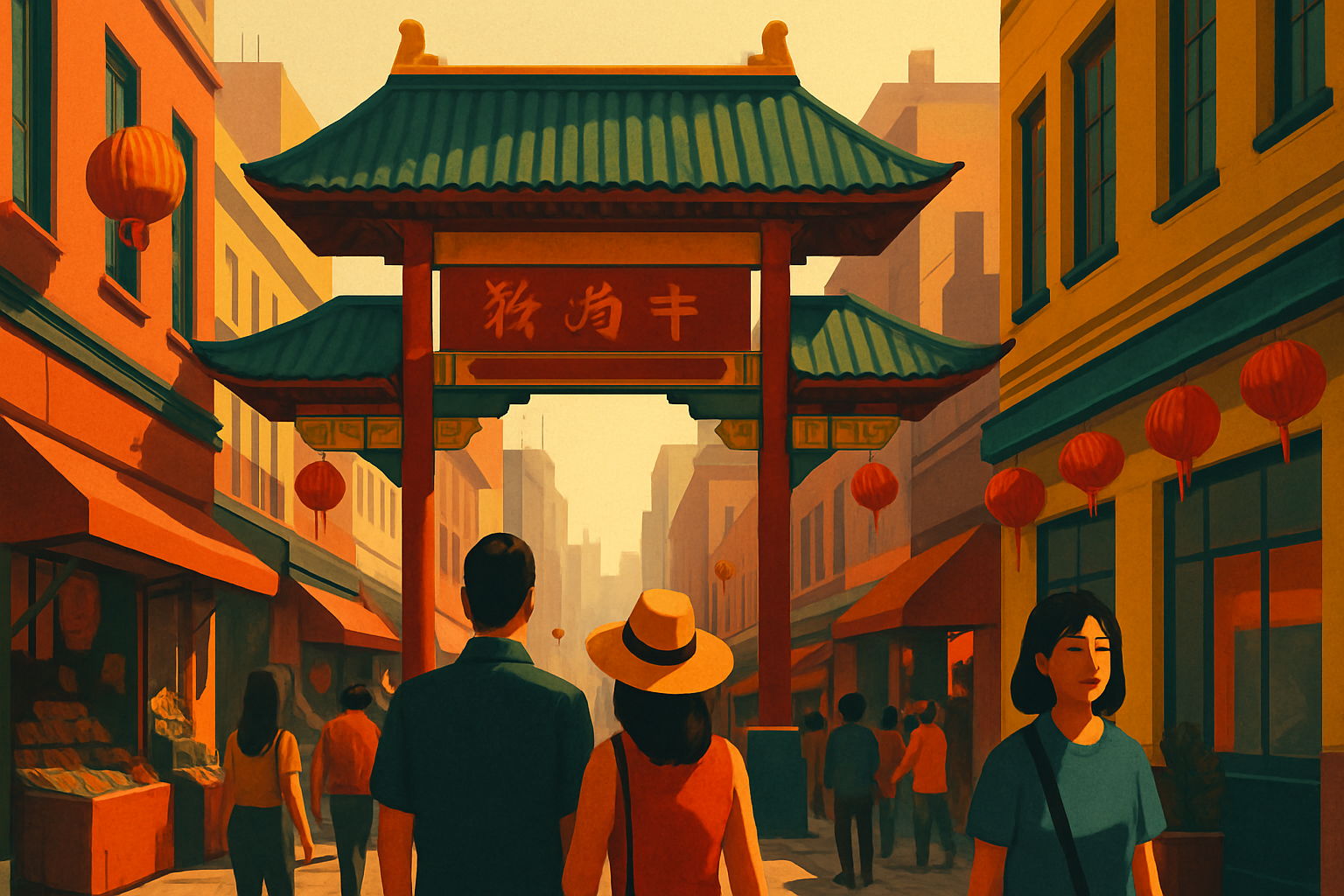
The visual anchor of Barrio Chino is the Paifang — a traditional Chinese ceremonial arch installed in 2008 through a collaboration between the Mexico City government under Mayor Marcelo Ebrard and the Chinese diplomatic community. The arch stands at the corner of Calle Dolores and Independencia, decorated with glazed tiles and ornamental details crafted in China and shipped to Mexico City for installation. It is the most photographed element of the neighborhood — and also the newest. The community had been on this street for more than a century before this formal architectural marker appeared. Walking south from the arch toward Articulo 123, four blocks unfold: red lanterns strung between buildings, storefronts selling imported teas, porcelain, preserved foods, and discount electronics, small restaurants with bilingual menus in Chinese and Spanish, and street vendors with steam carts stationed near the arch entrance. The street is pedestrian-only, which makes the browsing easy. What makes it visually distinctive is the collision of contexts: the Chinese commercial elements sit inside arched stone doorways and worn colonial facades, a layering that exists nowhere else in Latin America in quite this form.
•The Paifang arch at Dolores and Independencia was inaugurated in 2008 — tiles imported from China, installed through a joint project with the Mexico City government and Chinese diplomatic community
•Calle Dolores is pedestrian-only along the four-block Barrio Chino stretch — easy to walk end to end in 20 minutes, longer if you stop to eat
•The neighborhood runs roughly from Independencia south to Articulo 123, parallel to Eje Central Lazaro Cardenas
6. What to eat in Barrio Chino
Pan al vapor — steamed bread rolls — are the defining street food. Vendors with steam carts sell them near the Paifang arch in plain white, sesame-topped, red bean paste-filled, and pineapple varieties; 20 to 30 pesos each. The visual of billowing steam against the red lanterns and colonial stonework is part of the experience. Inside the sit-down restaurants, the menus lean toward Cantonese: wonton soup, congee, lo mein, roast duck, and dim sum on weekend mornings. The most enduring establishment on the strip is Casino Shanghai on Calle Dolores — open for decades, serving traditional Cantonese dishes alongside Mexican plates, and embodying exactly the long-term cultural negotiation that Barrio Chino represents. Beyond these four blocks, the Centro Historico has grown a broader East Asian food corridor in recent years, with Vietnamese, Korean, and Japanese spots within walking distance. But for the specific taste of what Chinese-Mexican foodways look like after a century of coexistence, Calle Dolores is the place.
7. Is Barrio Chino worth visiting?
If you come expecting the density of San Francisco's Chinatown — produce stalls, roast duck hanging in windows, the full immersive sensory experience — Barrio Chino will feel like a rough sketch. If you come understanding that this is one of the few surviving remnants of a community that was systematically targeted, displaced, and partially expelled from an entire country's northern region, it registers differently. Four blocks on Calle Dolores in a colonial Spanish city is what a century of persistence looks like. The Paifang arch, the steam cart vendors, the bilingual restaurant signs against stone facades — these are not tourist set dressing. They are what remains of a history that Mexico has been slow to formally acknowledge. For anyone interested in Mexico City's layers of immigration and settlement — Lebanese merchants in Mercado de San Juan, European exiles in Colonia Narvarte, Aztec palaces under Spanish cathedrals — Barrio Chino is essential context for understanding how many distinct communities have made their mark on this city.
8. How to get there and the best time to go
The quickest route is Metro Line 2 or Line 8 to Bellas Artes, then a 10-minute walk south on Eje Central Lazaro Cardenas and left onto Calle Dolores. The Paifang arch is visible from the Independencia intersection. Metro Line 3 to Juarez also works — five-minute walk east. Uber or DiDi from Roma Norte takes 10 to 15 minutes depending on traffic. Weekday mornings between 9 a.m. and noon are the quietest. Weekends bring more street food activity and more vendors working the pedestrian strip. The year's biggest celebration is Chinese New Year — the date shifts with the lunar calendar, falling in January or February — when dragon dances, red lantern installations, and additional food stalls transform all four blocks. The neighborhood pairs naturally with a morning at the Templo Mayor, three blocks east on Seminario — a useful reminder of how many distinct civilizations have left their mark on this particular square kilometer of the planet.