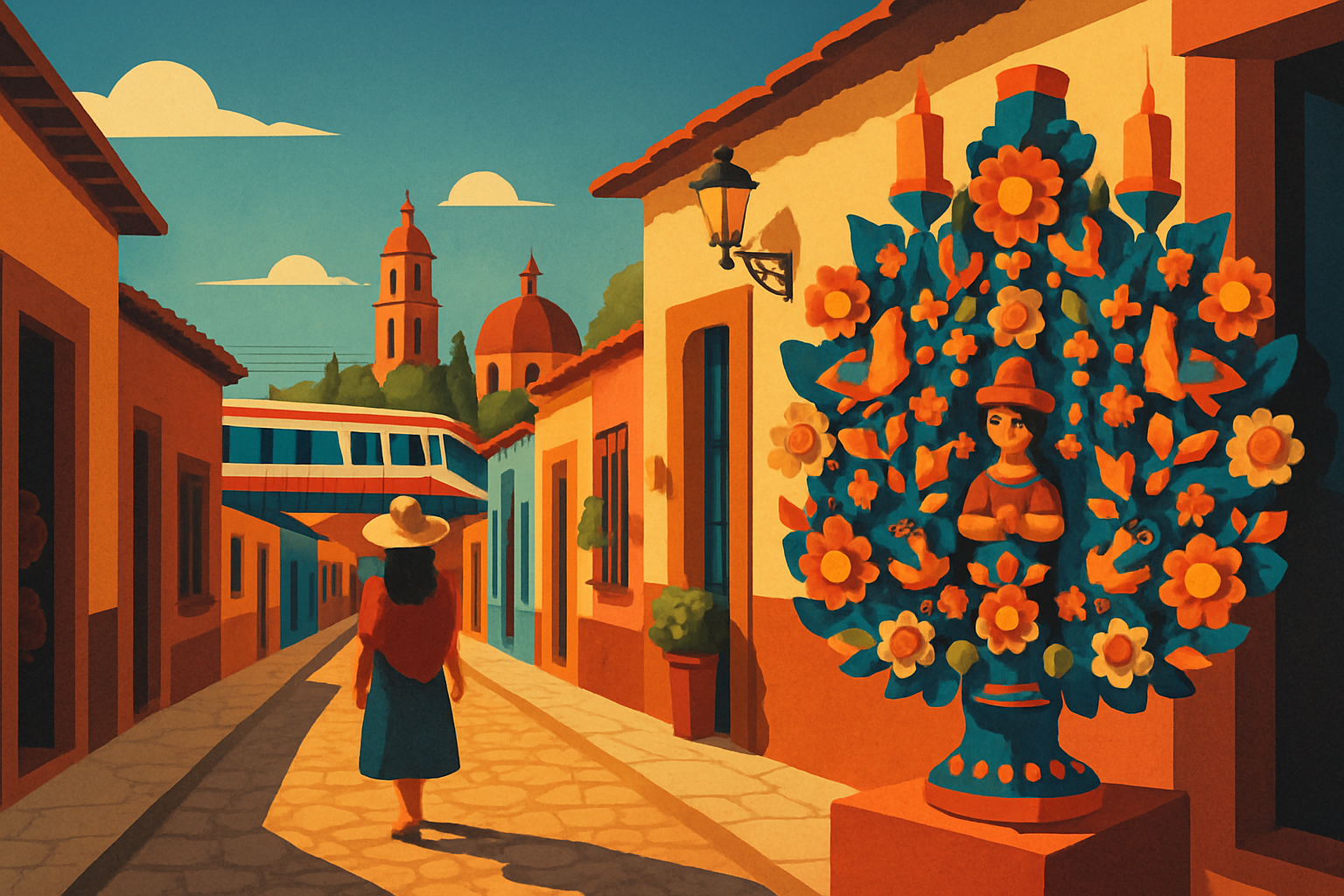
1. What Metepec actually is — and why most travelers miss it
Metepec is a municipality of about 250,000 people in the State of Mexico, 65 kilometers west of Mexico City. The historic center — the Pueblo Magico designated in 2012 — sits around the zocalo and the hill called the Cerro de los Magueyes. Most travelers who've heard of it treat Metepec as an add-on to Toluca, the nearby state capital. This is backwards: Metepec is the destination.
The town has been a ceramics center since pre-Hispanic times, when Matlatzinca and Mazahua communities produced utilitarian earthenware here. After the Conquest, Spanish missionaries redirected that production toward religious objects — candlesticks, figurines, devotional pieces. By the 20th century, a single family from the town had transformed that utilitarian tradition into one of Mexico's most technically ambitious folk art forms. The arbol de la vida — Tree of Life — turned a clay candelabra into an elaborate multi-figure sculpture that can stand a meter tall and take months to complete. Metepec is where that specific tradition lives, is still actively practiced, and can be watched being made in the open.
2. The arbol de la vida — how a candlestick became Mexico's most intricate folk art
The Tree of Life's documented origin in Metepec begins in the 1930s, when a potter named Modesta Fernandez Mata started adding decorative figures to the clay candlesticks her family made for the local church market. She began with whistles shaped like birds and animals — playful additions to functional objects. Over decades, those decorative elements became the point entirely.
The classical form is a tree structure rising from a base, with figures arranged across its branches: biblical scenes (Adam and Eve, the Temptation, the Expulsion) on traditional versions; saints, historical figures, and contemporary characters on modern interpretations. The tree is built piece by piece from hand-rolled clay, each figure attached before firing, the whole structure painted afterward with mineral-based colors — cobalt blue, oxide red, yellow ochre, white. A large tree with dozens of figures can take three to four months to complete. The most complex pieces require structural planning to stand at all.
The Concurso Nacional de Alfareria y Ceramica Arbol de la Vida — an annual national competition held in Metepec — draws entries from artisans across the country and has confirmed the town's role as the tradition's primary center for decades.
3. The Soteno family — the dynasty that put Metepec in international collections
The most important lineage in Metepec ceramics is the Soteno family. Dario Soteno Leon and Modesta Fernandez Mata — the potter who began the Tree of Life experiments in the 1930s — raised twelve children who all learned the form. Alfonso Soteno, one of their children, brought the family's work international recognition and received a formal acknowledgment from the Cuban government at the Casa de las Americas in 2012.
The most celebrated living practitioners are Tiburcio Soteno Fernandez and his nephew Oscar Soteno — third and fourth generation respectively. Tiburcio's trees are in the permanent collections of the British Museum, the Scottish Museum of Modern Art, the Lancaster Museum, and several French institutions. His pieces extend the tradition from the classical biblical format to political trees featuring Frida Kahlo, revolutionary figures, and erotic themes. Tiburcio's workshop is on Calle Ezequiel Capistran and operates by special order rather than as an open gallery. If seeing his work is the specific objective, contact ahead through social media or a local guide; pieces can occasionally be purchased directly.
•Tiburcio Soteno: Calle Ezequiel Capistran, Metepec — by appointment only, not a public gallery
•His work is in the British Museum and Scottish Museum of Modern Art
•Oscar Soteno produces more accessible pieces at lower price points — his work appears in the artisan corridor
4. Where to see, buy, and watch ceramics being made
You don't need to visit the Soteno workshop to experience Metepec's ceramics. The town's artisan infrastructure is unusually open.
Calle Comonfort is the main commercial artisan corridor in the historic center — lined with workshops and galleries selling Trees of Life at every scale, from small painted pieces under 200 pesos that fit in a carry-on to large architectural trees in the thousands. The quality range is wide. Train your eye on the clay work (clean joints between figures, no visible seam patching) and the glaze (mineral-based paints in flat, textured finishes rather than the uniform shine of commercial ceramics).
The Casa del Artesano, in the Coaxustenco neighborhood, displays nationally award-winning pieces and can connect you with specific artisans. This is the best place to orient yourself on the range of work being produced — Trees of Life alongside suns, moons, skulls, vases, and painted stained glass.
The barrios — Santiaguito, Santa Cruz, San Mateo, and Espirito Santo — are residential neighborhoods where family workshops have operated for generations. Walk in. You will see potters hand-rolling clay figures, painting completed pieces, or assembling branches on a tree in progress. Buying directly from a workshop's production means supporting the artisan and paying 20-40% less than the artisan corridor price.
5. The Ex-Convento de San Juan Bautista and the Cerro de los Magueyes
The historic architecture in Metepec frames the ceramics tradition: this was a colonial town built on a Mexica-era hilltop, and that layering is still visible.
The Ex-Convento Franciscano de San Juan Bautista, the dominant structure in the historic center, was built in the 16th century in baroque style using tezontle — the volcanic red stone common across central Mexican colonial construction. The atrium is defined by a triple arcade with Romanesque columns of tezontle, and the attached Parroquia and convento cloister form the visual anchor of the zocalo. The complex is not as elaborately frescoed as Actopan's Augustinian monastery, but it rewards 45 unhurried minutes.
The Cerro de los Magueyes — the Hill of Magueys — rises above the historic center. The Ermita del Tepeyac at the summit was built over vestiges of a Mexica temple, continuing the colonial pattern of layering Christian sacred sites over pre-Hispanic ones. The walk up through the residential neighborhood is the best way to see non-tourist Metepec: narrow streets, small household workshops, and views over the Estado de Mexico valley from the top.
6. How to get from Mexico City to Metepec
The best route is the Tren Interurbano Mexico-Toluca, nicknamed 'El Insurgente' — Mexico City's interurban rail link to the State of Mexico that most international visitors don't know exists.
Depart from Observatorio station on Metro Line 1 (the pink line, western terminus). The train stops at Metepec station — on Boulevard Solidaridad Las Torres — in approximately 50 minutes. From Observatorio the ticket costs roughly 80 pesos. The service runs Monday through Friday 5 AM to midnight, Saturdays from 6 AM, and Sundays from 7 AM, with trains departing every 5-7 minutes during peak hours. No advance booking required; pay with a Tarjeta de Movilidad Integrada or a QR ticket at the terminal.
From Metepec station, the historic center is a 10-15-minute Uber or taxi ride (roughly 50-80 pesos). By car, the trip via Highway 15 takes about 55 minutes under light traffic, longer on weekday mornings.
•Train: Observatorio (Metro Line 1) → Metepec station, ~50 min, ~80 pesos from Observatorio, no reservation needed
•From station to historic center: 10-15-min Uber, ~50-80 pesos
•By car: ~55 minutes via Highway 15; allow more time on weekday mornings
7. Is it worth combining Metepec with Toluca?
Toluca, the Estado de Mexico capital, is ten kilometers from Metepec and the next stop on the Tren Interurbano. Whether to add it depends on what you're after.
Toluca's main draws are the Cosmovitral — a botanical garden inside a massive Art Nouveau iron-and-stained-glass pavilion — and the historic portal buildings around the central plaza. It is a working state capital, not a craft town, and feels urban and institutional where Metepec feels residential and artisan. If you've already covered Mexico City's major museums, Toluca adds genuine contrast. If ceramics is the reason for the trip, the Metepec barrios deserve the full day.
A workable combined schedule: train from Observatorio at 9 AM, Metepec by 10 AM; two to three hours across the barrios and the Ex-Convento; lunch on the zocalo; train to Toluca for the Cosmovitral in the afternoon; return from Toluca before 8 PM. See the Toluca day trip guide for what specifically to see there.
8. Hours, costs, and practical tips
Ex-Convento de San Juan Bautista: Open daily approximately 9 AM-6 PM. Entry to the church and atrium is free; cultural spaces inside the convento may charge a small fee.
Artisan barrios: Residential streets with open-fronted workshops — no fixed hours, busiest on weekday mornings and Saturdays. Some close midday.
Prices: Trees of Life on Calle Comonfort range from 150-200 pesos for small pieces to several thousand pesos for large multi-figure trees. Direct workshop prices in the barrios run 20-40% lower.
What to bring: Cash — most barrio workshops and smaller stands are cash only. A spare bag if you plan to buy; wrap ceramic pieces in clothing rather than relying on seller packaging. Comfortable shoes for the Cerro de los Magueyes walk, which involves uneven cobbled streets.
•Ex-Convento: free entry to church and atrium; cultural space inside may have a small fee
•Workshop barrios: no fixed schedule, open-fronted, accessible any weekday morning
•Cash is essential — most artisan workshops don't take cards