1. Why Toluca? The case for Mexico's most overlooked day trip
Toluca is the capital of Estado de México and the fifth-largest city in the country — yet it barely registers on the typical tourist circuit. That's partly because it's not photogenic in the way that Teotihuacán's pyramids or Xochimilco's canal boats are, and partly because its main attraction is genuinely hard to describe without sounding like you're overselling it.
But here's the honest case for Toluca: it has one of the most extraordinary interior spaces in the Western Hemisphere (the Cosmovitral, more on that below), one of the most accessible high-altitude volcanic experiences on the continent (Nevado de Toluca), a compact historic center with covered 19th-century arcades, a chorizo tradition that predates most European settlements in the Americas, and an adjacent artisan town (Metepec) with Pueblo Mágico status. A full day here covers more genuine cultural ground than many popular day trips from Mexico City.
The city sits at 2,680 meters above sea level — higher than Mexico City itself — and its climate is noticeably cooler. Pack a layer regardless of season. The bus from Terminal Poniente takes 75 to 90 minutes and costs around 120 to 150 pesos each way, making it one of the cheapest day trips out of the capital.
•65 km from Mexico City — 75 to 90 minutes by bus from Terminal Poniente (Metro Observatorio)
•Cooler than CDMX at 2,680 meters — bring a jacket regardless of season
•~120 to 150 pesos each way by bus: one of the cheapest significant day trips from the capital
2. The Cosmovitral — one of the most extraordinary spaces in Mexico
The building at Juárez 700, right on the main square of Toluca, started life as the Mercado 16 de Septiembre, a cast-iron market hall built between 1909 and 1910 for the centennial of Mexican independence. By 1975 it had been closed as a market, and Yolanda Sentíes — the first female mayor of Toluca — oversaw its transformation into something no one had attempted before.
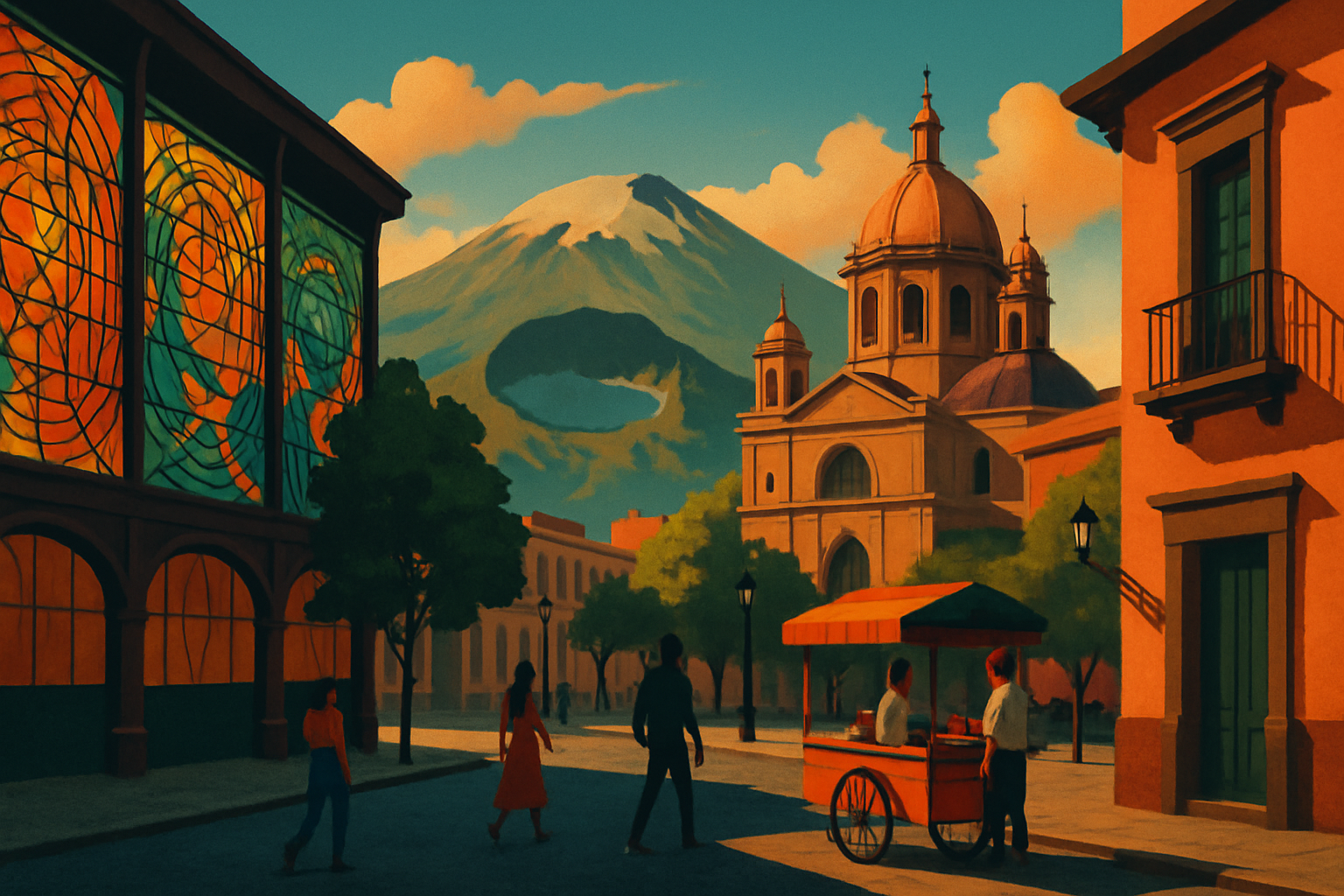
The artist Leopoldo Flores spent a year developing the concept: a complete stained glass mural encircling the building's walls and ceiling, executed at a scale that hadn't been done anywhere. The finished work consists of 71 modules covering 3,200 square meters of glass surface — roughly the area of seven Olympic swimming pools. The materials required: 75 tons of metal supports, 45 tons of blown glass, 25 tons of lead, and approximately 500,000 individual glass pieces ranging from 15 to 45 centimeters each. The glass came from 28 different countries including Italy, Germany, France, Belgium, Japan, Canada, and the United States. The Cosmovitral opened to the public in 1980.
The visual theme is universal dualities — life and death, day and night, good and evil, creation and destruction — rendered in figures that move from abstract to monumental across the full length of the hall. Below the glass: a functioning botanical garden containing over 500 plant species from Mexico State and around the world. You walk through tropical species and arid highland plants under colored light that shifts across every surface as the sun moves.
The practical advice about timing isn't a cliché: in the afternoon, the western-facing panels glow in a way they simply don't at midday. If you arrive at 4 p.m., you will see a different building than if you arrive at 11 a.m. Both are worth seeing. Only one will stop you in the middle of the room.
3. Los Portales and the historic center — an hour of walking
Toluca's historic center is compact enough to cover in two to three hours of walking, and the organizing logic is simple: everything revolves around the Plaza de los Mártires and the covered arcades — Los Portales — running along its south and east sides.
The portales were built in the 19th century and function the way they always have: a covered street of shops, restaurants, and vendors sheltered from the rain and the sun. The north side of the plaza is anchored by the Catedral de San José, built in the 18th century and notable for its pinkish volcanic stone facade. The portales side is where you eat, buy chorizo, and watch Toluca doing its daily business.
A few minutes' walk from the Cosmovitral is the Museo de Bellas Artes de Toluca, housed in a former Carmelite convent on Lerdo de Tejada, with a collection of colonial-era painting and local 20th-century work. The Centro Cultural Mexiquense — further out from the center, about 15 minutes by taxi — is a large complex with the Museum of Anthropology and History of Estado de México, a modern art museum, and a historical archive. It's the right call if you're interested in the pre-Aztec civilizations (Matlatzinca, Mazahua, Otomí) of the region — a story almost entirely absent from CDMX's own museums.
•Los Portales: the 19th-century covered arcades on the main plaza — the social and commercial spine of the centro
•Catedral de San José: 18th-century, pink volcanic stone, north side of Plaza de los Mártires
•Centro Cultural Mexiquense: 15 min by taxi — covers the pre-Aztec cultures of Estado de México (Matlatzinca, Mazahua, Otomí) that get almost no coverage in CDMX museums
4. Chorizo de Toluca — the best in Mexico since 1525
Hernán Cortés established cattle ranches in the Valle de Toluca by 1525, importing his own livestock. By the end of the 16th century, the valley had become the cured-meat capital of the country — not just chorizo, but chicharrón, longaniza, blood sausage, and ham. Toluca's altitude, cold nights, and abundant livestock created conditions for curing that the rest of Mexico couldn't match. For five centuries, that tradition has held.
The classic Toluca chorizo — rojo — is flavored with guajillo and ancho chile, garlic, oregano, cumin, and vinegar: a direct descendant of Spanish charcuterie reinterpreted with Mexican chile. It's intense, deeply savory, and noticeably different from the crumbly supermarket chorizo sold elsewhere in the country.
The more interesting version is chorizo verde: a newer invention (it dates roughly to the 1970s, attributed to the nearby municipality of Texcalyacac) made with tomatillo, chile serrano, cilantro, and pipián. The result is bright, acidic, and visually unexpected — green sausage is not a common sight. You can find it fried into quesadillas or tacos, stirred into scrambled eggs, or grilled with memelas (thick oval masa cakes) at the lunch spots around Los Portales.
For buying it to bring home: the stalls on Los Portales and the Mercado 16 de Septiembre (the active market, not the Cosmovitral building — they share the same founding name but are separate locations) both sell it fresh. Buy it the day you're leaving CDMX and keep it refrigerated.
•Chorizo rojo: five-century-old tradition, chile-and-vinegar cured pork — notably different from supermarket versions
•Chorizo verde: 1970s invention from nearby Texcalyacac, made with tomatillo, serrano, and cilantro — try it on memelas
•Buy to take home at Los Portales stalls or Mercado 16 de Septiembre — keep refrigerated on the bus back
5. Nevado de Toluca — the volcano you can drive into
Nevado de Toluca is a dormant stratovolcano 22 km south of the city and Mexico's fourth-highest peak at 4,680 meters (15,354 feet). What makes it unusual among high-altitude volcanic experiences is the access: a paved road climbs all the way to the crater rim, allowing you to drive to approximately 4,200 meters. The two crater lakes — Laguna del Sol (Sun Lake) and Laguna de la Luna (Moon Lake) — sit inside the caldera at that elevation, glinting turquoise and green depending on the light.
From the parking area at the crater rim, the hike down to the lake floor and back takes roughly two to three hours, all above 4,000 meters. Altitude affects people differently — go slow, drink water, and don't underestimate the combination of thin air and steep scree. The summit ridge at 4,680 meters requires an additional hour of scrambling and is genuinely demanding.
For day-trippers: the most convenient approach is via organized day-trip transport from Mexico City (multiple operators run weekend trips including transport, guide, and a stop at the Toluca city center), or by renting a car and driving the Route 15 toll highway to Toluca, then south on the Nevado road. Getting there independently by public transit is possible but involves multiple transfers and isn't practical for a single-day visit.
One firm seasonal note: the Nevado hike is best from October to May. During the June-to-September rainy season, clouds build rapidly and the crater is often socked in by noon. If you're visiting now (June or later), start the drive by 7 a.m. and aim to be at the crater by 9 a.m. — you'll have a clear view window before the weather closes in.
•Laguna del Sol and Laguna de la Luna: two crater lakes at 4,200m inside the caldera — accessible by paved road
•Hike from crater parking to the lake floor and back: 2-3 hours, all above 4,000m — go slow on altitude
•Rainy season (June-September): start at dawn — the crater is clear by 9 a.m. and often clouded by noon
6. Metepec — the artisan town worth one hour
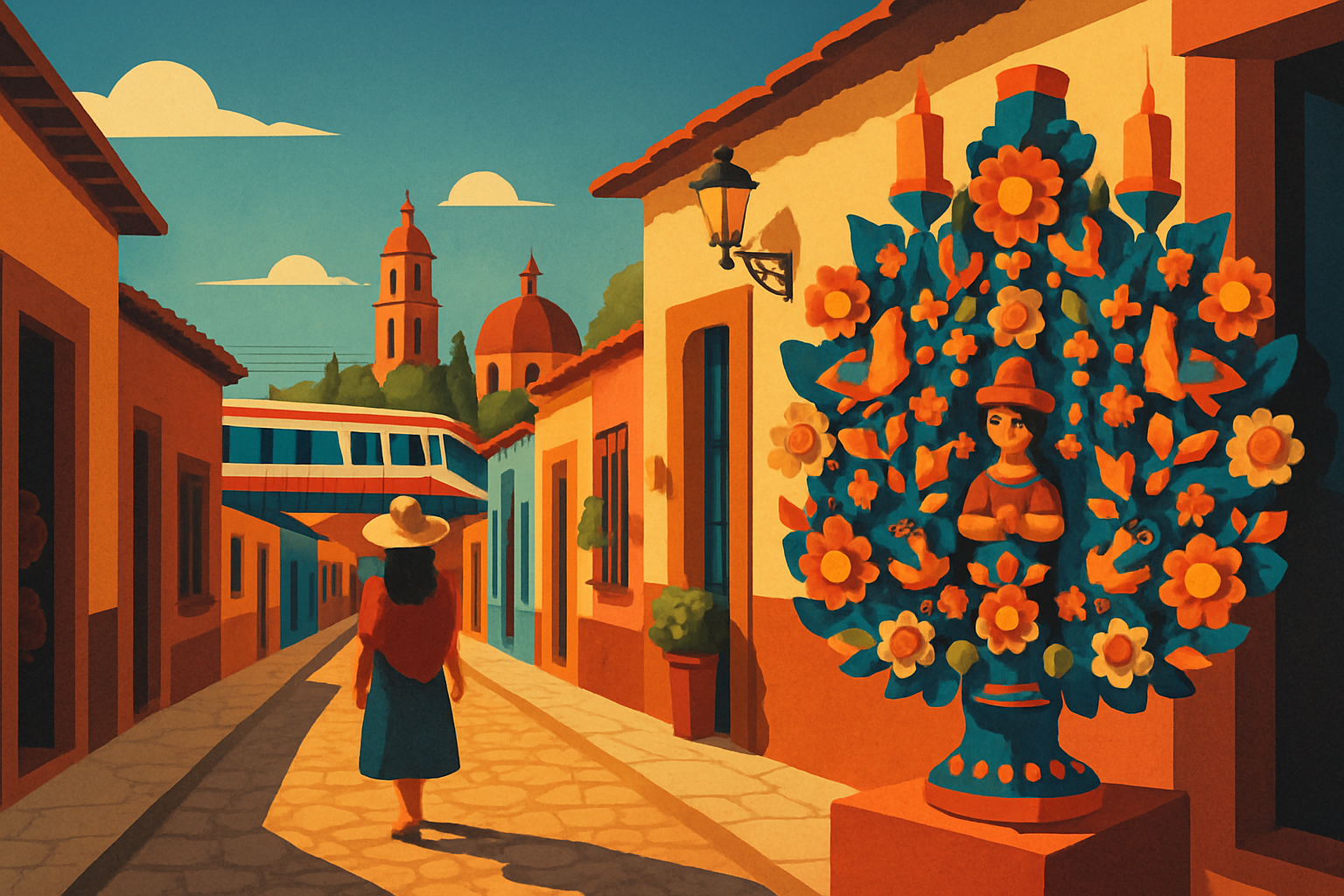
Metepec is a separate municipality immediately east of Toluca — 15 to 20 minutes by taxi — and one of Mexico's designated Pueblos Mágicos (Magical Towns). Its fame rests on a single craft tradition: the árbol de la vida, or Tree of Life, a dense clay sculpture typically depicting a biblical or cosmological scene with dozens of figures emerging from a central trunk. The best ones are massive, intricate, and painted in vivid enamel colors.
The tradition is older than the term for it: Metepec potters were producing pre-Hispanic clay figures long before the Spanish arrived, and colonial missionaries adapted the form to teach Christian narratives, producing the first Trees of Life as visual catechism. Contemporary versions range from wedding gifts (depicting Adam and Eve) to political commentary to purely abstract sculptural work.
The Mercado de Artesanías in Metepec is the most practical place to browse — a dedicated craft market with studios and storefronts selling everything from small tourist-friendly pieces to large commissioned works. Beyond the Tree of Life: talavera-style ceramics, painted clay animals, and hand-thrown functional pottery are all made here and priced significantly below what the same pieces cost in Mexico City shops. If you're buying anything fragile to bring home, the vendors here have the boxes and packing material ready.
•Árbol de la vida (Tree of Life): dense clay sculptures with dozens of figures — a tradition fusing pre-Hispanic form with colonial-era Christian imagery
•Mercado de Artesanías: the main craft market, with studios on-site — better prices than CDMX shops for the same pieces
•15-20 minutes by taxi from Toluca centro — easy to combine with a Toluca day trip as a late-afternoon stop
7. How to get to Toluca from Mexico City
By bus (easiest): From Terminal Poniente (Metro Observatorio, Line 1), multiple companies operate bus service to Toluca's main bus terminal roughly every 20 to 30 minutes throughout the day. The trip takes 75 to 90 minutes and costs 120 to 150 pesos each way. The Toluca terminal is a short taxi ride from the historic center. This is the most practical option for a solo day trip — no parking, no traffic stress.
By Interurban train: Mexico City and Toluca are connected by the Interurban Train, which runs from the Zinco terminal near the Observatorio interchange to Lerma (the nearest station to Toluca city center). Check current schedules before relying on this option — service times and frequency have shifted since the line opened.
By car: Route 15 (the Toluca toll highway) connects the two cities in 60 to 90 minutes depending on traffic. The tolls add up but the road is well-maintained. For the Nevado de Toluca, a car is effectively required (or a guided tour). If you're driving, leave Mexico City before 7 a.m. on weekends — the stretch near La Venta and the ascent out of the Valley of Mexico backs up significantly by mid-morning.
8. Is Toluca worth the trip? Practical FAQ
Is Toluca safe for tourists? The historic center is the state capital and has a visible police presence. The area around the Cosmovitral, Los Portales, and the plaza is safe for daytime tourism. As always in any Mexican city, take a registered taxi or Uber from the bus terminal to the center rather than walking with luggage.
How much time do you need? You can cover the Cosmovitral, Los Portales, lunch, and Metepec in a single day — roughly 8 a.m. to 6 p.m. Adding Nevado de Toluca requires starting earlier and sacrifices Metepec unless you have a car. If you want both the volcano and Metepec, an overnight stay makes more sense than rushing.
Best time to go? October through April is the ideal window — dry season, clear skies for the Nevado, and the Cosmovitral is just as good any time of year. June and July work fine for the city center and Metepec. If you're going to the Nevado in summer, go early and be realistic about the weather.
Can you combine Toluca with Metepec in one day? Yes — easily. Do the Cosmovitral first (morning), lunch at Los Portales, then Metepec in the late afternoon. A day like this doesn't require a car. Taxis between Toluca centro and Metepec run around 60 to 80 pesos.