1. The dance that was born in Cuba, died there, and survived in Mexico
Danzón has a specific birthday: January 1, 1879, in Matanzas, Cuba. That day, a composer named Miguel Faílde conducted the premiere of 'Las alturas de Simpson' — a piece that combined French contredanse, which had been circulating in Cuba since the 1790s, with African rhythmic patterns that arrived with enslaved people from West Africa. What came out was neither European nor African but something new: a stately, intimate, syncopated form of music and movement that became Cuba's national dance within a generation.
By the time danzón reached its peak in Cuba in the 1920s and 1930s, it had already spread far enough that it was flourishing in places Faílde never imagined. And then, in one of music history's stranger reversals, it began dying in Cuba as newer forms — mambo, son montuno, eventually salsa — overtook it. Cuba moved on. Mexico did not. Today, danzón is classified as Intangible Cultural Heritage of Mexico, not of Cuba. The country that invented it let it go; the country that adopted it made it permanent.
2. How danzón traveled from Havana to Veracruz to Mexico City
Danzón arrived in Mexico around 1890 the way most things arrived in coastal Mexico: by ship. Cuban theater and music companies docked regularly at the port of Veracruz, and the traveling orchestras brought danzón as part of their repertoire. Veracruz, a port city with deep Afro-Caribbean roots and a long history of absorbing Caribbean music, adopted it immediately. If you want to see danzón in its most original Mexican form, Veracruz is still where it happens — couples gather up to four times a week in the central plaza at Parque Zamora, dancing in formal wear in the humid Gulf heat, keeping it close to the Cuban original.
Mexico City got danzón a few years later and then changed it. The capital's dance salons of the mid-20th century pushed it toward something more urban and occasionally more acrobatic. The influence of American ballroom dance schools in the 1940s and 1950s accelerated the evolution. What you see at Plaza de la Ciudadela today is unmistakably danzón — the posture, the rhythm, the charanga instrumentation — but it carries the specific stamp of Mexico City: slightly faster, a degree showier, with a swagger the original never had.
3. What danzón actually sounds and moves like
If you arrive at Plaza de la Ciudadela without knowing what danzón is, the first thing you'll notice is that it sounds nothing like salsa. The instrumentation is different. Traditional danzón is played by a charanga — an ensemble built around two violins, cello, flute, timbales (shallow drums in metal casings), güiro (a ridged gourd scraped with a stick), double bass, and piano. The result is delicate and slightly formal, closer to chamber music than street-party energy. The flute carries the melody; the timbales mark the pulse.
The dance itself is performed on the contratempo — the offbeat — in a slow-quick-quick pattern that takes time to internalize. Couples stand upright in a close ballroom embrace, moving in small, deliberate circuits around the floor. Then — and this is what surprises most first-time observers — the music stops mid-song. This is the corte, a deliberate pause built into every danzón piece. Couples separate, fan themselves, exchange a few words with the pair next to them, adjust their outfits. The music resumes. The corte happens two or three times per song and it is not a break — it is the point. Danzón was designed for conversation as much as movement.
Danzón is also the genetic ancestor of Latin music as you know it: 1938 experiments fusing it with a stronger Afro-Cuban beat produced what musicians labeled 'mambo'; mambo eventually produced cha-cha-chá; those forms, filtered through New York in the 1960s and 1970s, contributed to salsa. When you watch couples at Plaza de la Ciudadela, you are watching the root.
4. Plaza de la Ciudadela: what to expect when you arrive
Plaza de la Ciudadela — also called Plaza Morelos or Plaza de Danzón — sits in Colonia Centro at the corner of Balderas and Dr. Mora, a short walk from the Tabacalera neighborhood and four blocks west of Alameda Central. It is anchored by the Ciudadela cultural center, a former tobacco factory turned arts complex, and ringed by shaded paths that become the dance floor every Saturday morning.
Arrive by 11 am to catch the beginner classes — open to anyone, run by experienced instructors, lasting roughly four hours, operating on a donation basis with no entry fee. Expect four distinct groups, each focused on a slightly different style: classic danzón, danzón-mambo, and a more modern Latin variant. You do not need a partner; instructors routinely match up solo arrivals.
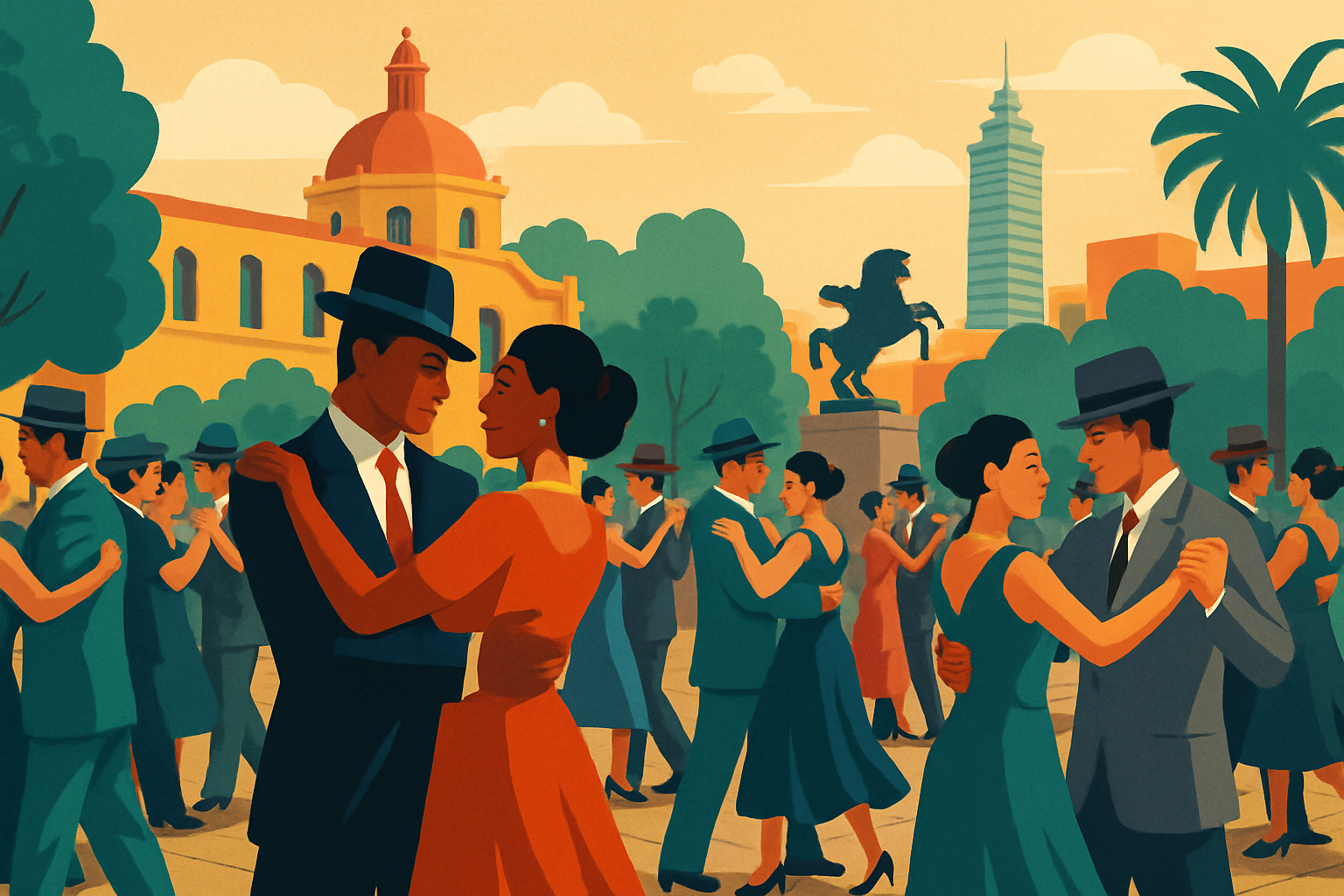
By 1 pm the floor is full. This is the best time to stand at the edge and watch. The couples who have been coming every Saturday for twenty or thirty years are impossible to miss: footwork minimal and precise, posture perfect, outfits deliberate. Men in zoot suits and feathered fedoras; women in long evening gowns, fans in hand for the corte. After 3 pm the style shifts — salsa and cumbia take over from the purist danzón crowd and the energy loosens considerably. If you stay through both halves of the afternoon, you experience two different versions of the same tradition.
5. The people who keep danzón alive — and why they dress up
The core of the Ciudadela community is older — many dancers are in their sixties, seventies, and eighties, some couples have been coming together for decades — but that picture is narrowing. Younger Mexicans have been returning to danzón for a decade, drawn by its difficulty, its elegance, and a reaction against the anonymity of nightclub dancing. Danzón requires a partner, a conversation, and a deliberate slowdown.
The outfits are not costume. They are the point. The deliberate elegance here — a retired schoolteacher in his best zoot suit, a grandmother in the evening gown she has worn since 1984 — is a statement about what the moment is worth. Mexico City's version of this ethic comes from the old salon culture of working-class neighborhoods, where men in the 1940s and 1950s saved for one good suit worn to the dance hall every Saturday as an act of dignity.
In 1994, composer Arturo Márquez wrote 'Danzón No. 2' — a concert piece for chamber orchestra, explicitly dedicated to the dancers of Plaza de la Ciudadela. Search for a recording before you go.
6. Other places to hear danzón in Mexico City
Plaza de la Ciudadela is the main stage, but not the only one. The Ballet Folklórico de México at Palacio de Bellas Artes occasionally includes danzón sequences in programs focused on Mexico's regional traditions — worth seeing on a theatrical stage because the posture and partner hold become architecturally clear when lit properly from above.
Salón Los Ángeles in Colonia Guerrero — one of Mexico City's last working-class dance halls, operating since 1937 — has historically run danzón nights on Tuesday evenings. The venue is part of the experience: a cavernous Art Deco room with mirrored pillars and a raised bandstand. Confirm the current schedule locally before visiting, as it can shift.
The charreada and danzón are often mentioned together as Mexico City's two great inherited performance traditions — both brought from outside (the charreada from Spanish horsemanship, danzón from Cuban music), both absorbed, transformed, and eventually claimed as distinctly Mexican over the course of a century.
7. Can I join the classes? What should I wear? How do I get there?
Can anyone join the beginner classes? Yes. Show up at Plaza de la Ciudadela at 11 am on a Saturday and walk toward the group with an instructor visibly demonstrating steps. Classes are free, donation-based, and designed for zero prior experience. The only requirement is that you try.
Do I need a partner? No. Classes rotate partners, and showing up alone is normal. If you want to dance beyond the class, a partner helps — but watching solo is entirely welcome.
What should I wear? You won't be turned away in casual clothes, but the community takes its presentation seriously. A shirt and slacks or a dress at minimum communicates respect for the occasion. The more you dress up, the warmer the welcome.
How do I get there? Take Metro Line 3 to Balderas station and exit toward Dr. Mora — the plaza is a two-minute walk north. From the Tabacalera neighborhood, it's an easy walk south along Bucareli. The Mexico City metro makes this straightforward from anywhere in the city.
8. Is danzón dying? And is this just nostalgia?
Is danzón dying out? No. It went through a genuine crisis in the 1980s and 1990s and was pulled back — partly through Mexico's Intangible Cultural Heritage designation, but mostly at street level, through dance schools in Veracruz and Mexico City that trained a new generation of instructors. The form is smaller than at its mid-century peak, but it is not shrinking.
Is it just nostalgia? This is the wrong frame. The people at Ciudadela are not frozen in the past — they are choosing, every Saturday, to maintain a practice that requires skill, physical presence, and genuine community. The same mechanism that keeps Day of the Dead alive across Mexico City — participation maintained on purpose, generation after generation — is what keeps danzón alive at Plaza de la Ciudadela every Saturday morning.