American rodeo and Mexican charrería share the same ancestral DNA — both descended from the working cattle culture of colonial-era ranches — but they evolved into completely different things. A rodeo is a set of individual timed events: fastest to rope a calf, fastest out of the gate. Charrería is a team sport, scored by judges on precision, technique, and style. There are no timers. The goal is mastery.
Mexico officially declared charrería its national sport in 1933, predating any formal recognition of soccer or baseball in the national identity. UNESCO added it to its Intangible Cultural Heritage of Humanity list in 2016 — the same list that includes the Day of the Dead celebration and traditional Oaxacan cuisine.
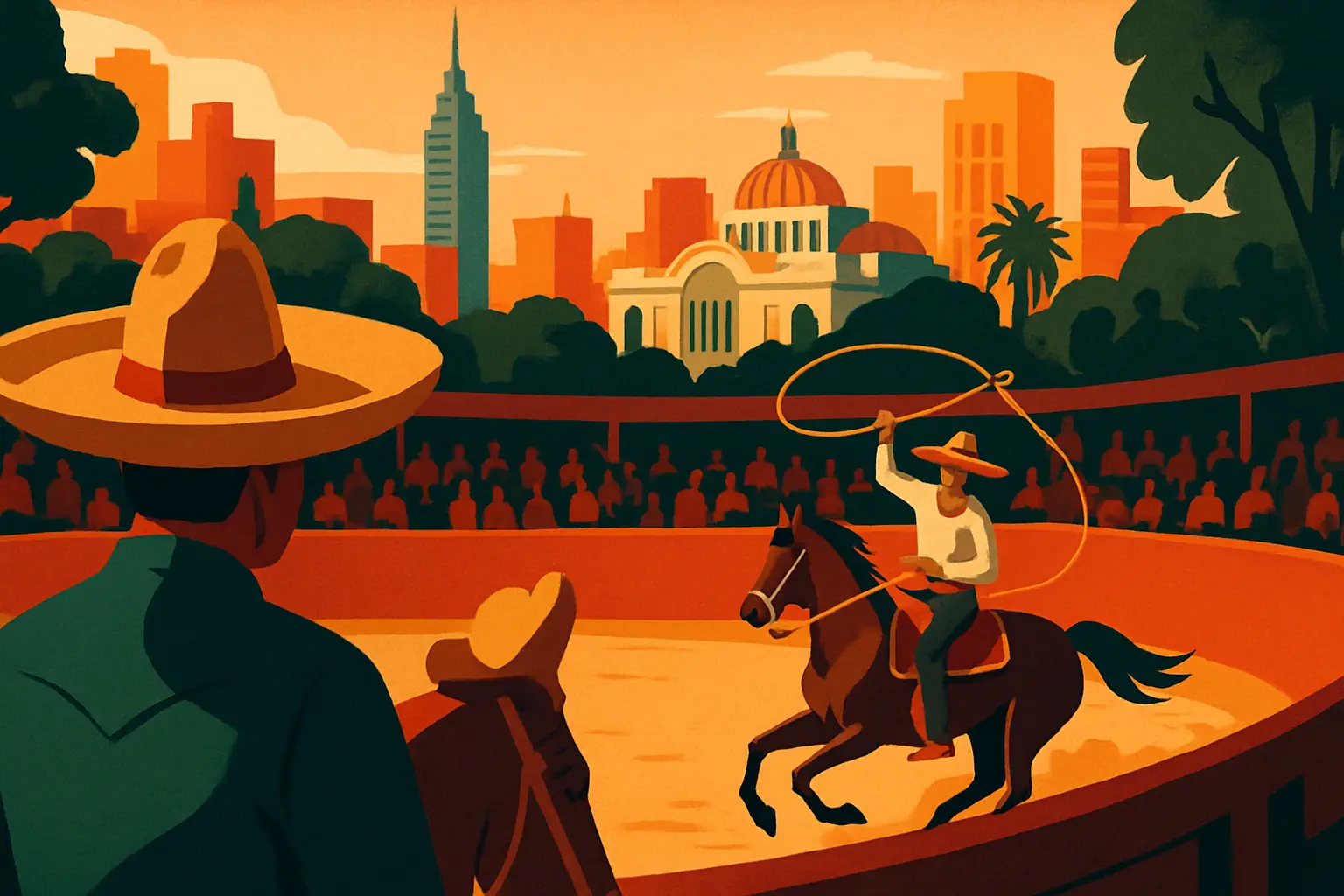
A charreada is a competition between two teams of charros (horsemen), each representing a specific lienzo charro association. Teams accumulate points through nine sequential skills called suertes charras. The entire event runs two to three hours and is accompanied by a live banda or mariachi ensemble playing from the stands. The atmosphere is closer to a county fair crossed with a precision equestrian competition than anything you'd find in a North American arena.
The lienzo charro is a purpose-built arena shaped like an elongated oval with a straight track running along one side. That track — the lienzo, meaning canvas or strip — is where most of the roping and running suertes take place. The circular arena at one end handles the bull-riding and team-roping events.
The grandstands are typically shaded on the main spectator side and open opposite. Between the two sections of the oval there's a central gathering area where horses wait and charros adjust equipment between suertes. Food vendors cluster near the entrance — expect carnitas, elotes, and cold drinks throughout the event.
The lienzo charro's dimensions are standardized by the Federación Nacional de Charrería, which has governed the sport since 1933. Every competing lienzo in Mexico follows the same measurements, which means a charro trained in Mexico City competes on exactly the same ground in Guadalajara, Monterrey, or Tijuana. The physical consistency is part of what makes charrería a national sport rather than a collection of regional traditions.
Get short, interactive stories that make each place easier to remember while you travel.
Each charreada moves through the same nine suertes in a fixed sequence, with judges scoring each attempt before moving to the next.
Cala de Caballo opens the event: a charro rides at full gallop, stops the horse abruptly with a single rein pull, holds the position, and reverses direction. It is as much a test of the horse's training as the rider's technique — a poorly trained animal cannot stop cleanly at speed.
Piales en el Lienzo involves roping a running horse by its hind legs from horseback. Timing and placement of the throw must be exact; a rope too early or too late scores nothing.
Coleadero is the most visceral suerte: a charro rides alongside a young bull at full speed, grabs its tail, wraps it around his leg, and uses the horse's momentum to tip the bull onto its side. Done correctly, it is explosive and controlled. The bull is back on its feet within seconds.
Jineteo de Toro is bull riding, bareback, one hand only — closer to American bronc riding than anything else in the charreada.
Paso de la Muerte closes the mounted phase: a charro on a trained horse must jump onto the back of a running, unbroken mare — no saddle, no stirrups. If he stays on for the required distance, full points. It is exactly what the name suggests.
Nine suertes total, run in a fixed sequence — the same order at every charreada in Mexico
Judges score each suerte individually before the next begins — a team can fall behind and come back
Paso de la Muerte (Pass of Death) is the final mounted suerte: jumping bareback onto a running wild horse
The Escaramuza Charra is the women's division of charrería, and it is arguably the most technically precise event in the entire charreada. Eight women on horseback perform a choreographed routine of interlocking patterns at full gallop — crossing paths at precise angles, reversing direction as a unit, executing figure-eights and tight spirals in tight formation.
The routine is scored on synchronization, spacing, and the tidiness of transitions between patterns. A near-collision that doesn't happen still costs points. The riders wear traditional china poblana dress — full embroidered skirt, sequined blouse, ribbons in the hair — and ride sidesaddle throughout the entire performance.
The Escaramuza typically opens the charreada before the nine suertes, or performs between events. It is the part that most first-time visitors remember most vividly. The combination of speed, precision, and the visual contrast between the delicate embroidered dress and the hard, technical riding creates something genuinely striking — the kind of performance that makes you wonder why you had never heard of it before.
Eight riders crossing paths within centimeters of each other at full gallop — precision is the entire point
Judges score synchronization, spacing, and cleanliness of transitions — a near-miss counts against you
Riders wear china poblana dress and ride sidesaddle throughout — the combination of form and speed is the spectacle
The charro suit — traje de charro — is Mexico's national dress, formally recognized as such. The outfit consists of tight-fitting pants (botonadura) with a line of silver or gold buttons running down each outer seam; an embroidered short jacket; a dress shirt with a wide bow tie; and a wide-brimmed sombrero embroidered in matching thread. A competition-quality suit takes months to produce by hand and represents a significant family investment — the suit signals lineage as much as skill.
The mariachi uniform is a direct descendant of the charro suit. When mariachi bands professionalized in the mid-20th century they adopted the traje de charro as their stage dress — partly for the association with Mexican national identity, partly because the embroidered clothing photographs and performs well under lights. The next time you see mariachis at Plaza Garibaldi or outside a Roma Norte restaurant, you are looking at a slightly simplified version of what charros have worn on horseback since the 1800s.
The number and quality of silver botones (buttons) along the trouser seam signal the charro's standing within the association
A full competition-quality traje de charro takes months to embroider and costs the equivalent of several thousand dollars
Mariachi suits are direct adaptations of charro dress — the style entered popular culture through charrería's prominence in the 1930s and 40s
Lienzo Charro Constituyentes is the flagship venue — Latin America's largest indoor lienzo charro, with capacity for 5,000 spectators. It sits on Avenida Constituyentes at the southern edge of Bosque de Chapultepec, near the Chapultepec Metro station (Line 1). This is the home arena of the Asociación Nacional de Charros, Mexico's governing federation for the sport. Major national championships happen here, and it hosts regular Sunday competitions throughout the season. The facilities are well-maintained and the sight lines from the main covered grandstand are excellent.
Lienzo Charro de la Villa is located in the borough of Gustavo A. Madero, north of the city near the Basílica de Guadalupe. It operates under one of the oldest charro associations in Mexico City and tends to draw a neighborhood crowd rather than visitors — which makes it feel more like a local family event than a performance staged for tourists.
Museo de la Charrería, at Isabel la Católica 108 in Centro Histórico, is not a competition venue but a dedicated museum two blocks south of the Zócalo. It houses saddles, trajes, historical photographs, and artifacts tracing charrería from 16th-century hacienda culture to the UNESCO listing. Worth an hour before your first live charreada.
The peak charreada season runs October through May, matching the cooler, drier months of central Mexico when horses and riders are at their best. Summer events still occur — Lienzo Charro Constituyentes runs competitions year-round — but the frequency drops in June, July, and August. Check the venue's Facebook page or Instagram account one to two weeks ahead of your visit for specific event dates.
Tickets are available at the gate on the day of the event. General admission runs roughly 100–250 MXN depending on the venue and event level; major national championship rounds cost more. Cash is preferred at most gates.
The charreada starts on time — genuinely unusual for Mexico City, so take it seriously. Arrive 20–30 minutes before the listed start to secure seats on the covered main grandstand. The event typically runs two to three hours without a formal intermission. Vendors inside the arena sell food and drinks throughout; you do not need to leave to eat. Dress code is casual for spectators, though you will notice many local families — especially the women — arrive in embroidered or traditional-inspired dress in support of the Escaramuza team.
Peak season: October–May at most venues; Lienzo Charro Constituyentes runs events year-round
Tickets at the gate, cash preferred — 100–250 MXN general admission for most regular competitions
Bring cash and arrive 20–30 minutes early — covered seats fill and charreadas start exactly on time
It is the question most visitors have before they go and few ask out loud. The short answer: charrería has explicit animal welfare rules enforced by the Federación Nacional de Charrería. Suertes that cause visible injury result in disqualification, veterinarians are required at major competitions, and the animals used in coleadero are young bulls that are flipped onto soft ground and back on their feet within seconds.
The suerte that draws the most scrutiny is coleadero, where a bull is knocked down by its tail. The technique is designed to use the animal's own momentum rather than brute force. Whether that clears your personal threshold is a judgment call — but charrería does not carry the systematic injury rate associated with North American bull riding circuits.
The horses used in charreadas are highly trained animals representing years of investment and care from the charro families who own them. Mistreating a competition horse is economic nonsense as much as anything else. The Ballet Folklórico comparison is useful: both are living traditions where the performance is the point, and both reward visitors willing to understand what they are watching before they watch it.