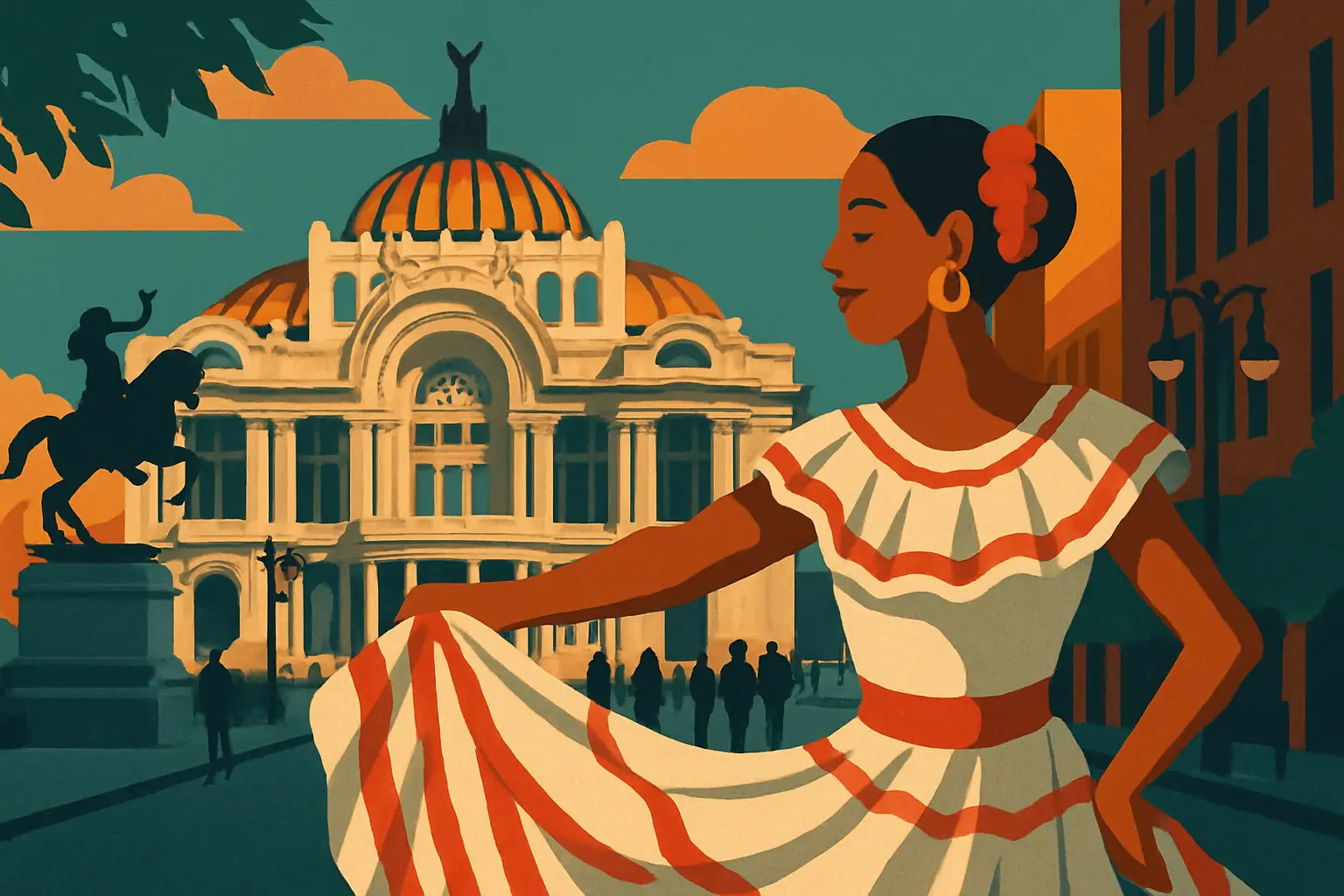
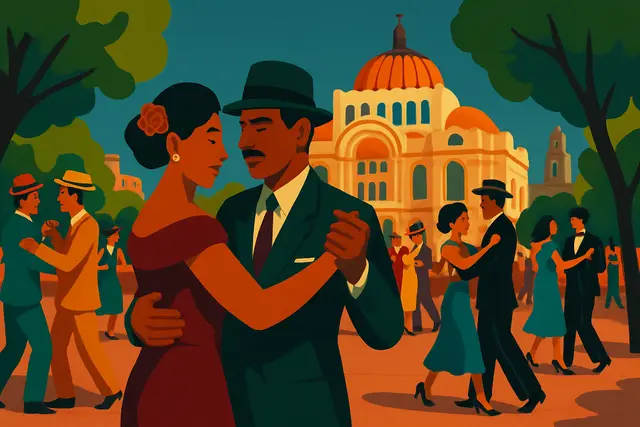
Visitors who arrive expecting European-style classical ballet leave confused. Ballet Folklórico de México is a theatrical presentation of Mexico's regional folk dances — Jalisco's jarabe tapatío, Veracruz huapangos, Oaxacan Guelaguetza pieces, Huastec footwork, Maya ceremony — staged with full orchestral accompaniment and costumes that represent decades of research into regional textile traditions. Amalia Hernández founded the company in 1952 with eight dancers and a mission: to rescue the folk traditions being erased by urbanization and modernization. She choreographed and staged each regional suite herself, consulting with communities from Oaxaca to the Huasteca to get the movements and dress right. Today the company has around 70 dancers and has performed in over 60 countries, but its home stage is the Palacio de Bellas Artes, and that's where the experience is irreplaceable. Shows run approximately two hours with one intermission, and the pacing is relentless — each suite is ten to fifteen minutes, representing a completely different region, rhythm, and visual language.
Founded 1952 by choreographer Amalia Hernández — not a government tourist production
Around 70 dancers performing regional suites researched from original folk traditions
Two hours with intermission — six to eight regional suites per program
Palacio de Bellas Artes sits at the east end of Alameda Central, and the building itself commands a full stop before you even enter. The exterior is Italian Carrara marble, designed by Italian architect Adamo Boari starting in 1904 — construction was halted twice, first by the Mexican Revolution and then by the building's own weight sinking into the soft lakebed soil, which is why the exterior is Art Nouveau and the interior is Art Deco. Those two styles shouldn't coexist, and yet the result is one of the most distinctive interiors in the Americas. Walk into the main lobby and look up: the murals are by Diego Rivera, José Clemente Orozco, and David Alfaro Siqueiros — three of Mexico's greatest muralists, all working in the same building within a decade of each other. Rivera's recreation of 'Man at the Crossroads' (the mural Nelson Rockefeller famously had destroyed at 30 Rockefeller Plaza in 1934) covers a third-floor corridor. The museum floors are open to the public for around 75 pesos — free on Sundays. Then there's the curtain: a Tiffany glass mosaic depicting the volcanic silhouettes of Popocatépetl and Iztaccíhuatl, assembled from more than a million pieces of colored glass. It only descends before the show. Arrive early.
Art Nouveau exterior (1904–1910), Art Deco interior (1930s) — construction interrupted twice
Murals by Rivera, Orozco, and Siqueiros on the upper floors — 75 pesos museum admission (free Sundays)
Tiffany glass stage curtain descends only before the performance — not visible once the show starts
Get short, interactive stories that make each place easier to remember while you travel.
A typical program cycles through six to eight regional suites, and the jump from one to the next is jarring in the best way. The Jalisco suite is the most iconic: mariachi rhythms, wide-brimmed sombreros, and the jarabe tapatío — Mexico's national dance — performed with intricate footwork and the kind of color saturation that makes the whole theater feel different. The Veracruz suite shifts entirely: white cotton dresses, son jarocho rhythms on jarana guitar and harp, movements rooted in the Caribbean influence of that port city. The Huasteca suite features the huapango — triple-meter rhythms with lightning zapateado footwork, the sound of the men's heels echoing off the stage boards. Oaxacan pieces often draw from the Guelaguetza festival dances of the Sierra Juárez mountain communities, with the distinctive feathered headdresses and braided ribbon regalia. Programs rotate by season, but most include at least one pre-Hispanic ritual suite — feathered headdresses, percussive ceremonial music, slow deliberate movement that feels genuinely ancient in a way that a museum exhibit cannot replicate. The Deer Dance from the Yaqui tradition of Sonora is one of the most arresting pieces in the repertoire when it appears.
Jalisco suite (jarabe tapatío, mariachi) is the signature closer — usually ends the first act
Veracruz suite: son jarocho rhythms, harp, white cotton dresses — Caribbean coastal influence
Pre-Hispanic ritual suite: ceremonial movement and percussion — no Spanish colonial influence
Two different companies perform Ballet Folklórico at Bellas Artes, and the difference matters when booking. The Ballet Folklórico de México de Amalia Hernández is the original company — the one Amalia Hernández founded in 1952, which became the resident company of the Palacio de Bellas Artes. It typically performs Sunday mornings at 9:30 a.m. and Wednesday evenings at 8:30 p.m., with additional dates added during high season. The second group, sometimes called Ballet Folklórico Nacional de México or listed under INBA (Instituto Nacional de Bellas Artes) programming, is a state-sponsored company that also performs at Bellas Artes on alternating dates. Both are high quality, professional companies — neither is a tourist-facing imitation. But if you want the institutional continuity of the original company exactly as Hernández built it, look for 'de Amalia Hernández' in the billing on Ticketmaster or at the box office. The Sunday morning show is almost always the Amalia Hernández company and is the easier one to plan around.
Ballet Folklórico de México de Amalia Hernández: the original, resident company of Bellas Artes
INBA / Nacional: state company, also performs at Bellas Artes on alternating dates — also excellent
Sunday 9:30am is almost always the Amalia Hernández company
The box office is the cleanest option: it sits on the northeast corner of the Palacio de Bellas Artes building, opens at 11 a.m. daily, and sells seats at face value for cash or card. Tickets range from roughly 200 to 700 pesos depending on tier — that's about $10 to $35 USD for a two-hour show in a UNESCO-listed building with three Diego Rivera murals in the lobby. Online, the official channel is Ticketmaster Mexico (ticketmaster.com.mx) — the website occasionally has interface issues, but tickets can be picked up at Liverpool department stores around the city, including the Polanco location on Presidente Masaryk. Avoid the men selling tickets on Eje Central outside the theater: they charge five to ten times face value for the same exact seats. For Sunday morning shows, book at least three to four days ahead — these sell quickly to local families, not tourists. Wednesday evening shows generally have more availability and feel less rushed.
Box office: northeast corner of Bellas Artes, opens 11am, face value only
Online via ticketmaster.com.mx — pick up at Liverpool Polanco (bring passport + purchase card)
Avoid street resellers outside on Eje Central — they charge 5–10x face value
The Palacio de Bellas Artes seating runs across three main levels: the Luneta (orchestra stalls at floor level), the Primer Piso (first balcony), and the upper rings. For Ballet Folklórico specifically, the Luneta — rows 10 through 20 — puts you close enough to see facial expressions and read the embroidery detail on the costumes, which matters for folk dance in a way it doesn't for opera. The first balcony has clean overhead sightlines to the full stage and is a strong value pick if the price difference is significant. Avoid front-row Luneta seats for dance: you're looking upward at an angle and lose the footwork patterns. The upper rings are steep but workable — Ballet Folklórico's costumes are vivid enough to read from a distance, and the formations make more visual sense from above than most people expect. One thing uniform across all seats: the acoustics. The hall was engineered for opera and orchestral performance, and it treats the folklórico's live music with the same precision.
Best overall: Luneta rows 10–20 (orchestra center) — close enough for costume and footwork detail
First balcony: excellent overhead view of formations, good value if cheaper than Luneta
Avoid front row Luneta — upward angle loses the footwork patterns that define folk dance
Sunday morning at 9:30 a.m. draws a genuinely local crowd — Mexican families, school groups, grandparents bringing grandchildren to see the company for the third or fourth time. It's a different atmosphere from the Wednesday evening shows, which skew more international. Both are the same production, but the energy in the house is different. Dress code is smart casual — no one will turn you away in jeans, but Bellas Artes is Mexico City's premier cultural venue and locals dress for it. The air conditioning runs cold even in warm months, so bring a light jacket. Shows run approximately two hours with one intermission of about 15 to 20 minutes. Arrive at least 30 minutes early: walk the lobby murals before taking your seat, and position yourself to see the Tiffany curtain descend as the house lights go down. Photography with phones is generally tolerated during the show, but flash photography is prohibited and will earn an immediate and emphatic correction from the ushers.
Smart casual — locals dress for Bellas Artes; bring a light jacket for the air conditioning
Two hours with 15–20 minute intermission — arrive early for the murals and the curtain
Flash photography prohibited; phone photography tolerated but frowned upon
Yes — and the argument is not close. For 200 to 700 pesos you get access to one of the most remarkable performance spaces in the Americas, a two-hour education in Mexico's regional cultural diversity that no museum can replicate kinetically, and a show specifically designed to be legible to complete outsiders. The costumes alone — researched and rebuilt from original regional textile traditions — represent decades of institutional knowledge made visible. First-time Mexico City visitors consistently rank Ballet Folklórico alongside Teotihuacán and the Museo Nacional de Antropología as the experience that reframed the rest of their trip. If you've already been reading about Diego Rivera's murals around the city, Bellas Artes is the single building that puts his Rockefeller mural, Orozco's social realism, and Siqueiros's experimental technique all under one roof — and then turns out the lights and fills the stage with the folk traditions those murals were painted to celebrate.