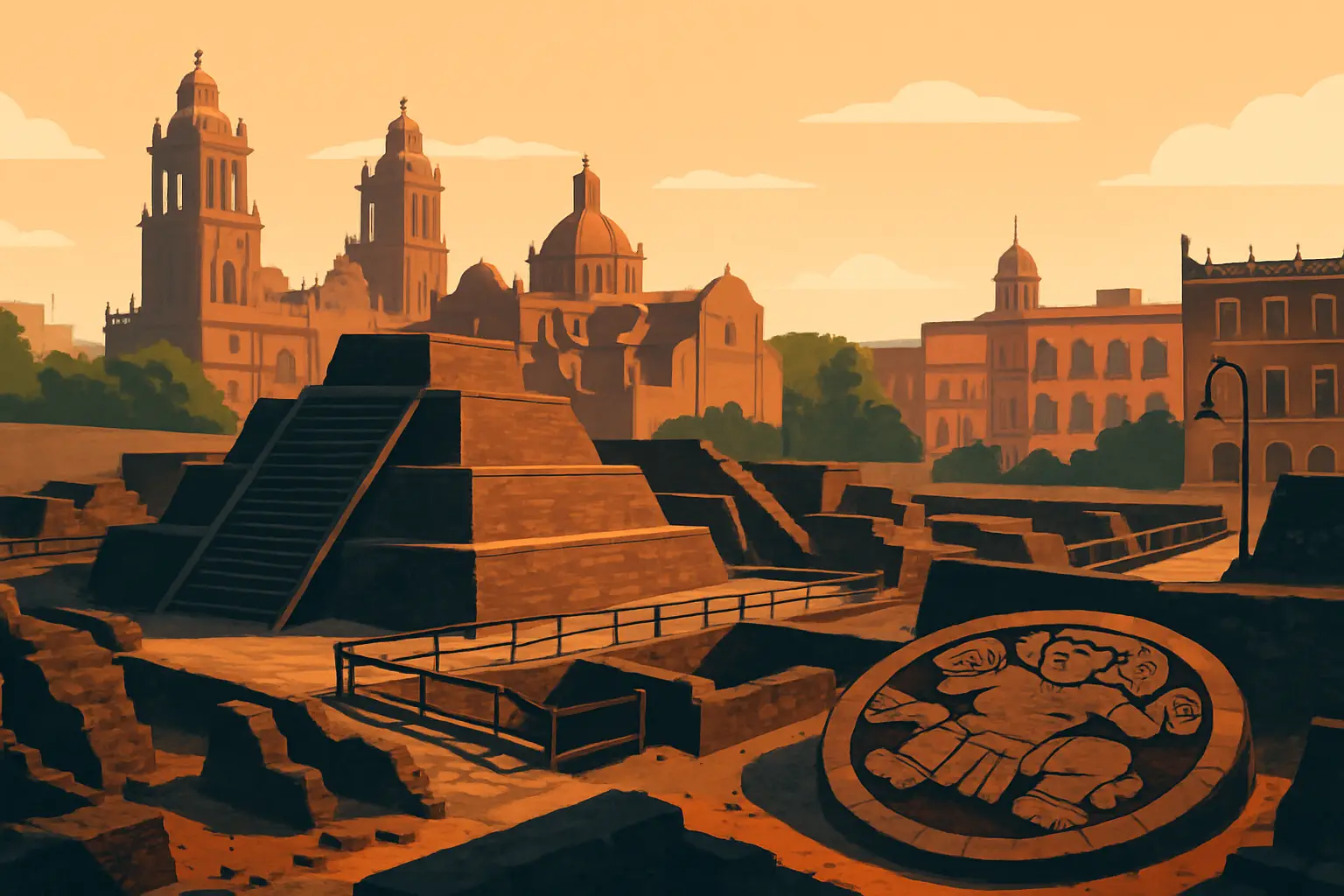
On February 21, 1978, electricians from the Compañía de Luz y Fuerza del Centro were digging a trench near the corner of Guatemala and Argentina streets — about 80 meters northeast of the Zócalo — when they hit something solid roughly two meters below the surface. What they'd struck turned out to be a stone disc 3.25 meters in diameter and weighing 8.5 tonnes, carved with the image of Coyolxauhqui, the Aztec moon goddess, dismembered and decapitated. The find triggered one of the largest urban archaeological operations in history. Mexico City's government authorized demolishing 13 colonial buildings on the block to expose what lay underneath. What emerged over the following decade was the Huey Teocalli — the Great Temple — the religious and political center of Tenochtitlan, the Aztec capital that Hernán Cortés razed and buried in 1521. The Spanish built their colonial capital directly on top. For 457 years, the most sacred structure in the Aztec world sat two meters below an ordinary downtown street.
The Recinto Sagrado — the sacred precinct of Tenochtitlan — was a walled enclosure roughly 400 meters per side containing at least 78 structures: twin-shrine pyramids, a ball court, a tzompantli (skull rack), priestly schools, and ceremonial plazas. The Huey Teocalli rose at its center, visible from across the valley. When you walk the exposed ruins today, you're seeing seven distinct construction phases — each successive Aztec ruler expanded the temple by encasing the previous structure inside a new one, like nesting boxes in stone. The oldest visible layer dates to roughly 1375 CE; the newest was completed just decades before the Spanish arrived. The Spanish didn't merely defeat Tenochtitlan: they dismantled the Huey Teocalli stone by stone and used the carved blocks as fill and foundation material for the Catedral Metropolitana standing 50 meters to the west. The sacred and the colonial literally share raw material.
Get short, interactive stories that make each place easier to remember while you travel.
The Huey Teocalli was a single pyramid with two shrines at the summit: Huitzilopochtli on the south side, the solar god of war and patron deity of the Mexica people; Tlaloc on the north side, the rain god, whose cooperation was essential for crops. The division was cosmological — war and rain, sun and water, military expansion and agricultural survival — and the two halves of the pyramid carry completely different archaeological signatures. The Huitzilopochtli side yields sacrificial offerings, flint knives, warrior regalia, and human remains. The Tlaloc side holds offerings connected to water: coral from the Gulf and Pacific coasts, fish, shells, turquoise, jade, and ceramic Tlaloc figures with their characteristic goggle eyes. A single main staircase ascends the west face — toward the setting sun — flanked at the base by massive serpent heads. At the top, two shrines faced west. Both are gone, but the platform they stood on is visible, and the view from that level down onto the Zócalo is genuinely disorienting: you're looking at the Spanish colonial heart of Mexico City from the floor plan of the city it erased.
The disc that electrical workers struck in 1978 now sits in a darkened room in the museum, displayed at ground level in a custom enclosure built to house it. The myth behind the carving explains why it was placed at the base of the pyramid's main staircase. Coyolxauhqui was Huitzilopochtli's sister. In the Aztec creation myth, she led 400 brothers in an attack on their mother, Coatlicue, who was pregnant with Huitzilopochtli. He was born fully armed, killed his sister, dismembered her body, and threw her down the pyramid. The stone carving depicts that moment in explicit detail: limbs separated, head severed, wearing bells — coyol — on her cheeks, xauh. Her name means 'painted with bells.' The Aztecs positioned the stone so that sacrificial offerings would roll down the staircase and come to rest on her image, physically re-enacting the myth with every ritual. It is one of the most significant single archaeological finds in Mexican history, and the room built around it is worth the 210-peso admission on its own.
The museum is arranged in eight halls, four on each side of a central staircase. The south wing covers Huitzilopochtli: war, sacrifice, cosmology, political power. The north wing covers Tlaloc: rain, agriculture, the underworld, and the natural world. The sequence matters. Room 1 explains the 1978 discovery and the decade-long excavation that followed — start here. Room 2 covers the Aztec ritual calendar and the structure of the cosmos. Room 3 is visually arresting: animal offerings including pumas, fish, deer, and coral brought from both coasts, all deposited to Tlaloc. Room 4, the Huitzilopochtli hall, contains the eagle warrior sculptures — two nearly complete ceramic figures, 1.7 meters tall, wearing eagle-feather helmets. They were found in the adjacent Eagle Warriors' Temple and are among the finest Aztec sculptures that survived conquest. Rooms 5 through 8 cover agriculture, trade, the flora and fauna of the Aztec world, and a final hall on the historical context of the excavation. The museum sells an English language guide booklet at the entrance desk for about 200 pesos — worth buying if your Spanish is limited, because the in-gallery text is Spanish-dominant.
Room 1: Start here — the story of the 1978 discovery and the excavation
Room 3: Tlaloc offerings — coral, fish, and puma skulls from across Mesoamerica
Room 4: Eagle warrior sculptures — the most iconic objects in the building
The entrance is on Seminario street, on the east side of the Catedral Metropolitana, one block from the Zócalo. Metro Line 2 to Zócalo station puts you at the door in two minutes on foot — exit toward Guatemala street and follow the signs. Admission is 210 pesos (roughly $10 USD) and covers both the ruins and all eight museum halls. Sundays are free for Mexican nationals; international visitors pay regardless of day. Photography is allowed everywhere, including the Coyolxauhqui room. The outdoor ruins have almost no shade. In May, the stone heats up quickly — arrive by 9 a.m. when the site opens, walk the ruins before 11 a.m., and save the museum for the middle of the day. The site is not heavily crowded by Mexico City standards; Saturday mornings are the busiest. Weekday mornings are the quietest. Plan to leave by 4:30 p.m. — the museum begins clearing at that point regardless of how much remains on your list.
Entrance: Seminario street, east side of the Cathedral — two minutes from Zócalo Metro
Hours: Tuesday–Sunday, 9 a.m.–5 p.m., last entry 4:30 p.m., closed Mondays
Cost: 210 pesos for combined ruins and museum access
Yes — and the two visits do not overlap in any meaningful way. The Museo Nacional de Antropología is a survey: it organizes artifacts from dozens of pre-Hispanic cultures across Mexico, thematically and chronologically, in a building designed to be a national monument. The Templo Mayor Museum is site-specific: every object on display was excavated within meters of where you're standing. You're seeing offerings, sculptures, and ceremonial objects in direct relation to the building they came from — not lifted out of context and placed in a gallery. If you've seen the Aztec Sun Stone and the Tlaloc monolith at the Anthropology Museum, Templo Mayor deepens that understanding. It doesn't repeat it. The Anthropology Museum is the broad overview; Templo Mayor is where you feel the Aztec world most directly. If you only have time for one, the Anthropology Museum covers more ground. If the Mexica civilization is what you came to Centro Histórico to understand, Templo Mayor is the more immediate experience.
Photography: Allowed throughout, including the Coyolxauhqui room. Flash is discouraged in the darker galleries but not enforced. Tripods are not permitted. English signage: Major pieces have English summaries; most extended panels are Spanish only. The bookshop at the exit stocks academic English-language publications and a good laminated site map. Guided tours: Several operators offer English-language guided visits that cover both the ruins and museum — booking ahead is worth it if historical context is why you came. Check GetYourGuide or Viator for current availability and pricing. What's nearby: The Zócalo is 80 meters west. The Palacio Nacional — with Diego Rivera's famous murals — is five minutes on foot. Calle Madero, the pedestrian street lined with colonial buildings, starts at the Cathedral's southwest corner. A comida corrida lunch at any of the small fondas on Argentina or Donceles streets costs about 100–120 pesos and will be one of the better cheap meals you eat in the city. How long: Two hours is the genuine minimum to see the ruins and all eight museum halls. Three hours is comfortable. Four hours is possible if you linger in the museum and stop at the bookshop.
Photos allowed everywhere; no tripods; the Coyolxauhqui room is the hardest to shoot well — wide lens, no flash
Palacio Nacional and Diego Rivera's murals are five minutes on foot — strong combination for a full morning
Comida corrida on Argentina or Donceles streets: 100–120 pesos, local clientele, no tourist pricing