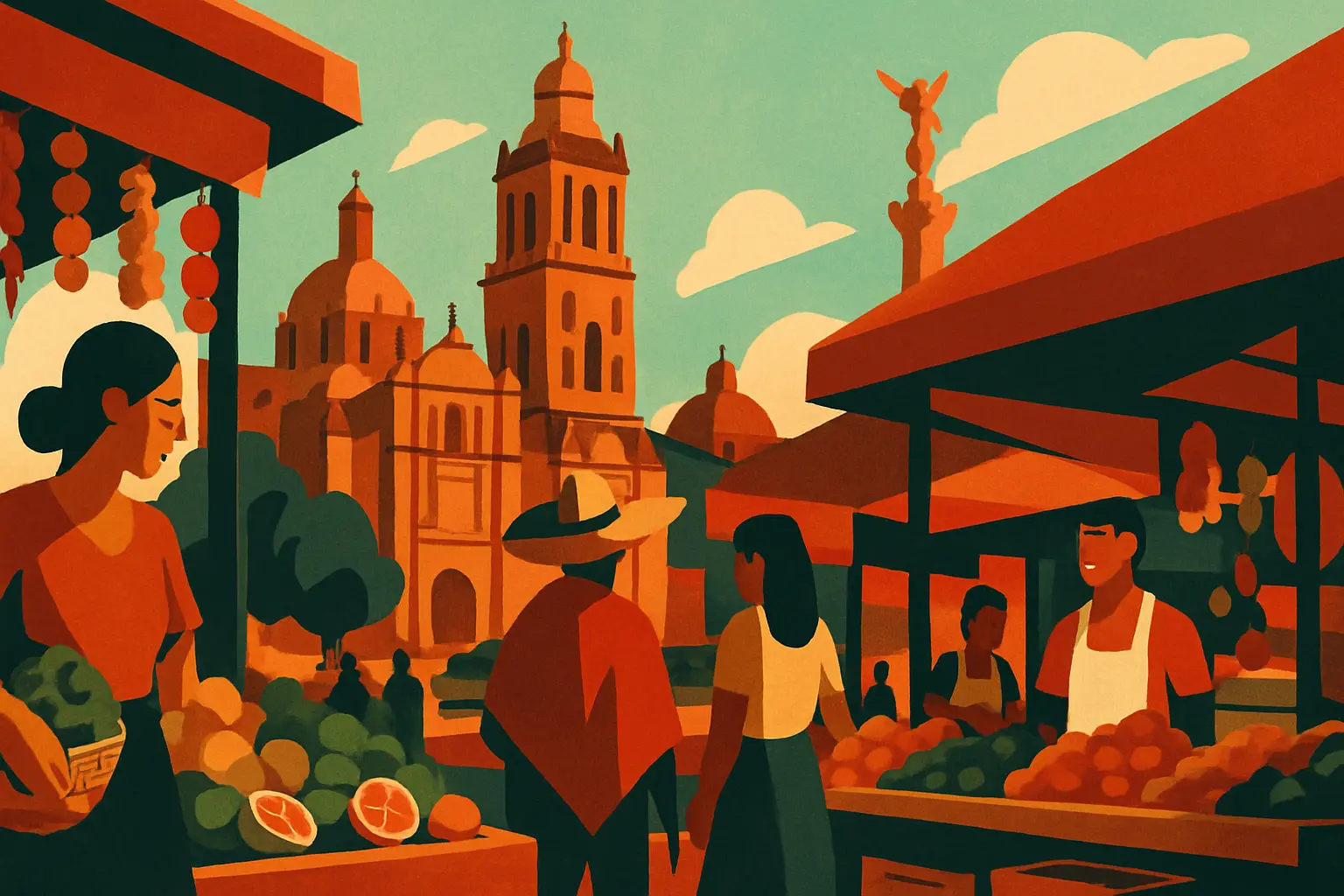
The word mercado describes a specific institution in Mexican urban life — not a weekend farmers' market, not a grocery store, and not a tourist bazaar. A traditional mercado is a permanent, covered structure where individual vendor families occupy fixed stalls, often across multiple generations. The stall selling dried chiles your grandmother used is still in the same spot, run by the same family. The woman making tlayudas in the prepared-food section has been there since before the current mayor. This continuity creates a different relationship between buyer and seller than a supermarket can — you become a regular, vendors remember your preferences, and the price you pay after a few visits is often not the same as what a first-timer pays. Mexico City has more than 300 registered markets operating under the city's public market system, plus hundreds of informal tianguis — rotating street markets that appear on different days in different neighborhoods. The five markets in this guide each have a clear, distinct identity: a specific reason to make the trip, not just geographic convenience.
300+ registered public markets operate under Mexico City's official market system
Vendor families occupy the same stalls across generations — continuity is the point
Tianguis are rotating street markets — different neighborhoods on different days of the week
Mercado de San Juan Pugibet sits on Calle Ernesto Pugibet in Centro Histórico, about a 10-minute walk from the Zócalo, and has operated continuously since 1955. What started as a neighborhood provisioner evolved into something genuinely unusual: a destination for chefs, food professionals, and anyone hunting for imported or specialty ingredients unavailable elsewhere in the city. One aisle stocks European-style deli meats, French cheeses, and Spanish jamón ibérico — actual imports. Another section carries fresh sashimi-grade tuna and unusual seafood. Near the center of the market, in refrigerated cases that look like an ordinary deli counter, you'll find the insects. Chapulines (grasshoppers roasted with garlic salt and lime) are the approachable entry point — they taste like a smoky, slightly citrusy chip. Harder to approach: alacránes (toasted scorpions, venom extracted), chicatanas (large flying ants from Oaxaca), and maguey worms. Vendors are accustomed to uncertain-looking visitors and will hand over a tasting cup without being asked. The market also has a small prepared-food section where vendors build tapas with the European cheeses and pour wine — odd context for Centro, but the execution is good.
Calle Ernesto Pugibet, Centro Histórico — Metro San Juan de Letrán (Línea 8), 10 min from the Zócalo
Start with chapulines — most vendors offer a free taste to first-timers
Also stocked with imported French cheese, jamón ibérico, and sashimi-grade fish
Get short, interactive stories that make each place easier to remember while you travel.
Mercado de Jamaica doesn't look like a visitor destination from the outside — it's a massive covered warehouse in the Venustiano Carranza borough, right next to Metro Jamaica on Línea 9. Inside, it's the single largest flower market in Mexico City: more than 1,150 stalls selling over 5,000 flower varieties, operating 24 hours a day, 365 days a year. The all-night schedule exists because this market is a wholesaler first, retailer second. Florists, event planners, hotels, and the crews who build Day of the Dead ofrendas across the city all buy here in the predawn hours — if you visit at 2 a.m., the market is fully stocked and actively transacting. During daylight hours the retail experience is different: enormous bundles of cempasúchil (marigolds), roses sorted by color and stem count, bird-of-paradise, orchids, and seasonal arrangements filling every square meter. Jamaica is also the best place in the city to find piñata supplies, papel picado, and party decoration wholesale. The food stalls near the entrance serve tamales and esquites throughout the day. Come on weekdays — weekend crowds make navigation genuinely difficult. If you're visiting in early May, plan your trip before the 10th: Mexican Mother's Day (May 10) is the single biggest sales day of the year here, and the market transforms into the flower supply point for the entire city.
Metro Jamaica, Línea 9 — the station exit deposits you directly at the market entrance
Open 24 hours, 365 days — the wholesale flower supply chain for all of Mexico City runs through here
Peak spectacle: the week before May 10 (Mexican Mother's Day) and Día de Muertos in late October
Mercado de Medellín operates on Calle Campeche between Medellín and Insurgentes Sur in Colonia Roma, an eight-minute walk from Metro Sonora. It's a neighborhood market in format — a permanent covered building with produce, meat, and prepared-food vendors — but what distinguishes it is a significant concentration of South American products that reflect the Colombian, Venezuelan, and Peruvian communities who actually shop here. You'll find fresh arepas, Colombian aguardiente, guanábana, plantain in multiple varieties, and produce that simply doesn't exist in a standard Mexico City supermarket. The prepared-food section makes a strong case for a late breakfast or early lunch: vendors serve Mexican market standards alongside Colombian bandeja paisa and Venezuelan breakfast plates. Mid-morning — 10 a.m. to noon — is the optimal window, when produce is at peak freshness and the prepared-food stalls are still running their daily batches. If you're staying in Roma or Condesa, Medellín is the market you'd actually use on a weekly basis — it's sized and stocked for a neighborhood, not a day trip, which is exactly what makes it feel like the real thing.
La Merced is the largest traditional market complex in Mexico City, and probably the most disorienting — in a good way. Located in the Merced neighborhood of Venustiano Carranza, accessible by Metro La Merced on Línea 1, it's actually several interconnected buildings covering multiple city blocks: a main produce hall, a separate building for spices and dry goods, another dedicated to candy and sweets, and the adjacent Mercado Sonora. The scale is difficult to process on a first visit. This is where Mexico City's restaurants buy in bulk — whole wheels of cheese and 20-kilo sacks of dried chiles are standard transaction sizes. You can find every dried chile variety in Mexico on a single visit: ancho, mulato, pasilla, cascabel, guajillo, chihuacle negro, and a dozen more. La Merced has operated on this site since the colonial period — the neighborhood takes its name from a Mercedarian convent that occupied the space before the market did. One practical note: the market interior is generally safe, but the surrounding streets, particularly on the south and east sides, require standard big-city alertness. Keep bags zipped, don't display phones, and arrive with a clear sense of what you want to see. It rewards wanderers — but alert ones.
Metro La Merced, Línea 1 — multiple interconnected buildings across several city blocks
Best for dried chiles, spices, bulk produce, and candy at wholesale pricing
Market interior is fine; stay alert on surrounding streets, especially south and east sides
Mercado Roma is not a traditional mercado — it's a privately developed food hall that opened in 2014 inside a restored 1920s mansion on Calle Querétaro 225 in Roma Norte. The concept drew immediate skepticism from locals who read it as gentrification theater, and honestly, that criticism has some validity. But the execution has held up: the vendors are small, independent operations rather than chains, and the rooftop bar on warm evenings from May through October has become a genuine neighborhood meeting point. What Mercado Roma does well is providing a format that works when you want to eat from multiple cuisines without committing to a full sit-down restaurant — quality tacos, fresh juice, ramen, craft beer, and a rotating selection of small vendors that the market actively curates. It's better suited to a weekend afternoon than a deep food culture dive — but it occupies a distinct niche. If you're in Roma Norte and want a quick lunch between gallery visits or a drink on the roof at sunset, it earns the stop. Just don't mistake it for the real thing. It's a food hall with market aesthetics, and there's nothing wrong with that as long as you know going in.
Calle Querétaro 225 at Tonalá, Roma Norte — inside a restored 1920s mansion
Rooftop bar is the main draw on warm evenings (May through October)
A curated food hall, not a traditional mercado — different purpose, still worth knowing
Cash is nearly universal in traditional markets. Bring 50- and 100-peso bills and don't expect change from a 500-peso note. At food stalls, there's often no posted menu — ask '¿qué hay?' (what do you have?) and the vendor will tell you what's available. Haggling is appropriate at craft and clothing markets but not at food stalls — the tamale vendor has a fixed price, and negotiating it is awkward for everyone. '¿Cuánto cuesta?' (how much?) is always fine. When handling produce, if you pick something up and don't buy it, put it back exactly where you found it — vendors sort carefully and random handling disrupts a system that's been running all morning. The single most consistent piece of advice for visiting any market: eat in the prepared-food section. The woman selling stews at the back of La Merced is usually better than the restaurant across the street. At Jamaica, tamales near the entrance are made fresh all day. At San Juan, the cheese tapas are genuinely worth ordering. At Medellín, the late-breakfast bandeja plates justify the trip on their own. Learning about the history of Mexican food culture before your visit gives all of this significantly more texture.
Traditional markets in Mexico City are safe during business hours. Standard urban precautions apply: zipped bags, no unnecessary phone display in crowded areas, carrying only the cash you need for the day. The interior of La Merced is fine — the caution is specifically for the surrounding streets, not the market building itself. Jamaica, San Juan, and Medellín present no elevated concerns. For a first-time market visit, Mercado de Medellín in Roma is the most manageable starting point — it's compact, walkable from most Roma and Condesa accommodations, and the prepared-food section is excellent for a mid-morning meal. Mercado San Juan is the right second visit if you want something more unusual. Jamaica works best as a dedicated morning excursion. La Merced rewards repeat visits — the first one is mostly orientation. The best general timing is Tuesday through Friday, 9 a.m. to noon. Avoid Saturday afternoons at any market if you dislike crowds, and avoid Sunday at La Merced specifically — it's significantly more chaotic than the rest of the week.
First visit? Start with Mercado de Medellín — compact, walkable from Roma, great food stalls
Best days: Tuesday through Friday, 9 a.m. to noon — freshest produce, manageable crowds
Avoid Saturday afternoons everywhere and La Merced on Sundays specifically