Mexico City is one of the great literary capitals of the Americas, and unlike Buenos Aires or New York, that identity is still embedded in the city's daily life rather than its museums. Octavio Paz — Mexico's only Nobel laureate in literature — was born here and spent most of his life writing about the city's contradictions. Carlos Fuentes, Elena Poniatowska, Juan Rulfo, and Rosario Castellanos all lived and worked here. The UNAM campus in the south of the city remains a major publishing and intellectual center — the Fondo de Cultura Económica (FCE), founded in 1934, is one of the most important academic publishers in the Spanish-speaking world, and it's based here. What this means practically: a good Mexican bookstore is stocked with regional history, Indigenous language dictionaries, political biography, and contemporary fiction that you won't find in a chain store anywhere else. You're not just browsing — you're looking at what the city actually reads.
Octavio Paz, Carlos Fuentes, Elena Poniatowska, and Rosario Castellanos all lived and worked in Mexico City
Fondo de Cultura Económica (FCE) — founded 1934, one of the most important publishers in Spanish — is based here
UNAM, in the south of the city, is a continuous engine for publishing and academic culture
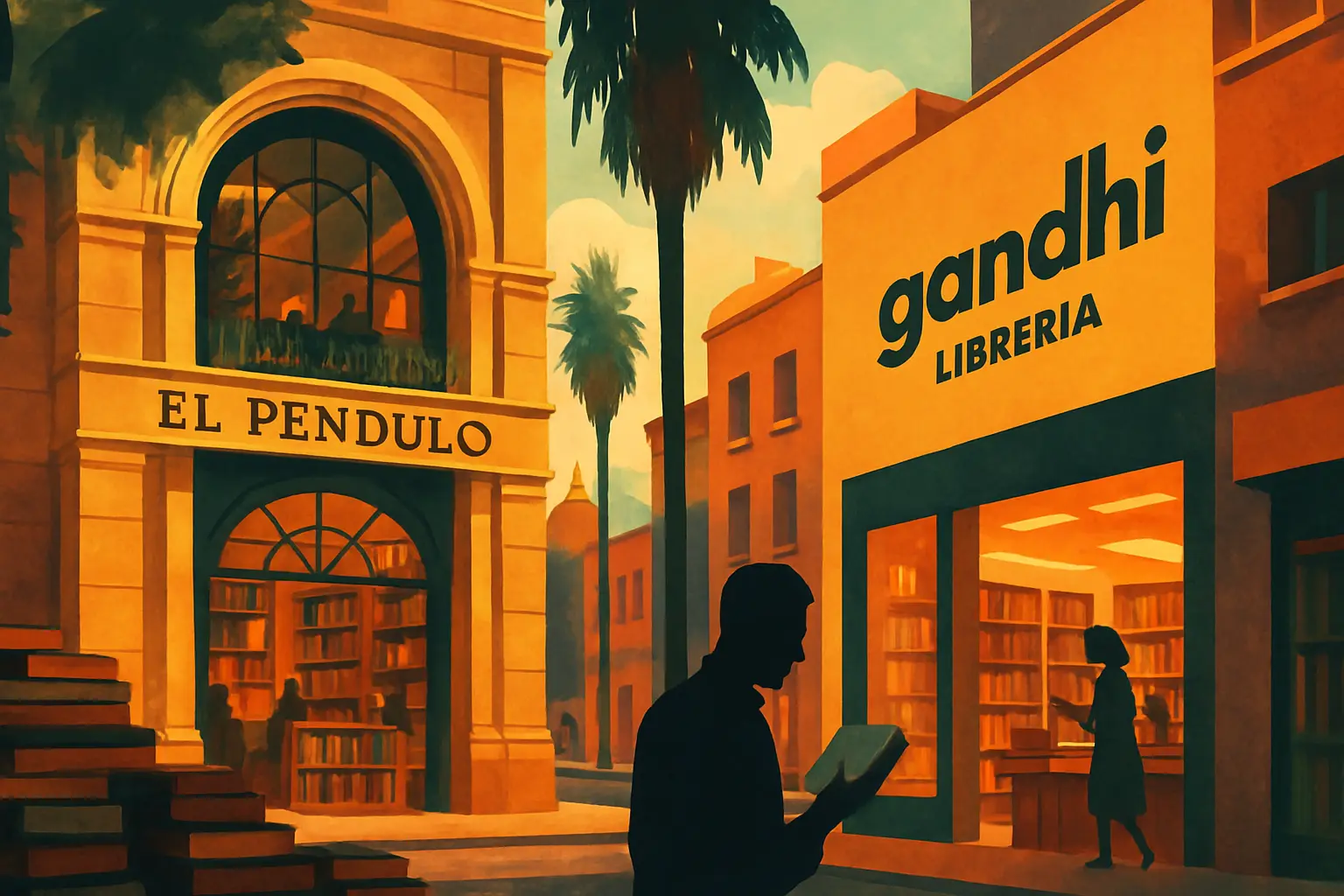
El Péndulo — officially Cafebrería El Péndulo — is the Mexico City bookstore most likely to stop you before you've looked at a single title. The Polanco branch at Alejandro Dumas 81 is the most photographed: two floors of floor-to-ceiling shelves connected by a spiral staircase, with tables tucked between the stacks and natural light coming through a glass ceiling. The Zona Rosa branch at Hamburgo 126 has a terrace garden and hosts live jazz on weekends. Seven branches across the city means you're likely within walking distance of one wherever you're staying. The English-language selection is the best in Mexico City for fiction, travel writing, and design — multiple shelves, not a token row of bestsellers. The coffee is genuinely good (the Polanco location doubles as a specialty café), and the menu runs to full meals. If you're in Roma Norte or Condesa, check which branch is nearest — each location has its own personality, and the differences are worth factoring in.
Polanco: Alejandro Dumas 81 — spiral staircase, glass ceiling, best for architecture photography
Zona Rosa: Hamburgo 126 — garden terrace, live jazz on weekends
English selection is the strongest in the city: multiple shelves of fiction, travel writing, and design
Get short, interactive stories that make each place easier to remember while you travel.
Gandhi Librerías was founded in Mexico City in 1971 and became a cultural institution largely by refusing to act like a normal bookstore. The flagship near Metro Miguel Ángel de Quevedo is the best argument: it's enormous, stays open until midnight on weekends, hosts author events and signings that draw real crowds, and has been running irreverent ad campaigns about reading for more than fifty years. The selection is wide rather than curated — Mexican history, contemporary fiction, political science, children's books, graphic novels, foreign language titles — and the prices are significantly lower than El Péndulo. What makes it worth the trip beyond convenience: the atmosphere at Gandhi feels like a genuine public space. On a Friday night near Quevedo, you'll find readers of every age, students from nearby universities, and the occasional author doing a signing two tables from the café counter. In an era when bookstores everywhere are fighting for survival, Gandhi is proof that in Mexico City a bookstore can still function as a town square.
Flagship near Metro Miguel Ángel de Quevedo — open until midnight on weekends
Hosts author signings and literary events regularly — check the schedule at gandhi.com.mx
Lower prices than El Péndulo; wide selection covering history, fiction, comics, politics
The Fondo de Cultura Económica is Mexico's most important academic publisher and has been operating since 1934. It publishes the works of Octavio Paz, the collected essays of Mexican historians and economists, Indigenous language texts, and editions of Latin American literature that are definitive in the Spanish-speaking world. FCE runs its own chain of bookstores across Mexico City — in Polanco, Coyoacán, and several other neighborhoods — and these branches carry the kind of depth on Mexican nonfiction, political biography, and academic titles on pre-Columbian history that you won't find at Gandhi or El Péndulo. The Coyoacán branch is particularly strong: the neighborhood attracts a literary crowd and the store carries a broader range of arts and culture titles than the downtown locations. It's also a short walk from Frida Kahlo's Casa Azul, which makes a natural pairing. If you're looking for the definitive edition of Carlos Fuentes or the complete poems of Rosario Castellanos — or a serious history of the Aztec empire in Spanish — FCE is where you'll find it.
FCE founded 1934 — publishes Octavio Paz, major Mexican history, Indigenous language texts
Branches in Polanco, Coyoacán, and several other neighborhoods across the city
Best for serious Mexican nonfiction, political history, and definitive editions of classic Latin American literature
Every Sunday morning, the wide tree-lined median of Álvaro Obregón in Roma Norte transforms into a slow-moving book market. Used books, old magazines, vintage maps of Mexico City, photography collections, and the occasional first edition appear on folding tables alongside vinyl records, antiques, and handmade goods. The book vendors here are regulars — they know their stock, and they know what's worth money. Go before 11am to get the best selection; by noon the crowds thin the tables and the vendors start packing up by early afternoon. Bring cash, bring a bag, and don't expect to browse quickly — this is a market for people who slow down. The combination of a book haul here and a late morning at any of the specialty coffee spots on the same street is one of the better Sunday mornings you can have in the city. The market runs from approximately 9am to 3pm and is free to enter.
Every Sunday on the Álvaro Obregón median, Roma Norte — roughly 9am to 3pm
Used books, vintage maps, old photography books, first editions occasionally
Bring cash; combine with breakfast or coffee along the same stretch of street
Librería Porrúa is one of Mexico's oldest bookstore chains — the Porrúa family has been in publishing and bookselling since 1900, and their stores in and around Centro Histórico carry the kind of depth on Mexican colonial history, law, and regional culture that you won't find at Gandhi or El Péndulo. The shelves run deep on 19th-century Mexican history, religious texts, legal codes, and editions of Indigenous codices. It's more like a research library you can buy things from than a café-bookstore destination. Centro Histórico itself has a cluster of smaller booksellers concentrated around Calle Donceles — a street north of the Zócalo where used books are stacked on the pavement, dealers specialize in rare and antiquarian titles, and the whole block smells pleasantly like old paper. If you're serious about Mexican history or pre-Columbian culture, Donceles is worth a dedicated hour — and the density of bookstalls makes it one of the stranger, more rewarding streets in the neighborhood.
Librería Porrúa: in business since 1900, deep on Mexican history, law, and colonial-era texts
Calle Donceles (north of the Zócalo): a full block of used and antiquarian booksellers
Best for serious Mexican history, religious texts, rare editions — not casual browsing
Yes — more than you'd expect. El Péndulo has by far the best English-language section in the city: at the Polanco and Zona Rosa branches, you'll find multiple shelves of fiction (contemporary American and British authors, classics), travel writing, design, photography, and art books. The selection skews literary rather than commercial — think Patti Smith over Dan Brown. Gandhi carries English titles at its larger locations, particularly translated Latin American fiction and some popular nonfiction. FCE stores are almost entirely in Spanish, but the translations they publish of major Latin American authors are an exception worth looking for. For used English books, the Sunday market on Álvaro Obregón occasionally surfaces English paperbacks, and the Paseo de la Reforma book stalls near the Ángel de la Independencia have a rotating English selection. The short version: if you read in Spanish, you've hit a jackpot. If you read in English, El Péndulo will cover you — especially for literary fiction and nonfiction.
Rainy season in Mexico City runs from May through September, and bookstores become ideal afternoon shelters when the daily downpour arrives around 4pm. The storm window (roughly 4pm to 6pm) is actually a great time to be inside El Péndulo or Gandhi — the café is warm, the shelves are dry, and half the city is doing the same thing. Weekday mornings are the quietest time at all the major stores. Weekends between 11am and 2pm — especially at El Péndulo branches near tourist areas — can get congested. For the Sunday used-book market on Álvaro Obregón, earlier is always better. If you're visiting during the World Cup in June, plan a bookstore visit on a match day — on game days, the neighborhoods around fan zones fill up and the quieter cultural spots like bookstores are at their best, since most of the city is elsewhere watching the game.
Rainy season afternoons (4–6pm, May–September) are ideal bookstore hours — warm, calm, dry inside
El Péndulo Polanco is least crowded on weekday mornings before noon
World Cup visitors in June: bookstores are at their most peaceful during match days