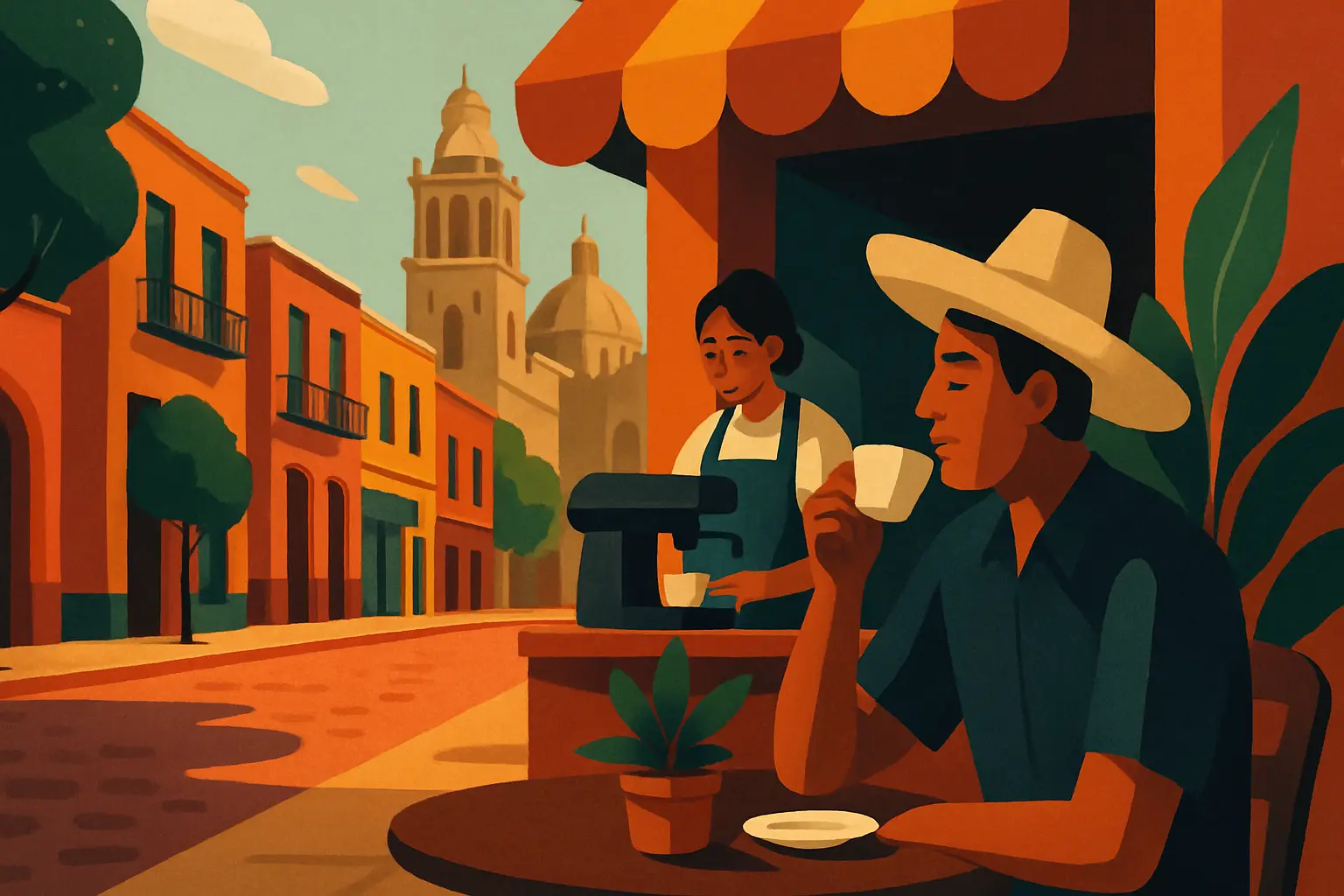
Mexico is consistently one of the world's top-ten coffee producers. Chiapas, Veracruz, Oaxaca, and Puebla all grow arabica at high elevation — and in Mexico City, you're closer to those farms than a coffee shop in Portland is to its suppliers. That proximity changes the relationship between roaster and producer: many of CDMX's best cafés buy directly from named farming cooperatives, often indigenous-owned operations in the Chiapas highlands or small family estates in the mountains above Xalapa, Veracruz. Chiapas beans tend toward chocolate, caramel, and brown sugar. Veracruz beans — from Mexico's oldest coffee region, planted by Spanish colonists in the 1700s — run brighter and more citrusy. Oaxaca produces wilder, more complex profiles. You don't need to memorize any of this before you arrive, but when a barista in a CDMX café explains where the espresso came from, they're usually talking about a specific village, a specific cooperative, and a specific harvest year — not a continent.
Chiapas: chocolate, caramel, brown sugar — the most widely represented origin in CDMX cafés
Veracruz: Mexico's oldest coffee region, bright and citrusy
Oaxaca: wilder, more complex, often works better as espresso than filter
Qūentin is consistently named the most technically precise espresso bar in Mexico City, and its Roma Norte location on Orizaba has become the benchmark other cafés are measured against. The menu is tight — espresso, cortado, flat white, filter — because the focus is on execution rather than novelty. Beans rotate through single-origin Mexican lots, and the staff can describe the farm and harvest profile for whatever's in the grinder that week. Roma Norte rewards café-hopping: within a few blocks of Qūentin, along Álvaro Obregón and the streets around Parque Río de Janeiro, you'll find Constela (the most consistent everyday option in the neighborhood), specialty bakeries pulling double duty as serious coffee bars, and enough sidewalk seating that drinking a cortado under a tree in the morning is not a special occasion but a Tuesday. It's the densest concentration of quality coffee in the city, and it's entirely walkable from anything you're doing in Roma Norte.
Qūentin on Orizaba: the technical benchmark for espresso in CDMX
Constela: multiple Roma Norte locations, reliable and accessible for daily visits
Walk Álvaro Obregón east from Insurgentes — cafés appear roughly every half block
Get short, interactive stories that make each place easier to remember while you travel.
Blend Station operates as both café and roastery, with every bean on the menu sourced from a named Mexican farm — Chiapas, Veracruz, Puebla, or Oaxaca — and roasted on-site. The menu includes V60, Chemex, cold brew, and espresso, which means you can taste the same origin as a filter or a shot and notice how the preparation changes the profile. The space is quieter than the Roma Norte corridor and handles longer visits better than most neighborhood cafés. If you want to take Mexican coffee home, Blend Station's retail bags are among the best-labeled in the city: each one lists the farm, the region, the altitude, the processing method, and the flavor notes. That's not marketing — it's information you can actually use when you're trying to explain to someone back home what you brought them.
All beans sourced from named Mexican farms — Chiapas, Veracruz, Puebla, Oaxaca
Roastery on-site; retail bags are exceptionally well-labeled for gifts
Quieter than Roma Norte spots — better for a long session with a laptop
Café Avellaneda at Higuera 40 in Coyoacán is one of the earliest specialty coffee operations in Mexico City, opening before the category had a name in Mexico. The space is small — stone walls, minimal decoration, a few tables — and the menu is intentionally limited to espresso drinks and filter coffee. The beans are Mexican, the staff know the sourcing, and the order most worth making is the pour-over rather than a milk drink: Avellaneda's strength is showcasing what the bean actually tastes like, not building around it with steamed milk. Arrive before 10 a.m. on weekends — the café fills quickly and the surrounding streets justify a slow morning anyway. Frida Kahlo's Casa Azul is a ten-minute walk from the door, and the Coyoacán market at the zócalo serves tamales and champurrado if you want breakfast before the coffee sets in.
Higuera 40, Coyoacán — ten minutes on foot from Frida Kahlo's Casa Azul
Order the pour-over, not a latte — the café's strength is showcasing the bean
Arrive before 10 a.m. on weekends; the café is small and fills fast
Before third-wave coffee arrived in Mexico City, the city ran on cafeterías — sit-down breakfast spots that opened at 7 a.m. and closed after lunch, where coffee was brewed in large aluminum pots and served in a glass with warm milk. That tradition is still alive, and skipping it because you prefer a V60 is a real mistake. Café de olla is the original: coffee brewed in a clay pot with a cinnamon stick and piloncillo (raw brown sugar cane), producing a sweet, lightly spiced drink that tastes nothing like American drip coffee. Café el Popular at Cinco de Mayo 52 in Centro Histórico has been serving breakfast since 1949 at long communal tables under fluorescent lights, with bread baskets, tamales, and a cup of café con leche that costs about 40 pesos. It's one of the few places in the city where you can sit next to a construction worker, a government clerk, and a tourist at the same table and feel like you're actually in Mexico City rather than a curated version of it.
Café de olla: brewed with cinnamon and piloncillo in a clay pot — Mexico's original coffee
Café el Popular, Cinco de Mayo 52, Centro: open since 1949, about 40 pesos for a cup
The cafetería tradition is still how most chilangos start their morning — it runs parallel to the specialty scene
Mexico City has become one of the world's top digital nomad destinations, and right now in May 2026 — with the World Cup opening match at Estadio Azteca on June 11 — remote workers are arriving weeks early to settle in. The cafés that handle laptop traffic well are mostly in Roma Norte and Condesa. Constela has multiple locations with reliable wifi and enough outlets to share. Blend Station has the quietest atmosphere for long sessions. Chiquitito Café — one of the city's original specialty spots, operating since 2012 — has a loyal local regular crowd and a neighborhood feel that's worth the walk. The general rule: arrive before noon to claim a seat, order something every 90 minutes as a courtesy, and avoid peak weekend brunch hours between 10 a.m. and 1 p.m. when every café in Roma Norte is at capacity. Weekday mornings are the sweet spot — quiet, fast wifi, and staff who have time to talk about the beans when they're not slammed.
Constela: most reliable for outlets and wifi across multiple Roma Norte locations
Chiquitito Café: operating since 2012, less tourist-facing than the benchmark spots
Best window: weekday mornings before noon — avoid Saturday and Sunday 10 a.m. to 1 p.m.
Yes — and the gap between its reputation and its reality is one of the bigger surprises for first-time visitors. The problem for most of Mexico's history was export economics: the best lots left the country bound for European and American buyers, while lower grades stayed domestic. The third-wave movement in Mexico City broke that logic. Local roasters now compete to buy the top harvest lots before they ship, which means a high-elevation Chiapas natural or an organic Veracruz washed lot is as likely to end up in a cup on Orizaba as in a container ship to Hamburg. Mexican coffee grown at 1,500 meters in the Chiapas highlands competes directly with the best Central American coffee in the world. The only reason it's still underrepresented internationally is that Mexico City started drinking it first — and in larger quantities every year.
Roma Norte is the answer for density: the highest concentration of specialty cafés in the city, all walkable, spread across a few blocks of Álvaro Obregón and Orizaba. Condesa is nearly identical in quality with slightly less foot traffic. Coyoacán is worth a trip if you're pairing coffee with the Frida Kahlo museum or the morning market. Centro Histórico has the best traditional cafetería experience — Café el Popular and Café Tacuba have been operating for decades — plus a few newer specialty spots near the Alameda Central. Polanco has expensive coffee in hotel lobbies and café-restaurants aimed at business travelers. For the fastest route to a genuinely great cup: take Metro Line 1 to Insurgentes, walk east toward Parque Río de Janeiro, and stop at the first café you see with a handwritten board and a single-origin filter on the menu.
Roma Norte: most cafés per block, best for a café-hopping morning
Coyoacán: Café Avellaneda plus the market — worth a dedicated trip
Centro Histórico: traditional cafetería culture — a completely different experience from the third-wave scene