1. What 'de cabeza' means — and why it's not barbacoa
Tacos de cabeza are beef head tacos — made from various cuts of a whole cow's head, steamed until fall-apart tender and served at dedicated taquerias through the day and night. The animal is almost always beef, not lamb, which separates them immediately from barbacoa — pit-cooked lamb that runs on a weekend-only schedule. Cabeza is available daily, uses a completely different cooking method, and shows up at spots with their own distinct identity.
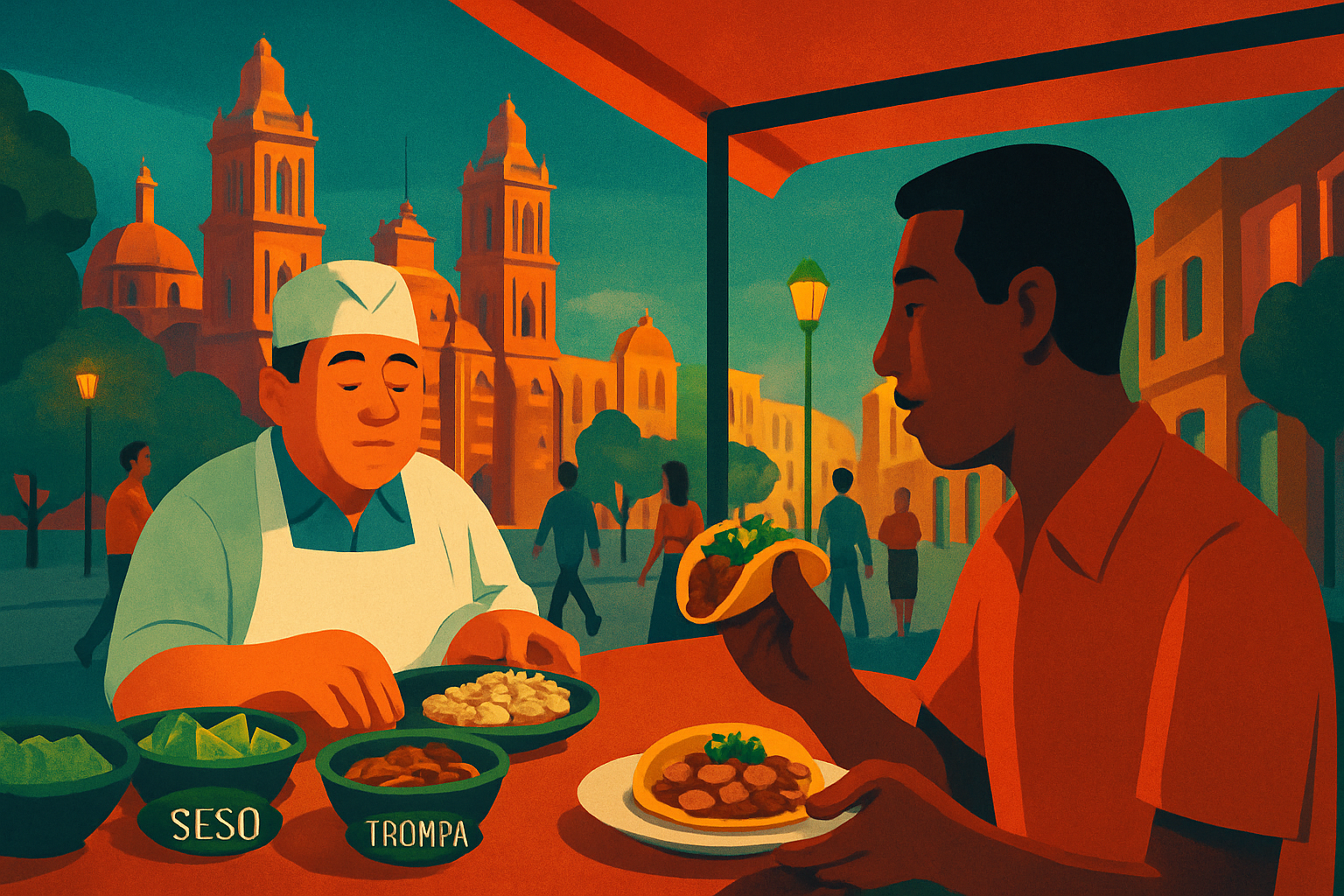
The key detail is that 'de cabeza' is not a single cut. A head contains at least six distinct parts, each with different texture, fat content, and flavor: cachete (cheek), lengua (tongue), maciza (lean head meat), trompa (snout), ojo (eye), and seso (brain). At a proper cabeza taqueria you specify which cut you want — not just 'de cabeza.' The taquero portions to order from labeled sections on the counter, so you can point if your Spanish isn't ready yet. Knowing the vocabulary transforms the experience from confusion to control.
•Beef, not lamb — cabeza uses cow head, barbacoa uses lamb slow-cooked in a pit
•Six distinct cuts available at one counter — specify which one(s) you want
•Available daily at dedicated taquerias, unlike barbacoa which is typically weekend-only
2. The vaporera: how a whole cow head becomes a taco
The standard preparation for tacos de cabeza is steaming in a vaporera — a large custom-built pot with a tight-fitting lid and a perforated rack inside. The head (or large sections of it) is seasoned with garlic, salt, and dried guajillo and ancho chiles, sometimes wrapped in banana leaves or heavy foil, then lowered over boiling water. The lid goes on. For six to eight hours — usually overnight — the steam slowly renders the fat, dissolves the collagen, and turns every cut from cheek to tongue into something that yields to a fork without resistance.
The banana leaf wrapping isn't ceremonial: it keeps the surface from drying during the long cook while letting steam circulate inside, creating a self-basting environment. When the vaporera is opened in the morning, the liquid that has collected at the bottom — a natural broth from the drippings — is sometimes offered alongside your tacos as a consomé. This steam-cook method is the fundamental difference from barbacoa's underground pit, and it shows in the texture: nothing crispy, nothing charred, everything silky or dense depending on the cut. Whether the taquero presses each portion briefly on a hot comal before plating is what adds the final exterior texture.
3. The six cuts: from beginner to adventurous
Cachete (cheek): The most popular and approachable cut. Cheek muscles work continuously, building dense fibrous meat that breaks down under steam into something that pulls like carnitas — tender, slightly stringy, with just enough rendered fat at the edges to keep it moist. The flavor is deeply beefy with no trace of the sharpness that can put first-timers off. Start here.
Maciza (lean head meat): The cleanest option — firm and dense, with less gelatinous texture than cachete and the lowest fat content of the group. The right call for anyone who wants slow-cooked beef flavor without any textural surprises.
Lengua (tongue): Technically a muscle rather than a head cut, but served alongside cabeza at virtually every dedicated spot. The outer skin is peeled after cooking, revealing a smooth interior that starts firm and becomes progressively silky. The flavor is mild and lightly fatty — people who expect something strong are consistently surprised.
Trompa (snout or lip): The first genuinely textured cut. Visible skin attached to muscle gives each bite a combination of chewy exterior and tender meat. The fat content runs higher than cachete. At a well-run spot, trompa should be soft enough to bite through cleanly — if it requires effort, it was undercooked.
Ojo (eye): A small, densely oily portion. The eyeball collagen produces an almost translucent, gelatinous texture with concentrated fat and minimal meat volume. Taqueros usually fold it into a mixed order rather than serving it as a standalone taco.
Seso (brain): The softest and most polarizing cut. Texture is custardy — almost no resistance, pale-colored, with a rich buttery flavor that coats the mouth. It has none of the 'meaty' quality of the other cuts. A dedicated section below addresses the safety question.
•Start: cachete or maciza — familiar textures, deeply beefy, nothing alarming
•Middle ground: lengua — smooth, mild, widely popular with regulars
•Advanced: trompa (chewy), ojo (gelatinous), seso (custardy) — each progressively more textured
4. Tacos Lolita — Roma Norte's afternoon institution
Tacos de Cabeza Lolita at Calle Morelia 84 in Roma Norte is the most-cited cabeza spot in Mexico City for good reason: it is consistent, accessible from the central colonias, and runs a tight operation that makes the whole format feel approachable without sanitizing it.
Lolita opens at 2:30 p.m. and runs until 10:30 p.m., Tuesday through Saturday (closed Wednesday and Sunday). The setup is a street stand with a few plastic chairs positioned on the sidewalk — not a restaurant with signage, but a taqueria on a quiet residential street that has built a following including Mexico City food writers, visiting chefs, and the neighborhood regulars who were eating here before anyone documented it.
Cachete and lengua are the cuts to start with. The taquero works the comal quickly, pressing each portion to order, loading it onto doubled corn tortillas. The salsa verde at Lolita runs hot — a blended tomatillo-and-chile-de-arbol preparation that's acidic and bright and cuts through the fat of the cachete precisely. From Parque Mexico in Condesa or the restaurants along Alvaro Obregon in Roma Norte, Lolita is a 10–15 minute walk east on Morelia. Arrive at or just after 2:30 p.m. on a weekday to get the first tacos before a line forms.
•Calle Morelia 84, Roma Norte — Tue, Thu, Fri, Sat from 2:30 PM to 10:30 PM
•Best order: dos de cachete and uno de lengua — a three-taco introduction to the format
•Hot salsa verde, doubled corn tortillas, sidewalk setup — cash only
5. El Borrego Viudo — Tacubaya's original since 1969
El Borrego Viudo at Avenida Revolucion 241 in Tacubaya is one of the oldest continuously operating cabeza taquerias in Mexico City. Founded in 1969 by Don Conrado Villagrana, the spot has held its location in the Tacubaya neighborhood for over fifty years — in the commercial transit hub west of Chapultepec Park where Metro Lines 1, 7, and 10 converge and where the street food density reflects the constant foot traffic.
The name — 'el borrego viudo,' the widowed sheep — predates the restaurant's founding and belongs to a regional food tradition. Today the spot serves beef cabeza alongside suadero and longaniza, in the classic late-night counter format: watch the taquero work the comal, say what you want, pay cash, eat standing.
El Borrego Viudo runs long hours, with peak activity from late evening into the early morning. It's less a destination and more a station on the way somewhere else — which is exactly the right way to use it. Metro Tacubaya is walkable from the door, making it reachable from anywhere on Lines 1, 7, or 10 without an Uber. For anyone in the Tacubaya area or heading west from Condesa after midnight, El Borrego Viudo is the most logical cabeza stop without crossing the city.
•Avenida Revolucion 241, Tacubaya — founded 1969, late-night hours, Metro Tacubaya (Lines 1, 7, 10)
•Best for: post-midnight cabeza when the rest of the city is shutting down
•Also serves suadero and longaniza — order a campechano to compare techniques in one stop
6. Los Cocuyos, Centro options, and the Merced corridor
The Centro Historico has the highest concentration of all-night taquerias in Mexico City, and cabeza cuts appear throughout. Los Cocuyos at Bolivar 56, best known for suadero and its Michelin Bib Gourmand listing, also carries maciza and some head cuts alongside the main menu. It's not a dedicated cabeza spot, but if you're already in Centro after midnight, adding a maciza de cabeza alongside your suadero order covers two techniques in one stop.
Around Mercado La Merced and the streets south of Circunvalacion — particularly along Rosario — there are morning-oriented cabeza stands that open around 7 a.m. and sell out before noon. These cater to market vendors and transport workers starting before dawn. The turnover is high, the price is at the lower end (20-25 MXN per taco), and finding them requires no map — follow the steam rising from vaporera lids on the sidewalk before 9 a.m.
Tacos Los Juanes, which sets up at the corner of Calle Puebla and Cozumel on the Roma-Condesa border starting at 8 p.m., is a reliable late-evening option — pastor and cabeza, simple stand, operating until around midnight on weeknights.
7. Is seso safe to eat?
Seso (brain) is the cut that raises the most questions from visitors from the US and Europe, where it was restricted following BSE (bovine spongiform encephalopathy, 'mad cow disease') scares in the 1990s. In Mexico, seso remains on the menu at cabeza spots and is treated as a standard cut under the same food safety framework as any cooked meat.
At a high-turnover, established taqueria like Lolita or El Borrego Viudo, seso is cooked as part of the same overnight steam process as every other cut — the relevant safety question is the spot's overall freshness and volume, not the ingredient specifically. If the stand is busy and the vaporera is refreshed daily, seso is not a separate risk category from cachete.
For most first-time visitors, seso is better approached as a texture experiment than a flavor test. The flavor is mild and fatty. The texture is genuinely unusual — nothing else in street food has the same soft, unctuousyield. Order it in a campechano alongside cachete if you want to try it without committing a full taco to the experience.
•Legal and commonly served in Mexico — not a special risk at high-turnover established spots
•Start with a campechano of cachete + seso to sample without a full dedicated order
•The texture adjustment (soft, custardy) is the real challenge — the flavor is mild, not strong
8. How to order — vocabulary, cash, and what to bring
Ordering at a cabeza stand follows the same pattern as any taqueria, with one difference: you specify the cut. The taquero will have portions visible on the counter or in covered trays behind the setup. You can point if needed, but the vocabulary covers everything.
Basic phrases: 'Dos de cachete, por favor' (two cheek tacos). 'Uno de lengua' (one tongue). 'Un campechano de cachete y maciza' (a mix of cheek and lean head meat on doubled tortillas). 'Con todo' means with onion, cilantro, and salsa. 'Mas salsa verde' adds more. 'Sin cilantro' removes it.
Bring 50- and 100-peso notes. Cards are uncommon at street cabeza stands. A full meal of four tacos and a soda runs 120–180 pesos. Double corn tortillas arrive standard — the fat content of head cuts makes a single layer structurally insufficient, so the taquero doubles automatically. Squeeze lime generously before the first bite. The acidity of limon mexicano (key lime) balances the richness of cachete and cuts through trompa or seso in a way that salsa alone doesn't achieve. If the counter has chiles en vinagre (pickled jalapenos or carrots), a few alongside the taco are the traditional pairing — the vinegar functions the same way as the lime.
•'Dos de cachete, por favor' — two cheek tacos to start, adjust from there
•Campechano mixes two cuts on doubled tortillas — efficient way to sample the menu
•Budget 120–180 MXN for a full meal; most stands are cash only