Tacubaya's name is the Hispanicized version of Atlalcuihaya — a Nahuatl term meaning 'where water is gathered.' It is a literal description. The neighborhood sits at the western end of a chain of springs that Aztec engineers recognized as a critical water source and, in 1449 under the reign of Moctezuma I, turned into one of the great engineering projects of the pre-Columbian Americas: an aqueduct of more than 900 arches running eastward from the Tacubaya springs to the island city of Tenochtitlan. The aqueduct supplied fresh water to a city that held between 200,000 and 300,000 people — the largest population in the Americas at the time, and larger than London or Paris in the same era. Most of the aqueduct was demolished or buried as Mexico City expanded after the Conquest. A few sections remain visible today, incorporated into colonial-era structures or showing as remnant arches near Chapultepec — easy to walk past without realizing what you are looking at. The neighborhood's relationship to water shaped everything that came after: the colonial villas, the olive groves, the 19th-century elite retreats that sprang up precisely because this western edge of the basin had reliable springs, good soil, and just enough distance from the capital's colonial center to feel like countryside.
On April 11, 1859, the neighborhood gave its name to one of the most violent episodes of Mexico's 19th century. The Battle of Tacubaya was fought between liberal forces under General Santos Degollado and conservative troops commanded by General Leonardo Márquez during the War of Reform — a civil war triggered two years earlier by the Plan de Tacubaya, a conservative pronunciamiento that had rejected the liberal Constitution of 1857 from this same neighborhood. The liberals lost. What made April 11 infamous was what happened after the battle: Márquez ordered the execution of the captured liberal officers, their field surgeons, and a group of medical students who had come to the site to tend to the wounded. The killings shocked even conservative Mexico. They earned Márquez the permanent nickname 'El Tigre de Tacubaya' — the Tiger of Tacubaya — a label he carried for the rest of his life and never disavowed. Márquez went on to command forces under Emperor Maximilian and later led a doomed defense of Mexico City against Juárez's republican army, eventually dying in Cuba in 1913 at the age of 95, one of the last surviving figures of that entire era. Mexico City has no monument to the massacre itself, but the neighborhood's name appears in every serious account of the War of Reform. If you have read about the Mexican Revolution, the Reform War that preceded it by fifty years is the story that explains why those particular grievances existed.
Get short, interactive stories that make each place easier to remember while you travel.
At Parque Lira 136, in a compound that opens onto a narrow park, sits a house whose history spans as much of Mexico City's story as any single building in the city. The property dates to the 16th century — the first documented owner in 1616 was Francisco Bazán y Albornoz, an Inquisitor of the Holy Office who inherited an estate that had been producing olive oil and pulque since Cortés landed. Over the following three centuries, the house passed through some of colonial Mexico's most illustrious and obscure hands, acquiring layers of architecture, furniture, and art in the process. By 1942, when collector Antonio Haghenbeck y de la Lama acquired the property, it had survived the Conquest, the colonial period, Independence, the Reform War, the French Intervention, the Porfiriato, and the Revolution — each era leaving sediment in the rooms. Haghenbeck furnished the house with 15th- through 20th-century furniture, iron and marble sculptures, paintings, and tapestries, then preserved the central courtyard's quarry stone columns and wooden corridors largely intact. The Museo Casa de la Bola opened in 1991 with 13 rooms organized as a walk through four centuries of Mexican decorative arts. Visits require an appointment and run in small groups, which means you can actually move through the rooms rather than shuffling through a crowd. It is the closest thing Tacubaya has to a time capsule, and it requires no prior knowledge of art history to find genuinely absorbing.
Luis Barragán moved to Mexico City from Guadalajara in 1936 and spent more than a decade working on other projects before building his own house. In 1947 he chose a small street in Tacubaya — General Francisco Ramírez 12-14, at the corner of Calle Gral. Juan Cano — and constructed a house that was declared a UNESCO World Heritage Site in 2004. The location was the first statement of the building's philosophy: Barragán believed architecture should provide refuge from the noise of the world, and a quiet street in a working-class neighborhood offered exactly the kind of anonymity he sought. From the outside, the house is intentionally invisible — a flat street facade of painted concrete with no windows visible from the pavement and nothing to announce its importance. Inside, Barragán organized the space around a sequence of rooms and terraces, each anchored by a single saturated color (the yellow wall behind the staircase, the pink-and-purple garden terrace), with light arriving through hidden skylights and vertical slots rather than conventional windows. The effect is closer to being inside a painting than a house. Casa Luis Barragán is one of Mexico City's essential experiences — not because it is spectacular in the conventional sense, but because the forty-five minutes you spend inside it changes the way you see color and space for the rest of the day. Reserve in advance: small-group tours fill out, and same-day entry is rarely available.
Tacubaya has never tried to be a gastronomic destination. What it has is the Mercado Tacubaya Becerra — a market occupying an entire city block for more than seventy years, operating at the pace of a neighborhood that feeds itself rather than performs for visitors. The comida corrida stalls inside are the main reason to eat here: three- to four-course set lunches for 80 to 120 pesos, served between 1 and 4 pm, rotating daily based on what came in that morning. There are usually six to eight stalls competing for the same customers on the same block, which keeps quality honest in a way restaurant reviews cannot replicate. The stalls that have been running for twenty or thirty years tend to be toward the interior of the market, not the entrance — turnover near the entrance is higher. Outside the market, around the Glorieta de Tacubaya and along Parque Lira, taco and torta street carts run from mid-morning onward. The neighborhood also has a number of loncheras — converted storefront kitchens that have operated in the same spot for decades, distinct from both market stalls and sit-down restaurants. A handwritten menu on a chalkboard and a line of office workers outside from 12 to 2 pm are both reliable indicators of quality.
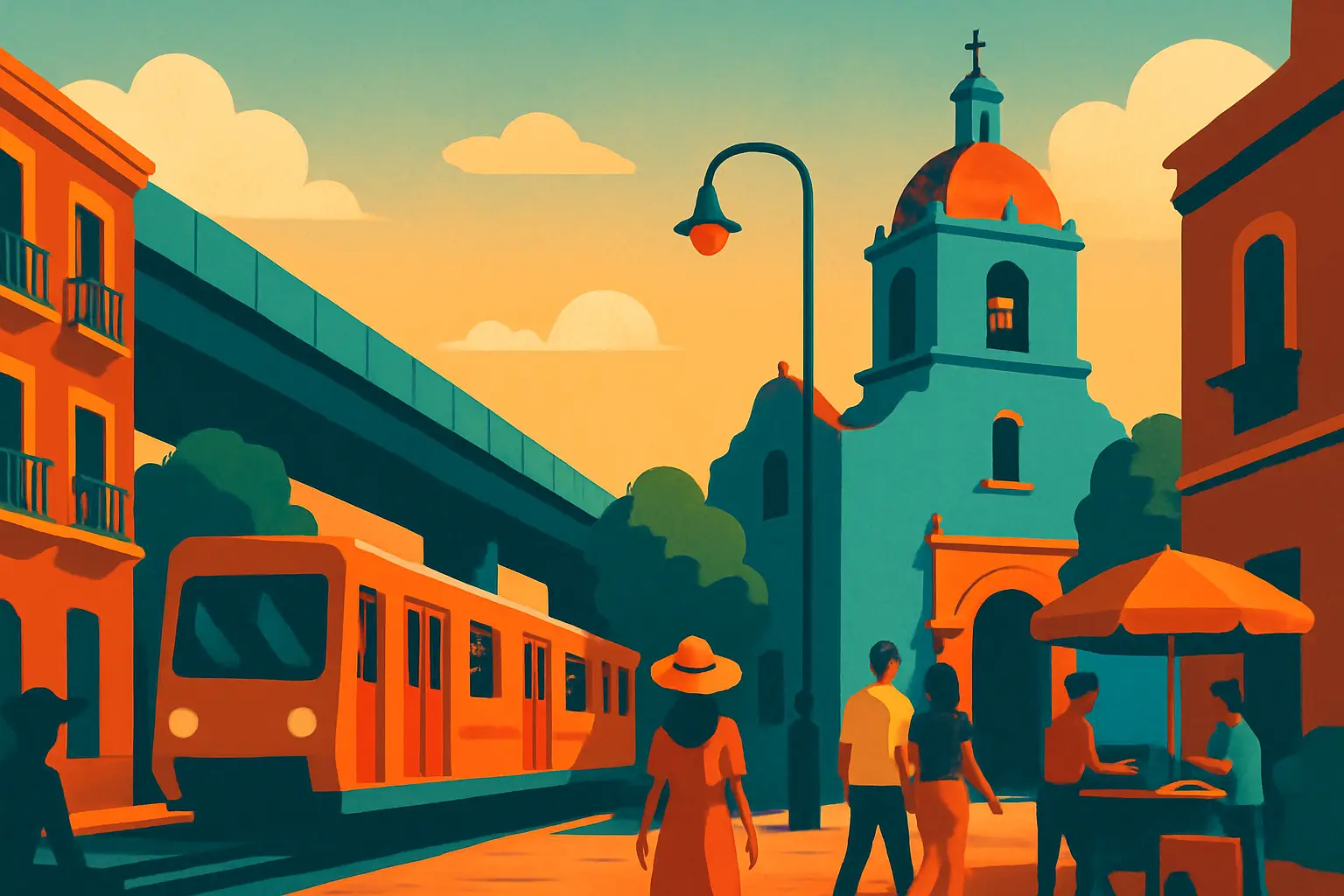
Away from the metro hub, which is loud and dense, Tacubaya settles into a working-class residential neighborhood of mid-century apartment blocks, converted colonial residences, and the occasional grand facade from when this was Mexico City's elite exurb. The area around Parque Lira — a long, narrow public park running east to west between Avenida Jalisco and Avenida Observatorio — gives the neighborhood its best walking. The park is used by residents for exercise in the mornings and by families in the evenings, and the streets bordering it show the mixture that comes from 19th-century money and 20th-century neglect: wrought-iron gates, peeling neoclassical facades, corner stores that have been in the same family for three generations. Heading north from Parque Lira toward the Barragán house on General Francisco Ramírez takes you through a transitional zone between the working-class blocks near the metro and the quieter residential streets of Colonia Daniel Garza — a gradient that makes the walk itself part of understanding why Barragán chose this specific location. On the way, you pass blocks where 1930s and 1940s construction mixed Californian colonial and early Mexican modernism in the same row of buildings — a street-level version of the same architectural conversation Barragán was conducting inside his house.
Is Tacubaya safe? The neighborhood is a mixed working-class and residential area. The streets around the Metro Tacubaya station are busy and dense — keep valuables in a bag rather than a back pocket, and avoid displaying phones near the transit hub. The blocks around Parque Lira, the Barragán house, and Casa de la Bola are significantly calmer and feel more like a quiet residential colonia. Standard Mexico City awareness applies. How do I get there? Metro Tacubaya (Lines 1, 7, and 9) is one of the city's most central transfer points. From Roma Norte or Condesa, take Line 1 west (direction Observatorio) to Tacubaya — six stops, about 12 minutes. From Polanco, take Line 7 south (direction Barranca del Muerto) — three stops. From Centro Historico, Line 1 runs directly. Uber and DiDi work well for a direct connection from anywhere else. When is the best time to visit? Weekday mornings are ideal: quieter streets, available appointment slots at both museums, and the Mercado Becerra in full operation by 8 am. A good full-morning plan: arrive at 9 am for breakfast at the market, walk Parque Lira, visit Casa Luis Barragán at 11 am (reserved in advance), and the Museo Casa de la Bola in the early afternoon. That combination covers what Tacubaya is about without any filler. In June during the rainy season, afternoon thunderstorms arrive around 4 to 6 pm — both museums make excellent dry shelter if you get caught out.