Luis Barragán was born in Guadalajara in 1902 and trained as a civil engineer before teaching himself architecture through travel — Spain, Morocco, France — and a deep reading of the French landscape architect Ferdinand Bac, whose enclosed Mediterranean gardens became a lifelong obsession. When he moved to Mexico City in 1935, he spent a decade building functionalist apartments in Colonia Cuauhtémoc before making a sharp creative turn.
The turn came from a reaction against the clean, colorless rationalism that dominated postwar modernism. Where Mies van der Rohe said 'less is more,' Barragán believed less was actually less — that architecture stripped of color, texture, and silence failed its most basic responsibility: making people feel alive inside it. He called what he was after 'emotional architecture': buildings that provoked serenity, mystery, and awe through proportion, material, and an almost obsessive control of how light entered a room.
The Pritzker Architecture Prize — the field's highest honor — went to Barragán in 1980, making him only the second architect to ever receive it. He died in Mexico City in 1988. His home in Tacubaya has been managed as a museum since shortly after his death, and was declared a UNESCO World Heritage Site in 2004, specifically citing the integration of architecture, garden, and landscape as a unified work of art.
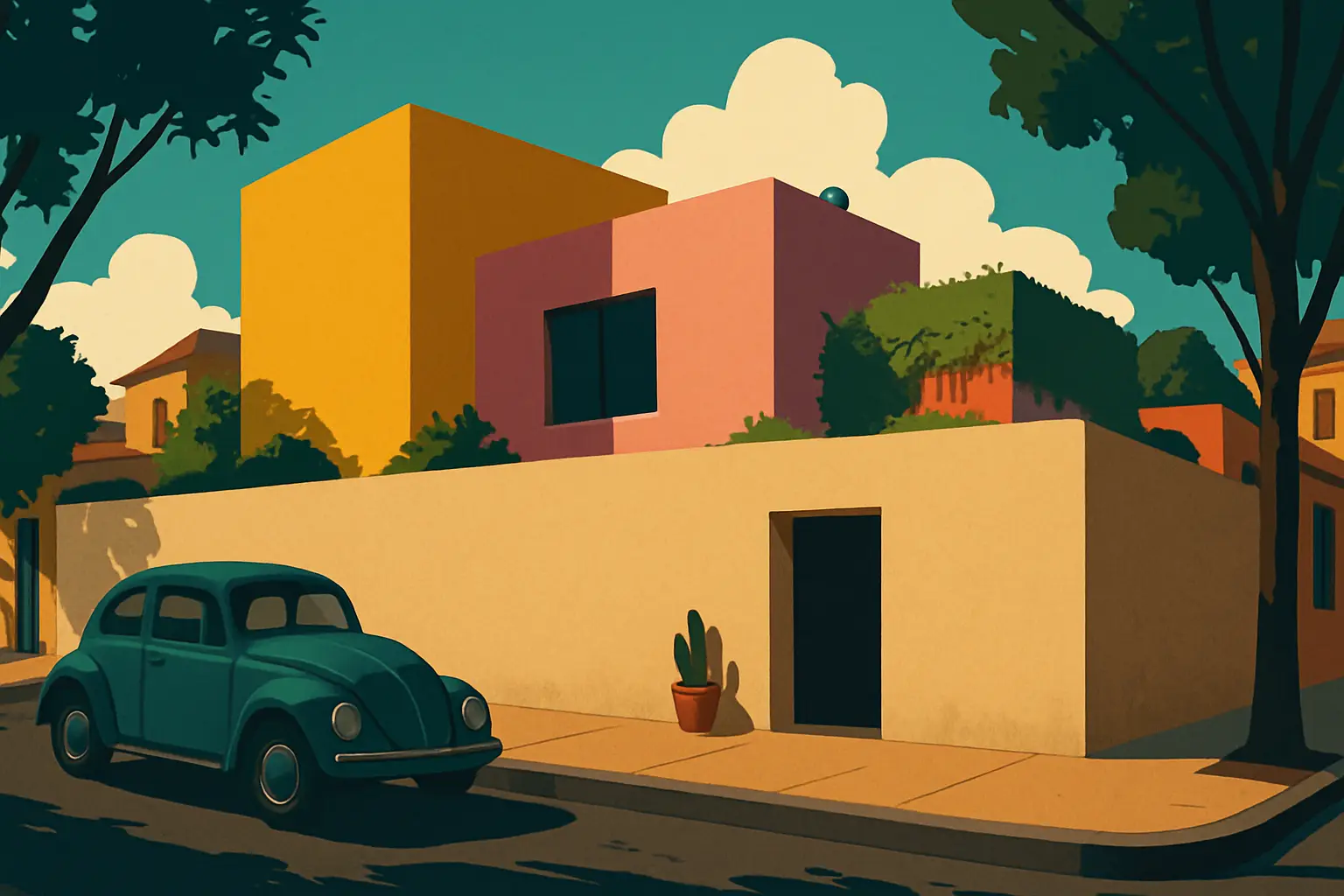
The exterior gives almost nothing away. The street-facing wall is deliberately plain — a beige facade that looks more like a warehouse than a masterpiece, which is itself a design decision. Barragán believed the threshold between street and home should feel like a rupture, a transition from the noise of the city into something entirely different.
Inside, the house unfolds slowly. The living room has a double-height ceiling and a wooden staircase, with bookshelves running floor to ceiling and a palette of deep terracotta and burnt sienna that shifts color depending on where the afternoon light hits the walls. The library is dense with books — Barragán was a serious reader of philosophy, theology, and landscape theory — and feels more like a private study than a museum exhibit. The studio where he drew and worked is preserved largely as he left it.
The rooftop terrace is one of the great architectural surprises in Mexico City: a series of abstract planes and screens in saturated pink and violet, rising above the roofline in shapes that have no obvious function beyond being beautiful and framing patches of sky. From up here, the logic of the whole building becomes legible — every decision about color and opacity was made in relation to where the sun would be at a specific hour of day.
Get short, interactive stories that make each place easier to remember while you travel.
The most photographed element of Casa Barragán — and the reason the 500-peso photography permit is worth considering — is the back garden. It's a small space, far smaller than photographs suggest, but proportion was always Barragán's secret weapon: a shallow reflecting pool at ground level, mature fig and bougainvillea, and at the far end, the golden yellow wall.
The wall is exactly what it sounds like: a flat surface painted in a rich ochre-gold, roughly 10 meters wide and three meters tall, positioned so that in the late afternoon it acts as both a mirror and a light source. Sunlight strikes it and bounces warm gold across the garden, turning the water pink, the shadows purple, and the white surfaces nearest it into a different shade every fifteen minutes. It sounds like a painter's trick. Standing in front of it, it feels closer to a religious experience.
Barragán completed the house in 1948 and lived in it until his death 40 years later, adjusting details across decades — the shade of a wall, the position of a screen — the way a painter might keep returning to a canvas. The UNESCO committee in 2004 cited the garden specifically as an example of a landscape that functions simultaneously as architecture, painting, and sculpture. That description is accurate in a way you don't fully understand until you're standing in it.
If one visit to a Barragán building creates the desire for another — which it almost always does — Casa Gilardi is the logical next stop. Built between 1975 and 1977 as Barragán's final commissioned work, the house is in Colonia Manuel Ávila Camacho in the Miguel Hidalgo borough, about a 15-minute taxi ride from Casa Barragán on Francisco Ramírez.
Casa Gilardi is famous primarily for one room: the indoor swimming pool. The pool is long and narrow, with a single hot-pink column standing in the water and one end open to a wall of glass looking into a courtyard. The light entering through the glass is first filtered through a jacaranda tree — turning it soft and purple — then reflected off the water and the yellow corridor walls leading into the room. The effect is closer to Rothko than to anything you'd expect from a residential pool.
Tours of Casa Gilardi also require advance reservations on a similar weekday schedule. Several tour companies offer a combined half-day itinerary covering both houses with an architecture guide — worth considering if this is new territory for you, since the context and comparisons make both visits more legible. The Traveling Beetle runs well-regarded small-group tours covering both properties for around $155–$250 USD per person depending on group size.
Tacubaya is one of Mexico City's older settlements — it predates the Spanish conquest as a lakeshore town, and by the 19th century it had become a fashionable suburb connected by the city's first tramway. The mansions are mostly gone, replaced by a dense residential district, but the neighborhood still has a specific texture: neither tourist-friendly nor hostile, just real.
Metro Tacubaya sits at the intersection of Lines 1, 9, and A — one of the busiest transit hubs in the city. From the station, the walk to General Francisco Ramírez takes about 10 minutes through quiet streets, which functions as a useful decompression before the visit. After the tour, the stretch of Avenida Jalisco near the metro has good local taco stands and fondas running comidas corridas at lunch for 80–120 pesos.
The Parque Lira, a few blocks north of Casa Barragán, is a pleasant green space with a weekend market worth a detour. Chapultepec Park's second section — quieter and less visited than the main entrance near Reforma — begins about a 20-minute walk east along Constituyentes. The full guide to what's inside the park is in the Chapultepec Park guide.
The honest answer: it depends on what you want from it. If you arrive expecting a conventional museum — explanatory panels, roped-off rooms, a gift shop — the experience will feel surprisingly intimate and a little spare. There's almost no interpretive material inside the house. The tour guide carries the entire weight of context.
If you go understanding that the house is the exhibit — that the colors on the walls, the way a beam of light crosses the floor at 3 p.m., the relationship between the library and the garden — these are the content — then it's one of the most affecting places in Mexico City. Architecture-curious visitors, interior design enthusiasts, photographers willing to pay the permit fee, and anyone interested in how a single person's private obsessions can produce a globally significant building: this visit is made for them.
For first-time visitors to Mexico City, it works best as a complement to something more visually immediate — a morning at the Museo Nacional de Antropología followed by an afternoon at Barragán's house creates a satisfying arc from ancient to modern Mexican visual culture. Full details on the museum are in the Museo Nacional de Antropología guide, which is also in the Miguel Hidalgo borough, about 15 minutes by taxi from Tacubaya.
Booking is non-negotiable. The house does not admit walk-in visitors, and showing up without a reservation means standing at the gate being turned away. The standard process: send an email to casaluisbarragan@gmail.com with your preferred date, number of visitors, and a contact number. Phone bookings at 55 5515 4908 are also accepted. The team typically responds within 24 hours.
Tours run Monday through Friday. The first tour of the day usually starts at 9:00 or 10:00 a.m.; the last typically ends by mid-afternoon. Groups are kept small — usually no more than six to eight people — which is what makes the experience feel so different from a large museum. You're not shuffled through. You stand in a room and the guide lets the room work on you.
For visitors who want a guaranteed English-language guide with photography logistics handled, third-party operators like The Traveling Beetle offer combined Barragán tours (Casa Barragán plus Casa Gilardi) at a higher price but with all coordination managed. This is the path of least resistance for travelers who aren't comfortable navigating Spanish-language email booking or who want architectural context that goes deeper than the standard house tour provides.
Arrive at least 10 minutes before your reserved time. The house is strict about punctuality — late arrivals may forfeit their spot to the next group, and the staff will not delay a tour already in progress.