Suadero is a cut of beef from the layer between the belly and the leg — a loose-textured piece with more connective tissue and intramuscular fat than a steak cut, but less than lengua (tongue) or cachete (cheek). The name likely traces to the Spanish 'suave' (soft), which tells you what the cooking is meant to achieve: a texture that is tender throughout, slightly gelatinous at the seams, with edges that crisp on the comal into something lightly caramelized.
The cut is not prestigious at a butcher counter — it's an economical piece of the animal, which is exactly the point. Suadero belongs to the Mexico City tradition of street food built from modest cuts transformed by technique into something remarkable. The same tradition produced carnitas (pork scraps slow-cooked in lard) and tacos al pastor (Lebanese shawarma adapted by immigrants in Puebla). What makes suadero specifically chilango — specifically Mexico City — is that outside the capital and the surrounding central states, the named cut and the street-food format essentially disappear. You are not eating something from Mexico in general. You're eating something that evolved on the street corners of this city and nowhere else.
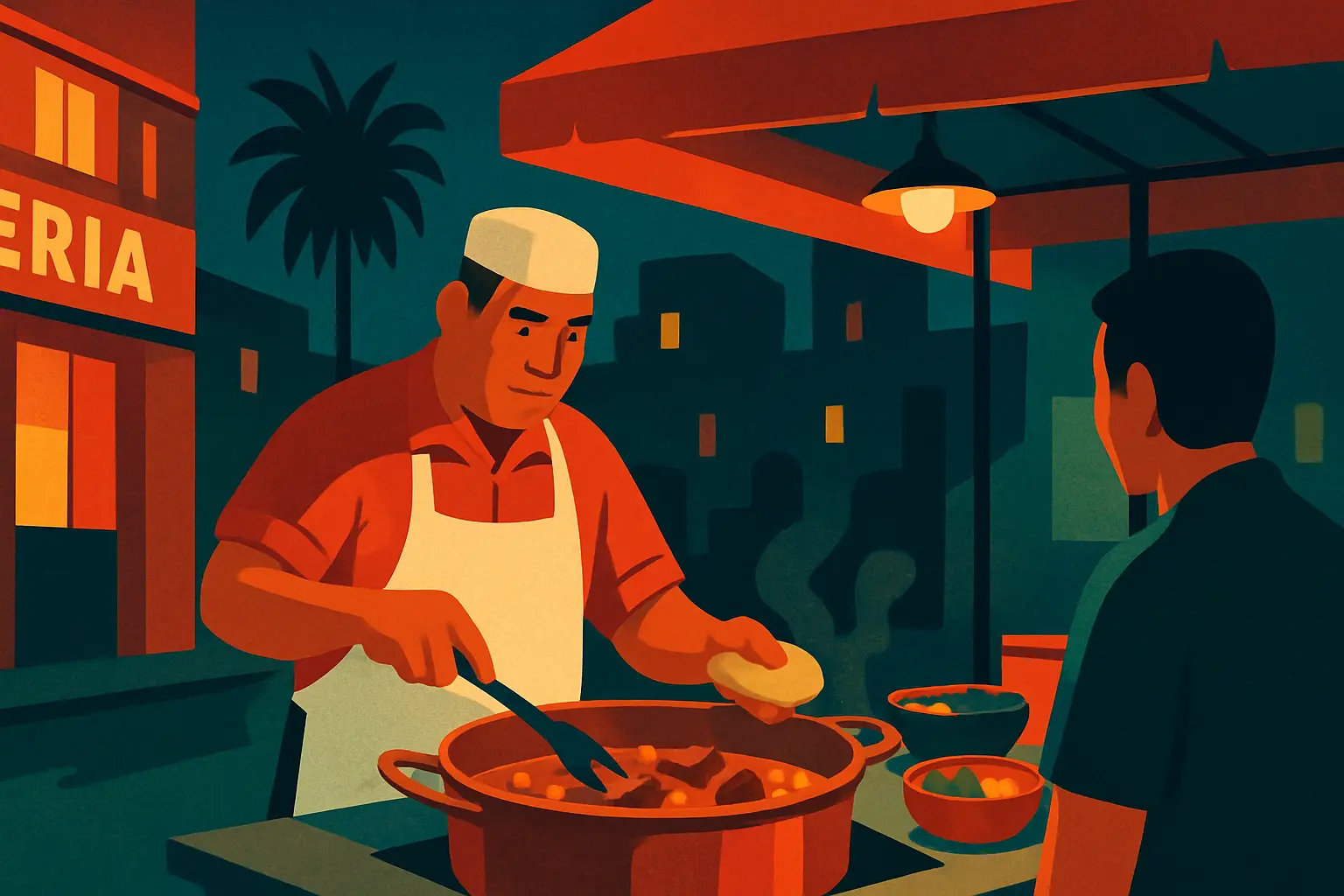
The physical setup of a suadero stand is immediately recognizable once you know what to look for. At the center is a large pot — most often copper, sometimes a wide aluminum cazuela — filled with rendered beef fat and sitting over a gas flame at low heat. Submerged inside are chunks of suadero, cooking slowly over hours: softening, absorbing fat, losing their toughness as the connective tissue dissolves.
When an order comes in, the taquero reaches into the vat with a slotted tool, pulls out a piece of suadero, and lays it on the flat comal positioned beside the pot. The comal runs hot. The suadero sizzles on contact. The taquero presses it, flips it, and works the edges until they turn golden and slightly crunchy. Then it's chopped — a quick, rhythmic motion — into irregular pieces that mix tender interior with crispy perimeter. Those pieces go onto two small corn tortillas, heated on the same comal until pliable. Onion and cilantro from the counter setup, salsa verde or roja from the bottles, a squeeze of lime, and that's the whole taco.
The vat is not emptied and refilled each day. The accumulated fat from each previous batch of suadero deepens the flavor of the next. This is why serious suadero stands get better as the evening progresses — the fat at 10pm has been absorbing rendered beef since morning, and it shows.
Get short, interactive stories that make each place easier to remember while you travel.
Taquería Los Cocuyos at Bolívar 56 in Centro Histórico has been running since 1980 and is essentially always open — through the night, into the morning, across every day of the week. That makes it uniquely useful in a city where most taquerias shut down by midnight and reopen at 6am for breakfast. At 2am on a Thursday, Los Cocuyos is the answer.
The Michelin Guide Mexico City included Los Cocuyos in its Bib Gourmand listings — recognition for exceptional quality at genuinely accessible prices. The menu is deliberately short: suadero, tripa (tripe), maciza (lean beef), and campechano (a combination of the above). Tortillas are doubled corn, heated on the same comal as the meat. The salsa verde is blended tomatillo and chile de árbol, bright and sharp. The salsa roja is cooked, smoky, and one level hotter.
The stand operates entirely on the street — no seats, no indoor tables, no signage beyond the physical setup itself. The crowd eats standing at the counter or on the curb. Los Cocuyos sits about a 5-minute walk from Metro Bellas Artes (Line 2, blue) and near Alameda Central, in the part of Centro that stays active well past midnight on weekends.
Address: Bolívar 56, Centro Histórico — near the corner with República de Uruguay
Hours: effectively 24 hours; busiest from 9pm to 2am
Best order: campechano (suadero + tripa) with salsa verde and extra lime
Tacos El Paisa on Joaquín García Icazbalceta 36, in the San Rafael neighborhood, is the spot food writers return to most consistently when ranking the city's best suadero. The address puts it about a block from Parque Sullivan, walkable from Paseo de la Reforma and the Monumento a la Revolución.
The signature technique at El Paisa is one specific detail that sets it apart: before loading the taco, the taquero dips each corn tortilla briefly into the fat from the vat. The base absorbs a thin coating of rendered beef fat before any meat touches it, so the tortilla itself tastes seasoned from the first bite. The result is a taco that seems more layered than a similarly assembled version elsewhere — because the fat is doing flavoring work at every level, not just through the meat.
El Paisa also serves tripa, longaniza, and campechano. The corner gets busy and the line moves fast. Arriving late morning or mid-evening avoids the longest queues. The San Rafael neighborhood has its own food culture and architecture worth exploring — the San Rafael guide covers the area's art-deco buildings and the Sunday Tianguis Sullivan market nearby.
Address: Joaquín García Icazbalceta 36, San Rafael — near Parque Sullivan
Signature move: tortilla dipped in the fat vat before the suadero goes on
Best arrival: late morning or mid-evening to avoid peak queues
Campechano is the phrase that separates suadero regulars from first-timers. It means a taco mixed from two proteins in the vat — the most common version is suadero plus longaniza (Mexican fresh pork sausage), but suadero plus tripa works equally well. You say 'campechano' and the taquero knows exactly what to do. It costs the same as a single-protein taco and is the default order for anyone eating here regularly.
Media means half a portion — half a taco's worth of one meat combined with half of another on the same doubled tortillas. It lets you try two different proteins without eating twice the tacos. At a busy stand during rush hours this request gets absorbed into the chaos; mid-morning is more reliable for experimenting.
Con todo means onion, cilantro, and whichever salsa the taquero applies by default. To specify: 'con salsa verde' or 'con salsa roja.' 'Sin cilantro' removes it. Most suadero stands carry both a blended salsa verde (tomatillo, chile de árbol, raw) and a cooked roja (dried chiles and tomato). Verde is the traditional pairing — its acidity cuts through the fat. The roja adds smoke.
One final texture note: the piece of tortilla at the bottom of your finished taco, slightly translucent from fat absorption, lightly crunchy at the fold — eat it. It is the best part of the taco and a reliable sign you've ordered correctly.
Suadero is not confined to any single part of Mexico City, and you don't need a map to find it. The signal is consistent: a copper or aluminum vat over a gas flame, visible from the sidewalk, with a flat comal beside it. If you can see the taquero pulling meat from liquid fat, you are at the right kind of stand.
By area: Centro Histórico has the highest density, especially late at night — Los Cocuyos is the anchor, but additional stands operate along Correo Mayor and around the streets near Mercado La Merced. Roma and Condesa have suadero on corner stands along Insurgentes Sur and near Mercado Medellín; the stand El Morocho on Insurgentes Sur also carries suadero alongside less common options like huitlacoche (corn fungus). San Rafael has El Paisa as the primary reference, plus several smaller stands along Ribera de San Cosme. Tlalpan, in the southern borough, has Tacos Charly — a standing-room, cash-only spot known to the southern neighborhoods for suadero and al pastor, operating with the same no-frills format as the best Centro stands.
For a broader orientation on Mexico City's street food before your first taco crawl, that guide covers the timing, payment, and general logic of how the city eats across all formats.
Suadero tacos range from 22 to 40 pesos per taco at street stands, depending on the neighborhood and the reputation of the spot. At Los Cocuyos, three tacos and a drink runs under 150 pesos. A complete suadero meal — four or five tacos, an agua fresca, and a few extra limes — lands between 120 and 220 pesos at most street-level spots.
Cash is universal across suadero stands. Cards are uncommon, and asking will often generate a quiet pause and a look of mild confusion. Bring 50- and 100-peso notes; 200-peso notes are manageable. Handing a 500-peso note for two tacos during a rush is genuinely inconvenient for the taquero, who has to locate change while the line builds behind you.
Is there a restaurant version worth knowing? There is no meaningful restaurant suadero — the technique requires the copper vat and the continuous fat accumulation, which is a street-food preparation, not a kitchen process you can replicate at a sit-down table. A few casual fondas serve it as a stew, which is fine but different. The standing counter, the noise, the fat-dipped tortilla eaten immediately while it's still hot — those are not accessories to the experience. They are the experience.
Suadero is available year-round — it's not seasonal and not limited to weekends the way barbacoa is. Time of day is what matters. The vat at any serious suadero stand has been accumulating flavor since morning, which means the best suadero is eaten in the evening. Los Cocuyos peaks between 9pm and 1am, when the fat is at its richest and the Centro crowd is at full volume. El Paisa is best late morning — before noon, when the taquero is attentive and the rendering is fresh — or in the early evening, when the day's fat is mature and the late-night crowd has not yet arrived.
June in Mexico City means rainy season: afternoon thunderstorms between 4 and 6pm, clearing by dinner, leaving the air cold and the pavement wet. A fat-rich suadero campechano from a covered street stand after the rain clears at 8pm on Insurgentes is a specific and excellent experience.
For international visitors arriving this summer for the World Cup — the opening match was played June 11 at Estadio Azteca — late-night suadero at Los Cocuyos or at any of the Centro stands along Bolívar is the most specifically local thing you can do at midnight in Mexico City in June 2026. No reservation, no menu, no decision beyond how many tacos and which salsa. That's the whole instruction set.