The image most Americans have of Mexican food — carnitas, cheese-stuffed quesadillas, lard-fried beans — describes the post-colonial version of the cuisine. The pre-Hispanic foundation looked almost entirely different. For two to three thousand years before the Spanish arrived in 1519, the Aztec diet revolved around corn, beans, squash (the three sisters, grown together in the same milpa field), chiles in every form, tomatoes, tomatillos, nopales (cactus paddles), avocados, tropical fruits, mushrooms, and edible fungi like huitlacoche. Meat — turkey, insects, lake fish — existed but played a secondary role for most of the population. The Spanish brought lard, beef, pork, and dairy, which became embedded in the cuisine over centuries. But the plant-based foundation never disappeared; it got pushed to the margins of international awareness. In Mexico City's markets today, you're not navigating around meat to find vegan options. The nopales, the mushrooms, the squash blossoms, the corn-based street food — they're at the center of the market, not the edge. Understanding this flips the experience: you're not eating around the food culture, you're eating the oldest layer of it.
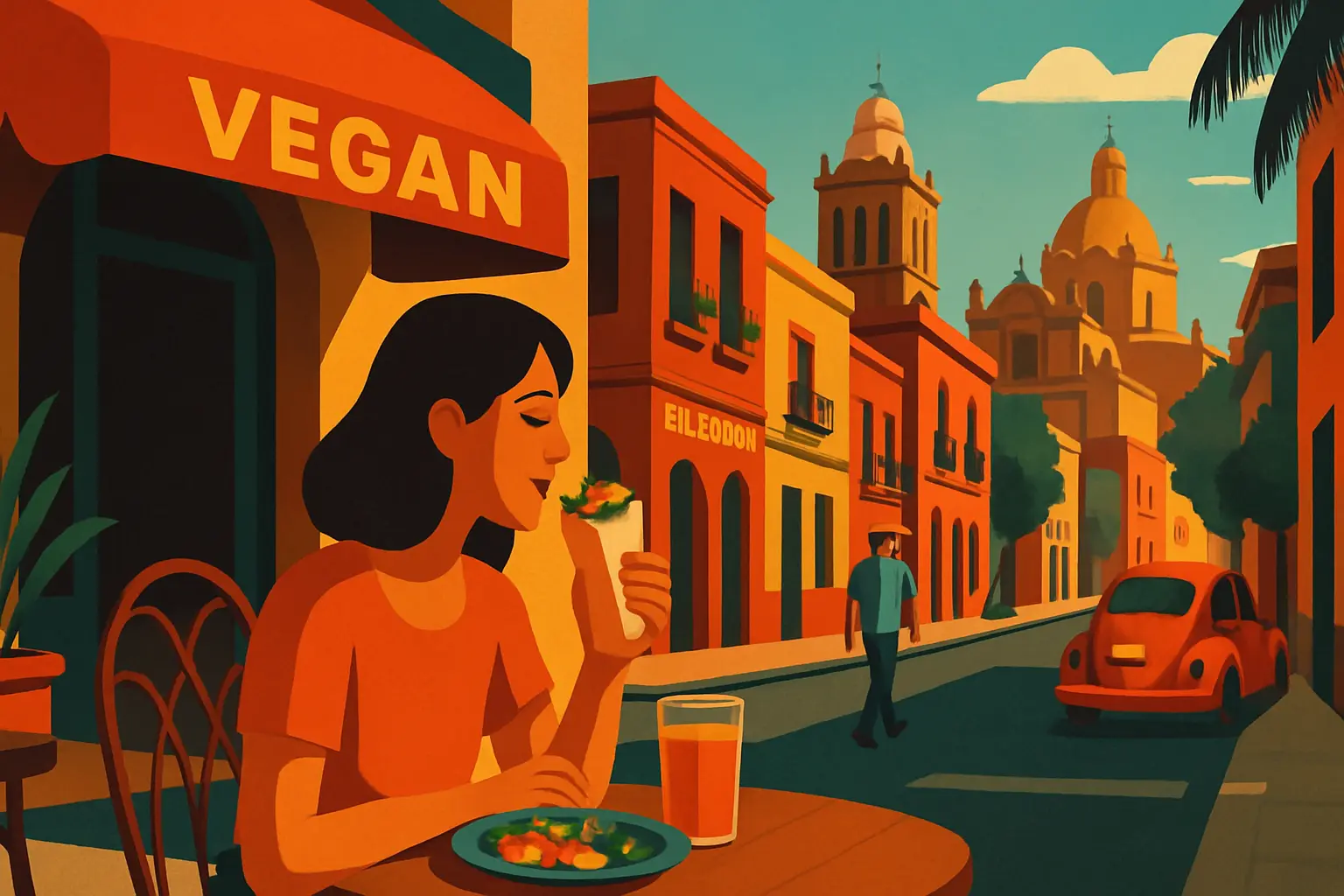
Por Siempre Vegana Taqueria in Condesa is the most-cited anchor of Mexico City's dedicated vegan taco scene, and the reason is the trompo. The shop runs a rotating vertical spit — identical in form to the al pastor trompo but built from marinated seitan — shaved directly onto corn tortillas with fresh pineapple. The marinade uses the same achiote base, guajillo, and citrus as traditional al pastor, which means the result is specifically Mexican rather than a substitute for something else. This distinction matters: the city's best vegan cooking doesn't position itself as a replacement for meat. It draws from the pre-Hispanic ingredient library and builds from there. The tostadas de tinga de champiñones (mushroom tinga), the hongos al ajillo (garlic mushrooms), the rajas poblanas (roasted poblano strips) you'll find at non-vegan guisado counters across the city — these dishes exist because mushrooms, chiles, and corn are genuinely compelling ingredients. That's what makes Mexico City's vegan food worth eating rather than just tolerable.
Por Siempre Vegana Taqueria, Condesa — seitan trompo al pastor, the closest thing to the real instrument
Ask for 'tacos de hongos' or 'tacos de nopales' at any street taqueria — both are common even at non-vegan spots
Tostadas de nopales con salsa: order beans, nopales, and salsa on a fried corn tostada — three layers of the oldest food tradition in the city
Get short, interactive stories that make each place easier to remember while you travel.
A guisado counter at a public market is Mexico City's version of a hot bar — eight to twelve clay pots of prepared dishes arranged behind a glass display, ladled onto handmade corn tortillas. At least three or four options at any counter will be naturally vegan: nopales (cactus paddles slow-cooked with tomato, onion, and serrano chile), hongos (mushrooms — portobello, setas, or seasonal huitlacoche), rajas (roasted poblano strips, often made with oil rather than cream at traditional spots — ask '¿las rajas son con crema o con aceite?'), and calabacitas (zucchini braised with tomato and chile). Beans vary: ask '¿los frijoles tienen manteca?' before ordering. Mercado de Medellín at Campeche 101 in Roma Sur has a guisado corridor along the back wall with several counters running from 9 a.m. to 3 p.m., with particularly good mushroom and cactus options. Any neighborhood market — Mercado Jamaica, Coyoacán, Portales — will have comparable variety. The handmade corn tortilla itself is almost always made from masa and water only, which makes the delivery system a reliable safe bet regardless of the filling.
Nopales: reliably vegan, available at nearly every guisado counter in the city
Hongos: ask what variety — huitlacoche, setas, and portobello all appear; huitlacoche is in season June through October
Frijoles de olla: check for lard; the bean broth (caldo de frijol) offered as a side is almost always vegan
Huitlacoche (also spelled cuitlacoche) is a fungus that grows inside corn ears when the kernels are infected during wet weather. It turns the corn black, swells the kernels into grey-blue blobs, and produces a flavor that doesn't map onto anything in Western food: earthy, sweet, faintly smoky, with notes of fresh corn and something richer underneath. The Aztecs cultivated it deliberately and considered it a delicacy. Spanish colonists called it a disease. Mexico City chose the Aztec position. From June through October — rainy season, which began this week — huitlacoche starts appearing fresh at market stalls and in guisado pots. The most common preparations: quesadillas de huitlacoche (ask for them 'sin queso' for the vegan version, which leaves just huitlacoche and epazote herb inside a corn masa pocket), tacos de huitlacoche with epazote, and sopa de huitlacoche — a warming, earthy soup. Mercado de San Juan near Centro Histórico carries it fresh from June onward, as does any market in Xochimilco, which supplies much of the city's produce corridor. If you eat one thing in Mexico City in June that you genuinely cannot eat anywhere else in the world, huitlacoche is the answer.
Mexico City's street food scene is far more plant-based than it appears at first pass. Elotes and esquites — corn on the cob and corn in a cup — are sold from wheeled carts throughout the city with lime, salt, chili powder, and optionally mayonnaise and crema. Order yours 'sin mayo, sin crema' and what remains is naturally vegan and genuinely good. Fruit carts (fruteros) sell sliced mango, pineapple, watermelon, jicama, cucumber, and guayaba with chili lime — the most ubiquitous reliably vegan street food in the city, priced at 25 to 40 pesos for a large portion. Aguas frescas — drinks made by blending or infusing fruit in water — are naturally vegan across every variety: agua de jamaica (hibiscus), tamarindo, sandía (watermelon), pepino con limón (cucumber lime). Horchata is the exception — it uses rice and sometimes dairy, so check. Tamales de rajas or hongos: traditional tamales are made with lard-enriched masa, but vegan versions made with vegetable shortening appear increasingly at dedicated stalls, especially at Mercado Jamaica on weekends. Ask '¿el masa tiene manteca?' before buying. Plain corn tortillas heated on a comal — the flat ones sold in bags of 30 at every market — cost about 20 pesos and are one of the oldest vegan foods on the continent.
Elotes and esquites: order 'sin mayo, sin crema' — what's left is lime, chili, and corn
Agua de jamaica (hibiscus water): the most common agua fresca, naturally vegan, found at every market and many street carts
Frutero carts: sliced mango, jicama, cucumber with chili lime — 25 to 40 pesos, always vegan
The practical foundation for vegan cooking in Mexico City is the neighborhood market rather than the supermarket. Any mercado público sells dried chiles by the kilo, fresh epazote and hierba santa, tomatillos, nopal paddles already de-spined and diced, and every variety of dried bean — black, pinto, bayo, flor de mayo — at prices that make cooking at home genuinely cheap. Around 500 pesos (roughly $25 USD) fills a bag for a week of produce. For specialty items — nutritional yeast, tofu, plant-based milks, imported vegan products — the options have improved significantly in Roma Norte and Condesa. Origen, a natural food store with multiple locations in Roma Norte, stocks the widest range of vegan specialty products in the city, including organic pulses and imported nut butters. Chedraui and Walmart carry expanding plant-based dairy sections, particularly oat milk. For the freshest seasonal produce, Mercado de Medellín on Campeche 101 in Roma Sur carries single-variety heirloom corn, locally grown mushrooms, and fresh chiles that supermarkets don't stock. Weekend organic tianguis — pop-up organic markets — appear in Parque México in Condesa and at Parque Pushkin in Roma Norte on Saturday and Sunday mornings, with vendors who sell directly from named farms in Morelos, Puebla, and the Estado de México.
Any mercado público: dried chiles, fresh herbs, nopal, beans — the foundation of Mexican vegan cooking at low cost
Origen natural food stores (multiple Roma Norte locations): best stock of specialty vegan products in the city
Weekend organic tianguis: Parque México in Condesa and Parque Pushkin in Roma Norte, Saturday and Sunday mornings
At dedicated vegan spots: fully accommodating — the vegan taqueria and restaurant scene in Roma Norte and Condesa is as developed as any major international city, and staff understand the question without needing explanation. At traditional markets and street food counters: mostly navigable with a few key phrases. The main hidden animal products are lard (manteca de cerdo) in refried beans and some tortilla doughs, chicken broth (caldo de pollo) in rice and soups, and crema or queso fresco added at the counter as a finisher. None of these are intentionally concealed — they're traditional ingredients that vendors don't flag unless asked. The vocabulary makes the difference. At mid-range and upscale restaurants: easily managed. Mexico City's restaurant culture has shifted significantly toward plant-forward menus over the past several years, and most have a dedicated vegetable section on the menu. At traditional cantinas: the menu is what it is — order guacamole, beans (check for lard), and tortillas and you'll eat well without drama. The honest caveat: Mexico City's food culture is not organized around dietary restrictions, and no one will spontaneously offer a vegan menu. The information exists if you ask for it. Asking '¿esto tiene carne o productos animales?' (does this have meat or animal products?) is always understood and never rude.
Five phrases handle ninety percent of situations. 'Soy vegano/a' establishes the baseline clearly — staff in Roma Norte, Condesa, and Coyoacán recognize the word immediately. '¿Tiene manteca de cerdo?' is the most important follow-up for beans, tamale masa, and anything fried. 'Sin queso, sin crema, sin huevo' covers the dairy and egg additions that appear at the last second at taco counters. '¿Los frijoles tienen caldo de pollo?' catches the other common hidden ingredient. 'Con todo pero sin crema' works at any taco counter where the default finish is a squeeze of sour cream. One phrase that doesn't work reliably: 'vegetariano' alone. In Mexico, the word often means 'no red meat' and doesn't exclude chicken, fish, or lard. 'Vegano' is better understood in urban CDMX in 2026 — use it directly. In smaller markets and traditional spots, pointing and asking '¿qué tiene?' (what's in it?) is as reliable as any phrase and is exactly how most chilangos navigate menus they're unfamiliar with anyway. The goal is to make it easy for the vendor to help you, not to force a formal declaration — most people are happy to tell you what's in the pot.
'Soy vegano/a' — the clearest way to establish context; well understood in Roma Norte, Condesa, Coyoacán
'¿Tiene manteca de cerdo?' — the single most important question for beans, tortilla dough, and tamale masa
'Sin queso, sin crema, sin huevo' — covers dairy and eggs added as finishers at taco and guisado counters