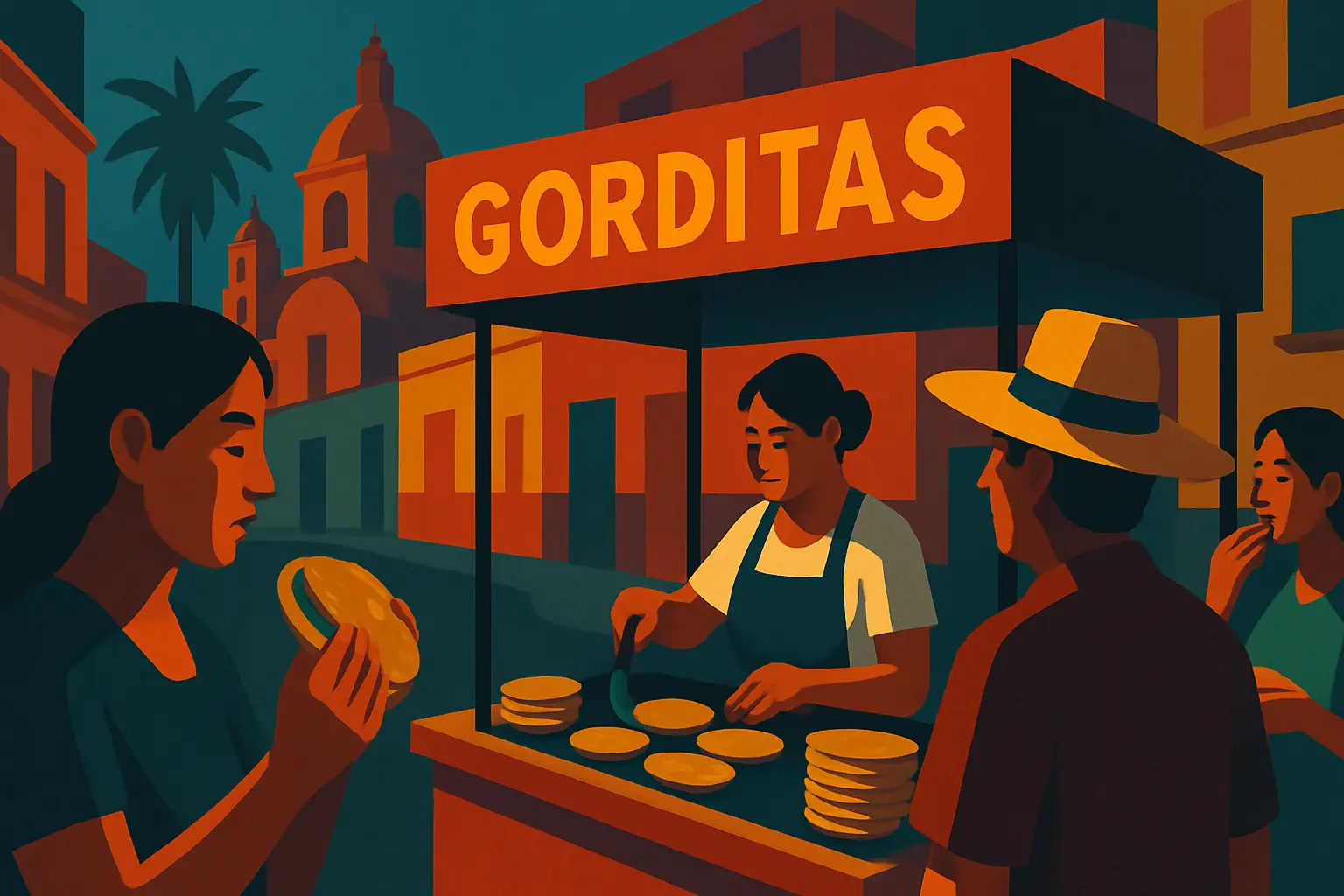
The word gordita means 'little fat one' — a reference to the thickness of the masa disk, not the person eating it. A gordita is made from the same masa that goes into tortillas and tamales, but shaped into a disc roughly an inch thick and three inches across, then cooked until a firm shell forms on the outside while the interior stays soft and doughy. Once cooked, it's split open along one edge like a pita pocket, filled with meat, beans, or stewed vegetables, and handed to you in a piece of paper or a small plate. You eat it with both hands. There is no fork involved.
The reason most visitors walk past gordita stalls without stopping is that uncooked gorditas look almost identical to thick tortillas sitting in a basket. There's no spectacle — no trompo spinning, no massive comal full of chicharron, no smoke. Just a woman pressing masa at a table. What happens after she puts the disc on the comal or into the oil is the whole story.
Taco Bell launched a product called a 'gordita' in 1999 — a soft flour flatbread folded around seasoned beef and sour cream. It shared nothing with the original except the name, and it gave an entire generation of Americans a completely wrong mental model. The real gordita is not a flatbread. It is not folded. It is not made from flour. Once you eat one fresh from a comal in Mercado de la Merced or off a street stall near Centro Historico, the Taco Bell association disappears entirely.
Every gordita stall in Mexico City does one of two things: drops the masa disc into hot oil (or lard), or cooks it directly on a dry comal. These two methods produce fundamentally different results and each has its advocates.
A gordita frita is submerged in hot oil until the exterior puffs and turns golden brown, forming a shell that shatters slightly when you bite through it. The fat seeps into the masa, making the whole thing richer and more intensely flavored — you'll taste the lard in the dough itself, not just in the filling. This is the version most commonly found at dedicated gordita stands and large market stalls.
A gordita asada cooks on a dry or minimally greased comal, relying on direct contact heat to form a crust. The result is lighter, less oily, with a slightly chewier interior texture. The exterior toasts rather than crisps. Neither version is universally better; they pair differently with fillings. Frita holds up against wet, stewed fillings like picadillo or chicharron en salsa verde — the oil-crisped shell resists moisture longer. Asada works well with drier fillings like frijoles or requesón, where a subtler crust lets the filling's flavor dominate without competing with fried fat.
If you see both options at a stall and you're undecided, go frita the first time. It's the version that makes the strongest argument for itself.
Get short, interactive stories that make each place easier to remember while you travel.
The filling menu at a gordita stall is a direct reading of whatever the cook made that morning. Most stalls have five to eight options; a few have more. The following are the most common across Mexico City:
Chicharron prensado: This is the filling specific to CDMX. It's made from the scraps and accumulated fat of chicharron production — pressed together into a compact, somewhat spreadable mass that's fatty, deeply savory, and softer in texture than you'd expect. When it heats inside the gordita, it partially melts into the masa walls. Order this first.
Rajas con crema: Roasted poblano chile strips cooked in heavy cream, usually with corn kernels. Mild heat, rich, slightly sweet. A good choice if you're uncertain about spice levels.
Frijoles refritos: Refried beans — either pinto or black — sometimes with a layer of chicharron prensado added on request. Simple, but it's the most common filling in the city for a reason.
Picadillo: Ground beef with potato, carrot, and a cumin-tomato sauce. Slightly sweet and homey — the same filling you'd find in empanadas or stuffed chiles.
Tinga de pollo: Shredded chicken braised in chipotle and tomato. Smoky, mildly spicy, and the most forgiving of the protein options for anyone new to the heat levels common in CDMX.
At most stalls, you can request two fillings in one gordita. The correct combination: chicharron prensado and frijoles. They merge inside the masa pocket into something that tastes like it was always a single filling.
Chicharron prensado + frijoles is the correct combination order — they merge inside the masa
Rajas con crema is the mildest option if you want to manage heat
Ask for dos rellenos (two fillings) — most stalls accommodate the request for the same price or just a few pesos more
Mexico City's antojito landscape runs on variations of corn masa cooked into different shapes. Most visitors conflate them, which means they often order something different from what they meant. Here is the practical distinction:
A sope is a thick, round masa disc with the edges pinched upward to form a shallow rim, cooked on the comal, then topped with beans, meat, crema, and salsa — open-faced, like a thick pizza base. The filling sits on top, not inside.
A huarache is a large, flat, oval masa cake — named for the sandal it resembles — cooked on the comal and topped with beans, meat, and cheese. Also open-faced, also bigger than a sope, typically 20 to 25 centimeters long.
A tlacoyo is the closest relative to a gordita structurally: it's oval, smaller than a huarache, and filled before cooking — the filling is folded into the masa and enclosed from the start. The exterior is toasted, not fried. Tlacoyos are commonly filled with fava beans, requesón (fresh ricotta-like cheese), or chicharron prensado. The tlacoyos guide covers this in more detail.
A gordita is the thickest of the group, cooked first as a plain disc, then split and stuffed after cooking. That post-cook split is the defining feature. If you see something being cut open and filled with a spoon, you're looking at a gordita.
Gorditas are sold across the city but don't announce themselves loudly — you find them by looking for a comal stacked with thick masa discs, or a pot of oil with golden ones floating.
Mercado de la Merced (Anillo de Circunvalación, Centro Historico — Metro La Merced): One of the city's largest and oldest markets, with a vast food corridor inside. Multiple gordita stalls operate from the early morning through mid-afternoon. Look for vendors near the market's main indoor food section, where the stalls are arranged in rows. La Merced is also covered in the Mexico City markets guide.
Plaza Santo Domingo and surrounding streets (Centro Historico, near Metro Allende or República de Chile): The blocks around this square — particularly Donceles and República de Brasil — have housed informal food vendors for generations. Gordita stalls appear at lunchtime when the printing shops, scribes, and small businesses around the plaza bring foot traffic. This part of Centro is worth exploring for more reasons than just gorditas; see the Centro Historico guide.
Mercado de Medellin (Campeche 101, Roma Sur): The food corridor along the back wall of this neighborhood market runs from morning to early afternoon and includes gordita vendors alongside guisado and quesadilla stalls. A practical stop if you're already in Roma or Condesa.
Street stalls near Mixcoac metro: The residential neighborhood around Mixcoac has a cluster of gordita vendors near the metro exits serving the morning and lunchtime crowd. Fewer tourists, more regulars, and the stalls have been operating in the same spots for years.
El Cardenal at Palma 23 in Centro Historico is one of the city's most important restaurants for traditional Mexican cooking, and its breakfast menu makes the case against starting any morning at a hotel buffet. The gorditas here are served as part of a full desayuno — alongside fresh-squeezed orange juice, cafe de olla (clay pot coffee brewed with cinnamon and piloncillo), and a basket of pan dulce brought to the table without asking.
The fillings at El Cardenal rotate; chicharron prensado and rajas con crema are the most consistent options. The masa is finer-ground than what you'll find at a market stall, with lard worked into the dough before cooking — the result is a smoother interior texture and a more evenly toasted exterior. It's a calmer, more controlled version of the same dish, better for understanding the baseline flavors before you start working through market stalls.
The price difference is real and significant: 120 to 180 MXN at El Cardenal versus 25 to 40 MXN at a stall. What you're buying is the full table service, the salsa presentation, and the controlled environment. For visitors who want to eat a gordita before learning to navigate a busy market, El Cardenal is the right entry point. For everyone else, the market stalls are the experience.
Is a gordita a breakfast food? It can be, but it's an all-day antojito with no strict time rule. Markets sell them from around 9 a.m. through mid-afternoon; street stalls sometimes run into the evening. This is different from tacos de canasta (morning only) or barbacoa (weekends only) — the gordita has no fixed hour.
How do you eat one? With both hands, slightly folded if it's large. Eat it quickly — the filling is hot and the shell softens as moisture from the filling works its way into the masa. If you wait more than five minutes to eat it, the crust loses its structural advantage and you're left with a soggy pocket. When salsa is offered, pour it inside the pocket rather than on the exterior. Exterior-applied salsa falls off onto the paper or the counter and does nothing for the flavor inside.
Are gorditas spicy? Not inherently. The masa itself has no heat; the filling has mild heat at most. All the spice comes from the salsas served alongside, and those vary from stall to stall. The safest move at a new stall: ask for salsa on the side, taste a small amount of each, then decide how much to pour.
How many should you order? One gordita frita with chicharron prensado is a complete light meal. Two makes a full one. If you're doing a market crawl alongside quesadillas, huaraches, and juice, order one gordita and keep moving — the street food circuit in any major CDMX market has enough options that pacing matters.