Cochinita pibil starts with a technique, not a recipe. The word 'pibil' comes from 'pib' — Mayan for underground oven, specifically a pit lined with heated stones, sealed with banana leaves and earth, and used to slow-cook wrapped food over several hours. The ancient Maya used this method for turkey, deer, and game long before pork existed in the Americas. When Spanish colonizers introduced pigs in the 16th century, the pib technique attached to pork with immediate enthusiasm: the fat content and the long, sealed cook made the result exceptional. The marinade that defines the modern dish has two essential ingredients. The first is achiote paste — called recado rojo in Yucatan — made from dried annatto seeds ground with garlic, cumin, oregano, black pepper, and cloves. Achiote gives cochinita its vivid orange-red color, a warm earthy flavor, and a slight bitterness that balances the richness of the slow-cooked pork. The second is naranja agria — sour orange, the Seville variety, which is sharply acidic and floral in a way regular orange juice isn't. The pork marinates for at least twelve hours in this mixture, then gets wrapped tightly in banana leaves and cooked very slowly. The banana leaf isn't just packaging — it imparts a distinct grassy, slightly floral vapor that infuses the meat from the outside in. Modern CDMX restaurants use ovens and pressure cookers rather than earthen pits, but the banana leaf wrapping is maintained across every serious spot because the flavor genuinely changes without it.
'Pib' is Mayan for underground oven — the cooking technique predates pork in the Americas by centuries
Achiote paste (annatto seeds + garlic + spices) gives cochinita its orange-red color — not food coloring
The banana leaf is flavor-active, not just packaging — it imparts a grassy, floral note no oven alone replicates
Cochinita pibil traveled to Mexico City the way most regional dishes do: through migration. Yucatecan families — merchants, professionals, working-class families — settled in the capital during the mid-20th century, concentrating in neighborhoods around Tepito, Centro Historico, and eventually Polanco. The dishes they cooked at home became the dishes they sold from small taquerias and fondas. By the 1970s and 1980s, cochinita pibil had developed a devoted following among chilangos who had never set foot in Yucatan. Mexico City didn't just adopt the dish — it formalized it into a specific food ritual. Cochinita in CDMX is weekend food, prepared Thursday through Sunday at the spots serious enough to do it correctly, sold until it runs out, and gone for the week by Sunday afternoon. This rhythm mirrors the city's barbacoa and carnitas traditions: dishes that require long overnight preparation, sold at specific morning hours, consumed by a crowd that knows when to show up. The timing is part of the culture, not an inconvenience. If a spot serves cochinita seven days a week, it's either running at high enough volume to justify daily preparation — rare — or it's reheating product that was made days ago. The logic of the weekend schedule is built into the dish.
Get short, interactive stories that make each place easier to remember while you travel.
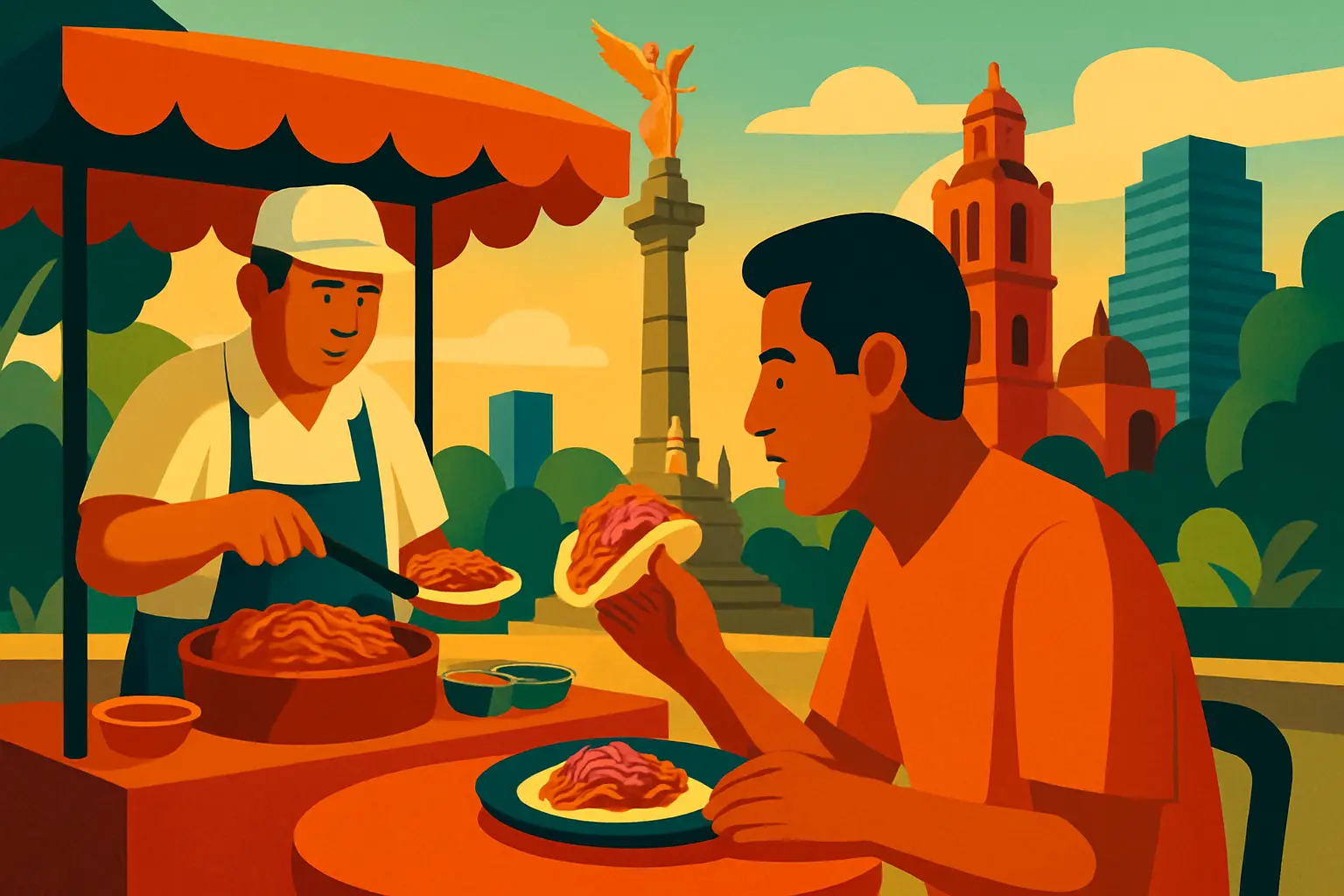
El Turix at Emilio Castelar 212 in Polanco occupies a genuinely unusual position in Mexico City's food landscape. Polanco is the city's most expensive, most European-feeling neighborhood — wide tree-lined avenues, luxury hotels, restaurants where a dinner for two runs 2,500 pesos. El Turix is a small, bare taqueria counter with a hand-lettered price board, and it is busier on a Saturday morning than almost anything else in the neighborhood. The family that runs it is originally from Yucatan, and the spot has been operating since the 1980s. Achiote paste is made from scratch using whole annatto seeds. The pork — shoulder and ribs — marinates overnight and is wrapped in fresh banana leaves that arrive from outside the city regularly. Tacos are the foundation order: two or three small corn tortillas, a generous heap of pulled cochinita, and the banana leaf cooking juices poured over. Panuchos are the second thing to order — a Yucatecan specialty where a small corn tortilla is fried, stuffed inside with refried black beans, and topped with cochinita, pickled onions, and avocado. The bean layer inside the fried tortilla creates a structural base that keeps it from going soggy under the juices, and the textural contrast between the crunchy shell and the tender pork is one of the best things available in CDMX on a weekend morning. El Turix is closed Monday through Wednesday. On Sunday, arrive before 10 a.m. When the cochinita runs out, a sign goes up and the taqueria closes for the day.
Emilio Castelar 212, Polanco — closed Mon–Wed, open Thu–Sun until sold out
Order both tacos and panuchos — the fried bean-stuffed base changes the texture entirely, not just the volume
Sunday is the busiest day and the earliest to sell out; Saturday 8:30–10 a.m. is the optimal window
Los Cocuyos on Calle Aranda 14 in Centro Historico is better known for suadero and campechano — Mexico City's native late-night comal tradition, explored in depth in the Mexico City taco guide — but it runs cochinita as part of its overnight spread, operating roughly 6 p.m. to 6 a.m. (closed Sunday). Eating cochinita at 2 a.m. in Centro is a specific experience: the bright banana leaf juices against the heavy comal fat, the four-stool counter, a crowd of market workers and taxi drivers on break. The flavor profile is different from El Turix's morning version — not better or worse, but shaped by context. For daytime options, Mercado de San Juan near Metro Salto del Agua in Centro Historico has Yucatecan food stalls toward the back that open around 9 a.m. — the same market covered in the Mercado de San Juan guide. The cochinita here is legitimately good and costs 20 to 30 percent less than at dedicated restaurants. For a slower, sit-down version, several established Yucatecan restaurants in Roma Norte and Polanco serve cochinita as a plated dish alongside rice and black beans — useful for groups or first-timers who want the full regional context without the taqueria counter format.
Los Cocuyos: Calle Aranda 14, Centro Historico — late night (6 p.m.–6 a.m.), cochinita alongside suadero and campechano
Mercado de San Juan: Yucatecan stalls open around 9 a.m., lower prices than dedicated restaurants
Sit-down Yucatecan restaurants in Roma Norte and Polanco serve cochinita as a plated dish — good for context and groups
If you find a good cochinita spot, the menu around it rewards attention. Poc chuc is thin-cut pork steak marinated in the same sour orange base as cochinita, then grilled fast over high heat and served with pickled onions and refried black beans on the side. It has none of the fall-apart texture of cochinita — it's chewy and charred at the edges — but the citrus-and-achiote flavor profile creates a natural companion order. Salbutes are the lighter counterpart to panuchos: a puffed, unfried corn tortilla topped with shredded turkey or chicken, shredded lettuce, sliced tomato, avocado, and pickled onions. The texture is softer and airier than a panucho's crunchy fried base, and a plate of two salbutes alongside two panuchos is the standard way to sample the full range of what a Yucatecan spot does. Queso relleno — a Dutch Edam cheese wheel hollowed out and filled with seasoned ground meat, then baked or poached — appears on menus at larger Yucatecan restaurants in CDMX and is worth trying if you see it. Yucatan was a major importer of Dutch Edam during the colonial period (via the Gulf trade routes), and queso relleno is one of the odder and more delicious artifacts of that commercial history.
The pickled onions are not a garnish. In Yucatecan food culture, cebolla curtida — thinly sliced red onion macerated in sour orange juice, salt, and usually sliced habanero — is as structurally essential to cochinita pibil as salsa verde is to tacos al pastor. The acid from the sour orange breaks down the raw onion's sharpness and concentrates a floral brightness that cuts directly through the deep richness of the achiote pork. Without them, cochinita pibil is great but flat. With them, the whole dish has a counterweight that makes every bite more precise. A well-made batch turns bright magenta-pink after two to four hours of maceration, which is both a visual indicator that they're correctly prepared and the reason Yucatecan food photographs so distinctively. The habanero slices embedded in the jar add fruity, delayed heat — you may not notice it for fifteen to twenty seconds after eating, then it arrives. At El Turix, cebollas curtidas are offered automatically and made correctly. At market stalls and smaller spots, they're sometimes optional or omitted entirely. If they don't appear on your tray, ask: '¿Tiene cebolla morada?' — literally 'do you have purple onion?' — is the phrase. If the spot doesn't have them, that is a meaningful data point about how seriously they take the dish.
Bright magenta-pink color means the onions were macerated long enough — pale pink means they weren't
Ask '¿Tiene cebolla morada?' at any spot that doesn't offer pickled onions automatically
Habanero heat in the onion mix is delayed — it arrives 15 to 20 seconds after eating and then peaks fast
The weekly schedule is strict, and planning around it is the difference between eating cochinita and missing it entirely. Most serious CDMX spots operate Thursday or Friday through Sunday only — the preparation requires at minimum twelve hours of marinating and three to four hours of slow cooking, making a daily operation economically impossible at the scale of a small taqueria. Spots that list cochinita every day of the week are typically reheating pre-cooked product or working in much smaller batches than the real thing requires. Price guide: tacos at El Turix run approximately 35 to 50 pesos each; panuchos and salbutes slightly more. Mercado de San Juan stalls: 25 to 40 pesos per taco. Sit-down Yucatecan restaurants: 90 to 160 pesos for a plate. Budget in USD, cochinita tacos at a taqueria cost roughly $1.75 to $2.50 per taco — in Polanco, one of the most expensive zip codes in Latin America. When El Turix runs out, a handwritten sign goes up on the counter and the spot closes without ceremony. There is no second batch, no estimated wait, no rain check. The correct response is to arrive earlier next week. The Mercado de San Juan stalls and Los Cocuyos run later into the day and night respectively, so if you miss the morning window at El Turix, options remain — just at a different register of the experience.
Is it spicy? The dish itself is not — achiote and sour orange are earthy and floral, not hot. All of the heat comes from the pickled habanero in the cebollas curtidas and from any accompanying habanero salsa. Habanero is Mexico's most fragrant and intense common chile: if you're capsaicin-sensitive, ask for the onions without habanero ('sin habanero') and the salsa on the side, and taste before committing. Getting to El Turix: Metro Line 7 to Polanco station, exit toward Emilio Castelar and walk south about five minutes to the corner of Emilio Castelar and Julio Verne. Several Ecobici stations are within a two-minute ride. For the Polanco neighborhood as a whole, the area rewards a longer morning — good coffee shops and bakeries line Presidente Masaryk a few blocks north. Getting to Los Cocuyos: Metro Lines 1, 3, or 8 to Salto del Agua, then walk north along Eje Central to Calle Aranda. What if you don't eat pork? Cochinita pibil is definitively a pork dish, and no widely available non-pork version exists at dedicated taquerias. Most Yucatecan spots will have poc chuc (also pork) and occasionally a chicken variant. If pork isn't an option, the Yucatecan menu offers very little — this is genuinely one situation where a different cuisine is the better call.
Habanero heat is delayed — give it 20 seconds before deciding to add more salsa
El Turix: Metro Line 7 to Polanco, walk south on Emilio Castelar — corner of Emilio Castelar and Julio Verne
No pork substitute exists in the cochinita tradition — a Yucatecan spot is the wrong stop for a pork-free eater