Mexico City is not where tacos were invented — the taco predates the city's Spanish foundations by centuries. But CDMX is where the form became obsessive. The city is home to the only taco style that originated here (suadero), the most concentrated collection of regional styles from across Mexico, and a specific comal culture that exists almost nowhere else in the country. In most of Mexico, a taqueria has a charcoal grill or a flat iron griddle. In Mexico City, the dominant instrument is a massive concave comal — shaped like a shallow bowl — filled with rendered lard and accumulated drippings from every meat that has cooked in it that day. Suadero, longaniza, nana, riñon, tripa: everything goes into the same fat bath, absorbing each other's flavor over hours of cooking. That shared fat is the foundation of the CDMX taco flavor. It's why a suadero taco from a corner stand in Centro Historico tastes fundamentally different from anything you'll find in Guadalajara, Monterrey, or Los Angeles — even if the recipe is identical on paper. Understanding this one fact unlocks the rest of the guide.
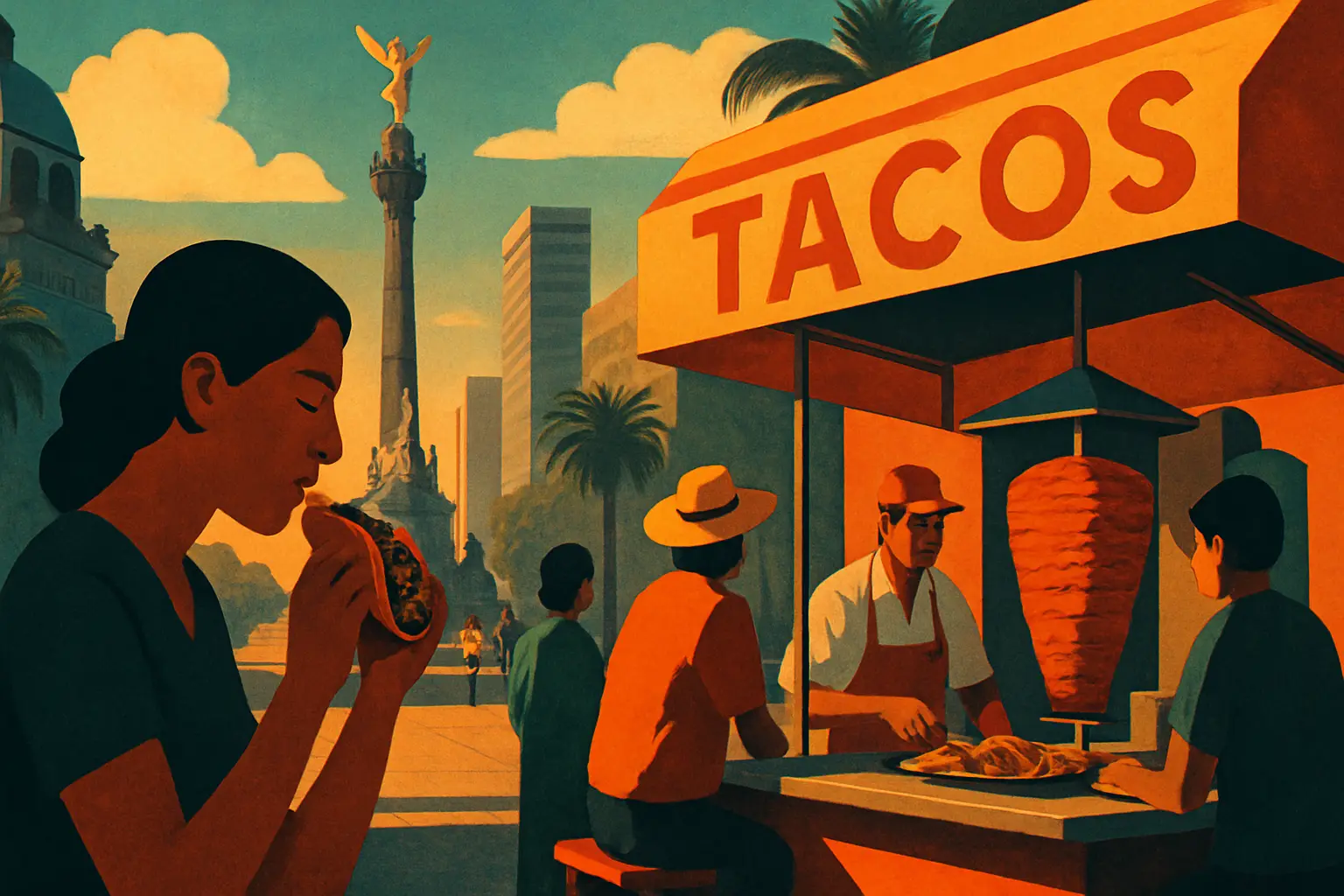
Al pastor is Mexico City's most famous taco, but its DNA is Lebanese. Syrian and Lebanese immigrants arrived in Mexico beginning in the early 1900s, settling first in Puebla and gradually in the capital, bringing with them the technique of vertical spit roasting that would eventually become the shawarma. By the 1960s, Mexican taqueros had adapted the method for pork: the meat is marinated in a mixture of achiote (a red paste from dried annatto seeds), dried chiles like guajillo and chipotle, orange juice, vinegar, and oregano, then stacked in thin layers onto a rotating metal spit called the trompo (literally 'spinning top'). The trompo cooks slowly in front of an open flame, and the taquero shaves thin slices directly into a waiting tortilla, cutting a sliver of pineapple from the top of the stack in the same motion. The skill is in the cut — the best taqueros shave the meat without stopping and catch it on the tortilla without letting it hit the counter. El Huequito on Calle Lopez 21, near Metro Salto del Agua in Centro Historico, has been operating since 1959 and is widely cited as the oldest al pastor spot in the city. For late-night al pastor, El Vilsito at Peten 248 in Narvarte is obligatory: it operates as a PEMEX gas station by day and transforms into one of the city's best taquerias after 9 p.m., running until around 4 a.m. Go after 10 p.m. when the trompo is at full speed.
Get short, interactive stories that make each place easier to remember while you travel.
Suadero is the only taco style that belongs to Mexico City — the specific cut, the cooking method, and the resulting texture exist almost nowhere else in the country. The cut comes from the thin membrane of beef between the skin and the muscle on the belly and lower flank, a part of the cow that most butchers elsewhere discard or process into ground meat. In Mexico City, it gets slow-cooked in the concave comal's hot fat until completely tender, then gets pushed to the hot edges of the comal to crisp just before serving. The result is simultaneously soft inside and slightly crispy at the edges, with a flavor built from the accumulated fat of hours of cooking. Los Cocuyos, at Calle Aranda 14 in Centro Historico (open from around 6 p.m. to 6 a.m., closed Sunday), is the most-cited benchmark for suadero in the city. The taqueria is small — four stools and a counter — and the menu is whatever is on the comal. Order a campechano: half suadero, half longaniza on one tortilla. The longaniza (a lightly spiced pork sausage) cuts through the richness of the suadero with something bright and fatty in a different way. It's the default order for anyone who lives near Centro, and once you've had it, you'll understand why.
Tacos de canasta operate on a completely different logic from everything else in this guide. The fillings — potato with chile, refried beans, adobo (pork slow-cooked in guajillo sauce), and chicharron in salsa verde — are made in the early morning, packed into a large cloth-lined basket (the canasta), and strapped onto a bicycle or cargo tricycle. The steam and heat trapped inside the basket slowly cooks everything together as the vendor pedals through the neighborhood, creating what locals call tacos sudados ('sweated tacos'): soft, compressed, and deeply flavored from sitting together in the enclosed heat. You'll find canasta vendors in Centro Historico and working-class neighborhoods like Doctores and Tepito between 7 a.m. and 11 a.m. — you'll hear them before you see them, calling 'canasta, canasta' as they pedal. They don't stop for long. The correct approach is to intercept them, tell them how many of each filling you want, and hand over cash. The price is around 15 to 20 pesos per taco. The correct number to order is three. Adobo is the best filling; potato with chile is the most popular. These tacos do not photograph well and taste better than anything that does.
A guisado (literally 'stew' or 'braised dish') is a prepared home-cooking dish served from a large clay pot, ladled onto a handmade corn tortilla. The selection at a good guisado spot rotates daily depending on what the cook prepared that morning, and serious spots carry eight to twelve options arranged in pots behind a glass display: rajas con crema (roasted poblano strips with heavy cream), tinga de pollo (shredded chicken braised in chipotle and tomato), picadillo (ground beef with potato, carrot, and chiles), calabacitas con queso (zucchini with fresh cheese), and nopales (cactus paddles cooked with tomato and serrano). You pick two or three fillings, they go on one tortilla, and a crumble of fresh cheese and salsa go on top. The tortilla matters here more than in any other taco style — handmade and warm, pressed that morning, not the packaged kind. Mercado de Medellin in Roma Sur has a solid guisado corridor along the back wall that runs from 9 a.m. to 3 p.m. Mercado Jamaica in Iztacalco has arguably the widest daily selection in the city. Both are worth building a morning around.
Centro Historico is the single best taco neighborhood in the city for density and variety. Los Cocuyos (suadero, Calle Aranda 14) and El Huequito (al pastor, Calle Lopez 21) are within a 10-minute walk of each other. Canasta vendors circle the blocks near Plaza Garibaldi and along Eje Central from 7 to 11 a.m. For everything else going on in the neighborhood, the Centro Historico guide is worth reading. Roma Norte and Condesa skew toward sit-down options: El Tizoncito at Tamaulipas 67 in Condesa claims to have invented tacos al pastor and offers a reliable version with a full dining room; El Pescadito on Culiacán 100 in Roma Norte serves fish and shrimp tacos that have a devoted local following. Narvarte has El Vilsito (Peten 248) for late-night al pastor — go after 10 p.m. Coyoacán is the destination for weekend barbacoa: vendors set up near Mercado de Coyoacan early Saturday and Sunday morning with lamb slow-cooked overnight in underground pits, served with consomme on the side. Barbacoa is a weekend-only tradition across the city — you won't find it on a Wednesday.
Most street taquerias have no written menu. Walk up, look at what's on the comal or behind the counter, and name what you want. Point if you don't have the word — taqueros are entirely accustomed to it. The vocabulary that actually matters: con todo means 'with everything' (cilantro, diced white onion, and salsa of your choice); sin cebolla means no onion; sólo con salsa means just salsa, no toppings. When there are two salsas — one red, one green — try the green first, then the red, then decide which to pour more of. Most comal taquerias are cash only; 50 and 100 peso bills are standard, and the taquero will have change. If asked '¿doble o sencilla?', they're asking whether you want your taco on one tortilla or two stacked — always say doble (double) when eating standing up, since a single tortilla breaks under the weight of suadero. Finally: eat where you see locals eating. A line of three people at a street corner at 1 p.m. is a more reliable recommendation than any review. The best tacos in Mexico City are not on Instagram.
Is street food safe? High-volume street tacos are as safe as any restaurant — and often safer. The key indicator is turnover: a taquero who has worked that corner for fifteen years and serves a hundred people a day has better food safety practices (even if informal) than many sit-down kitchens. Avoid slow vendors with food that has been sitting; high turnover means fresh product. Stick to spots where you can see meat being cooked in front of you. How much do tacos cost? Street tacos run 20 to 35 pesos each (roughly $1 to $1.75 USD) depending on the filling and neighborhood. Canasta tacos are cheaper at 15 to 20 pesos. Tacos in Roma Norte and Condesa at sit-down taquerias run 40 to 60 pesos. What is the best time of day? Al pastor is good from noon onward and exceptional late night. Canasta tacos exist only from 7 to 11 a.m. Barbacoa and carnitas are Saturday and Sunday morning traditions — most vendors sell out by noon. Guisado spots peak between 10 a.m. and 2 p.m. before the stews run low. The city's food culture has always been tied to the cantina tradition of eating at specific hours — tacos follow the same rhythm.