1. The butterfly shape — and what it means for how you explore
The name Astypalaia comes from ancient Greek, but the island's visual identity is defined by its geography: two lobes of land — the western Mesa Nisi (inner island) and the eastern Exo Nisi (outer island) — connected by a land bridge barely 100 meters wide at its narrowest point. Seen from above, the island traces the silhouette of a butterfly. This shape is not just an interesting fact; it determines how the island works.
The western half holds Chora, the port of Agios Andreas, the main beaches, and the vast majority of accommodation and restaurants. The eastern half is quieter, flatter, and reached by a single road that winds 8 km along exposed coastline. The village of Analipsi — locally called Maltezana, after the Maltese pirates who used its broad bay as a landing point — sits at the eastern tip and operates on a different register: fewer tourists, a wider sandy beach, and Roman bath ruins with mosaic floors still partially intact.
For anyone spending more than two days on Astypalaia, both halves are worth the time. Most visitors who stay only in Chora see perhaps half the island.
2. Chora and the Venetian Kastro of the Querini family
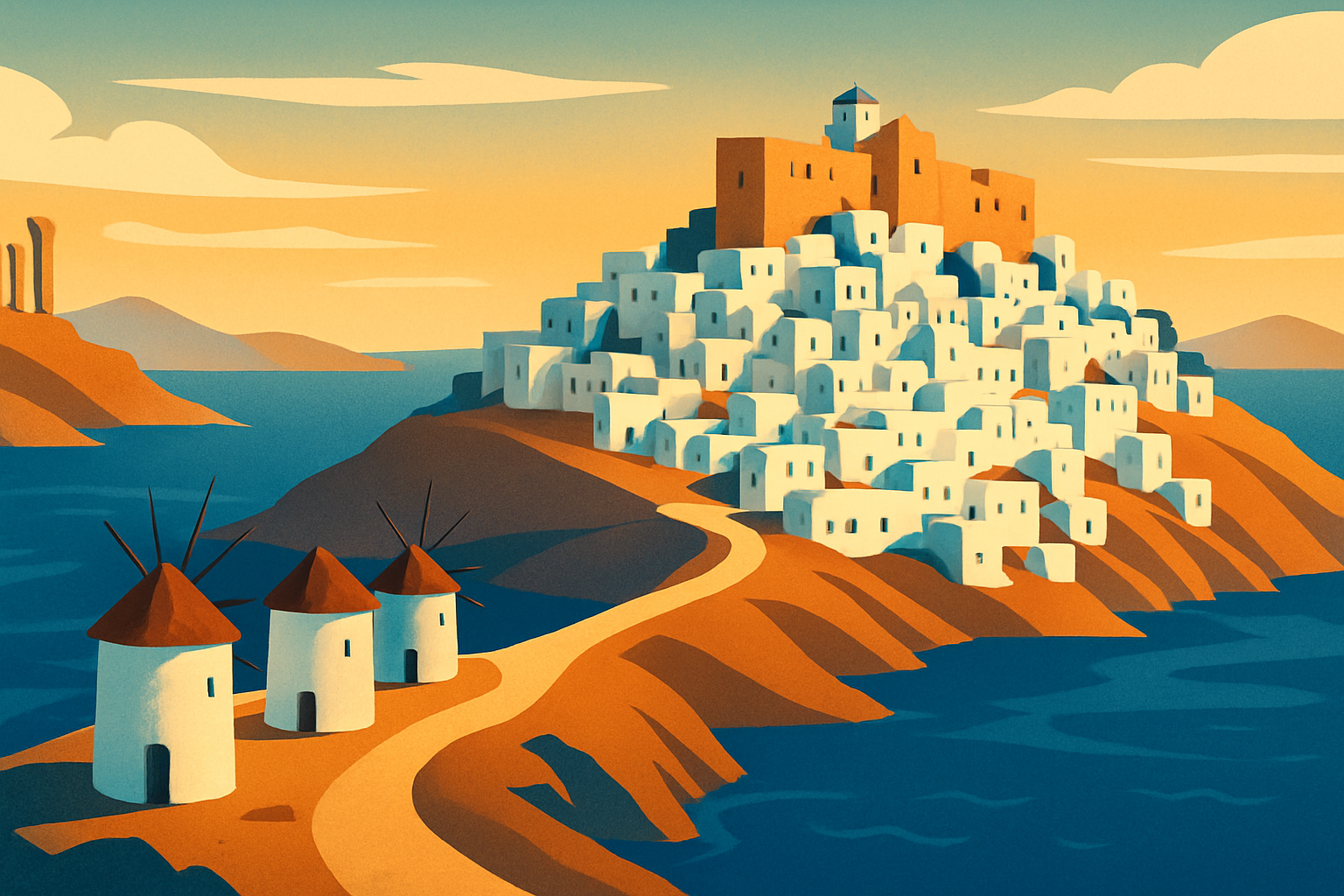
Chora is the island's capital, draped across a rocky promontory between two bays. It is one of the most architecturally coherent towns in the Aegean: cubic whitewashed houses stacked in tight terraces, narrow pedestrian lanes, blue-framed windows, and wooden balconies in faded pastels. Everything leads upward to the castle.
The Kastro of Astypalaia was built in the 13th century by the Querini family, a Venetian dynasty that controlled the island for over three centuries. Its thick stone walls were designed to shelter the entire island population during pirate raids — at full capacity the castle could house up to 4,000 people inside its walls. Today the interior holds two small churches: the Church of Panagia Portaitissa (Our Lady of the Gate) and the Church of Agios Georgios, whose blue dome is visible from the windmill ridge below.
The castle is free to enter and open until sunset. The best approach is through the main gate on the upper lane of Chora, a ten-minute walk from Plateia Exochis, the main square below. The views from the ramparts take in both bays of Chora, the whitewashed terraces of the town below, and the windmill ridge to the east. In late afternoon the stone walls go amber. Allow at least an hour for the castle and the terraces directly below it.
3. The eight windmills and what they actually ground
Below the castle on the eastern ridge of the Chora promontory, eight restored whitewashed windmills stand in a line. They are the defining image of Astypalaia — reproduced on every tourist postcard — and in person they earn the cliché. The whitewash is blinding in direct sun. At golden hour it turns warm yellow. At dawn the light catches both the towers and the blue dome of Agios Georgios behind them in one continuous composition.
The windmills were built in the late 18th and early 19th centuries to mill wheat and barley — the staple grains of an island economy that could not rely on regular mainland supply. They operated until the 20th century's population decline made them uneconomical. Most have been restored and are viewable from outside; one holds a small display about the island's milling history.
The windmill lane branches right from the main path between Plateia Exochis and the castle gate. Walk the full length to where the ridge ends at a small terrace with a bench and a clear view down to the port and to the narrow beach at Pera Yalos — the swimming spot directly below the castle rock, reachable by a short stepped descent from the lower town.
4. Beaches: Agios Konstantinos, Livadi, Vathy, and the coves by boat
The island's best beach is Agios Konstantinos, a stretch of fine shingle on the western shore of Mesa Nisi about 8 km from Chora. The water is clear even by Aegean standards — turquoise at the shoreline fading to deep blue — and the bay faces west, which makes it excellent for late-afternoon swimming. A small beach bar operates June through September.
Livadi, 2 km south of Chora by a flat road, is the most accessible: a long beach lined with tamarisk trees, sunbed rentals, two tavernas, and calm water that suits families and less confident swimmers. The beach at Pera Yalos directly below the castle is the most dramatic — the Venetian walls loom overhead and the ferry port is visible to the east — but the beach itself is narrow and stony.
Vathy, on the north coast of Mesa Nisi, requires a 21-km drive on a road that turns unpaved in sections. The reward is a sheltered bay less than 50 meters wide, enclosed by steep hills that drop directly to the water, with a single taverna at the far end. It is unlike anywhere else on the island — silent on weekday mornings, with water too calm for waves.
The uninhabited islets immediately south of Astypalaia — Koutsomyti and Kounoupoi — are reachable by daily boat trips from Chora port. Both trips include sea cave swimming and snorkeling stops. The caves on Koutsomyti's southern face have underwater light conditions that turn the water an unusual violet-blue in mid-morning. Tickets are sold at the port kiosk each morning.
5. Maltezana (Analipsi) — where Maltese pirates landed, and the Roman mosaics they did not destroy
The village of Analipsi on the eastern lobe of the island is almost universally called Maltezana — named for the Maltese pirates who used its broad, calm bay as a regular landing point during the island's most turbulent centuries. The official name changed; the nickname did not. Maltezana sits 8 km from Chora across the isthmus, and it has a different feel: lower, quieter, with a taverna-lined waterfront and a beach that is wider and sandier than most of the western options.
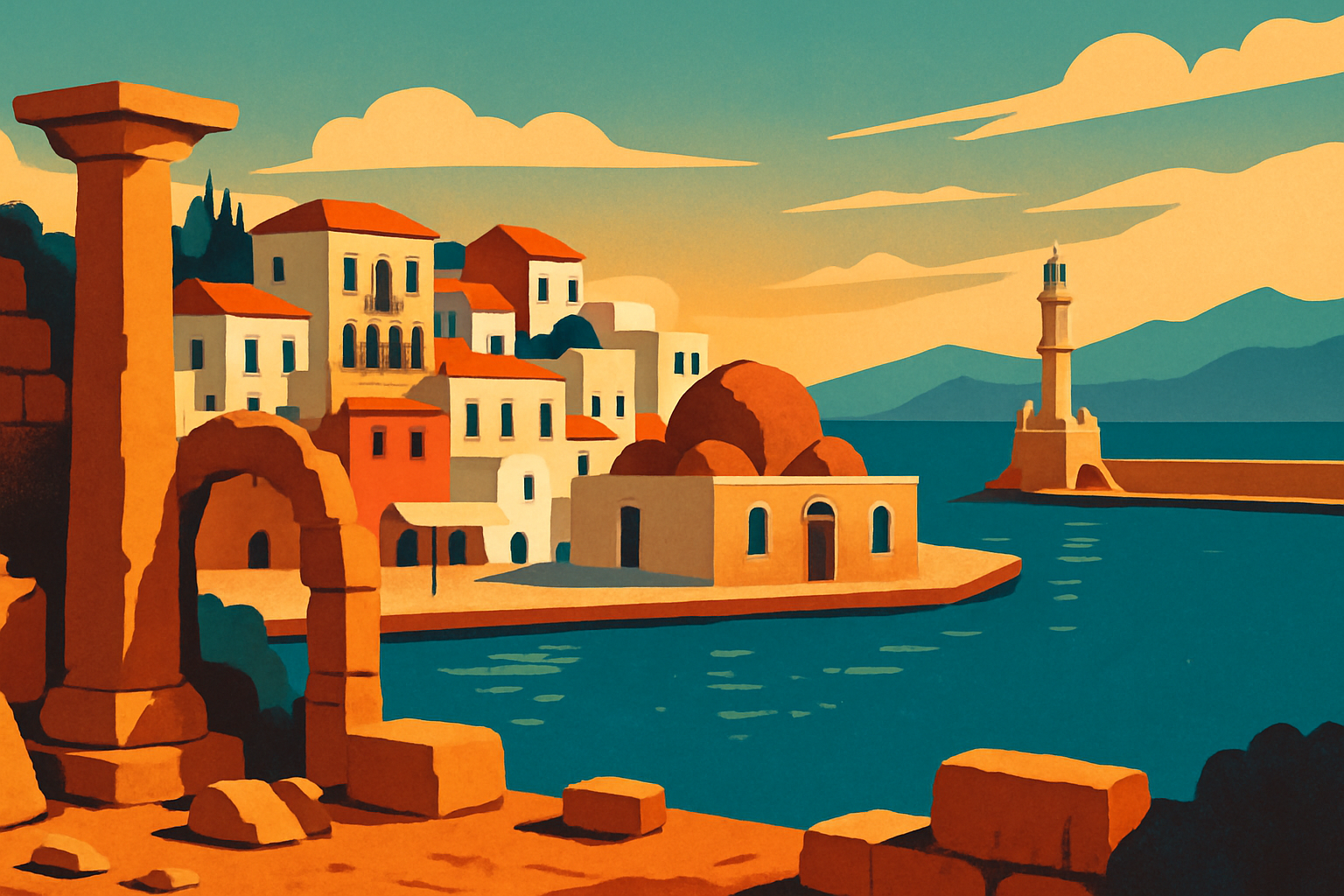
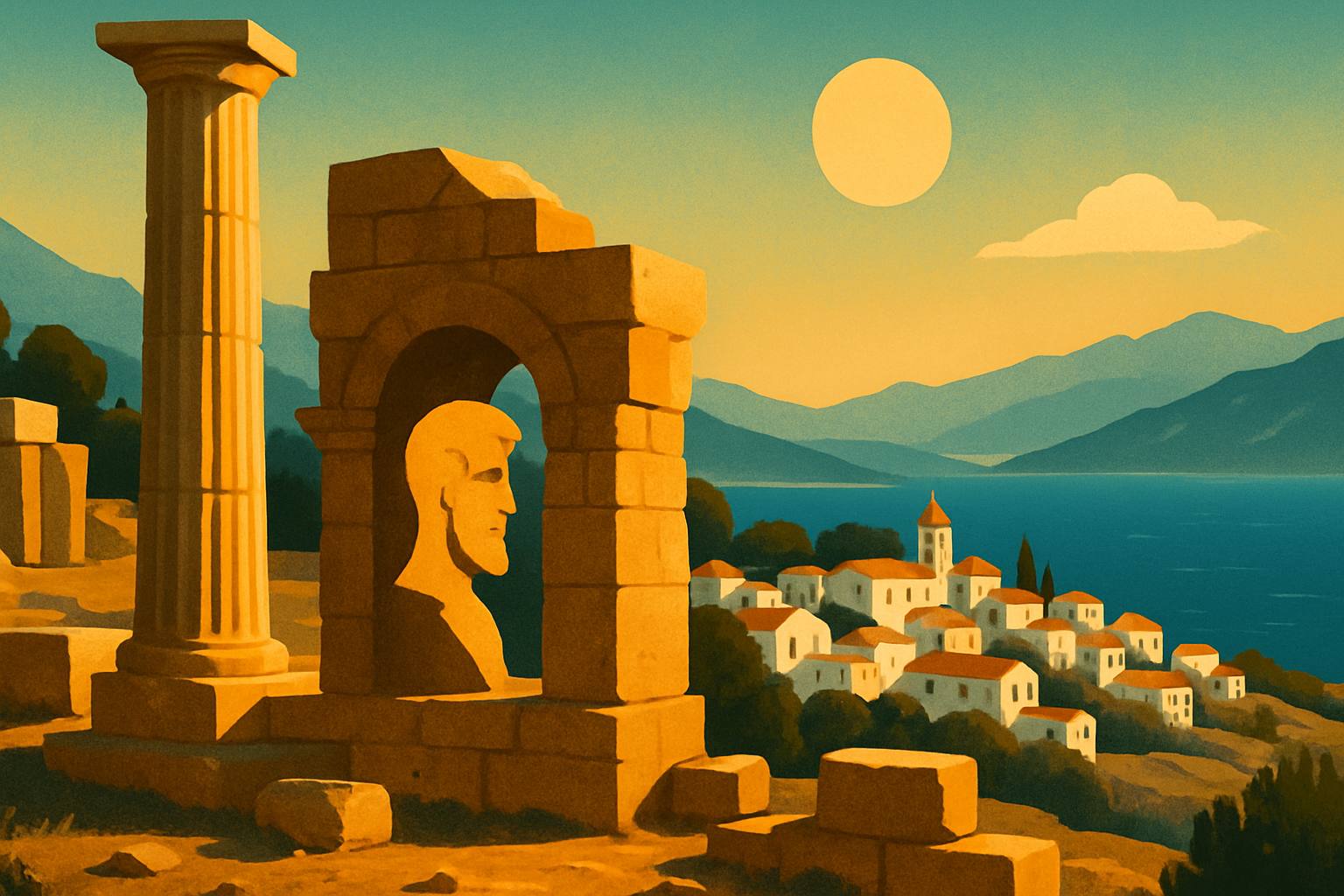
On the outskirts of the village, within walking distance of the beach, are the remains of Roman baths dating to the 4th or 5th century CE. The baths preserve fragments of original mosaic floors — geometric patterns, a fish, what may be a dolphin — protected under a simple shelter. They are not a major site in the museum sense, but the existence of a functioning heated Roman bath complex on this remote edge of the Aegean is a specific kind of interesting: even Astypalaia was integrated into Mediterranean trade and administration during the imperial period, not merely a place people occasionally shipwrecked on.
The Astypalaia Archaeological Museum in Chora holds finds from the island's prehistoric, Archaic, and Roman periods, including evidence of its role as a stop on Aegean trade routes long before the Venetians arrived. It is small and worth an hour.
6. What to eat on Astypalaia: poungia, kopanisti, and lobster pasta
Astypalaia's food tradition was shaped by centuries of relative isolation from the mainland supply chain. The island's signature dish is poungia — small pastry parcels filled with kopanisti cheese and local honey, then baked or lightly fried. The combination sounds unusual: kopanisti is a peppery, funky curd cheese made from goat's and sheep's milk, aged in ceramic crocks, closer in profile to a mild blue than to feta. Combined with honey, the heat from the cheese and the sweetness of the honey balance in a way that works immediately. Every bakery in Chora makes them; eat them warm.
Kopanisti itself appears at virtually every taverna as part of the opening mezedes — spread on bread alongside olives and a glass of cold house wine. If you have been eating feta across Greece for a week, the first bite of kopanisti registers as a genuinely different food.
For seafood, Astypalaia's position between the Cyclades and the Dodecanese means the fishing is consistently good. Astakos — fresh spiny lobster — is available at the waterfront tavernas in Chora and Maltezana from June through September. The standard preparation is spaghetti me astako: lobster halved and cooked with garlic, white wine, and tomato into a sauce tossed with thick spaghetti. A full portion runs €35–50, which is not cheap — but lobster this fresh, this far from a major port, is a different experience from the same dish served in Piraeus or Monastiraki.
For dinner in Chora, the tavernas facing Pera Yalos bay on the lower steps of the town, particularly those with outdoor terraces that catch the evening sea breeze, are the most reliable. Arrive after 9 p.m.
7. How to get to Astypalaia from Athens
By ferry: Blue Star Ferries operates from Piraeus to Astypalaia's port of Agios Andreas roughly five times a week in summer. The crossing takes 10–11 hours depending on intermediate stops; ferries depart Piraeus in the early evening and arrive at dawn. A standard deck ticket costs from €38; a two-berth cabin adds €30–45. Book cabins at least two weeks ahead in July and August. From Athens, take Metro Line 1 (Green line) from Monastiraki or Omonia to Piraeus — the ride takes about 20 minutes.
By plane: Olympic Air and Sky Express operate direct flights from Athens International Airport (Eleftherios Venizelos) to Astypalaia's small airport on the western part of the island. The flight takes approximately 50 minutes. Tickets range from €60–130 depending on lead time. The airport handles small turboprop aircraft and enforces luggage limits strictly. A taxi from the airport to Chora takes about 10 minutes and costs approximately €15.
Combining with other islands: Astypalaia sits between the Cyclades and the Dodecanese, making it a natural junction on a broader island circuit. Blue Star ferries on the Piraeus–Dodecanese route call at Astypalaia before continuing toward Kos and Rhodes. If you are combining Astypalaia with Naxos or Milos, check the seasonal Cyclades connections that run in summer months via smaller operators — the ferry schedules make an island-hopping loop possible without returning to Athens.
8. Astypalaia vs Paros, Milos, and Folegandros: the honest comparison
Compared to Paros: Paros is easier to reach, has better nightlife, and offers a wider range of restaurants. Astypalaia is quieter, cheaper in every category, and has a coherence of character that Paros has partly lost to mass tourism. If you want beach clubs and a full social scene, Paros wins without contest. If you want the Cycladic aesthetic — whitewash, castle, windmills, a main square where life slows down — without the Cycladic crowds and prices, Astypalaia is the answer.
Compared to Milos: Milos has more dramatic landscapes and more famous beaches (Sarakiniko, Kleftiko). Astypalaia has the castle, the windmills, and a historical center that Milos lacks. Both are valid choices for travelers avoiding the Mykonos–Santorini axis.
Compared to Folegandros: Folegandros is the closest comparison — both are small, un-overrun, and built around a clifftop chora above the sea. Folegandros has steeper cliffs and a wilder landscape. Astypalaia has the Venetian castle, more beaches accessible by car, the pirate history that gives Maltezana its name, and the Roman mosaic floors. Both are islands where the historical substance matches the scenery.
The honest verdict: Astypalaia is the right island for travelers who want to see Greece working the way it worked twenty or thirty years ago in more famous destinations — before the luxury hotels and the English-only menus. It is not undiscovered; it is just not yet overrun. June is the ideal month: the water is warm (23–24°C), the island is at full summer operation, and the evening temperatures make dinner on an outdoor terrace until midnight effortless.