Folegandros sits in the southern Cyclades between Milos (the island with the famous white rock formations and the Venus de Milo's origin story) and the rarely visited Sikinos. Its name likely comes from Phoenician for 'rocky island' — an apt description for terrain that rises sharply from the Aegean with very little flat land and almost no natural harbor.
The island was used as a place of exile in antiquity. Augustus reportedly banished people here, which gives you a sense of how remote it felt before modern ferries. The permanent population across the island's three settlements — Karavostasi (the port on the south coast), Chora (the clifftop capital), and Ano Meria (a farming settlement spread across the northwestern plateau) — sits under 800 people in winter.
In summer the island swells with visitors who have figured out what Folegandros represents: a Cycladic island that looks the way the Cyclades looked before mass tourism arrived. Chora is genuinely beautiful in the way older Cycladic capitals are — whitewashed, car-free, built for residents rather than visitors — without the souvenir-shop saturation that has overtaken Fira and Little Venice. The beaches require real effort to reach, which filters the crowd naturally. The food is local. June 2026 is the right moment: ferry schedules are full, the tavernas are open, and the late-summer peak hasn't yet arrived.
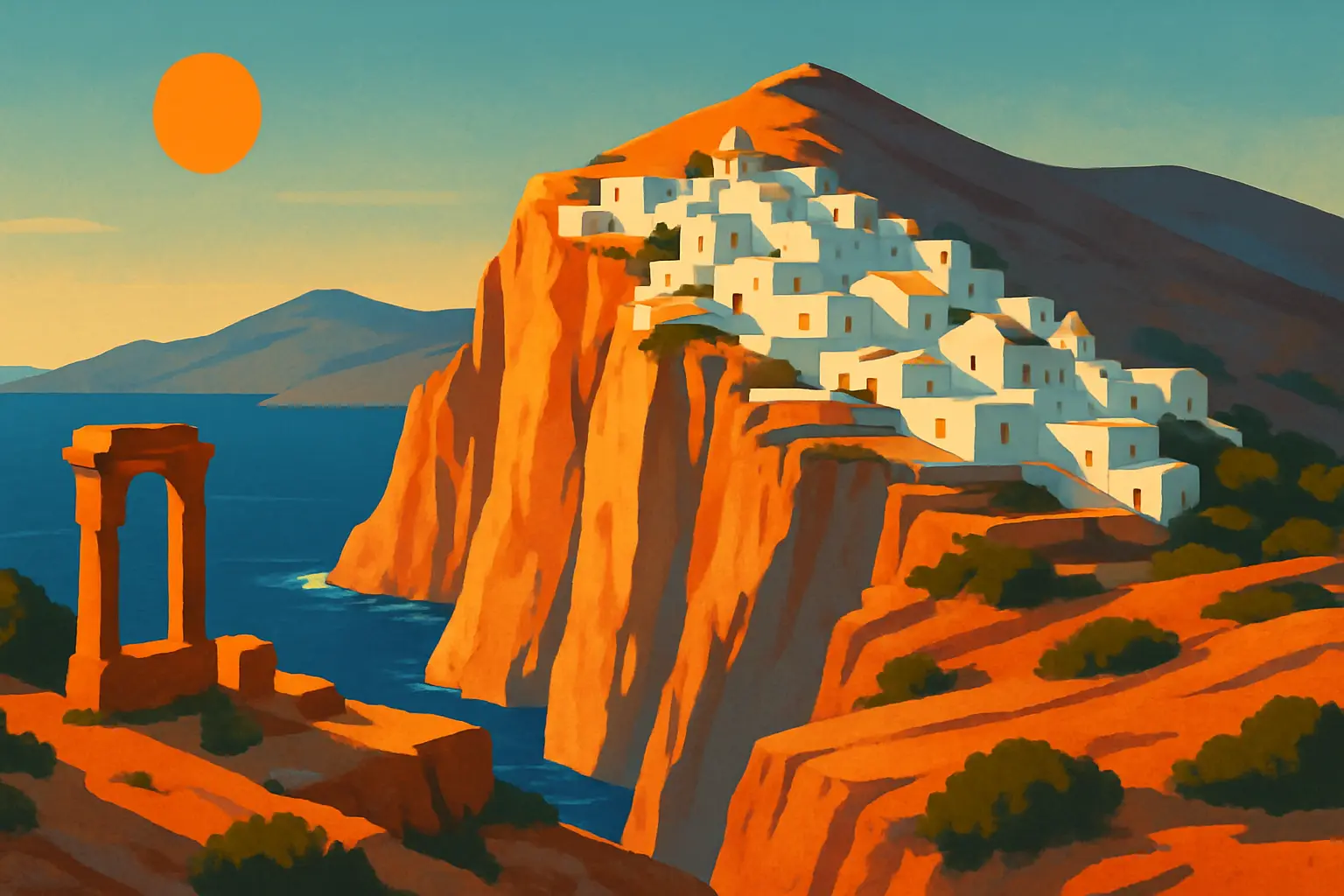
Chora stands at the edge of a cliff roughly 200 meters above the Aegean — high enough that the views from the village's outer edges look directly down to the water. The village is organized around a sequence of whitewashed alleys connecting small squares where cafe tables fill the open space and the only traffic is pedestrians.
The oldest quarter is the Kastro — a medieval fortification built during the Venetian period, probably the 13th century, when Aegean piracy was a genuine operational threat to every Cycladic island. The defensive logic was architectural: the outer walls of residential houses were built flush and continuous, presenting no entry point to raiders approaching from the sea. The houses are two stories, whitewashed, with upper floors projecting slightly over the cliff face. Walking the Kastro alleys, you pass doorways with carved stone lintels and windows that look out over a sheer drop to the sea below.
Chora beyond the Kastro runs through three connected squares — Plateia Pounda (where the bus stops), Plateia Kontarini, and Plateia Dounta — linked by narrow lanes where bougainvillea covers walls and the pace slows to an island tempo. The squares are where life organizes itself in the evening: tables extend into the open space, the light softens, and the Cycladic village atmosphere the more famous islands have largely lost is simply present here.
Cars are banned inside Chora. Free parking sits in designated lots just outside the village entrance. Once inside, nothing is more than a ten-minute walk.
Get short, interactive stories that make each place easier to remember while you travel.
Above Chora, reached by a zigzag stone path from Plateia Pounda, stands the Church of Panagia — a one-aisle basilica topped with multiple domes and a tall bell tower, its wide stone courtyard looking out over an unobstructed Aegean horizon. The walk from the square takes about 15 minutes at a relaxed pace, ascending through terrain that shifts from village stone to open limestone as you climb.
The church is photographed from below so often that arriving at it in person can feel disorienting — you've seen the image without its scale, without the texture of the courtyard's paving stones, without the wind off the water at that elevation. The interior is small and austere, as Cycladic churches typically are: wooden benches, an iconostasis, hanging oil lamps. The exterior and the view from the courtyard are the point.
Go at sunset. The light on white walls at golden hour on Folegandros is not a travel cliche — it is what the island actually looks like. The zigzag path from Pounda is well-maintained and requires no special footwear.
On August 15th — the feast of the Assumption of the Virgin, the island's most important religious and cultural festival — the path is walked by candlelight in a nighttime procession that has taken place on this island every year for centuries. It is not a performance for tourists; it is an event the island runs for itself. If your dates overlap, it is worth staying for.
Folegandros does not have easy-access beaches. The terrain is vertical and the coastline is mainly cliff. Getting to the water requires intention, and that intention is most of the filtering mechanism keeping the island uncrowded.
Agali is the main beach, on the west coast below Chora. A local bus runs there from the village in summer, or a 45-minute walk along a dirt track. The beach is a sheltered bay with calm water, a handful of sun loungers, and two or three tavernas operating behind the sand from June through September. The water is extraordinarily clear — the Cyclades generally are, but Agali's western orientation and shallow approach give it visibility to the seabed at significant depth.
Agios Nikolaos extends from Agali along a short coastal path — about 15 minutes of easy walking along the rocky shoreline. Less organized (no sun loungers, no bar), more rewarding if you want a stretch of water mostly to yourself.
Katergo is the reason to book the boat trip. A double beach on the southeastern tip of the island, divided by a narrow rock ridge, with water that reads turquoise from the boat and deep blue at the center. No road reaches it; the alternative to the boat is a steep, unmarked scramble across rough terrain that most visitors don't attempt. Boat trips depart from Karavostasi port multiple times daily from June through September, cost approximately €10–15 return, and take about 20 minutes. The boat waits at Katergo for 2–3 hours of swimming — note the last departure time before you get in the water.
Folegandros has its own food culture, which is unusual for a small island that could easily default to generic Greek taverna menus.
Matsata is the island's signature dish: thick handmade pasta similar to tagliatelle — the name comes from 'maza,' a flour-water mixture — served with a slow-cooked rabbit ragout. The pasta is made fresh, the rabbit is local, and the preparation varies by household. It reads as Cycladic comfort food rather than a restaurant dish, which is why the best versions come from family kitchens.
Souroto is the island's local fresh cheese — slightly sharp, crumbled over salads or served alongside vegetables. It appears in sourotenia, a savory pie using souroto as the filling. Kalasouna is a cheese-and-herb pastry that appears in Ano Meria kitchens and the island's traditional bakeries. Tomatokeftedes — crispy fried tomato fritters — round out the local snack repertoire alongside chickpeas that appear on nearly every traditional menu.
Where to eat in Chora:
- To Spitiko on a side street near Plateia Pounda: a family kitchen serving chickpeas, matsata, kalasouna, and daily specials. Bulk wine by the carafe. Correct prices. The first recommendation from anyone who has been to Folegandros more than once.
- Piatsa on Plateia Pounda: mezedes at outdoor tables directly on the main square, good for a long lunch with cold white wine.
- Eva's Garden on a quiet Chora lane: garden setting with string lights and bougainvillea, elevated approach to local ingredients. The right choice for a deliberate evening meal.
For the most local experience on the island, drive to Ano Meria — about 5 km from Chora — and find Kafepantopoleio tis Irinis: a tiny grocery store with tables in back where Kyria Eirini serves homemade dishes from whatever she has available that day. The only restaurant on Folegandros that operates year-round.
From Athens: Ferries depart from Piraeus, the main Athens port. Take Metro Line 1 (Green Line) to Piraeus station and walk to the E2 ferry terminal, roughly 10 minutes from the metro exit.
Seajets operates a high-speed catamaran that reaches Folegandros in approximately 3 hours 45 minutes at around €36 for a standard seat. Book online 2–3 weeks in advance for July and August travel. Zante Ferries runs conventional ferries on the same route — 7–8.5 hours, overnight options available, considerably cheaper.
Ferries arrive at Karavostasi on the south coast. A local bus meets every ferry arrival in summer and runs the 5-minute journey up to Chora (€2). From Chora, the same bus continues north to Ano Meria about 20 minutes further.
On the island: No rental car is necessary. Chora is car-free and walkable. The bus covers Karavostasi-Chora-Ano Meria several times daily in season. Boat trips to Katergo and the coastal caves depart from the port. Agali beach is served by a summer minibus from Chora. Ano Meria is also a comfortable 30-minute walk from the north end of Chora if the bus timing doesn't work.
Folegandros connects by ferry to Paros (2.5–3 hours), Milos (1 hour 20 minutes), and Santorini (1.5–2 hours), making it a natural stop in a Cyclades island-hopping route without needing to return to Athens between islands.
How long do you need? Three nights is the practical minimum: one day for Chora and the Church of Panagia walk, one day for Agali and Katergo, one day for Ano Meria and a long lunch at Kyria Eirini's. Four nights allows you to slow down, which is the actual point of being here.
Best time to visit Folegandros? June is the most balanced month: ferry schedules are full, all tavernas are open, water temperature is warm enough for comfortable swimming (around 23–24°C), and the island hasn't yet hit the late-July peak when accommodation books out months ahead. September is the second-best window — crowds thin, prices drop, the water retains summer temperature. July and August are busy and hot (30–35°C at midday), but the island's limited accommodation capacity provides a natural ceiling.
Will the 2026 trending status ruin it? Less than you'd expect. Folegandros has structural limits that protect it: no airport, no large hotels, limited beds overall, and beaches that require real effort. The people arriving because of travel-trend coverage are largely self-selecting for somewhere requiring more than five minutes of walking. The island has absorbed waves of attention before — it was a bucket-list destination in the 1990s and 2000s before Mykonos-style development drew attention toward flashier options — and its physical constraints prevent it from tipping past a certain threshold. The Kastro alleys will still be quiet at 7 a.m. The matsata at To Spitiko will still be homemade.