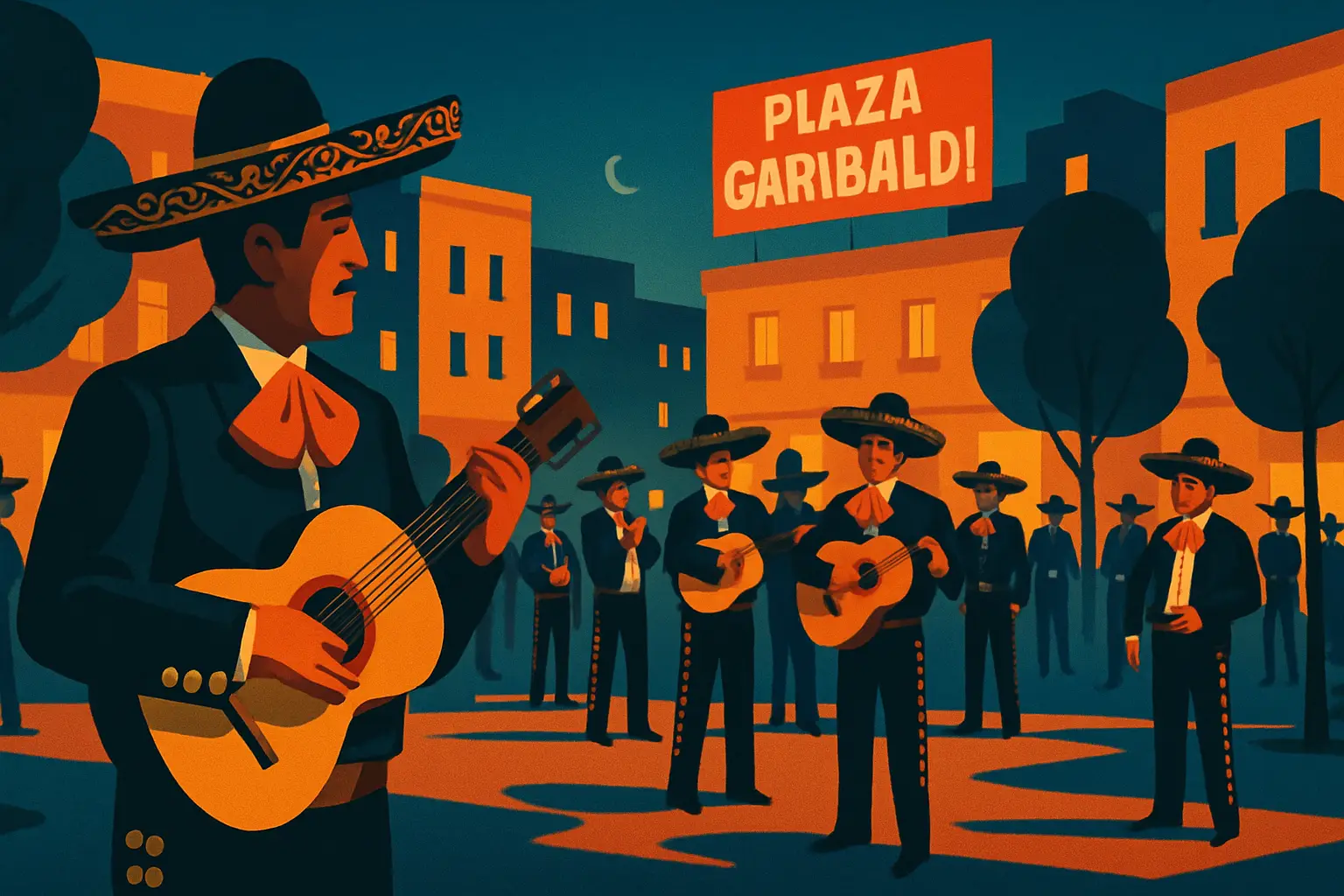
Plaza Garibaldi sits eight blocks north of the Zócalo, just past Eje Central and a short walk from the Palacio de Bellas Artes. By day it looks like a slightly tired city square. By 9 p.m. it transforms: men in tight black charro suits with silver botonadura down the seams gather on the corners, sling guitarrones over their shoulders, and wait to be hired. There can be 200 mariachis on the plaza on a busy Friday — entire orchestras of trumpets, violins, vihuelas, and that deep round bass guitar called the guitarrón. Norteño, jarocho, and marimba groups stake out the edges. It is, plainly, the densest concentration of working mariachis on earth, and it has been that way since the 1920s. If you only do one nighttime experience in Centro Histórico, this is a strong contender.
Eight blocks north of the Zócalo, two blocks east of Eje Central
Officially Plaza Garibaldi, named after Giuseppe Garibaldi II (a Mexican Revolution fighter)
Up to 200 mariachis gathering on a busy Friday night
On the north side of the plaza, behind a yellow façade with hand-painted murals of every legendary mariachi figure, sits Salón Tenampa. It opened in 1925 when a man named Juan Hernández Ibarra moved to the capital from Cocula, Jalisco — the village where mariachi as we know it was effectively invented — and started serving tequila and ranchera music to Chilangos who had never heard either. He brought the first mariachi groups up from Jalisco, paid them to play inside, and the musicians who couldn't fit indoors started playing outside on the plaza. That's literally how Garibaldi became Garibaldi. The cantina is still owned by the same family. The murals inside are a who's-who of Mexican music: José Alfredo Jiménez, Lola Beltrán, Jorge Negrete, Pedro Infante, Vicente Fernández. Order a tequila derecho (neat) with a sangrita chaser, sit at one of the wooden booths, and let a roaming mariachi find you.
Salón Tenampa, north side of the plaza — open since 1925
Founded by Juan Hernández Ibarra, who brought mariachi up from Cocula, Jalisco
Open daily until around 3 a.m.; cash and card both work
Get short, interactive stories that make each place easier to remember while you travel.
This is the part most travelers fumble. Here's the play: walk up to a mariachi standing on the plaza, make eye contact, and ask "¿Cuánto por una canción?" A standard rate in 2026 is around 150 to 250 pesos per song for a full group of 6 to 10 musicians (about US$8–14). Always agree on the price first — and confirm whether it's per song or per set. Then name the song. Classics that always land: El Rey, Cielito Lindo, La Bikina, México Lindo y Querido, or anything by José Alfredo Jiménez. The musicians will form a half-circle around you on the cobblestones and play it through, trumpets and all. Tip 20 to 50 pesos per musician on top if they nailed it. Bring small bills — nobody on the plaza wants to break a 500.
Roughly 150–250 pesos per song from a full group (US$8–14)
Always confirm the price and whether it's per song or per set
Bring small bills (50s and 100s) — change is scarce on the plaza
Tucked into the southwest corner of the plaza is MUTEM — the Museo del Tequila y el Mezcal. Most people walk right past it. They shouldn't. The ticket (around 100 pesos) includes a self-guided walk through three floors covering the agave plant, the distillation regions of Jalisco and Oaxaca, and the cultural history of both spirits. The good part: your ticket also includes a tasting at the rooftop bar with a sweeping view over the plaza. You'll usually try a blanco tequila, a reposado, and a mezcal joven — served correctly, with orange slices and worm salt rather than the lime-and-salt routine. Go before you sit down for dinner; you'll order smarter for the rest of the night.
Southwest corner of Plaza Garibaldi, easy to miss
Roughly 100 pesos for entry + a guided tasting on the rooftop
Open Tuesday–Sunday, typically 11 a.m. to about 8 p.m.
Plaza Garibaldi hits a different gear on the night of May 10 — Día de las Madres in Mexico. Families pile into the plaza after dinner, adult sons and daughters bring their mothers, and the mariachis play Las Mañanitas (the Mexican birthday and celebration song) on a loop from about 11 p.m. straight through 3 a.m. It's one of the most emotional public scenes in CDMX: dozens of small family clusters all around the plaza, each one with its own private mariachi, all singing the same song at slightly different times. If you're in Mexico City the second week of May, walk over after dinner and just watch. The other big nights here are September 15 (Independence Day eve), Día de Muertos weekend, weekend wedding overflow, and any night a Mexican telenovela star decides to throw a party. If you want a quieter introduction, come on a Wednesday or Thursday around 9 p.m. — same musicians, half the crowd.
May 10 (Mother's Day) is the most intense night of the year
September 15 and Día de Muertos weekends are the next-biggest
Wednesday and Thursday nights are the calmest way to first experience it
Right behind Salón Tenampa is the Mercado de San Camilito — a covered food hall packed with about 60 fondas serving birria, pozole, consomé, carnitas, and pancita until the early hours. Two recommendations. First, grab a steaming bowl of pozole rojo (hominy and pork in a deep red broth, dressed with shredded lettuce, radish, oregano, and lime) from any of the stalls — it's the perfect base for a long night. Second, walk one block west to La Hermosa Hortensia at República de Honduras 4, the city's most famous pulquería, open since 1937. Pulque is the slightly slimy, slightly sour fermented agave drink the Aztecs were drinking 1,500 years ago. It's served with curados (flavored versions — guava, oatmeal, celery, pine nut) and you should try at least one. If pulque clicks with you, our CDMX pulquerías guide goes deeper.
Mercado de San Camilito: 60 fondas, open most nights until 3 a.m.
La Hermosa Hortensia (Honduras 4): pulquería open since 1937
Order pozole rojo before you start drinking — your future self will thank you
Plaza Garibaldi has a reputation that's about ten years out of date. Since the city renovated it in 2010 and added permanent lighting and police presence, the plaza itself is well-watched and busy with families until about 1 a.m. The blocks immediately east and north — toward Tepito — are not safe to walk at night. Practical rules: take an Uber or DiDi door-to-door, don't wander east of the plaza after dark, keep phones tucked except when actively using them, don't flash large bills when paying mariachis (count out the price beforehand and have it ready), and head home by Uber when you're done rather than walking back to Centro. Inside Salón Tenampa, MUTEM, and the Mercado de San Camilito you're as safe as anywhere in the city. The plaza itself is fine. It's the surrounding blocks at 2 a.m. that aren't.
The plaza itself is patrolled and busy with families until ~1 a.m.
Do not walk east toward Tepito at night, ever
Uber or DiDi door-to-door is the right move both ways
The closest Metro is Garibaldi/Lagunilla (Lines 8 and B), but honestly take an Uber — the walk from the station after dark crosses the wrong blocks. Drop pin: Plaza Garibaldi, Eje Central. Here's the timeline that works: 7:30 p.m. Uber over from Roma Norte or Centro. 7:45 p.m. duck into MUTEM for the rooftop tasting while the plaza is still warming up. 8:30 p.m. pozole and a beer in the Mercado de San Camilito. 9:30 p.m. walk one corner to La Hermosa Hortensia for a curado. 10:30 p.m. into Salón Tenampa for the main event — order a tequila and let a mariachi find your table. 11:30 p.m. step back onto the plaza, commission one song outside under the sky, then Uber home before midnight. That's a complete Plaza Garibaldi night. Anyone telling you to stay until 3 a.m. on your first visit is showing off.
Uber in and out — skip the Metro after dark
Best window: 8 p.m. to midnight, Wed–Sat
One song commissioned outside is the perfect way to end the night