The single most common misconception about Mexican national holidays is that Cinco de Mayo is Independence Day. It isn't. Cinco de Mayo marks a single military battle in 1862 in Puebla — a regional commemoration that most of Mexico barely observes. Mexican Independence Day is September 16, marking the moment in 1810 when the independence movement began. The night before — September 15 at 11 p.m. — is when the main ceremony happens: the Grito de Independencia, the declaration of independence that echoes the original cry made by the priest Miguel Hidalgo in the town of Dolores (now Dolores Hidalgo, Guanajuato) on September 16, 1810. The Grito happens simultaneously across the entire country: every president, every governor, every municipal mayor steps out onto their respective government balcony at 11 p.m. on September 15 and delivers the call. Every plaza in every Mexican city and town fills with people. It is the closest thing to a national simultaneous moment that Mexico has.
Mexican Independence Day: September 16 — a federal holiday, schools and banks closed, military parade
The main ceremony: the Grito on the night of September 15 at 11 p.m. — not September 16
Simultaneous Gritos across Mexico: every president, governor, and mayor delivers the call at the same moment nationwide
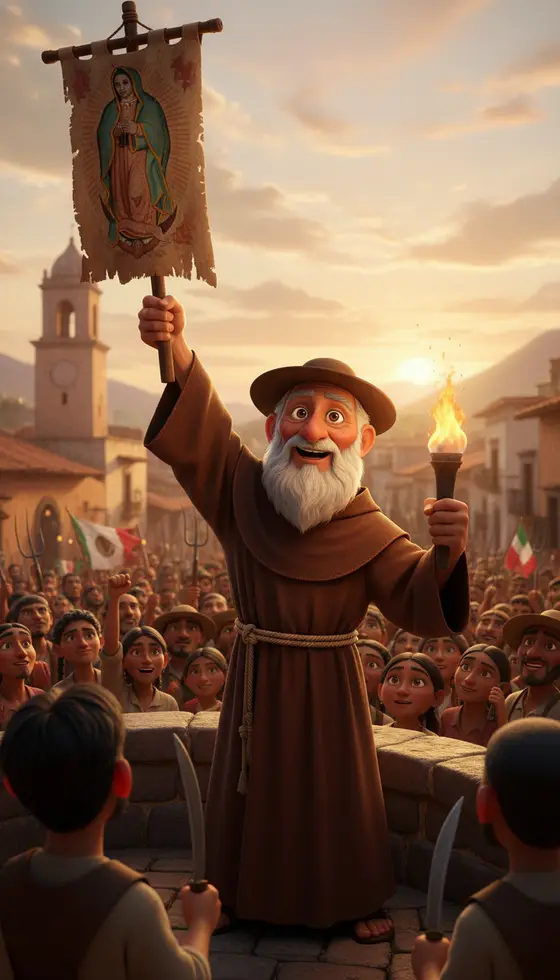
In 1810, Mexico was New Spain — a Spanish colonial territory that had existed for nearly 300 years. The Bourbon reforms of the 18th century had stripped Criollo elites (Spaniards born in Mexico) of political power they had held for generations, creating a class of educated, wealthy Mexicans who had no formal political voice. Enlightenment ideas from France and the American and French revolutions circulated through intellectual circles. A conspiracy was organized in Querétaro — the Querétaro Conspiracy — involving Criollo intellectuals and the local military. When the conspiracy was discovered and arrests were ordered in September 1810, one of the conspirators sent word to Miguel Hidalgo, the parish priest of the town of Dolores. Hidalgo rang the church bell — the Campana de Dolores — in the early morning hours of September 16 to summon his congregation. He then delivered a speech urging them to rise against the Spanish government. The exact words he used are not recorded — the versions we have are reconstructions. The movement he launched that morning turned into an 11-year war that ended with Mexican independence in 1821.
The Querétaro Conspiracy was discovered and Hidalgo rang the bell not as a planned event but as an emergency response to imminent arrest
The exact words of the original Grito are not recorded — every version since is a reconstruction
The independence war lasted 11 years (1810–1821) — Hidalgo himself was captured and executed in 1811, a year after he started it
Miguel Hidalgo y Costilla was 57 years old and a parish priest when he rang the Campana de Dolores on September 16, 1810. He was not a soldier — he was an intellectual, a Criollo of Spanish descent, educated at the College of San Nicolás in Valladolid (now Morelia). He had been investigated by the Inquisition multiple times for reading banned books and unorthodox theological views. He spoke Nahuatl, Otomí, and Purépecha in addition to Spanish, and had spent years working to improve the economic conditions of his indigenous parishioners — introducing silk production, beekeeping, and pottery to the community of Dolores. His army was not a trained military force: after ringing the bell, he marched with his congregation and quickly gathered tens of thousands of indigenous and mestizo followers. They took Guanajuato, the Alhóndiga de Granaditas, in a brutal attack. Hidalgo was excommunicated by the Catholic Church. He was captured in March 1811, executed in July 1811, and his head was displayed on a pike on the Alhóndiga de Granaditas as a warning — for ten years, until independence was achieved.
Hidalgo rang the bell to summon his congregation — the 'Grito de Dolores' was not a planned speech but an improvised call to arms
Excommunicated by the Catholic Church for leading the rebellion — the same Church that now venerates him as a founding father
Executed 10 months after starting the rebellion — his head displayed on a pike in Guanajuato for 10 years until independence was achieved
Get short, interactive stories that make each place easier to remember while you travel.
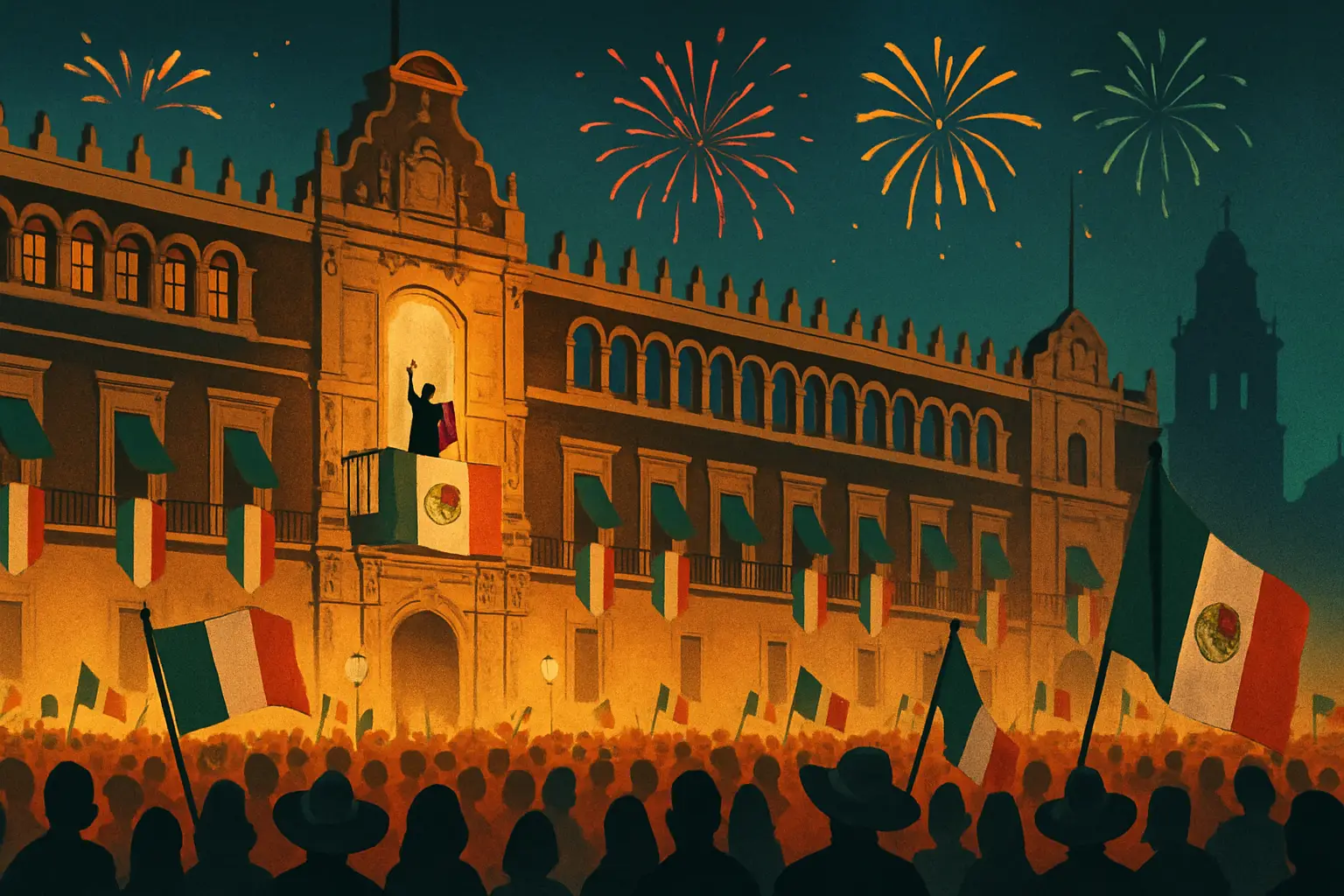
At 11 p.m. on September 15, the president of Mexico steps onto the central balcony of the Palacio Nacional — the same building, on the same site as Moctezuma's palace in Tenochtitlán, overlooking the Zócalo — and rings the Campana de Dolores (the original bell from Hidalgo's church, moved to Mexico City in 1896). The Grito that follows is not a fixed text: different presidents have emphasized different heroes and moments, and the version has evolved over the centuries. The constant elements: a declaration of 'Viva México!' repeated by the crowd, invocations of the key independence figures (Hidalgo, Morelos, Josefa Ortiz de Domínguez, Vicente Guerrero), and the crowd's chanted response. The fireworks begin at 11 p.m. exactly. The crowd — which by September 15 fills the entire Zócalo and the surrounding streets — responds to each 'Viva!' with a roar. The ceremony lasts about 10 minutes. What it produces in the crowd, and what the president says, and what the bell sounds like ringing over 100,000 people in the dark is difficult to convey in writing.
The Campana de Dolores: Hidalgo's original church bell, transported from Dolores Hidalgo to the Palacio Nacional in 1896, rung every September 15
The Grito is not a fixed text — each president adapts the heroes and framing, while the crowd response 'Viva México!' remains constant
Fireworks begin at 11 p.m. exactly — the ceremony is precisely timed, coordinated nationally across every plaza in Mexico
The Zócalo on the night of September 15 is one of Mexico City's most overwhelming experiences — in the best possible sense. The plaza begins filling in the early afternoon. By 7 p.m. it is densely packed. By 9 p.m., the surrounding streets — Madero, 5 de Mayo, Tacuba, 20 de Noviembre — are also full. The entire area becomes pedestrian-only from the afternoon. Vendors sell green, white, and red glow sticks, plastic horns (cornetas), flags, shredded paper in national colors (confetti), and every kind of food and drink. The national colors appear on everything: clothing, face paint, car decorations, lights on buildings throughout the city. The security presence is very high but the atmosphere is genuinely festive — families, children, elderly couples, teenagers, tourists, and politicians all in the same space. The Grito at 11 p.m. is followed by fireworks from the roof of the Palacio Nacional that last 10–15 minutes. After the fireworks, the plaza slowly empties over the following hours, with street food vendors staying open through the early morning.
Arrive by 7–8 p.m. to get into the Zócalo itself — by 9 p.m. the plaza is completely full and entry is restricted
Metro to Zócalo (Line 2): the only reliable transport — the entire surrounding road network is pedestrian-only from the afternoon
Dress in red, white, and green — not doing so makes you feel more out of place than any tourist experience in Mexico City
September 16 — the official Independence Day — begins with a military parade along Paseo de la Reforma, the grand boulevard that runs from Chapultepec through the city center. The parade includes the Mexican Army, Navy, Air Force, national police, and representatives of state security forces from every Mexican state, along with military equipment, marching bands, and civic organizations. The parade typically runs from 10 a.m. to around noon and closes Paseo de la Reforma completely, from Chapultepec Park to the Zócalo. September 16 is a full federal holiday: banks, government offices, most schools, and many businesses are closed. Museums have mixed schedules — the Museo Nacional de Antropología is typically open, and many use the day for special programming. Centro Histórico remains festive through the 16th, with the Zócalo still dressed in its independence decorations and vendors still present.
Military parade: September 16, 10 a.m.–noon, Paseo de la Reforma from Chapultepec to the Zócalo
September 16 is a full federal holiday — most services closed, museums often open with special programming
The entire city stays in the green-white-red mood through the 16th — the celebration does not end with the Grito
The Grito happens everywhere simultaneously, and in smaller cities and towns the scale can make it feel more intimate without being less intense. Dolores Hidalgo, Guanajuato — where the original bell rang — draws enormous crowds every September 15 for a ceremony at the Parroquia de Nuestra Señora de los Dolores, the same church where Hidalgo rang the bell. The current president sometimes goes to Dolores Hidalgo instead of Mexico City to deliver the Grito at the original site, a significant symbolic gesture. Guadalajara's Zócalo, Oaxaca's Zócalo, and San Cristóbal de las Casas in Chiapas all host significant local celebrations. In the US, Mexican-American communities hold their own Gritos — Los Angeles, Chicago, Houston, San Antonio, and dozens of other cities with large Mexican diaspora populations mark September 15–16 with public celebrations that are sometimes as large as those in Mexican provincial cities.
Dolores Hidalgo, Guanajuato: the original site — the president occasionally delivers the Grito here instead of Mexico City
Oaxaca and Guadalajara: two of Mexico's most vibrant Independence Day celebrations outside the capital
Los Angeles, Chicago, Houston: Mexican-American communities hold large September 15 Grito events — the holiday travels with its people
Independence Day has its own dish: chiles en nogada — poblano chiles stuffed with picadillo (a mixture of meat, fruit, and spices), covered in a white walnut cream sauce, and garnished with pomegranate seeds and parsley. The dish is green (parsley), white (walnut cream), and red (pomegranate) — the colors of the Mexican flag. It is said to have been created in Puebla in 1821 to honor Agustín de Iturbide, who led the army that finalized independence, and the dish's ingredients were chosen specifically to represent the newly formed nation. Chiles en nogada is only made during the brief season when all its fresh ingredients are simultaneously available — roughly August through October, which happens to coincide exactly with Independence Day. It is one of the most complex dishes in Mexican cuisine: the picadillo alone can contain over 30 ingredients including pear, peach, plantain, raisin, pine nuts, almonds, and multiple spices. Finding a good version in Mexico City in September is not difficult — it appears on every restaurant menu in the city during this window.
Chiles en nogada: the Independence Day dish — green, white, and red in its presentation, the colors of the flag
Available only August–October when all fresh ingredients are simultaneously in season — the timing is not symbolic, it's agricultural
The picadillo filling can contain 30+ ingredients: pear, peach, raisin, pine nut, almond, plantain, multiple chiles and spices
September is one of the best months to visit Mexico City — the rainy season is winding down (showers are typically brief afternoon events rather than all-day rain), the city is green from summer rains, and the Independence Day atmosphere makes the entire month feel celebratory. The Zócalo is decorated in green, white, and red from early September. Hotels near the center fill quickly for the September 15–16 period — book 4–6 weeks ahead if you want to stay in Centro Histórico or Roma Norte. The Mexico City cultural guide gives the full neighborhood picture. If you're not staying near the Zócalo: the Metro is the correct choice on September 15 — line 2 runs extended hours, and every other transport option will be blocked by pedestrian crowds and road closures. Dress warmly for the post-midnight period: Mexico City in September at 2 a.m. is colder than most visitors expect from a 'tropical' country at altitude.
September hotel booking: reserve 4–6 weeks ahead for Centro Histórico and Roma Norte — the city fills for September 15–16
September is excellent for visiting: rainy season winding down, city green, festive atmosphere all month
Post-midnight warning: Mexico City at altitude (2,240 m) in September can drop to 10–12°C after midnight — bring a jacket