The story of alebrijes begins in Mexico City's La Merced neighborhood in 1936, with a man named Pedro Linares López hallucinating through a near-fatal fever. Linares was a cartonero — a craftsman who made piñatas, Judas figures, carnival masks, and papier-mâché sculptures from newspaper pulp and paste, a craft he had learned from his father. He was a market worker, not a fine artist. In 1936, peritonitis put him unconscious for days.
The fever took him somewhere else. He dreamed of a strange forest where every animal was anatomically wrong: a donkey with butterfly wings, a lion with an eagle's head, a rooster with bull horns, all of them calling out the same impossible word — Alebrijes. When he recovered, he spent weeks recreating the creatures from his dream using the papier-mâché techniques he knew from making piñatas. He had no patron, no art school, no market for what he was making. He made them because the image wouldn't leave him.
In 1975, filmmaker Judith Bronowski documented Linares at work, bringing international attention to his creations. Diego Rivera and Frida Kahlo reportedly acquired pieces from him. By the time Linares died in 1992 at age 89, the word alebrije had entered the permanent vocabulary of Mexican folk art — and everything the art form has become since traces back to this one craftsman's fever in a working-class market neighborhood east of the Zócalo.
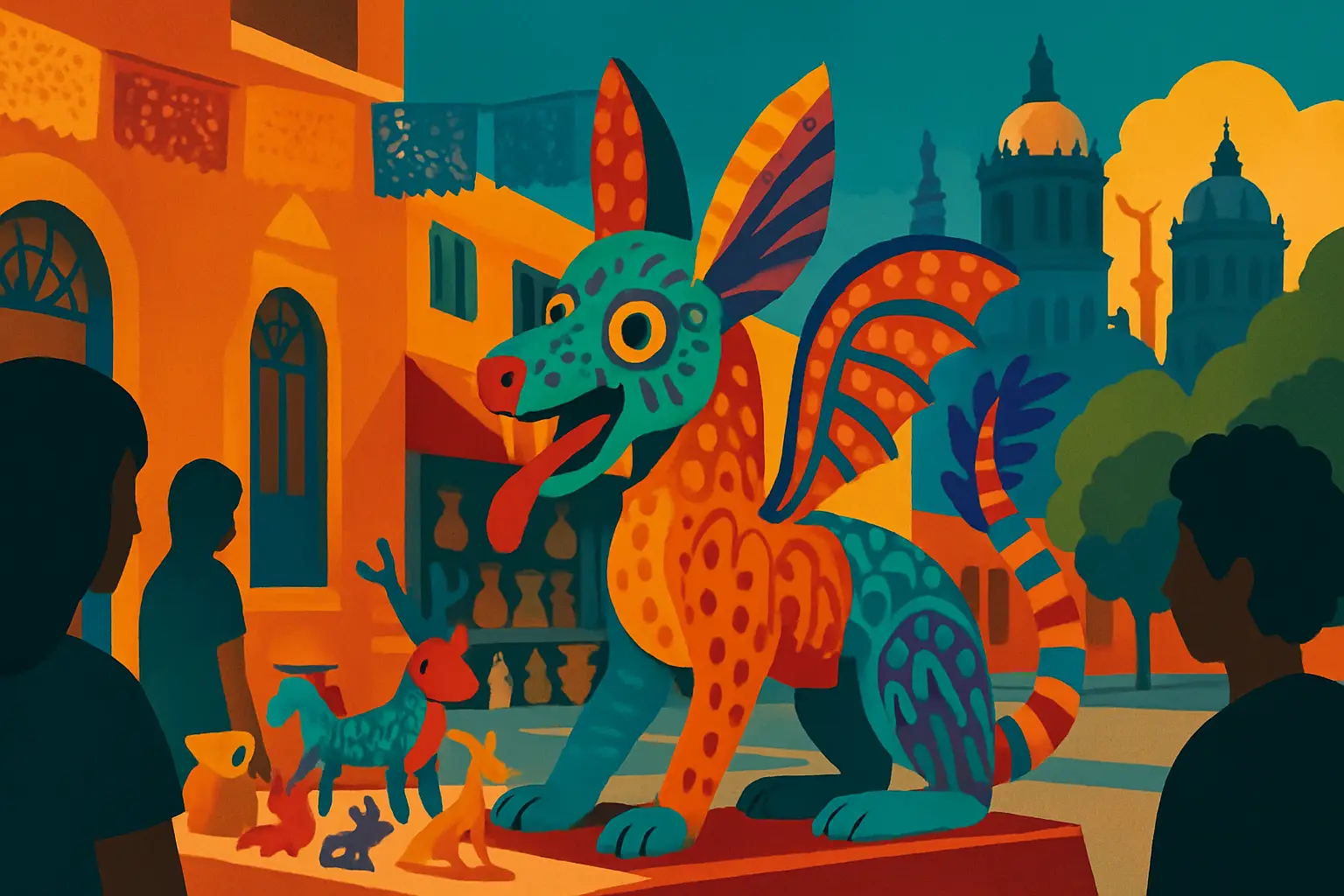
The visual image most people associate with alebrijes — brightly painted animals carved from pale soft wood, covered in intricate dots and geometric patterns — is actually Oaxacan, not from Mexico City. The concept traveled south in the 1980s when artisan workshops began exchanging techniques, and woodcarvers in the Central Valley villages of San Pedro Arrazola and San Martín Tilcajete adapted Linares' idea to copal wood, the fragrant local timber those communities had always used for carving. Manuel Jiménez of San Pedro Arrazola is credited as the first to make the full adaptation.
The Oaxacan form became far more commercially successful: copal is heavier and more durable than papier-mâché, easier to export, and the painting style that developed — dense geometric patterns, phosphorescent colors, fine brushwork — became a visual identity that traveled worldwide.
This creates a meaningful distinction to know at any craft market: if you buy something called an alebrije in Mexico City, you are almost certainly buying an Oaxacan copal piece, not the original CDMX papier-mâché form. Both are legitimate art forms. They are different things, made by different communities, with different techniques and histories. Knowing which you're looking at is part of engaging seriously with either one.
Get short, interactive stories that make each place easier to remember while you travel.
Pedro Linares' descendants still make alebrijes in Mexico City. His son Miguel Linares and grandchildren Blanca, Elsa, and Ricardo Linares continue the papier-mâché tradition from a workshop in the area near Mercado de Sonora — the same east-side market district where Pedro built his career.
The family's pieces are distinct from Oaxacan woodcarvings: lighter, more textured from the layered newspaper-and-paste construction, and with a looser anatomical logic that reflects the original dream imagery rather than the graphic precision of Oaxacan painting. The Linares workshop does not maintain a public storefront with walk-in hours, but the Museo de Arte Popular has a long relationship with the family and can direct serious collectors. For most visitors, the MAP collection is the most accessible entry point to the family's historical work — the museum holds pieces commissioned directly from multiple generations of Linares and displays them with full craft documentation.
The Museo de Arte Popular — MAP — at Revillagigedo 11 in the Cuauhtémoc neighborhood is the anchor for any serious engagement with alebrijes in Mexico City. The building is a former 1928 fire station, renovated in 2006 into a five-floor museum with the original Porfiriato facade intact and an open interior courtyard that serves as a gallery and event space. It is a five-minute walk from Metro Juárez (Line 3) or Metro Salto del Agua (Lines 1 and 8).
The permanent alebrije collection spans the upper floors and includes Linares family papier-mâché pieces alongside Oaxacan copal woodcarvings, all labeled with maker origin and craft context — the clearest side-by-side comparison of the two forms available anywhere in the city.
Museum hours: Tuesday through Sunday, 10 am to 6 pm. Admission is 70 MXN for adults; free on Sundays. The MAP store in the adjoining Plaza Juárez sells curated alebrijes sourced directly from documented artisans — this is the most transparent place in the city to buy a quality piece, with verified provenance built into the price.
La Ciudadela (Mercado de Artesanías de la Ciudadela) at Plaza de la Ciudadela 1 — about ten minutes southwest of MAP — has the widest selection of Mexican craft in the city, including dozens of alebrije vendors. Quality varies significantly. A well-made Oaxacan copal piece with fine detailed painting runs 800–2,500 MXN ($40–$125 USD); mass-produced versions made with faster drying processes run 200–400 MXN and are identifiable by uniformly thin painted lines and visible seams at the joints. Ask the vendor which village the piece is from and whether it came from a family workshop or a production operation — the ones who know will tell you.
Bazar Sábado in San Ángel runs every Saturday and carries juried-quality pieces at 30–60% above La Ciudadela prices. The curation is built in and worth the premium if you want artisan-grade work.
For design-leaning pieces — alebrijes that fuse traditional form with a more contemporary aesthetic — Onora and Caralarga in Roma Norte stock curated selections at gallery prices. MUMEDI at Francisco I. Madero 74 in Centro Histórico carries design-forward folk objects from documented makers.
The MAP store remains the most verifiable source in any price range.
La Ciudadela, Plaza de la Ciudadela 1 — biggest selection, widest quality range, 200–2,500 MXN; ask for village origin before buying
Bazar Sábado, San Ángel (Saturdays only) — juried quality, higher prices, good to combine with a morning in San Ángel's colonial streets
MAP store, Revillagigedo 11 — documented artisan sourcing, verified provenance, physically adjacent to the museum's collection
Every October, the Museo de Arte Popular organizes the Desfile de Alebrijes Monumentales — a procession of papier-mâché creatures four to six meters tall, walking the full length of Paseo de la Reforma from the Zócalo to the Ángel de la Independencia. Artisan workshops from across Mexico City are commissioned months in advance to build each creature, competing for prizes judged by MAP.
After the parade, the giant alebrijes are installed along the Reforma boulevard for three to four weeks of public display. Even visitors who miss the Saturday night procession itself can walk the boulevard and see the creatures up close during that window. The scale is hard to convey in photographs: a six-meter bat-eagle-serpent hybrid standing on the Reforma median between lanes of traffic, painted in phosphorescent colors, is a specific image that earns its own memory.
The Reforma display typically runs through the first two weeks of November, overlapping with Día de Muertos on November 1–2 — making that two-week stretch the most concentrated time to experience both the giant alebrije installation and the ofrenda altars at the Zócalo. MAP publishes exact parade dates in September each year.
The 2017 Pixar film Coco drew directly from the real art form. The production team visited Mexico City and Oaxaca specifically to research papier-mâché and copal wood alebrijes, and the spirit guide creatures in the Land of the Dead use the same hybrid anatomy logic — a deer with flame wings, a cat with a fish tail — that Pedro Linares described from his 1936 fever dream.
The film differs from tradition in one significant way: real alebrijes are inanimate folk art objects, not supernatural spirit guides. The connection to Día de Muertos and to guiding souls of the dead is the filmmakers' invention, not part of any Mexican tradition. Alebrijes in real life are extraordinary objects — creatures from a dream, made by hand, belonging to no mythology except the one Pedro Linares invented in a La Merced workshop ninety years ago.
That said, the film brought enormous international attention to the art form. MAP reports that interest from international visitors roughly doubled in the years following Coco's release. If you're visiting Mexico City partly because of that film, the museum at Revillagigedo 11 is where the actual story starts.
Year-round: The Museo de Arte Popular at Revillagigedo 11 has a permanent collection open Tuesday through Sunday, 10 am to 6 pm. The Linares family pieces and the Oaxacan collection don't rotate out — they're available on any visit, any month.
Late October through early November: The annual parade and the Reforma boulevard display make this the peak window for alebrije culture in the city. Combined with the Día de Muertos ofrendas at the Zócalo, the two-week overlap is a genuinely rare concentration of folk art tradition that Mexico City does unlike anywhere else.
May through September: No parade, but MAP and La Ciudadela operate normally and museum crowds are lighter than October–November peak season. Weekday mornings at La Ciudadela give you the most vendor attention and the most honest prices.
Bazar Sábado in San Ángel runs year-round, every Saturday — a natural pairing with a walk through San Ángel's colonial streets and a stop at the Diego Rivera and Frida Kahlo Studio Museum two minutes away.