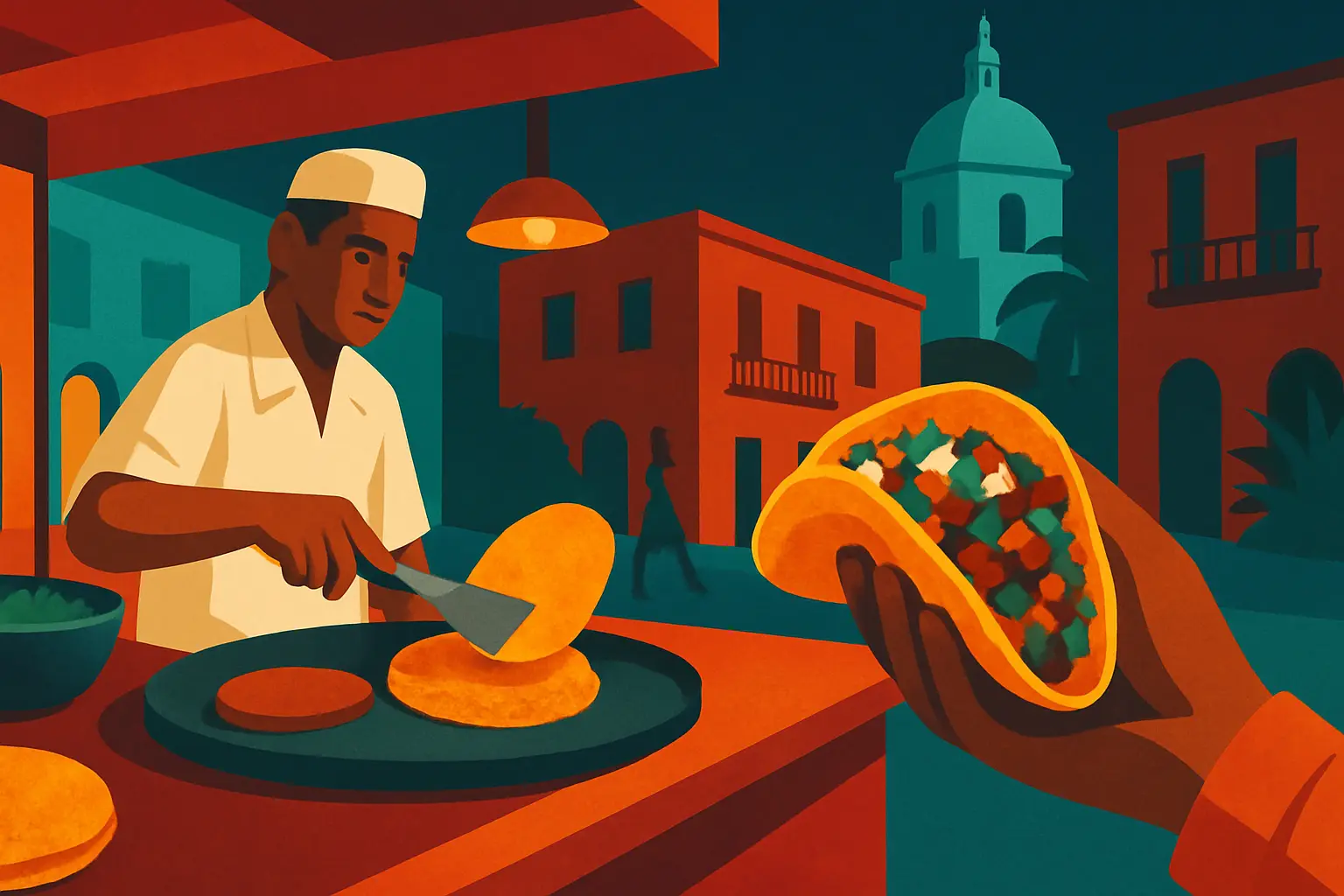
The confusion between a taco de costra and a quesadilla is understandable but misses the point. A quesadilla melts cheese inside a folded tortilla. A costra skips the tortilla entirely — or adds it as a secondary layer. The costra is built by placing a generous mound of grated cheese directly on a flat, dry comal and letting it melt and fry until the bottom surface becomes a solid, lacy, golden disc. No oil is added — the natural fat in the cheese handles the browning. Once the underside has set into a rigid, slightly charred crust, the filling — arrachera (skirt steak), carne asada, chorizo, suadero, al pastor, or even huitlacoche — is placed on top of the cheese, and the whole thing folds over the filling like a taco shell. The result is textural in a way no regular taco achieves: a crispy outer surface, molten interior, and protein sealed inside. Some taquerías add a corn tortilla underneath for structural support; others serve the costra as the sole wrapper. Costra means 'crust' in Spanish — that's exactly what you're getting. One culinary analogy: the Italians call a similarly fried cheese disc a frico, and the technique is essentially identical. The costra got there independently, by way of a nightclub in western Mexico City.
The taco de costra was not invented in Guadalajara, despite what some accounts claim. It originated in Mexico City in the early 2000s, at a taquería called Las Costras that operated just outside the Bandasha nightclub in Bosques de las Lomas — a wealthy, hillside residential neighborhood in the western part of the city, about 20 minutes by car from Roma or Condesa. The invention was practical and nocturnal: when hundreds of people exited Bandasha at 2 and 3 in the morning, hungry and wanting something immediate, the stand next door had their answer. The combination of crispy cheese, hot meat, and post-midnight hunger built a following almost immediately. By mid-decade, Las Costras had expanded into a chain and the format had spread across CDMX. The nightclub eventually closed, but the stand lived on. Las Kampostras — the current operation descended directly from the original Las Costras del Bandasha — still operates in Bosques de las Lomas, and the location carries a real pilgrimage energy for CDMX taco enthusiasts who understand the history. It is the single most honest place to eat a costra in the city, not because the costra is necessarily better than elsewhere, but because the context is the dish.
Get short, interactive stories that make each place easier to remember while you travel.
The cheese is everything. Mexican queso manchego — which shares nothing with Spanish Manchego except the name, and is a mild, semi-firm, high-fat melting cheese — is the standard. Asadero and Chihuahua cheese work equally well; all three melt cleanly, brown evenly on the comal, and produce the lacy, crispy-edged disc that defines a good costra. Quesillo (Oaxacan string cheese) is used at some spots and produces a chewier, more elastic result. What ruins a costra is the wrong temperature or an impatient cook. If the comal is too cool, the cheese melts without crisping and arrives soft and greasy. If it's too hot, the cheese burns before it unifies into a disc. The best costras are cooked at medium-high heat for a full 3–4 minutes — long enough for the underside to set into a rigid shell while the top remains molten. The edges of a properly made costra are thin, lacy, and translucent-brown, with a defined charred rim. A pale, uniformly yellow costra with no browning was pulled too early. A costra with dark black spots throughout was burned. You can identify the ideal version before you bite: the edges should look like the outer crust of a well-done grilled cheese sandwich.
Taquerías that serve costras offer them as an upgrade to any taco on the menu. The phrase is '[protein] con costra' — 'arrachera con costra,' 'pastor con costra,' 'suadero con costra.' At some spots the costra is listed as a standalone option on the board. First-timers should start with arrachera (skirt steak) or carne asada — both have enough body and fat to hold their own against the richness of the melted cheese. Al pastor works well for those who want the acidity of the achiote marinade and pineapple to cut through the costra. Chorizo is an aggressive, very rich combination — excellent, but order it second rather than first. At Tacos Los Alexis in Roma Norte, the 'Costra Especial' comes pre-composed with a specific protein and house sauce pairing, which is the best choice for a first visit. Garnishes follow the same rules as any beef taco: cilantro, diced white onion, salsa verde or roja, lime. Guacamole, where offered, works extremely well — the cold, fatty avocado against the hot cheese creates a genuine contrast. Skip the sour cream: it softens the costra shell within seconds.
Roma Norte — Tacos Los Alexis (Calle Chiapas 46): The Michelin Bib Gourmand winner for 2024 and 2025 is the most consistent costra in the city right now. Chef Alexis Ayala's Costra Especial has a reliably well-browned cheese shell, freshly sliced meat, and a slightly smoky house red salsa. The space is small — indoor prep visible through a window, a handful of outdoor tables. Expect a line on weekend evenings. Roma Norte — El Califa (Avenida Álvaro Obregón 174): One of the first CDMX taquerías to put costras on a printed menu and serve them consistently to a non-nightclub crowd. The Roma Norte location is a useful benchmark — this is the costra format standardized and made reliable, which is what you want on a weeknight when you don't want to hunt. Additional locations in Condesa (Calle Altata 22) keep similar hours. Bosques de las Lomas — Las Kampostras: The direct descendant of the original Las Costras del Bandasha. Far from Roma and Condesa, about 20 minutes by Uber, but worth making the trip once for the history alone. Roma Sur — Los Parados: Quietly excellent costra de arrachera — the skirt steak version with deeply browned manchego. Less famous than Los Alexis, less polished than El Califa, but a steady neighborhood favorite that rarely has a line.
Tacos Los Alexis — Calle Chiapas 46, Roma Norte: Michelin Bib Gourmand 2024–2025, Costra Especial, best consistency in 2026
El Califa — Av. Álvaro Obregón 174, Roma Norte / Altata 22, Condesa: reliable chain, costra available on any protein, good benchmark
Las Kampostras — Bosques de las Lomas: descended from the original Las Costras del Bandasha, the dish's birthplace
Mexico City has several taco formats built around a single defining technique rather than a specific filling, and the costra fits squarely into that tradition. The taco de suadero — slow-cooked beef navel rendered in its own fat in a copper pot — exists because of one cooking method, not one ingredient. The birria taco is defined by its overnight chile marinade and braising process. The costra adds a cheese-first philosophy to this lineage. What connects all of them is deliberate technique: the taco format emerged from a specific way of cooking, not the other way around. The costra's nightclub origin is also consistent with how CDMX food culture actually evolves — informally, at night, in response to a real need, and then refined over years into something worth crossing the city for in the afternoon. Street food in Mexico City has always had this quality: the best versions of any dish were invented by someone solving a practical problem, usually at an inconvenient hour.
This is genuinely debated, and the answer depends on what you want. Without a tortilla: the cheese disc is the only outer structure. The taco is smaller, richer, and more intensely flavored — the cheese is in every bite. The texture is crispier at the edges and molten in the center. It needs to be eaten quickly before the hot filling softens the shell. This is the original format. With a tortilla underneath: the cheese disc folds over a corn tortilla, adding structural support and the distinct flavor of masa. The taco is slightly larger and more filling. The tortilla absorbs some of the cheese fat during cooking, producing an additional flavor layer. Most taquerías default to this format because it's more practical. Recommendation: try one of each on the same visit. At Tacos Los Alexis, ask the cook to make one with and one without — they'll usually accommodate. The bare costra is the technically purer version; the tortilla-forward is the more satisfying meal.
How much: A single costra at a street stand or neighborhood taquería runs 70–110 pesos. At Tacos Los Alexis, expect 90–130 pesos per taco. Costras are priced higher than standard tacos because of the cheese quantity and the longer cooking time — two to three times the time of a standard taco. Hours: Tacos Los Alexis is open Tuesday through Sunday, roughly 1pm to 9pm — check @tacoslosalexis on Instagram for current hours. El Califa's Roma Norte location typically runs noon to midnight on weekdays and until 1am on weekends. Las Kampostras in Bosques de las Lomas leans toward late-night service, consistent with its origins. Getting there: Tacos Los Alexis on Calle Chiapas is about 15 minutes on foot from Metro Insurgentes (Line 1), or a short Ecobici ride from anywhere in Roma. El Califa on Álvaro Obregón sits on Roma Norte's main boulevard, accessible from the same metro stop. Las Kampostras requires a car or Uber — there is no practical metro connection to Bosques de las Lomas. Is it safe: All listed spots operate in well-trafficked areas during normal business hours. Roma Norte is among the most tourist-friendly parts of the city. Las Kampostras is in a residential neighborhood that's safe for visitors arriving by car.