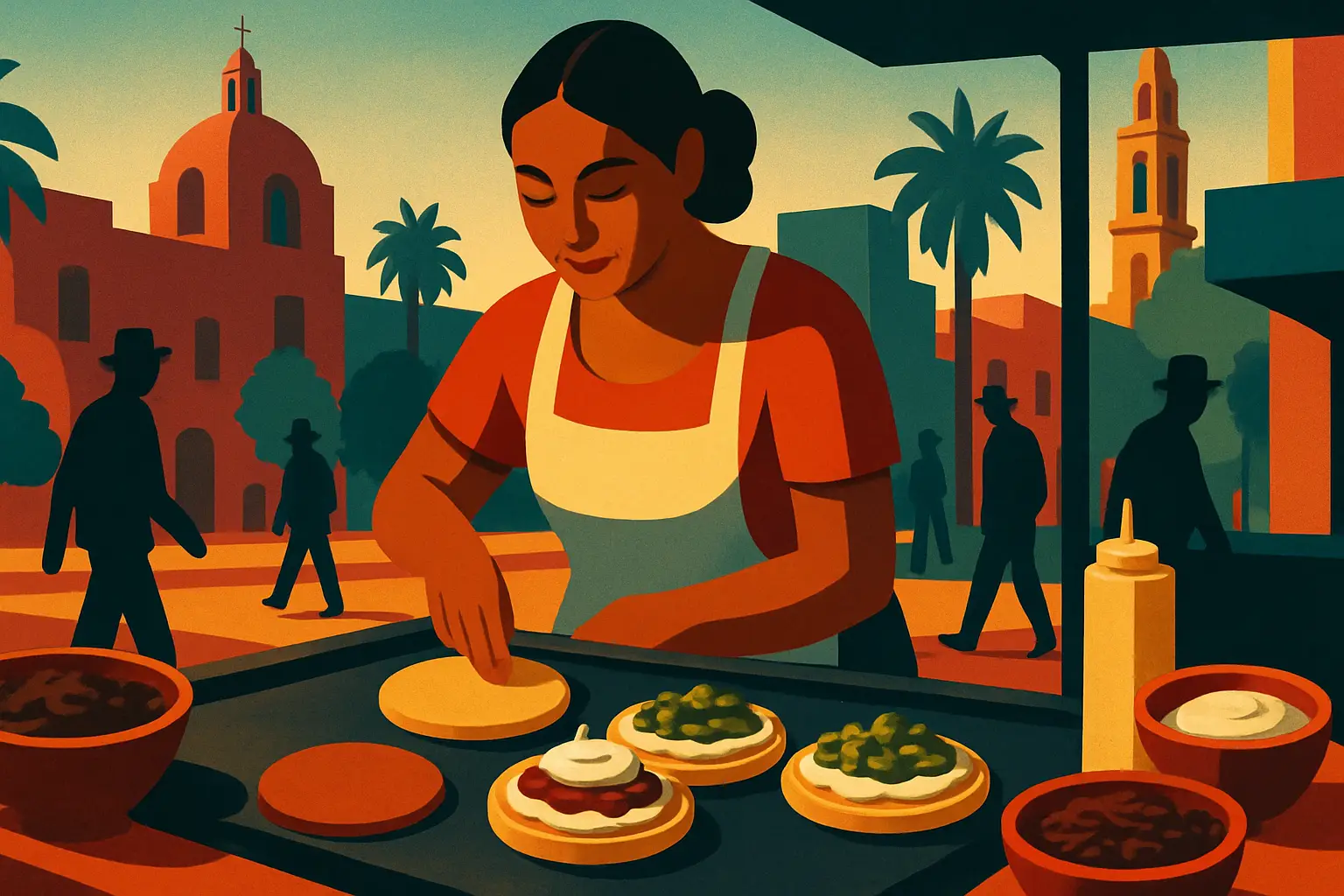
Most visitors to Mexico City spend their first days eating tacos and discover the rest of the city's masa vocabulary only by accident, if at all. The sope is the easiest miss. It looks, from a distance, like a small thick tortilla sitting on a comal surrounded by a cluster of other small thick things. But the sope has one defining feature: a pinched ridge running around its circumference, creating a shallow rim that keeps the toppings from sliding off. Once you can spot that rim, you'll see sopes everywhere — on comales at the edges of markets, behind the glass cases of antojiterías, stacked near kitchen prep stations with beans already spread.
A fully dressed sope starts with a round masa base roughly eight to ten centimeters wide and about two centimeters thick, pressed by hand and grilled on a dry comal until it firms up. While still hot off the heat, the cook pinches the edge to create the raised border — then sometimes flash-fries the base for a slightly crispy exterior before the toppings go on. The layering order: refried black or pinto beans spread directly on the base, then the protein (shredded chicken, carne, chorizo, or chicharrón prensado), then shredded lettuce or cabbage, crema mexicana, crumbled cotija, and salsa. Every element is visible on the surface and eaten in one or two bites that pull it all together.
Knowing where sopes sit within the larger family of masa antojitos lets you navigate any street stall or antojitería menu with genuine confidence.
Tlacoyo: Oval, elongated, and stuffed before cooking — black beans, fava beans, or chicharrón prensado sealed inside the masa. Grilled until the exterior is firm, then finished with nopales, raw onion, salsa, and cotija on the outside. The filling is hidden; the toppings are a garnish rather than the main event. The tlacoyos guide covers the best spots in the city.
Huarache: Named for the sandal it resembles — 30 to 40 centimeters long, oval, with a layer of beans or chicharrón pressed into the base before grilling. Sized to serve as a full meal. Large enough that one with a beer at a market counter constitutes lunch.
Gordita: Round and thick like a sope, but cooked and then split open along one edge to create a pocket. The filling — stewed meat, cheese, or chicharrón — goes inside after cooking. The opposite presentation philosophy from a sope.
The simplest shorthand: sopes show everything on the surface, tlacoyos and gorditas seal the filling inside, and huaraches are sandal-sized.
Get short, interactive stories that make each place easier to remember while you travel.
A sope is only as good as its masa, and masa is only as good as its nixtamal. Nixtamalization — from the Nahuatl words nextli (lime solution) and tamalli (dough) — is the process of soaking dried corn kernels in water mixed with cal (calcium hydroxide) for several hours, then rinsing and grinding the softened grain into a pliable dough. The process is at least 3,500 years old, developed by Mesoamerican cultures long before the Aztecs organized their civilization around it.
Nixtamalization does two things that matter enormously. It makes niacin (vitamin B3) bioavailable in corn — a fact that Spanish colonizers didn't understand, which is why communities in Europe and North America that adopted corn but skipped nixtamalization suffered epidemic pellagra for centuries. And it fundamentally changes the flavor and texture of the masa: untreated corn dough is flat and chalky; nixtamal dough has a specific mineral, slightly alkaline depth that is so embedded in Mexican food culture that most people can't articulate it until they taste masa made without it.
The best sopes in Mexico City use masa freshly ground from nixtamal that morning, often purchased in dense blocks from neighborhood molinos — the corn grinders that still operate near most traditional market areas. Masa made from maseca (the shelf-stable dehydrated flour) is perfectly serviceable, but fresh masa produces a sope that is meaningfully better in texture and flavor, and it holds its shape under the toppings in a way that pre-mixed masa doesn't.
Sope geography in Mexico City follows the rule of most good street food: the most reliable vendors cluster in and around traditional markets. Any comal stall at the outer ring of La Merced — the city's largest traditional market, anchored on Calle Anillo de Circunvalación just east of Centro Histórico — will have sopes as a baseline offering. Arrive before 10 a.m. on a weekday for the freshest masa and the lightest crowds at the cooking counters inside.
The Mercado de Medellín on Calle Campeche 101 in Roma Sur is a more accessible option for visitors already staying in Roma or Condesa. The comal section near the back of the market serves a rotating antojito menu throughout the morning, and the regulars eating lunch at the tiled counters by 1 p.m. are a reliable quality signal.
In Santa María la Ribera — the colonial-era neighborhood northwest of Centro that most visitors skip entirely — Quesadillas y Sopes Lupita has built a strong local following. The neighborhood rewards a detour on its own: it's one of the few remaining places in the city where Porfirian-era townhouses, working-class street life, and genuine neighborhood commerce coexist without the gentrification layer that has changed the character of Roma and Condesa.
In Centro Histórico, the vendors along the edge of Plaza de Santo Domingo — the square bordered by República de Brasil and República de Argentina, two blocks north of the Zócalo — operate comal stations that have held more or less the same spots for decades. Sopes share the menu with gorditas, quesadillas, and tlacoyos. The square also houses the former seat of the Inquisition and some of the oldest functioning print shops in Latin America, both within a hundred meters of the antojito stalls.
If any single restaurant has codified the sope experience for multiple generations of chilangos, it's La Casa de Toño. Founded as a neighborhood pozolería, the menu expanded to cover the full antojito canon, and the chain now has multiple locations across the city. The branch at Londres 144 in Colonia Juárez — one block from the eastern edge of the Zona Rosa — and a second frequently visited location at Dolores 7 in Centro Histórico are the two most relevant for visitors.
La Casa de Toño is not a fashionable restaurant. It doesn't need to be. It's open 24 hours, most items stay under 90 pesos, and the sopes arrive with properly thick masa, generously spread beans, and a full layer of crema, cotija, and salsa. Two sopes and a bowl of pozole rojo is a complete meal. The dining room fills with students, taxi drivers, families on a Sunday outing, and night-shift workers eating before dawn — all at the same prices in the same plastic-chair room, which is the most Mexico City thing you can say about a restaurant.
Londres 144, Colonia Juárez — one block from Metro Insurgentes; open 24 hours
Dolores 7, Centro Histórico — second convenient location after exploring the historic center
Two sopes plus a bowl of pozole rojo: under 200 pesos, a genuinely filling meal
Street sopes at market stalls typically run 20 to 40 pesos each, depending on the topping. Plain versions with beans and salsa are at the lower end; those topped with carne asada, chorizo, or carnitas run higher. At sit-down antojiterías like La Casa de Toño, expect 35 to 55 pesos per sope, with orders of two or three being standard.
At street stalls, the glass case in front of the comal displays the topping options in small labeled containers. You point to what you want rather than reading a menu. Most vendors will ask 'con qué?' (with what?) when you order. A useful default: 'con pollo y salsa verde' or 'con chicharrón y roja' gets you shredded chicken or pressed pork rind with your choice of green or red salsa — the two most common combinations at any stall in the city.
First-time visitors consistently over-order. Sopes are denser than they look — the masa alone is substantial before the toppings go on. Start with two, see where you are, and order a third if the vendor is good enough to deserve it. At busy market stalls, the best quality signal is watching the vendor press and pinch each sope individually to order. If a stack of pre-made bases is already sitting to the side of the comal, turnover is slower and the texture will be softer.
Sopes are genuinely easy to eat without meat in Mexico City. A sope topped with refried beans, crema, cotija, nopales (grilled cactus strips), and salsa is naturally meat-free, and most vendors offer this combination without any special request — it's the base version before protein gets added. The masa itself is corn-based.
The main caveat: many traditional antojiterías prepare refried beans with lard (manteca), which makes them not strictly vegan. At market stalls this is common practice and worth asking about if it matters. At more contemporary spots in Roma Norte, Condesa, and Colonia Juárez, vegetable oil-based beans are increasingly standard. The vegan Mexico City guide covers this broader landscape in more detail.
On the gordita question: the difference comes down to where the filling lives. A gordita is cooked until it develops a slight crust and then split open along one edge to create a pocket — the filling goes inside, like a stuffed pita. A sope always displays everything on the surface. Same masa, same general family, opposite architecture. If you order at a stall and receive a thick pocket rather than a layered disc, you've ordered a gordita. Both are worth knowing.