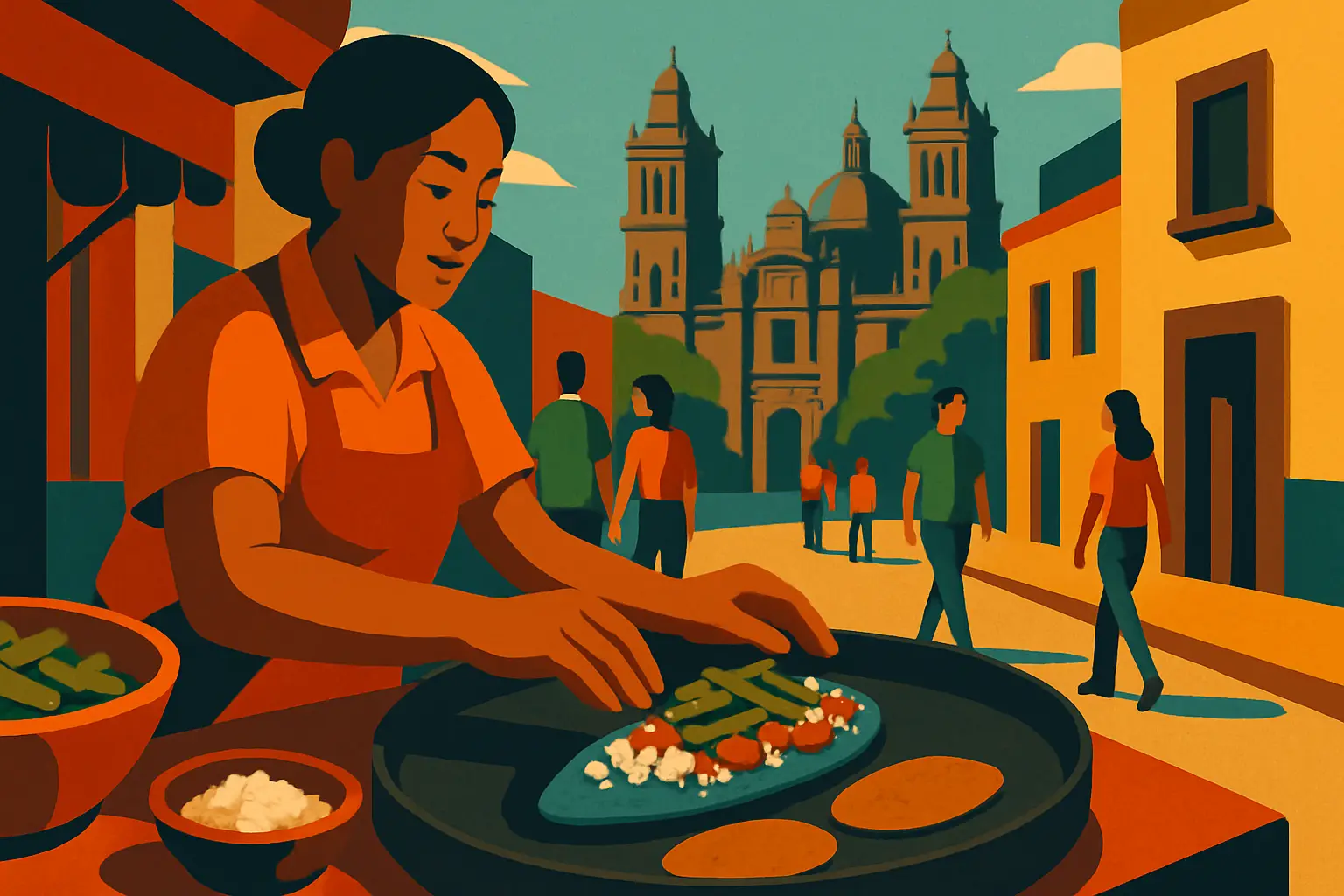
A tlacoyo (tlah-KOY-oh) is a hand-formed oval patty of masa — typically blue corn — stuffed with a filling before it ever hits the comal. The raw dough is shaped around a core of frijoles negros (black beans), habas (fava beans), or requesón (a fresh cheese similar to ricotta), pressed flat by hand, and cooked on a dry comal until the outside develops a slightly crispy skin and the inside filling turns soft and hot. Once cooked, toppings are applied: a stripe of nopales (sliced cactus paddle cooked in salsa), a spoonful of salsa verde or roja, and a crumble of queso fresco or panela. The result is dense, earthy, and filling in a way that a taco isn't — one large tlacoyo and a coffee is a complete breakfast. The name comes from Nahuatl, and the dish predates both the Spanish conquest and the concept of the taqueria. In its current form on Mexico City street corners, it is essentially unchanged.
Tlacoyos exist elsewhere in central Mexico, but Mexico City is where the tradition has survived most densely in urban street food form. The dish has pre-Hispanic roots tied to the Valley of Mexico, where the ancient lake system supported maize agriculture dating back over 3,000 years. Maíz azul (blue corn) is native to central Mexico's highlands and has higher protein content and a nuttier, slightly earthier flavor than yellow or white corn. The tlacoyo was the working food of the market and the cornfield: portable, calorie-dense, and requiring no plate or utensil. After the conquest, it survived in home cooking and market stalls in a way that many other pre-Columbian dishes did not — its ingredients were entirely local, cheap, and abundant. Today, most of the women who sell tlacoyos in Mexico City are from Nahua communities in the southern boroughs of Milpa Alta and Xochimilco, where blue corn farming is still active. The dish travels with the people who know how to make it.
Get short, interactive stories that make each place easier to remember while you travel.
Every tlacoyo stand offers two or three fillings. Frijoles negros (black beans, mashed smooth) is the most common and the best baseline — cooked with epazote, a pungent native herb, which gives them a flavor that doesn't translate to any canned equivalent. Habas (fava beans) is the older filling found at traditional spots — favas cooked soft and mashed, with a slightly more mineral, less sweet flavor than black beans. Requesón is the wild card: a fresh, slightly grainy cheese similar to ricotta that turns molten inside the hot masa, giving the tlacoyo a creamy, tangy interior. If you're ordering for the first time, get one frijol and one habas to compare. The requesón is better once you've eaten a few and understand what the masa is doing. All three fillings are vegetarian — the tlacoyo may be the most significant naturally vegetarian street food in Mexico City. Completely satisfying, with no concession made.
All three are masa snacks grilled on a comal, and most first-time visitors assume they're variations of the same dish. They aren't. A sope is thicker and round, with pinched-up edges around the rim, and the toppings — beans, meat, lettuce, crema — are applied to the surface after cooking rather than stuffed inside. It functions as a small open-faced masa plate. A gordita is thicker still, cooked sealed, then split open horizontally and stuffed like a pita — chicharrón, cheese, or guiso fills the interior. A tlacoyo is the only one where the filling is enclosed inside the raw masa before the first contact with heat. This changes the texture entirely: the filling steams inside the masa as it cooks, making the interior moist and integrated rather than layered on top. It's also the only one of the three with unbroken pre-Columbian provenance — sopes and gorditas emerged in their current form after the Spanish introduced lard and techniques that made thick-masa cooking more practical. Order all three once and the difference becomes unmistakable.
Tlacoyo stands are almost always run by one or two women — one forming the dough and managing the comal, one taking orders and money. Walk up and wait to be acknowledged; don't interrupt if she's mid-press. You'll be asked '¿De qué le pongo?' or '¿Qué va a querer?' — both mean 'what would you like?' Name your filling: 'uno de frijol', 'uno de habas', or 'uno de requesón'. The tlacoyo goes on the comal. While it cooks (3–5 minutes), you'll be asked about toppings. The standard set is nopales, salsa verde, and queso — if you don't specify, this is what you get. If you want salsa roja instead of verde, say so. Pay when you receive it: 25 to 40 pesos. There are no menus. Everything is made in front of you. Eat standing at the counter or nearby — these aren't sit-down operations. The comal is simultaneously the kitchen and the counter.
Mercado de Medellín (Calle Medellín between Campeche and Laredo, Roma Sur) has one of the most reliable tlacoyo and quesadilla corridors in the city. Vendors inside and along the exterior southern entrance operate from around 8 a.m. to 2 p.m., use blue corn masa pressed that morning, and offer nopales cooked in salsa verde rather than plain strips. The full Medellín guide covers the whole market. Mercado de Coyoacán (Ignacio Allende at Malitzin, Coyoacán): weekend morning vendors set up just outside the main entrance on Saturdays and Sundays from 7 to 11 a.m. These are often Milpa Alta women who bring fresh masa from the southern boroughs — the blue corn is noticeably more fragrant than at stands using commercial masa harina. Near Metro Merced (Avenida Uruguay between Eje 1 and Correo Mayor, Centro Histórico): the blocks around La Merced have active morning street food corridors where tlacoyo vendors set up alongside canasta taco vendors. Peak hours are 7 to 10 a.m. on weekdays. Mercado Jamaica (Congreso de la Unión, Colonia Jamaica): exterior stalls along the eastern face of the market have tlacoyo vendors on weekday mornings — arrive before 11 a.m.
Is one tlacoyo enough? One large tlacoyo has roughly the same caloric density as two standard tacos — the masa is thick and the filling adds protein. For a light breakfast, one is enough; for a full meal, two is standard. How much do they cost? Between 25 and 40 pesos ($1.25 to $2 USD). Working-class neighborhoods like Jamaica and La Merced skew toward 25–30 pesos; Roma Sur and Coyoacán spots tend toward 35–45 pesos. Can vegetarians eat them? Yes — all three fillings are vegetarian by default. The comal may be shared with other foods at busy stands, so strict vegans should ask, but no meat is ever in the tlacoyo itself. When do stands close? Almost universally by 2 p.m., with the best selection before 11 a.m. They don't operate at night. What to drink with one? Agua fresca from a nearby vendor — hibiscus (jamaica) or tamarind — is the traditional pairing. Early in the morning, some stands offer atole, a warm masa-based drink that doubles down on the corn flavor in a way that works surprisingly well alongside a habas tlacoyo. For more on where this dish fits in the broader street food picture, the Mexico City street food guide covers the full landscape.