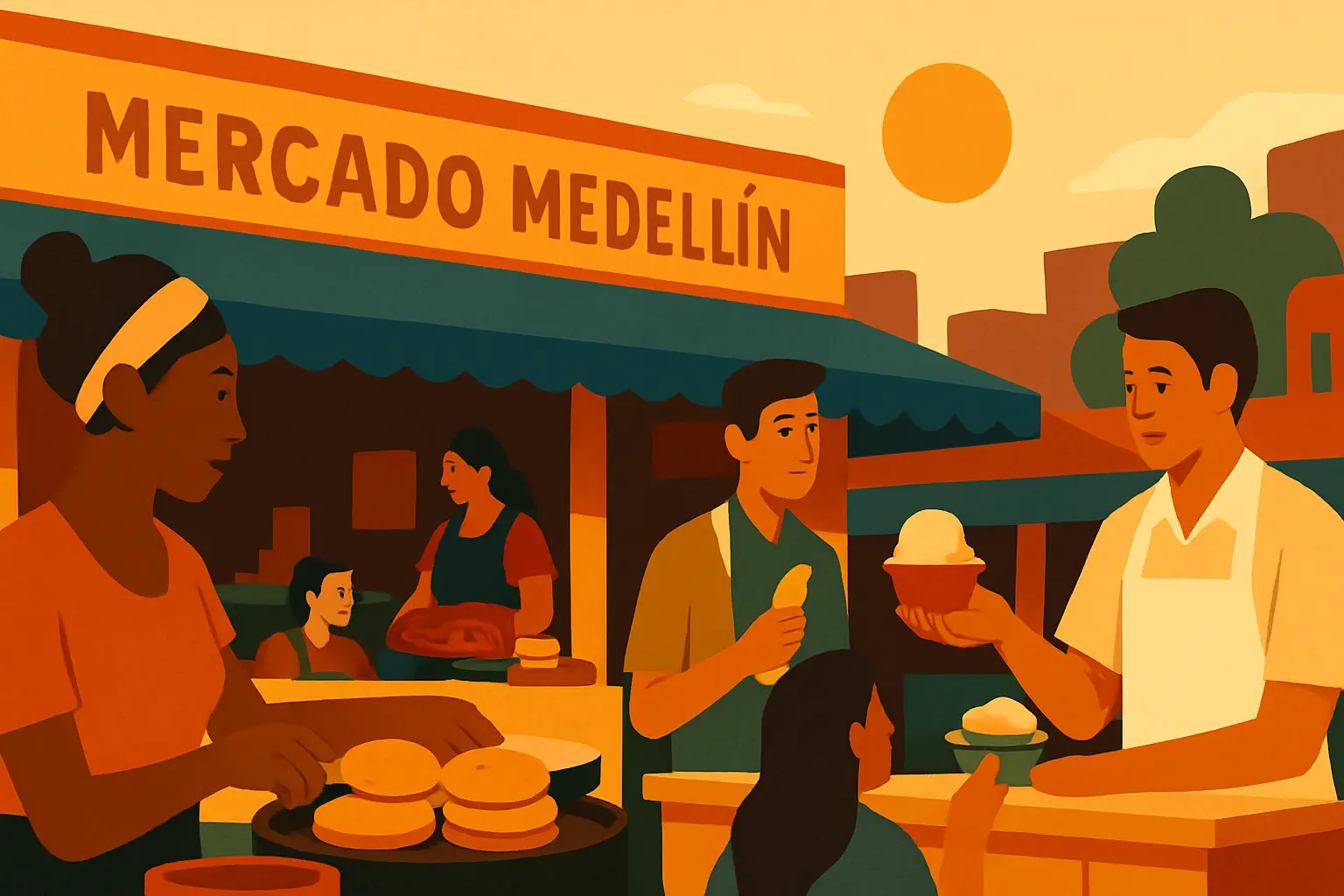
The Roma Sur neighborhood developed differently from its northern counterpart. While Roma Norte evolved into the city's art deco showpiece, Roma Sur — the blocks south of Álvaro Obregón — remained quieter and more residential, with lower rents that made it a natural landing spot for immigrant communities arriving in Mexico City through the mid-twentieth century. Colombians settled first in significant numbers, establishing businesses around the blocks near Calle Medellín. Cubans followed after 1959, bringing their food traditions, their flags, and their ice cream. Venezuelans, Brazilians, and Argentine immigrants added to the mix over subsequent decades. The market itself — officially named Mercado Melchor Ocampo but known to everyone simply as Mercado Medellín, after the street it runs along — predates all of this. It was established in the late 1800s as a produce and dry goods market for the neighborhood. What changed over a century is what fills it. Today you walk past a Cuban ice cream counter, a vendor selling Colombian cassava arepas, shelves of Bucanero and Cristal (Cuban beers imported from Havana), and Argentine-style sausages before you even reach the Mexican chiles and mole pastes. The Colombian, Venezuelan, and Cuban flags are hung proudly from rafters and across shelves. No other market in the city tells that story.
The heart of the Latin American section runs through the interior lanes, roughly in the middle of the market between the Campeche and Medellín-facing stalls. Helados Palmeiro is the anchor: a Cuban-style ice cream counter that draws a steady line from late morning through early afternoon. The ice cream is made in traditional Cuban style — dense, not too sweet, slow-churned, with flavors like mamey (a dense orange tropical fruit with a custard-like texture), guanábana, and chocolate. A single cone runs 40–50 pesos. On the surrounding shelves you will find Bucanero and Cristal — the two principal Cuban lager beers — sold cold in cans for around 30 pesos each. They are rarely stocked in Mexico City supermarkets, and finding them here feels like a small discovery. A few stalls down, vendors sell pan cubano (Cuban bread rolls, lighter and crustier than a bolillo) and assemble sandwiches cubanos on request: slow-cooked pork, ham, Swiss cheese, and pickles, pressed flat on a hot plancha. This is not a gentrified reconstruction — it costs 60–80 pesos and tastes like something made for the neighborhood, not for Instagram.
Get short, interactive stories that make each place easier to remember while you travel.
Several stalls specialize in Colombian and Venezuelan products. Arepas de choclo — thick, slightly sweet corn cakes from the Colombian tradition, made fresh and served with a slice of melted cheese — are sold from early morning. These are different from a corn tortilla in every way: thicker, chewier, with a sweetness from white corn masa that does not exist in Mexican nixtamal. Tequeños (Venezuelan cheese-filled bread sticks, fried until golden) appear at a couple of stalls and disappear quickly on weekend mornings. The pantry stalls carry Colombian maltesa (a sweet, malty barley soda that is a staple of Colombian households), panela in solid block form, ají amarillo paste from Peru, cassava flour, and dried guanábana leaf for medicinal infusions. Argentine and Uruguayan shelf staples turn up alongside them — dulce de leche in large tins, yerba mate, and medialunas (Argentine-style croissants) from a small bakery counter near the interior. The families running these stalls have been in the market for decades. Ask about the arepas and you will get a story.
The outer aisles of Mercado Medellín do what every good Mexico City market does: supply the raw materials for Mexican cooking at prices and quality no supermarket matches. The dried chile section covers the full range sold loose by weight — guajillo, ancho, mulato, chihuacle negro, pasilla, and chile de árbol. A bag of twenty guajillos runs 25–30 pesos. The mole paste vendors sell house-made pastes in five or six styles: negro, coloradito, almendrado, verde, and pipián. The paste here is fresh, not jarred — you thin it with chicken broth at home and it tastes like actual mole rather than the diluted, shelf-stable version. Fresh herbs including epazote, hierba santa, and hoja santa sit next to the chiles. The tortillería in the back of the market makes flour tortillas throughout the morning, supplying restaurants across Roma Sur and Condesa. A packet of ten costs 30 pesos. These are the flour tortillas that warm in a dry skillet and puff slightly at the edges — the kind that make you understand why Roma Sur kitchens buy them here instead of at the store.
A row of small fondas runs along the back section and fills from noon to 3 p.m. Cocinas Juanita e Hijas is the most-cited standby for a proper comida corrida: sopa de fideos, a guisado del día (rotating options include chicharrón en salsa verde, pollo en salsa morita, and picadillo), rice, beans, tortillas, and an agua fresca for 80–100 pesos. El Carnerito, positioned near the center of the market, specializes in chiles rellenos — large poblano peppers filled with cheese, battered in egg, and fried to order — alongside milanesas and barbacoa tacos on weekend mornings. Las Tablas Roma, managed by Rosa Martha Jasso since 2001, has a small standing-room counter and is worth a stop for the daily soups. The real standout is La Marisquería La Morenita de Medellín: one of the few spots in landlocked Mexico City where seafood shows up reliably fresh, served as tostadas de ceviche, sopa de mariscos, and mixed aguachile. Order the ceviche tostada for around 80 pesos. Arrive by 12:30 p.m. before it fills — there are only a handful of stools.
Delicatessin La Reyna is unlike anything else in the market: a narrow deli counter stocked with house-made Italian and Spanish-style sausages, imported products from Argentina and Uruguay, and a cold case of cured meats and specialty cheeses that do not appear in Mexican supermarkets. The proprietors make their own morcilla (blood sausage) in the Argentine style, a spiced chorizo criollo, and a Uruguayan-style longaniza — all without fillers, using old-world techniques. Imported Argentine products fill the shelves: vacuum-packed morcilla de arroz, Uruguayan-style salami, and tinned paté from Buenos Aires butcher houses. It runs during standard market hours but tends to sell out of the house-made sausages by 2 p.m. A 200-gram package of their chorizo costs around 80–90 pesos. Pick up a bag of dried chiles from the adjacent stall and a packet of tortillas from the tortillería and you have the skeleton of an excellent dinner.
The market is located at the corner of Calle Medellín and Calle Campeche in Roma Sur — the official address is Medellín 234, though the Campeche entrance at Campeche 101 is the more useful entry point for first-time visitors. Hours: Monday through Saturday 8 a.m. to 7 p.m., Sunday 8 a.m. to 6 p.m. The best window is Tuesday through Friday, 9 a.m. to noon: all vendors are present, the fondas are prepping but not yet crowded, and you can move through the aisles without the Saturday-morning rush. Avoid arriving after 2 p.m. on any day — stalls begin packing up and the fondas run out of their daily specials.
By Metro: Line 2 (Blue line) to Campeche station. Exit toward Avenida Sonora and walk two blocks west along Campeche — the market entrance is on your right. By Metrobús: Line 1 to the Sonora stop, then a short walk south. On foot from Roma Norte: cross Álvaro Obregón heading south on Orizaba or Medellín and continue four blocks — about 10 minutes from Parque Pushkin. The Roma Sur neighborhood guide covers what else is in the area.
Is it tourist-friendly? Yes — more so than Mercado de Sonora or Mercado Jamaica, which cater almost entirely to Mexican buyers and can feel confusing on a first visit. Medellín has enough variety and visual logic that it makes sense quickly. Most vendors speak Spanish only, but pointing is completely normal and no one will make you feel unwelcome for it. Is it safe? Roma Sur is a residential neighborhood with no significant safety concerns. The market is a working public space — the same precautions you would take anywhere in the city (keep your bag in front of you, use your phone with awareness) apply here. How does it compare to other CDMX markets? Mercado de San Juan is the city's dedicated gourmet and international market — more expensive, more curated. Mercado Medellín is less edited and more functional: the prices are lower, the variety is wider, and the atmosphere is that of a neighborhood market rather than a tourist destination. What else is nearby? Parque Ramón Gómez Corriente is a two-block walk — a good quiet park for post-market recovery. The Roma Sur restaurant corridor on Calle Orizaba begins about 10 minutes on foot from the Campeche entrance.