Most visitors arrive expecting a single flea market and find something considerably harder to map. La Lagunilla is actually a cluster of three permanent market buildings operating throughout the week, plus a massive open-air tianguis that unfolds around them every Sunday and nearly doubles the footprint of the whole thing.
The three permanent buildings each have their own specialty. The northern building handles clothing — rebozos (traditional woven shawls), blankets, fabric by the meter, and garment-trade supplies that have made this neighborhood a center for the textile business since colonial times. The southern building runs toward household goods: pottery, copper lamps, tools, and the kind of practical domestic inventory that working-class Mexico City has sourced here for generations. A third building covers food staples.
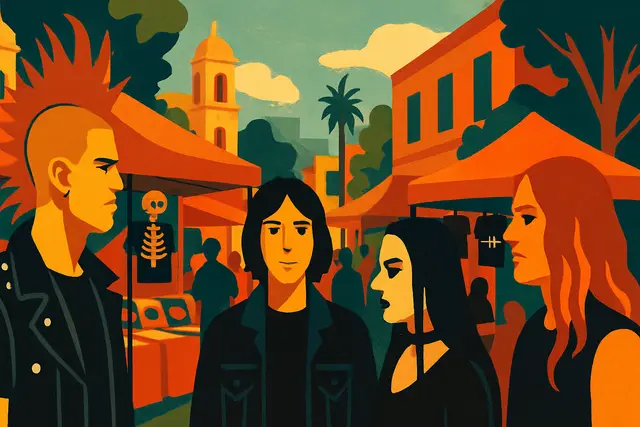
Then Sunday hits. The Tianguis de Comonfort — named for Comonfort Street, which runs directly through the market zone — activates. Bigger antique dealers set up inside the covered Tianguis de Comonfort building, where you'll find the more serious inventory and the higher price tags. Hundreds of smaller vendors unfurl their tarps on the surrounding sidewalks and spill out over multiple blocks, eventually merging with a separate street market aimed at younger buyers — vintage sneakers, streetwear, and early-2000s nostalgia. The two markets blur at their edges, which means that hunting one will accidentally take you through the other.
Three permanent buildings: clothing/rebozos, household goods/pottery, food staples — open most of the week
Sunday adds the Tianguis de Comonfort antiques market, which roughly doubles the footprint
The antiques zone blends into a sneaker and streetwear tianguis on the northern edge
La Lagunilla's location was not random. Before the Spanish conquest, the area served as an offloading point for the canoes that supplied the great Tlatelolco market — one of the largest marketplaces in the pre-Columbian world. Goods arrived by water, were unloaded in this zone, and moved into the city. You can read more about that Tlatelolco market legacy in the Tlatelolco guide.
After the conquest, Mexico City's street trade consolidated around El Baratillo — a flea market of sorts that operated in and around the Zócalo. In 1609, the viceroy of New Spain banned the baratillo from the main plaza. The reason was less about aesthetics and more about what was being sold: stolen goods, contraband, and merchandise with murky provenance had always circulated in street markets, and the colonial government preferred those transactions to happen somewhere less visible. The vendors moved to La Lagunilla, where they have remained ever since.
That 1609 displacement is part of why the neighborhood has always had an edge — it was specifically designated as the place for the commerce the authorities didn't want in their sightline. That history is present in the market today in a way that's easy to feel without quite being able to explain.
Pre-Hispanic origin: the zone offloaded goods from Tlatelolco market canoes before the Spanish arrived
1609: the viceroy banned the Zocalo baratillo; vendors relocated to Lagunilla and never left
The neighborhood has a long history of selling things the authorities preferred not to see too clearly
Get short, interactive stories that make each place easier to remember while you travel.
The Sunday Lagunilla tianguis has real depth if you know what you're looking at. The categories that consistently reward careful browsing:
Books — First-edition Mexican novels, vintage photography books, old technical manuals, political pamphlets from the 1960s and 70s, art catalogs from exhibitions long since closed. Spanish-language material dominates, but unusual English-language books surface regularly. Some vendors specialize entirely in books and organize their inventory carefully; others have boxes you'll need to dig through.
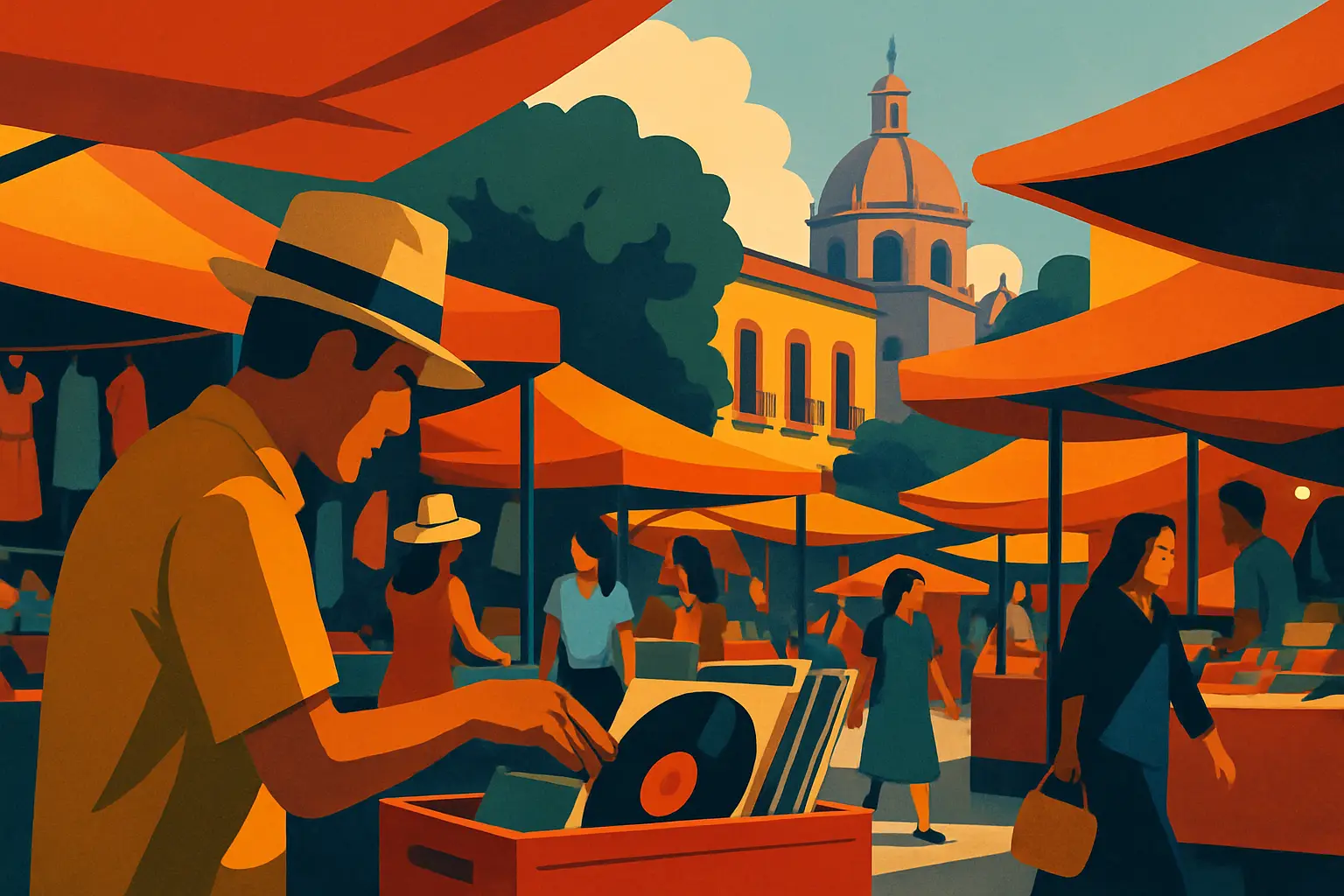
Vinyl records — LP records are everywhere: boleros, cumbia, early rock en español, and occasionally jazz or classical imports. Prices vary wildly. A vendor who knows what they have will price accordingly; a vendor running a general stall may not notice that a 1970s Caifanes reissue is buried under a stack of easy-listening compilations.
Mid-century Mexican furniture — Van Beuren desks, art deco bedroom sets, Thonet bentwood chairs, and the kind of heavy wooden office furniture that Mexico City office buildings unloaded in bulk during the renovation waves of the 1990s. These vendors cluster inside and immediately outside the Tianguis de Comonfort building. Prices are negotiable but the big pieces are priced in the thousands of pesos — bring cash and realistic expectations about logistics.
Vintage paper goods — Old postcards of Mexico City from the 1940s–1970s, tourist brochures, vintage drink trays with lithographed advertising, political posters, and hand-tinted photographs. These are among the best souvenirs at the market because they're genuinely old, genuinely cheap, and genuinely specific to Mexico.
Art and prints — Signed lithographs occasionally surface, attributed to significant artists including Leonora Carrington. Treat any claimed provenance with skepticism unless you know how to verify it. That said, unsigned prints and posters from Mexican printmaking collectives appear regularly and are almost always underpriced.
The anchor is the Tianguis de Comonfort building on Comonfort Street. This is where the more established antique dealers maintain semi-permanent stalls — they come every Sunday, they know their inventory, and their prices reflect that. Start here to calibrate what's available, then work outward.
The sidewalks and adjacent streets surrounding the building fill with smaller vendors who set up folding tables and tarps. These are the spots where the real bargains tend to hide, both because the vendors are less certain of their inventory's value and because fewer buyers think to dig through what looks like a random pile. Allow yourself at least 90 minutes if you're doing this seriously — the market spans enough blocks that a quick pass misses most of it.
On the north end, the antiques tianguis gradually merges with the sneaker and streetwear market. If you suddenly find yourself surrounded by Jordans and early-2000s sports jerseys instead of copper lamps and old books, you've drifted. Turn back south and you'll find where the two markets separate.
On Sundays, Avenida Paseo de la Reforma is closed to car traffic from Centro Histórico all the way up to the market area. The city opens it for cyclists and pedestrians, which means the nicest approach is a 15-minute walk or bike ride up a car-free Reforma from the Zócalo area — through the monuments, past the Diana fountain, and into the market zone without a single traffic light to wait for.
Start at Tianguis de Comonfort building — established dealers inside, browse outward from there
Budget at least 90 minutes; the market spans too many blocks to rush
Sunday Reforma is car-free — the walk from Centro Historico through the monuments is one of the best approaches
Negotiation is not optional at La Lagunilla — it's structural. The asking price is a starting position, not a conclusion, and vendors who set up here every Sunday are fully prepared for it.
The standard opening is 50–60% of the marked or stated price. A vendor asking 500 pesos for something expects an offer of 250–300. The usual landing zone is 65–75% of the original ask. Some vendors will hold firm on pieces they know are rare; others will fold quickly on items they've been carrying for months.
Cash is required. Most vendors have no card reader. Bring enough pesos to shop without breaking large bills — 500-peso notes are workable, but 200s and 100s make transactions easier.
On photography: ask before pointing a camera at a vendor or their merchandise. A few will decline, and the few who do mean it. It's a thirty-second courtesy that prevents a long argument.
On signed pieces: if a vendor is telling you something was signed by a famous artist, treat it as a story rather than a fact. Some pieces are genuine. Many are not. Mexican art forgery is a real industry, and La Lagunilla has historically been a place where those goods circulate. If you're paying serious money for a signed work, you need more documentation than Sunday morning at a street market can provide.
Open at 50–60% of asking; expect to settle around 70–75%
Cash only — bring small bills, not large notes
Ask before photographing vendors or merchandise — most say yes, a few don't
Street food sets up around the market on Sunday mornings to feed the vendors and the shoppers. Tacos, quesadillas, and tamales are within walking distance of almost any point in the tianguis.
The signature drink of La Lagunilla — not because it's unique to the market but because it fits — is the michelada made with a caguama: a 940ml bottle of beer (one of the larger-format bottles sold cheaply across Mexico) poured into a tall cup over ice, lime juice, salt, and sometimes a dash of Worcestershire or chamoy. It's enormous, it's cold, it costs about the same as a regular beer elsewhere, and it lasts long enough to get you through a serious browsing session.
For coffee, the surrounding neighborhood — which borders Guerrero — has a few neighborhood cafés that open Sunday mornings. You're not in Roma Norte; don't expect a specialty espresso menu. Expect strong café de olla in a ceramic cup at a plastic table on a sidewalk, which is a significant upgrade in some respects.
Michelada with a caguama (940ml bottle) is the market's standard drink — look for vendors selling them near the Comonfort building
Street tacos and tamales set up to feed the Sunday crowd — the market runs through the prime breakfast hours
Café de olla from a nearby neighborhood spot is a better choice than hunting for a specialty coffee shop in this area
By Metro: The closest station is Garibaldi-Lagunilla on Line B, which deposits you essentially at the market's front door. From there, head north on Comonfort Street. From Line 2, Allende or Bellas Artes are reasonable walk options — about 20 minutes through Centro Histórico.
On foot or bike on Sundays: If you're starting from anywhere along Reforma — the Zócalo, Zona Rosa, or Condesa — use the Sunday car-free Reforma corridor. The city closes Reforma to vehicles on Sunday mornings and opens it to cyclists and pedestrians. It is one of the most pleasant ways to move through Mexico City and it drops you directly into the market neighborhood.
When to go: Sunday only, 9 a.m. to roughly 3 p.m. Arrive by 10 a.m. to find the best pieces before regular collectors and dealers make their passes. The market gets crowded from 11 a.m. onward. By 2 p.m., vendors start packing up and the good inventory is gone.
The weekday market runs on a smaller scale every day of the week — the three permanent buildings are open and worth checking for household goods, fabric, and food staples — but the Sunday antiques explosion is the main event.
La Lagunilla sits between Centro Histórico and the Guerrero neighborhood, adjacent to Tepito — and that geography means it gets the anxiety-inducing reputation of its neighbors without quite deserving it. The market itself, on a Sunday morning, has a dense crowd of vendors and shoppers and the general social safety of any busy public space.
Practical precautions that apply here more than in, say, Polanco:
Leave the backpack at home or wear it in front. A messenger bag across the chest is better than a shoulder strap that hangs loose. Pickpockets work crowded markets and this one qualifies.
Bring only the cash you intend to spend. Don't arrive with a wallet stuffed with bills and cards. The transactions here are all cash, but that doesn't mean you need to carry everything you own.
Don't display expensive electronics. The phone you're using to look something up is fine. The camera with a long lens slung around your neck is a different statement.
Avoid the blocks that are explicitly Tepito rather than Lagunilla if you're unfamiliar with the area — but the market zone itself, during Sunday market hours, is fine. The vendors have a vested interest in keeping the market functional and the foot traffic coming back. See also our guide to Mexico City markets for how this fits into the broader market ecosystem.
Wear bags in front or cross-body — pickpockets work crowded markets
Bring only the cash you plan to spend — all transactions are cash, but that means targeted carrying, not a full wallet
During Sunday market hours, the area is active and social — the concern is petty theft, not serious danger