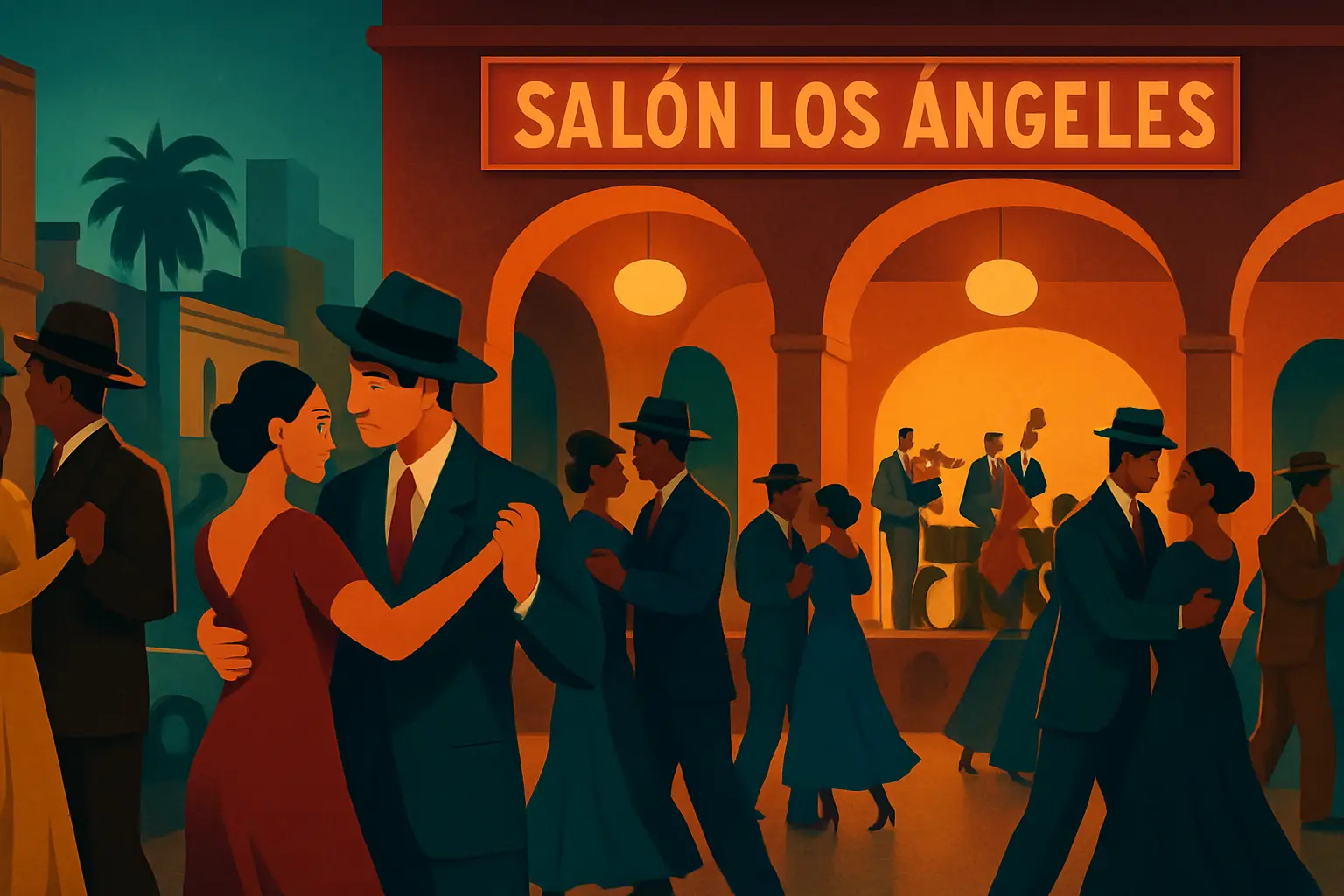
Salón Los Ángeles is a ballroom at Lerdo 206 in Colonia Guerrero — a working-class neighborhood northwest of Centro Histórico — that opened on July 26, 1937, and has never closed. The Nieto family built it on the site of a coal business they had operated at the same address since the early 1900s. What began as a neighborhood dance hall became, within a decade, one of the most significant music venues in Latin America: a room where Cuban danzón, Colombian cumbia, and Mexican coastal rhythms collided with the tastes of a capital city that was, in the 1940s and 1950s, a gathering point for artists, exiles, and intellectuals from across the continent. Every other salón de baile from that era in Mexico City is gone. The famous El Salón México — once called the 'Cathedral of Danzón' — closed in 1962 and was demolished. Salón Los Ángeles survived by staying exactly what it had always been. The exterior is easy to miss: a faded orange facade, a modest sign, a doorway that looks like it leads somewhere ordinary. Inside, the scale surprises — a wide hardwood dance floor, a proper raised stage, tables along the walls, and a ceiling high enough to give the orchestra room to breathe.
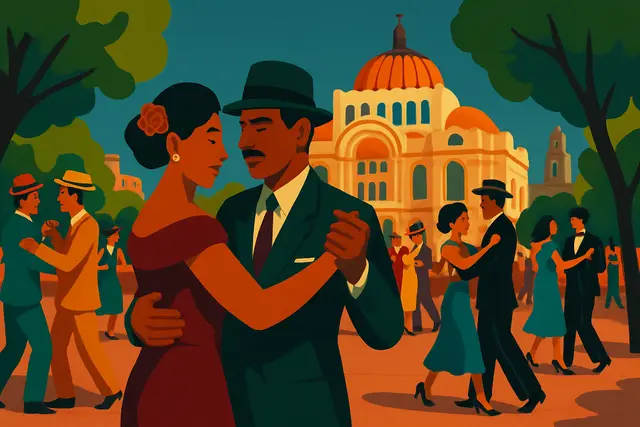
Danzón is a Cuban musical form that originated in Matanzas in 1879 when composer Miguel Faílde first performed 'Las alturas de Simpson.' It fuses European contradanza structure with West African rhythmic patterns — specifically the clave, the organizing pulse that underpins all Afro-Caribbean music — filtered through the experience of Haitian refugees who arrived in Cuba after the revolution of 1791. The dance itself reflects this complexity: a closed hold, small precise footwork, an emphasis on timing over spectacle. Watching skilled danzón dancers, you notice how little they appear to move. The craft is internal — in the connection between partners and in the footwork — not in the display. Danzón traveled from Cuba to Mexico through the Yucatán Peninsula, where proximity made musical exchange easy, then spread to Veracruz and eventually to Mexico City in the 1920s. The great irony of the form is that it has essentially disappeared in Cuba, its country of origin, while Mexico kept it alive. Today the most committed danzón community on earth is in Mexico City, in venues like Salón Los Ángeles and the Sunday gatherings at the Jardín Hidalgo in Coyoacán, where couples dance outdoors to recorded music every week.
Get short, interactive stories that make each place easier to remember while you travel.
The golden age of Salón Los Ángeles ran from roughly 1945 to 1960, and the names attached to those years read like an improbable novel. Diego Rivera and Frida Kahlo brought the exiled Soviet revolutionary Leon Trotsky to hear music there. In 1949, Cuban bandleader Dámaso Pérez Prado premiered Mambo No. 5 at Salón Los Ángeles — testing it on a live dance floor in Colonia Guerrero before it had been recorded — and the crowd responded immediately. Fidel Castro and Che Guevara, during their years in Mexico City in the mid-1950s, stopped in to hear music. Gabriel García Márquez, who lived in the city for years and was part of the same expatriate Latin American circle, was a regular at the bar. This accumulation is not promotional mythology. It reflects the actual function the venue served: Mexico City in that period was a hub for Latin American exiles and artists, and the salones de baile were where everyone eventually ended up. The hall's endurance through decades of shifting neighborhoods and changing tastes is its own kind of achievement — most institutions from that era have a museum plaque where the building used to stand.
Admission is around 150 pesos (roughly $8 USD) at the door — cash only. Inside, tables and chairs ring the central dance floor, with the stage at one end. The decor has not been dramatically updated since the hall's peak decades, and this is precisely the point: the faded photographs on the walls, the vintage advertisements near the bar, and the quality of light are not curated nostalgia. They exist because the room has always looked like this. The crowd on a typical Tuesday evening skews toward 50 and older, with a significant contingent of regulars who have been coming for decades. The identifiable ones are dressed in the pachuco style of the 1940s: men in high-waisted wide-leg trousers, long jackets, and two-tone shoes; women in long gowns with heels. The look references the era when performers like Tin Tan — who appeared at the hall in person — made pachuco style the aesthetic of Mexico City's dance culture. Coming in dressed up is not required, but it is noticed. Smart casual — a collared shirt, clean shoes — is the realistic minimum. Arriving in gym clothes will earn a certain quality of silence from the regulars.
A typical evening opens with a danzonera — a full orchestral ensemble specialized in danzón — playing classic pieces from the 1940s and 1950s. Couples settle into the closed hold: man's right hand on the woman's upper back, left hand holding her right, bodies close but not pressed together. Danzón is danced in a small territory, rotating in place more than traveling across the floor; the footwork is intricate and slow. A key feature that surprises first-time watchers: at the introduction of each new section of a danzón piece, dancers stop completely. They stand still and wait, holding position, until the main melody returns — then they resume. Getting that pause right signals that you understand something real about the form. Between danzón sets, the orchestra shifts to mambo (faster, big-band energy), then cha-cha-cha. On Sundays, the program leans toward Afro-Caribbean styles — son montuno, early salsa — and the crowd skews slightly younger. Arriving at 6 p.m. is ideal: the floor has warmed up, good tables are still available near the dance floor, and you have an hour to watch the regulars before the room fills.
Yes, and the experience holds up. Watching is completely normal at Salón Los Ángeles — at any given table, a third of the seats are occupied by people who are there to observe, drink, and listen. The spectacle of a live orchestra playing danzón for couples who have been dancing this way for forty years is worth the admission on its own. If you want to try dancing, the regulars are the best resource you will find anywhere. It is an established custom for experienced dancers to invite solo visitors or obvious newcomers onto the floor, and most do it without condescension — there is a clear sense that passing on the knowledge is part of why they keep coming. The basic structure can be absorbed from watching: small steps that follow the rhythmic pattern of the music, a closed hold with both partners maintaining slight tension in the connection between hands, and the full stop at each new musical introduction. Attempting it imperfectly is received better than not trying at all. The regulars at Salón Los Ángeles are not interested in gatekeeping a form that is already eighty-seven years old in this room.
Address: Lerdo 206, Colonia Guerrero, Cuauhtémoc, CDMX. The closest Metro station is Guerrero on Line B, a five-to-seven minute walk. At night, taking Uber directly to the door is the more comfortable option. Colonia Guerrero has a rough reputation — parts of it border Tepito — but the block around the hall is well-trafficked and the venue itself has operated without serious incident for nearly ninety years. Use standard urban judgment: stay aware, take Uber after 10 p.m. rather than walking back to the Metro station at that hour. Hours: Tuesdays and Sundays, 5 p.m. to 11 p.m. The venue does not operate on other nights. Admission is around 150 pesos; drinks run 70 to 100 pesos. Cash is strongly preferred. If you're pairing the evening with something nearby, Plaza Garibaldi is about a 12-minute walk — mariachi bands play there nightly, and Garibaldi peaks after 9 p.m., which aligns neatly with ending a Salón Los Ángeles session. On Sundays, the nearby Mercado de Lagunilla runs its vintage and antiques market during the day, making the afternoon and evening a natural pairing.
Tuesday or Sunday? Tuesday for the danzón purist experience — the music program is more historically specific, the crowd more committed, and the atmosphere more concentrated. Sunday for more variety in the musical program and a slightly broader mix of ages. First-time visitors who want the most distinctive experience should go on Tuesday. How is it different from a salsa club? Completely. Venues like Mama Rumba in Colonia Polanco or El Babalú near Zona Rosa attract a younger international crowd, a louder and faster program, and a nightclub atmosphere. Salón Los Ángeles is the opposite: quiet enough between sets to hold a conversation, specific in its music, and attended by people who have been coming for thirty years and will be here thirty years from now. It is not the place to go looking for a high-energy night out. It is the place to go when you want to understand something that exists nowhere else in the city — and increasingly, nowhere else in the world.