Porfirio Díaz ruled Mexico for 35 years. By 1910, his modernization project had transformed Mexico City into something resembling a European capital — gas lamps on Paseo de la Reforma, electric trolley lines, a new postal palace, a gleaming opera house on Avenida Juárez. The next item on the list was a grand legislative chamber to replace the crumbling colonial Congress building near the Zócalo. He hired Émile Bérnard, a French Beaux-Arts architect, to design it. Construction broke ground at Plaza de la República in 1910. The steel skeleton went up. The foundations were poured. Then, in November 1910, Francisco I. Madero issued his call to revolution, and within 18 months Díaz was on a boat to Paris — where he died in exile in 1915, never setting foot in Mexico again. The half-finished legislative palace — an iron skeleton exposed to the elements on a windswept plaza — was the last thing he commissioned and the first thing the revolution chose not to complete.
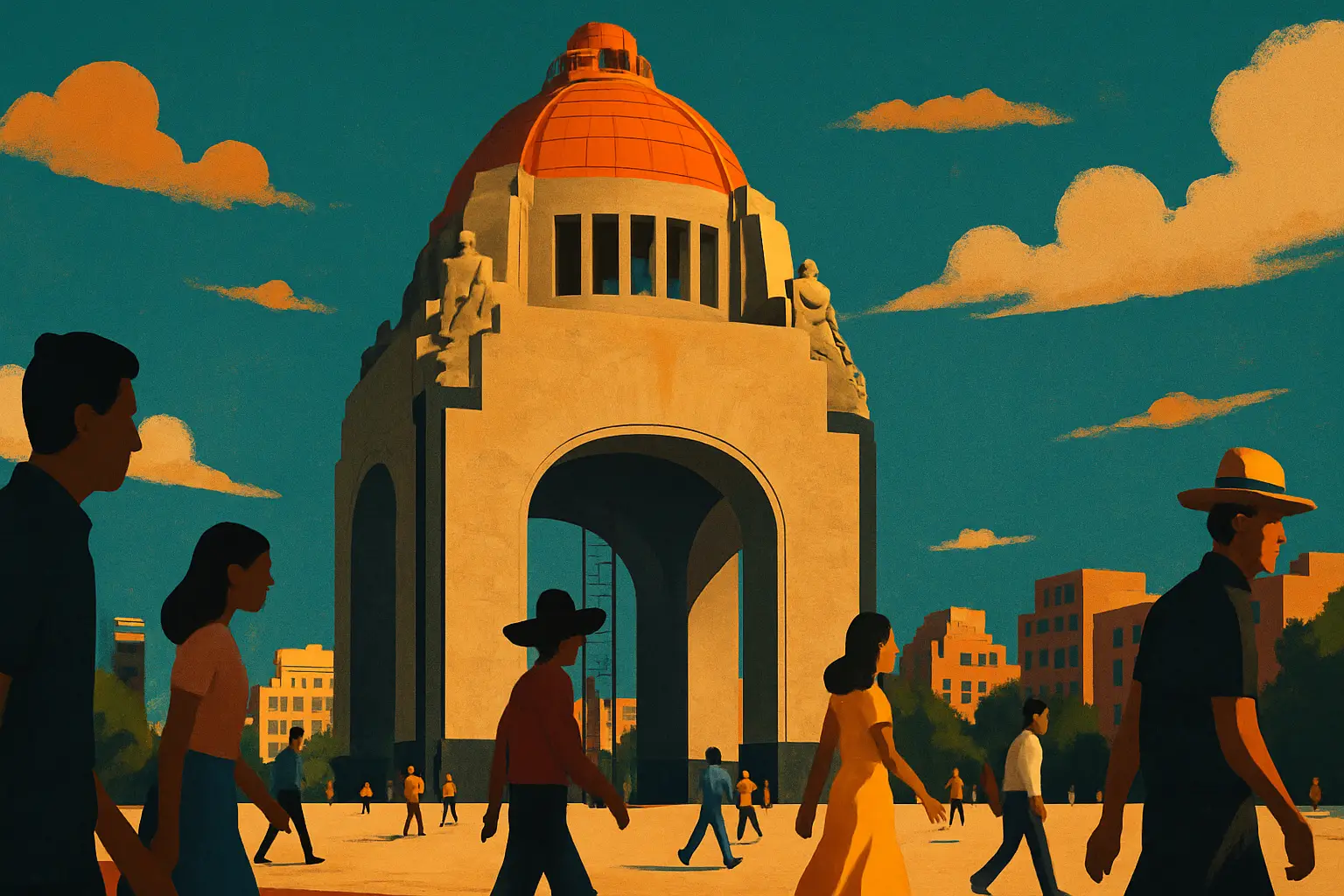
The unfinished skeleton stood on Plaza de la República from 1911 through the 1930s while successive governments debated what to do with it. Proposals circulated for decades: finish it as a congress building, tear it down, repurpose the steel for something else. None moved forward. Then Carlos Obregón Santacilia — one of Mexico's most significant early Modernist architects — proposed a different approach: strip the steel cladding planned for the exterior, expose the massive stone piers already poured for the base, and reframe the entire structure as a triumphal arch commemorating the Revolution as a movement. The redesign was completed in 1938. At 67 meters, it surpassed Paris's Arc de Triomphe and became the tallest triumphal arch in the world. The dome originally intended to crown a legislative chamber became an observation platform. The building that was supposed to house the government of a French-influenced dictatorship was reborn as a monument to the revolution that ended that dictatorship — same foundation, entirely different meaning.
Get short, interactive stories that make each place easier to remember while you travel.
The four massive corner pillars of the monument are not decorative. Each one houses the remains of a key figure from the Revolution and its aftermath. Francisco I. Madero — the idealist candidate who sparked the uprising, won the presidency in 1911, and was assassinated after just 15 months in office in February 1913 — is in one pillar. Venustiano Carranza, the president who convened the 1917 Constitutional Convention and promulgated the constitution that still governs Mexico today, is in another. Plutarco Elías Calles, the political operator who controlled Mexican politics for a decade after his own presidency and founded the party that eventually became the PRI, is in a third. Lázaro Cárdenas — remembered for nationalizing the oil industry in 1938 and creating PEMEX, and for redistributing more land to rural communities than any president before or since — occupies the fourth. Pancho Villa, the División del Norte general whose guerrilla army was the largest force in revolutionary Mexico, was brought to the monument in 1976 by presidential decree and is honored alongside them. Five figures who collectively shaped the country for most of the twentieth century, entombed in a building that was never supposed to exist in its current form.
Francisco I. Madero: first revolutionary president, assassinated February 1913
Venustiano Carranza: promulgated the 1917 Constitution that still governs Mexico
Lázaro Cárdenas: nationalized oil in 1938, created PEMEX, largest land reform in Mexican history
The museum occupies the excavated space beneath the monument's plaza — a subterranean hall that most visitors standing above have no idea exists. Eight rooms trace Mexico from 1867, the end of Maximilian's short-lived empire, through the promulgation of the 1917 Constitution. The collection is built around physical objects rather than interpretive panels: Madero's handwritten correspondence, uniforms worn by both federal soldiers and Zapatistas, field weapons from the Battle of Celaya, and a significant collection of photographs by Agustín Víctor Casasola — the photojournalist whose images of the Revolution became the definitive visual record of the war and are among the most reproduced images in Mexican history. The exhibition is primarily in Spanish, with enough English signage to follow the chronology on your own. Free guided tours are sometimes available at the entrance; when they're running, they're worth joining. The space itself — low ceilings, stone columns, artifacts lit from below — reads as genuinely subterranean and stands in deliberate contrast to the scale and openness of everything above it.
The panoramic elevator runs inside one of the monument's corner pillars to the observation level at the top of the dome. On a clear morning — which most Mexico City mornings are, before the afternoon cloud buildup that defines rainy season from May through October — the 360-degree view covers more of the city than almost any other public viewpoint. To the southeast: Popocatépetl and Iztaccíhuatl, the two volcanoes that mark the city's eastern horizon, rising visibly above the smog line on days with good visibility. To the west: the forest canopy of Bosque de Chapultepec, with the castle tower visible above the treeline. Directly below, Paseo de la Reforma cuts diagonally through the city's grid. On World Cup match days this June, that avenue fills with fans in green jerseys walking toward fan zones near the Ángel de la Independencia — visible from the deck as a gold spike about 1.5 kilometers to the southeast. Café Mirador Emil operates at the top, serving coffee, snacks, and micheladas. The view earns a longer stop than most people plan for.
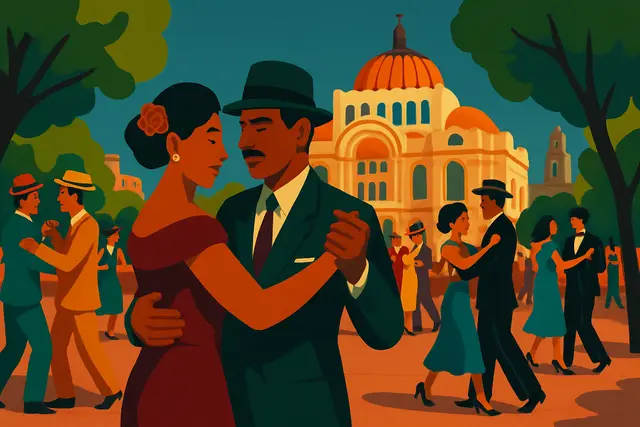
The monument sits at the center of Plaza de la República, a broad esplanade that doubles as one of Mexico City's main event venues — outdoor book fairs, political demonstrations, and the stage setup for Vive Latino, one of Latin America's largest rock festivals, each spring. The surrounding neighborhood is Tabacalera, historically a working-class district that grew around a tobacco factory and has in recent years attracted architecture studios, design offices, and a quieter restaurant scene than neighboring Juárez or Roma Norte. Walking south from the plaza on Insurgentes Norte for about ten minutes brings you to Avenida Hidalgo, and from there the Alameda Central and the Palacio de Bellas Artes are five minutes further south — making the monument a natural first stop on a morning that ends at Bellas Artes. Calle Ezequiel Montes, one block east of the plaza, has been quietly accumulating good lunch spots that most tourists walking between sites never detour to find.
Metro: Line 2 (the blue line) stops at Revolución station, directly adjacent to the monument's east side. From Roma Norte or Condesa, take Metro Line 1 to Insurgentes and transfer to Line 2, or walk north on Insurgentes Norte about 25 minutes. From Centro Histórico, Line 2 connects Bellas Artes to Revolución in four stops.
Costs: Museum admission is free every day (and confirmed free on Sundays). Observation deck with elevator: approximately 150 pesos per person. Café Mirador Emil at the top: 80–200 pesos for coffee, beer, or a michelada with a view.
Hours: Museum open Tuesday through Sunday, 9 a.m. to 5 p.m. The observation deck runs the same hours. The plaza is accessible 24 hours — it's well-lit at night and the monument is illuminated after dark.
Time needed: Allow 2 hours for the museum and observation deck together. Add 30 minutes if you stop at the café on top. If you're combining with Bellas Artes, budget a full morning.
Yes — and it's undervisited specifically because it's not on the standard CDMX tourist circuit that runs from Zócalo to Coyoacán to Chapultepec. Most visitors arrive knowing the broad strokes of Aztec history. The Mexican Revolution is less internationally known and harder to contextualize without a physical anchor. This monument provides that anchor: real historical figures buried inside a building with one of the stranger origin stories in the city, a subterranean museum that covers the decade of fighting with documentary precision, and a rooftop that puts the city's geography in perspective. Go before Teotihuacan or Chapultepec Castle — not because it's more visually dramatic, but because the history it covers makes every other site in Mexico City more legible. The Revolution is the event that produced modern Mexico, and this is where that starts to make sense.