TourMe
Best Cooking Classes in Mexico City: What You'll Actually Learn (2026)
Mexico City • Food Culture • Culinary Experiences

Best Cooking Classes in Mexico City: What You'll Actually Learn (2026)

A cooking class in Mexico City is one of the few tourist experiences that holds up to scrutiny. The cuisine has genuine depth — pre-Hispanic techniques, colonial-era fusions, and regional traditions that change block by block — and a good class opens that depth rather than performs it. Here's how to find the right one and what to expect when you do.

🌮 Short stories • Collectible cards • Learn as you travel

Published

Share:Post

Quick tips before you go

Book well in advance
The best small-group classes — Casa Jacaranda, Lucia's, Aura — cap at 8 to 12 participants and sell out weeks ahead, especially June through August
Morning is the right time
Most market-to-table classes start at 9 or 10 a.m.: freshest produce, smallest crowds at the mercado, and a meal ready before the afternoon heat
Bring a notebook
A good class is roughly 50% food and 50% context — the pre-Hispanic origin of achiote, the colonial backstory of mole, the regional logic behind each chile

The Mexico City cooking class guide

1. Why Mexico City is the right place to take a cooking class

Mexico City holds 12 Michelin stars as of 2026 — more than any other Latin American city — but that number only hints at what's here. The reason to take a cooking class in CDMX rather than Oaxaca or Guadalajara is concentration: this is the city where every regional tradition of Mexican cooking converges. A single morning class might touch on pre-Hispanic ingredients from central Mexico (nopal cactus, huitlacoche, epazote), colonial-era imports that became permanent fixtures (lard, soft cheese, toasted almonds), and regional dishes that traveled here with internal migrants from across the country. You're not just learning to cook Mexican food. You're learning a cuisine that was assembled over 700 years, and Mexico City is the one place where all of that context lives within a few market stalls of each other. The food history of Mexico City runs from Aztec chinampas to French-influenced pastry kitchens — and a good cooking class puts you inside that story rather than just beside it.
2. What you'll actually learn: the building blocks of the cuisine

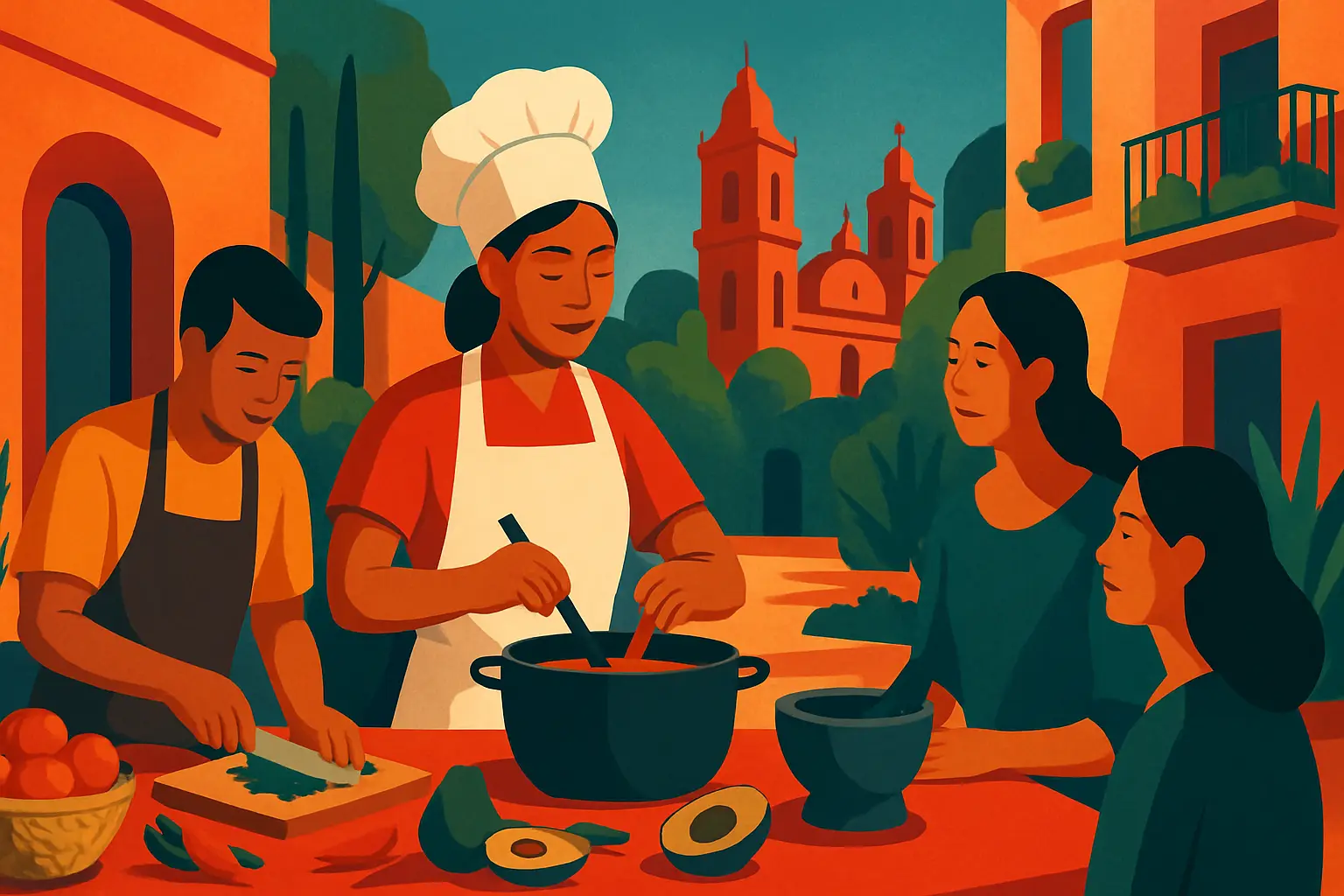
Good cooking classes in CDMX are organized around techniques and ingredients rather than individual dishes. The core modules you'll encounter at most reputable schools:

**Corn and masa** — how tortillas are made from nixtamalized corn (soaked in lime water to unlock protein and nutrition), why this 3,000-year-old process matters, and the tactile difference between fresh masa and the packaged kind
**Chile identification** — tasting fresh chiles (jalapeño, serrano, poblano) against dried and smoked versions (chipotle, mulato, pasilla, ancho) to understand how drying and smoke transform the flavor completely
**Salsa construction** — not a recipe but a ratio: how to balance heat, acid, and fat using the molcajete, the volcanic-rock mortar that predates the blender by several thousand years
**Mole logic** — most classes don't make full mole in a single morning, but they'll walk through the layering principle: how 30+ ingredients become one coherent sauce through sequential toasting, charring, and grinding. Understanding the logic is more useful than following any recipe

Keep touring

Discover more about Mexico in minutes

Get short, interactive stories that make each place easier to remember while you travel.

3. Casa Jacaranda: the benchmark for morning cooking classes

Casa Jacaranda, at Calle Havre 77 in Colonia Juárez, is the most consistently recommended cooking school in the city — and earns the reputation. The school operates out of a restored 19th-century building, keeps classes to six to eight people, and structures the morning around a prior visit to Mercado de San Juan (Ernesto Pugibet 21, roughly four blocks east) to shop for ingredients before cooking. The market component matters: you learn to navigate a professional market — where the best chile vendors are, why hoja santa (a large anise-scented herb) comes from Veracruz, how to tell masa fresca from the reconstituted kind. Back at the school, the class covers two or three core techniques. The meal at the end is the one you made — this isn't a demonstration. You're on the comal. Classes run $85 to $100 USD per person and can accommodate vegetarians with advance notice. Colonia Juárez is worth exploring before or after class — it runs from Avenida Álvaro Obregón north to Paseo de la Reforma and is one of the city's best eating and walking neighborhoods.

4. Market-to-table: classes that start at La Merced or Coyoacán

Several smaller operators run market-first, cook-second experiences that differ from Casa Jacaranda in one key way: they use working-class markets rather than the curated Mercado de San Juan. La Merced — the enormous wholesale market near Metro Merced in Centro Historico — is a completely different experience: raw, loud, un-touristed, and genuinely instructive about how real Mexico City households source food. Classes that start here run 4 to 5 hours, cover more ground than the polished school format, and are better suited to visitors who want less curation and more friction. Coyoacán-based classes often use the Mercado de Coyoacán (on Calle Allende, near Metro Viveros) as the shopping base — a calmer, neighborhood-scale option that suits travelers who want the texture of a real market without La Merced's overwhelming scale. These operators are usually individuals rather than schools; find them on Airbnb Experiences or Cookly. Read reviews for class size (above 12 people, it stops being a class and becomes a tour) and language of instruction.

5. Other operators worth knowing

Aura Cocina Mexicana (Condesa area) offers smaller and more personalized experiences focused on moles, regional salsas, and traditional technique rather than crowd-pleasing basics. The instructor works food history into each session — context on why certain chiles are only used in specific states, how Oaxacan cooking differs from CDMX's central Mexican baseline. Well suited to repeat visitors who've already done a standard class and want to go deeper. Bite Culinary Studio in Roma Norte runs half-day and evening classes, including sessions devoted entirely to tamales — the process of soaking corn husks, building masa with the correct fat ratio, and folding the packets correctly is worth an entire morning on its own. For visitors with a tighter schedule, several hotels run abbreviated 90-minute sessions (Las Alcobas in Polanco, Condesa DF on Sonora 40) covering tortilla making and one fresh salsa. Not a replacement for a full class, but a reasonable introduction if your schedule doesn't allow more.

6. How to choose the right class for you

The honest framework: Duration — a 3-hour class teaches you techniques; a 5-hour class teaches you how to think about Mexican food. If you have the time, go longer. Group size — 6 to 8 people means you're actively on the comal; 15+ people means you're mostly watching someone else be on the comal. Market component — the market portion adds an hour and real context about how CDMX households shop; skip it only if you've already visited a working market like Mercado de San Juan on your own. Technique vs. recipe focus — some classes teach you to make enchiladas verde; better classes explain why toasting then rehydrating dried chiles extracts a completely different flavor than frying them fresh. Ask the operator directly which approach they take. Language — most reputable schools teach in English or bilingually; the Spanish vocabulary (molcajete, nixtamal, comal, guisar) is itself part of the lesson and worth learning as you go.

7. Cost, logistics, and what first-timers should know

How much does a cooking class cost? Structured small-group classes run $70 to $100 USD per person for a 3-to-4-hour session including the full meal. Market-to-table formats with longer durations run $80 to $120 USD. Hotel-run sessions cost $40 to $60 USD for shorter formats. Airbnb Experiences start around $35 to $50 USD per person and vary widely — read recent reviews before booking. When should I book? At least two to three weeks ahead for June through August. Casa Jacaranda's morning sessions sell out consistently in summer. For Airbnb Experiences, one week in advance is usually sufficient. Do I need to speak Spanish? No. Nearly all classes marketed to international visitors are taught in English or bilingually. Knowing a few ingredient names helps but is not required. Can vegetarians and vegans participate? Yes, with advance notice. Traditional Mexican cooking is more plant-forward than most American visitors expect — masa, chiles, salsas, nopales, and most guisado fillings are naturally meatless. Most operators can run a fully plant-based session if asked when booking.

Keep touring

Want the context behind what you cooked?

TourMe turns the story behind nixtamal, the colonial origins of mole, and the pre-Hispanic logic of each chile into short interactive stories and collectible cards — so every cooking class you take comes with a deeper layer. Explore Mexico City's food culture as you live it.

Keep reading

Access Hundreds of Stories

Curated cultural journeys, each chapter filled with stories you can play.