Colonia Juárez rewards people who slow down. It sits in a long triangle between Paseo de la Reforma to the north, Avenida Chapultepec to the south, and the Eje 1 Poniente near Bucareli to the east — neighbors with Roma Norte on one side and Zona Rosa on the other, yet distinctly its own. The streets are wide, tree-canopied, and laid out on a European grid. The buildings range from crumbling Porfirian-era mansions to converted coffee shops in former garages. What makes it feel distinct is the texture: not performatively hip like Roma Norte can get, not Zona Rosa's neon energy. Juárez has been quietly living its best life for decades — you just have to know to look for it.
In the late 19th century, wealthy families fleeing the crowded city center built their dream homes here, channeling Paris as hard as they could. The result is a colonia full of Second Empire mansions with mascarons above doorways, tall iron-gated windows, and facades of tezontle stone and marble. Streets were named after European capitals — Hamburgo, Praga, Berna, Génova, Londres — as a deliberate nod to the era's cosmopolitan aspirations. French merchants from Alsace and the Barcelonette community settled here and opened businesses along these same streets. When the Mexican Revolution swept through in 1910–1913, many of the grandest mansions were abandoned or burned. But enough survived to make a walk down Calle Génova or Calle Havre feel like you're reading architecture as autobiography.
Streets named after European capitals: Hamburgo, Praga, Berna, Génova, Londres
Second Empire facades with mascarons, marble, and tezontle stone
Walk Calle Génova or Calle Havre for the best-preserved examples
Get short, interactive stories that make each place easier to remember while you travel.
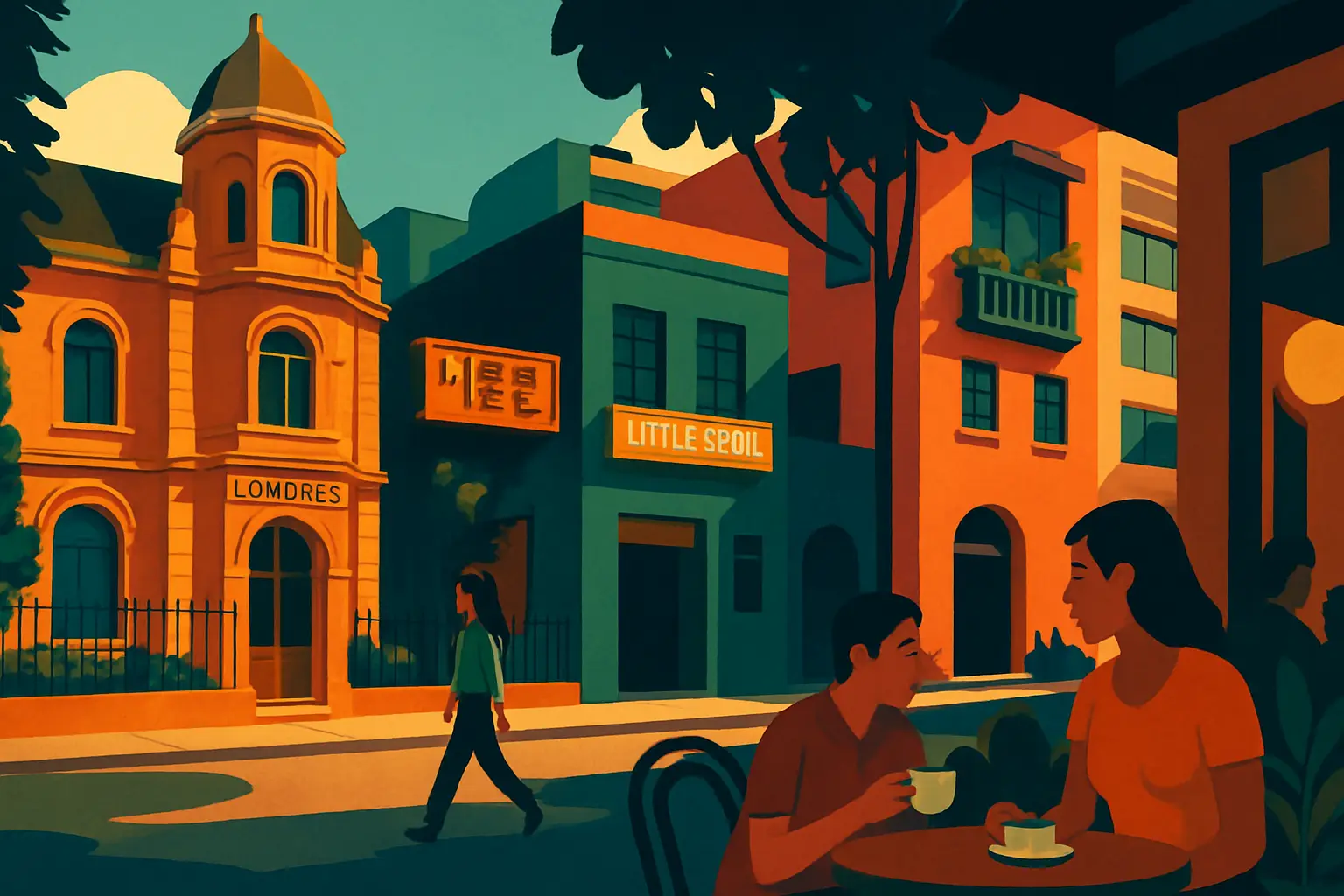
Around the blocks bounded by Hamburgo, Praga, Berna, and Biarritz, the neighborhood quietly became 'Pequeño Seúl' — Little Seoul. The Korean community built roots here decades ago, and today you'll find Korean barbecue restaurants next to Spanish tapas bars, Japanese ramen spots near Latin American art galleries, and coworking cafés packed with digital nomads from all over the world. It's not themed or curated — it happened organically and still feels that way. You can eat Korean BBQ for lunch, visit an Argentine-run gallery in the afternoon, and finish your day at a café run by a family from Oaxaca, all within a three-block radius. This is genuinely unlike anywhere else in Mexico City.
'Pequeño Seúl' concentrated around Hamburgo, Praga, Berna, and Biarritz streets
Korean BBQ, ramen, and Latin American galleries in close proximity
One of the most quietly international pockets in all of CDMX
Juárez is a morning neighborhood. Plaza Washington — a small green park at the corner of Londres and Dinamarca — is the unofficial living room of the colonia. Grab a drinking chocolate from Chocolatería La Rifa, the café that sits right beside it, and you'll be doing exactly what the regulars do. La Rifa lets you choose the strength, temperature, and flavor of your chocolate; it arrives thick and deliberate. Panadería Rosetta (on Colima, at the Juárez–Roma Norte border) is worth the inevitable line for pan au chocolat that rivals anything in Paris. Cicatriz offers specialty coffee and a slow-morning menu that takes sourcing seriously. Café Nin is the sit-down choice for a real brunch — pork chops, pastries, and mellow music in a restored mansion courtyard.
Plaza Washington (Londres and Dinamarca) — the outdoor living room of the colonia
Chocolatería La Rifa: choose your chocolate strength and temperature to order
Cicatriz for specialty coffee; Café Nin for a full sit-down brunch
If you've read anything about cocktail culture in Mexico City, you've heard of Hanky Panky — but Juárez is where the whole speakeasy scene in the city took root. Hanky Panky at Turín 52 is consistently ranked among the World's 50 Best Bars. There's no sign on the door. You walk through what looks like a local fonda, and suddenly you're in a jewel-box of a room where 20 people at a time are drinking cocktails built around Japanese technique, Mexican ingredients, and European rigor. The space is intimate and intentional. The surrounding streets have filled with other cocktail programs that fed off the energy — which means you can make a full evening of it without ever leaving the neighborhood. Book Hanky Panky well in advance; this is not a walk-in situation.
Hanky Panky (Turín 52) — unmarked door, walk through the fonda to get in
Consistently ranked top 20 globally in the World's 50 Best Bars
The surrounding blocks have built an entire cocktail destination around it
By Mexico City standards, yes — Juárez is one of the more comfortable neighborhoods to walk around day or night. The density of cafés and restaurants keeps the streets active during the day, and the bar scene keeps the main streets — Génova, Turín, Londres — well-lit and populated into the early morning on weekends. Basic awareness still applies anywhere in CDMX: keep your phone pocketed in uncrowded areas, use Uber for late-night rides rather than hailing taxis off the street, and avoid wandering east toward Bucareli late at night. The western portion of the neighborhood, near Zona Rosa and Insurgentes, is where most visitors spend time and where the street-level energy feels most active.
Cafés anchor daytime activity; bars keep the main streets active at night
Use Uber or DiDi for late returns rather than hailing street taxis
The western strip near Insurgentes is the most comfortable zone for first-time visitors
Metro Insurgentes on Line 1 (the pink line) puts you directly at the southern edge of Juárez on Avenida Chapultepec — a three-minute walk from Plaza Washington. From Roma Norte, it's a flat ten-minute walk north along Orizaba or Álvaro Obregón. Weekday mornings are the sweet spot for the café experience: seats at Cicatriz and Café Nin are actually available, and the light through the mansion windows is at its best. Thursday and Friday evenings are the strongest nights for the cocktail bars — the Hanky Panky crowd builds momentum earlier in the week. May through October is rainy season, which means afternoon showers that usually pass within an hour; they actually push everyone indoors around 5pm, which turns out to be good timing for a speakeasy reservation.
Metro Insurgentes (Line 1, pink) — 3-minute walk to Plaza Washington
Weekday mornings for cafés; Thursday–Friday evenings for cocktail bars
Rainy season (May–Oct) afternoon showers usually clear before evening — plan accordingly