Ask a Mexico City local where they actually eat tacos al pastor on a Tuesday night and there's a strong chance they'll name a corner in Narvarte. The neighborhood sits just south of Roma Sur, across Eje 4 from Roma and Condesa, but the vibe is completely different. Narvarte is residential, mid-century, and a little gritty around the edges — fewer boutiques, more family taquerías, more hardware stores, more grandmothers walking small dogs. It's the kind of neighborhood that doesn't try to impress you, which is exactly why it works.
Just south of Roma Sur in the Benito Juárez borough
Built out in the 1940s as a planned middle-class neighborhood
Best known to locals for food, not sights
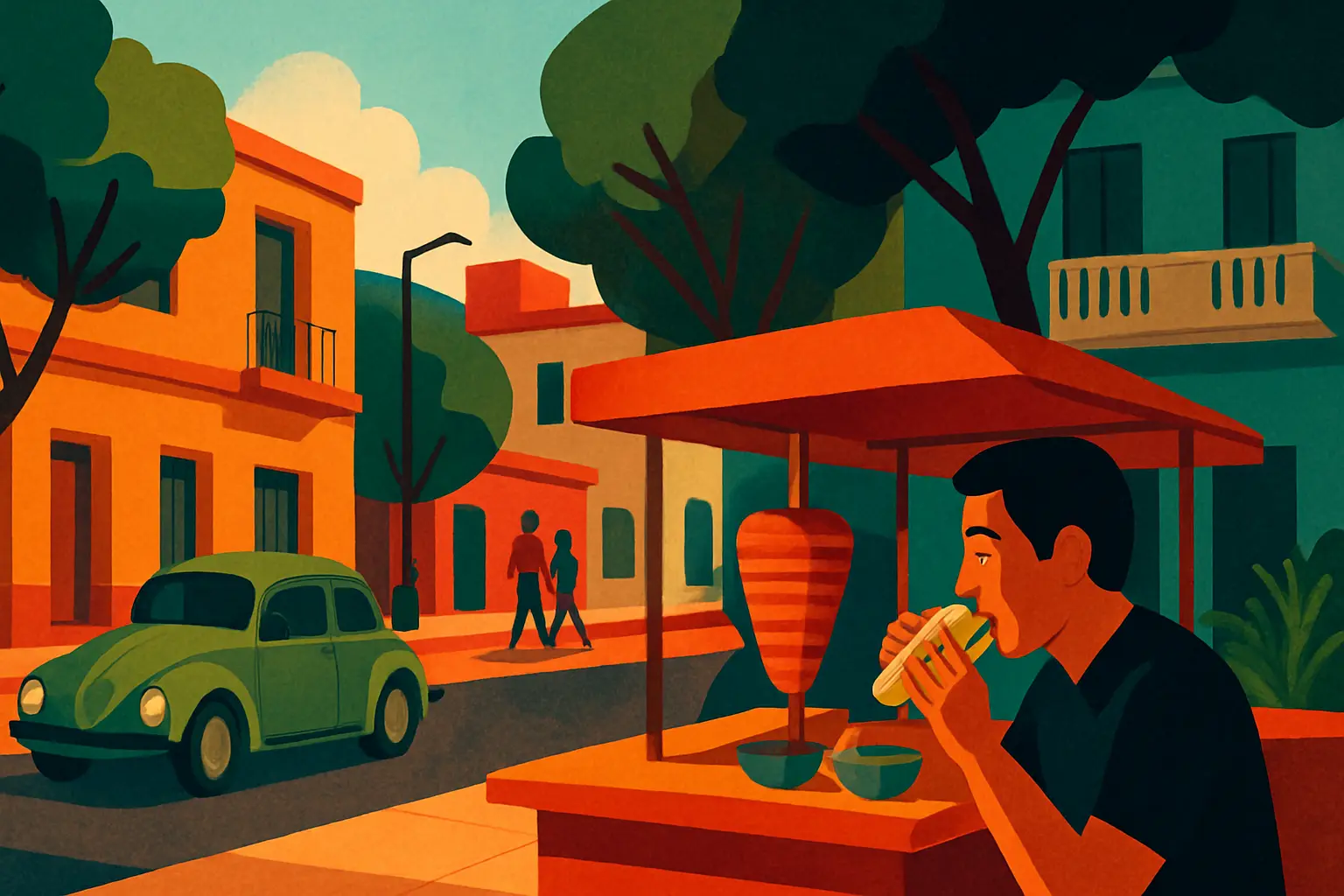
El Vilsito at Petén 248 and Av. Universidad is the spot most CDMX food writers cite when they're done writing listicles. The trick: by day it's a working mechanic shop, and the trompo only fires up after dark. Roll up between 9 p.m. and midnight, sit on a plastic stool by the sidewalk, and order al pastor with everything. The achiote-marinated pork is shaved off the spit with a sliver of grilled pineapple flicked on top — a move that takes years to land cleanly. The Michelin Guide listed it as one of the city's standout taquerías, but the prices and the plastic chairs haven't moved. Bring cash.
El Vilsito (Petén 248 y Av. Universidad): mechanic shop by day, trompo by night
Open until 3 a.m. weeknights, 5 a.m. Friday and Saturday
Bring cash — most Narvarte taquerías don't take cards
Get short, interactive stories that make each place easier to remember while you travel.
On Narvarte's western edge, between Av. Vértiz and Av. División del Norte, sits Parque Francisco Villa — known to everyone as Parque de los Venados because of the bronze deer perched in its fountains. It's one of the largest parks in central CDMX (about 94,000 square meters, opened in 1953), and on Tuesday and Thursday mornings a full street market unfurls along the perimeter. This is the move: buy a kilo of ripe mangos, eat tlacoyos straight off the comal, then walk a loop past the planetarium and the open-air theater. It's a market for people who actually live here, which makes it ten times more interesting than any tourist version.
Tianguis on Tuesdays and Thursdays around the park
The Joaquín Gallo Planetarium sits inside the park grounds
Closest Metro: Parque de los Venados (Line 12)
If Condesa is Mexico City's Art Deco showcase, Narvarte is its quieter mid-century cousin. The neighborhood was platted in the 1940s, and the streets fill in with low-slung functionalist houses, ribbon windows, exposed concrete, and the occasional sculptural staircase. There's no single landmark to chase — instead, walk the blocks between Calle Diagonal San Antonio, Av. Cuauhtémoc, and Calle Petén and look up. You'll start spotting tiled façades, geometric ironwork, and corner buildings that wrap around their plots like cars. Half the design studios in CDMX have moved here in the last decade for exactly this reason.
Functionalist mid-century homes from the 1940s and 50s
Best walking grid: Diagonal San Antonio, Petén, Eugenia, Universidad
Look up — the second-floor details are where the neighborhood shows off
For a working morning, Café Negro Narvarte on Petén is the local favorite — minimalist, strong WiFi, espresso pulled by people who care. Boicot Café has a Narvarte branch with an outdoor patio that fills with laptops by 10 a.m. By night, the neighborhood swaps cocktail bars for cantinas and mezcalerías. La Jefa de la Roma (just over the Roma Sur border) and a handful of low-key mezcal spots along Av. Cuauhtémoc and Calle Anaxágoras are where Narvarte does its drinking. It's a sit-down-and-talk neighborhood, much closer in feel to a classic CDMX cantina evening than a Roma Norte bar crawl.
Café Negro and Boicot Café for working mornings
Cantinas and mezcalerías over cocktail bars after dark
Most spots close earlier than Roma — plan to start by 8 p.m.
Start at 10 a.m. with chilaquiles and café de olla at any of the sidewalk fondas around Calle Eugenia. Walk south through the residential blocks toward Parque de los Venados, stopping anywhere with a deer fountain or a sculptural mid-century gate. Have lunch at a guisado spot — the daily-stew tacos served from steam tables that Narvarte does almost better than anywhere — and then sit out the warmest hour with an iced coffee. In the early evening, walk back north along Av. Universidad. By 9 p.m., the trompo at El Vilsito is spinning and you've earned your spot in line. Total cost: less than a single sit-down lunch in Polanco.
Morning: chilaquiles and a slow walk south
Afternoon: guisado tacos + iced coffee on a residential corner
Night: al pastor at El Vilsito between 9 p.m. and midnight
Narvarte is generally one of the safer central neighborhoods for travelers and expats — it's well-lit, residential, and busy with locals at most hours. Use the same big-city common sense as anywhere in CDMX: take Uber or DiDi after midnight rather than street taxis, keep phones tucked at corners, and don't walk far east of Eje Central late at night. Compared to Roma and Condesa, Narvarte is less polished, less English-spoken, and more residential. You'll see fewer tourists, eat for less money, and have to lean on a little more Spanish — which is the trade most expats end up loving once they make it.
Generally safe and walkable; standard CDMX precautions apply
Less English-spoken than Roma or Condesa — basic Spanish helps
Cheaper, calmer, and less curated than the better-known neighborhoods
The fastest entry point is Metro Eugenia (Line 3), which drops you on Calle Eugenia at the heart of Narvarte Poniente. Metro Etiopía / Plaza de la Transparencia (also Line 3) and Parque de los Venados (Line 12) are good alternatives depending on where you're starting. From the airport, Uber is the easiest hop (about 30–45 minutes depending on traffic). Narvarte is great year-round, but May through September is the rainy season — pack a small umbrella and plan eating-and-walking loops for late afternoon and evening, when the storms have rolled through and the streets cool down. If you want a longer day, pair Narvarte with Roma Norte to the north for an easy two-neighborhood walk.
Metro Eugenia (Line 3) is the fastest entry point
May–September: rainy season, plan walks for after the afternoon storms
Pair with Roma Sur or Roma Norte for an easy two-neighborhood day