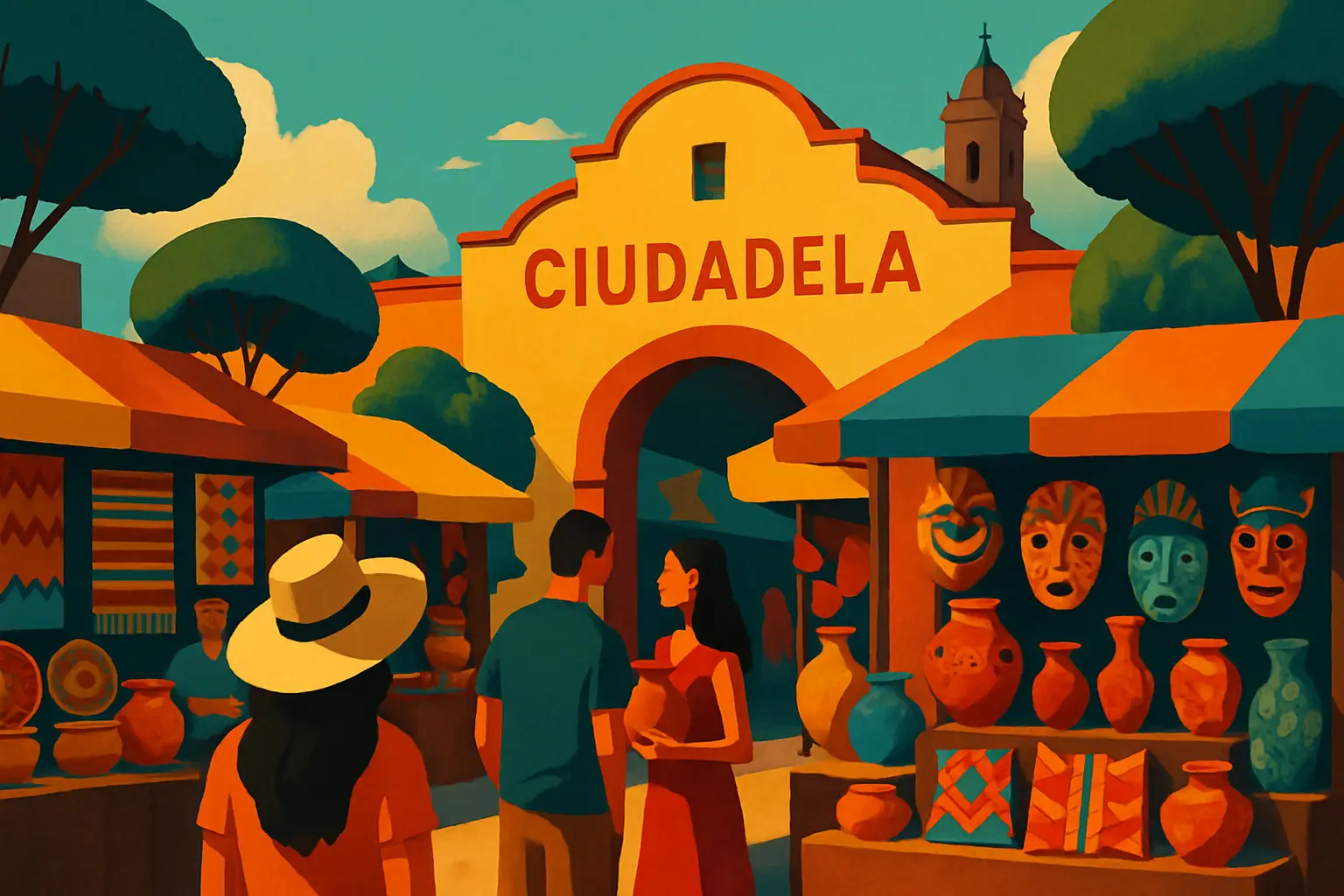
La Ciudadela is not a craft market that grew organically around a neighborhood need. It was designed with intention. When Mexico City hosted the 1968 Summer Olympics, the federal government wanted to present the country's regional artisanal traditions as a unified national showcase — a single address where visitors from around the world could encounter the breadth of Mexican handicraft without traveling to Oaxaca, Chiapas, Guerrero, Michoacán, and Puebla separately. The building chosen for this purpose was already layered with history: a Royal Tobacco Factory built in 1807 during the colonial period, later repurposed as a military fortress during the turbulent 19th century — which is where it got its name, La Ciudadela, meaning 'the citadel.' The stone walls and arched ceilings of that fortress are still visible today, giving the market an architectural gravitas that most souvenir shops in the world cannot claim. Today the market runs more than 350 stalls organized across a main floor and an upper gallery, loosely grouped by craft type and loosely by region of origin. Entry is free. It is open daily from around 10 AM to 7 PM, though the best vendors are consistently present Tuesday through Saturday mornings.
Located at Plaza de la Ciudadela, Centro Histórico — three-minute walk from Metro Balderas (Lines 1 and 3)
Free entry, daily approximately 10 AM to 7 PM — Tuesday through Thursday mornings are significantly less crowded
The building dates to 1807 and was converted to an artisan market for the 1968 Olympics
La Ciudadela organizes itself roughly by region, which means you can move through the market and understand the geographic breadth of Mexican craft in a single morning. Alebrijes — the brightly painted fantastical animals that have become one of Mexico's most recognized folk art forms — occupy several clusters throughout the market. The authentic version is carved from copal wood by artisan families in the Oaxacan villages of Arrazola and San Martín Tilcajete, then painted by hand with pigments in patterns unique to each family's style. You can read the full origin story in the alebrijes guide. Talavera pottery from Puebla appears throughout: the distinctive blue-and-white ceramic style produced in Puebla since the 16th century, when Spanish potters brought Moorish and Chinese techniques that fused with indigenous clay traditions. Genuine Talavera carries the heft of thick, high-fired clay and rings with a clear tone when tapped. Rebozos — the traditional rectangular shawls worn across Mexico for centuries — come from weaving centers in Tenancingo (Estado de México) and Santa María del Río (San Luis Potosí); the finest are woven so thinly they can pass through a wedding ring. Huipiles — the embroidered ceremonial blouses of Chiapas, Oaxaca, and Guerrero — represent some of the most labor-intensive textile work produced anywhere in the Americas, with certain styles requiring 200 or more hours to complete. Silver jewelry from Taxco occupies its own section; Taxco has been Mexico's silver capital since colonial times. Lacquered boxes and trays from Olinalá, Guerrero — decorated using a technique involving chia oil from the lináloe tree — round out the major categories. Amber from the Chiapan highlands and obsidian carvings echoing pre-Hispanic traditions are available throughout.
Get short, interactive stories that make each place easier to remember while you travel.
This is the question that divides a satisfying visit from a frustrating one. La Ciudadela sells both genuine handmade craft and mass-produced imitation, sometimes from stalls side by side, and the price difference between them is not always obvious from the tag. A few tests that actually work. For alebrijes: look at the surface under direct light. Genuine copal wood carvings have slight variations in the painted surface — brushstroke direction changes, tiny imprecisions where the carver's chisel caught a grain line — and the wood itself is visible under thin areas of paint. Machine-cast resin alebrijes have a perfectly uniform surface and don't chip the way carved wood does at the edges. For Talavera: the weight is the tell. Genuine Puebla Talavera is heavy for its size, fired at high temperatures, and the glaze is thick and slightly uneven where it pooled during firing. Import imitations are lighter and the glaze sits perfectly flat. For woven textiles: ask about the fiber. Genuine hand-loomed rugs from Teotitlán del Valle are 100% wool, often dyed with natural colorants — cochineal insects produce the deep reds and purples, indigo produces the blues — and the dye sits slightly unevenly in the fibers, which is a feature, not a flaw. Synthetic-dyed imitations look more perfectly uniform in color and feel slightly slicker. The most reliable approach is direct: '¿Es hecho a mano?' (Is it handmade?) and '¿De qué pueblo viene?' (Which village is it from?). A vendor who can name a specific village and artisan family is almost certainly selling the real thing.
La Ciudadela covers every budget from 80 pesos to 15,000, and knowing what delivers real value at each level keeps you from either under-spending on something forgettable or overpaying for something that should have cost less. Under 300 MXN (~$15 USD): Small obsidian carvings — the volcanic glass was sacred to the Aztecs and remains genuinely mined near Teotihuacan — Day of the Dead ceramic skull figurines, copal resin incense cones, and small painted wooden animals from Oaxacan village cooperatives. These aren't fine art, but they're real craft products, not factory plastic. 300–1,500 MXN ($15–75 USD): This is the range where the market delivers the best value. Quality Tenancingo rebozos in cotton-silk blends, medium-sized copal wood alebrijes from named Oaxacan family workshops, hand-embroidered table runners from Chiapas, amber pendants from San Cristóbal de las Casas set in Taxco silver. 1,500–5,000 MXN ($75–250 USD): Signed alebrijes in the 20–30 cm range from recognized family names, hand-loomed wool rugs from Teotitlán del Valle in medium sizes, full huipil blouses from Oaxacan cooperatives, and quality Talavera serving sets. 5,000 MXN and up ($250+ USD): Museum-quality lacquered pieces from Olinalá, large Teotitlán rugs — a well-made 2x3 meter rug runs 8,000–15,000 MXN here and retails for two to three times that price in US design galleries — and large signed alebrijes from recognized family workshops.
Bargaining at La Ciudadela is expected, but the culture around it is different from what many visitors assume. It's not a high-pressure haggling situation — it's a polite price conversation that both parties understand as normal, and getting it wrong in either direction (too aggressive or not engaging at all) costs you something. The right entry phrase is '¿Me hace precio?' — literally 'Can you make me a price?' — which signals you're serious about buying without being aggressive. Vendors respond well because it implies you're not window-shopping. What works: showing genuine interest in the piece before mentioning money; buying two or three items from the same vendor (the multi-item discount is almost always available and never offensive to request); paying in cash. A 10–15% discount on larger pieces is typical for a respectful ask plus cash payment. What doesn't work: making a very low offer on your first interaction before any relationship has formed; bargaining on small items under 150 pesos (the margin is too thin and it reads as dismissive of the craftsperson's time); and naming a price and walking away when the vendor accepts — if you make an offer and they agree, you've committed. The craft behind the piece took hours or days. The price reflects that.
La Ciudadela sits on Plaza de la Ciudadela, just off Calle Balderas in Centro Histórico, and the Balderas metro station is a three-minute walk. Line 1 (the pink line) connects from Chapultepec and Insurgentes in the west straight through Centro, making it a direct shot from Condesa, Roma, or Polanco without a transfer. Line 3 (olive-green) runs north–south through Tlatelolco and Hidalgo to Universidad — accessible from Coyoacán or Ciudad Universitaria with a single train. From Roma Norte, a 15-minute Ecobici ride along Álvaro Obregón to the Alameda Central and then south on Balderas is a pleasant approach on a clear morning. The market makes a natural complement to a Centro Histórico morning — the Alameda Central, Palacio de Bellas Artes, and the Zócalo are all within 15 minutes on foot. Best visiting window: Tuesday through Thursday before noon. The artisan vendors who are actually makers — not just resellers — tend to staff their own stalls on weekday mornings when foot traffic is low enough to have real conversations. Saturday mornings are good but noticeably busier. Sunday the market thins out and some specialty stalls close early.
Metro Balderas (Lines 1 and 3) — three-minute walk north to Plaza de la Ciudadela
Open daily approximately 10 AM–7 PM; Tuesday–Thursday mornings offer the best vendor access
Free entry — no ticket, no reservation, no guided tour required
The most common complaint in expat forums is that La Ciudadela costs more than buying directly from artisan cooperatives in Oaxaca or Chiapas — and that's true. There's an intermediary markup at every stall. But the right comparison is not to village-source prices; it's to what you'd pay for the same item at a boutique craft gallery in Roma Norte or Polanco, and by that comparison La Ciudadela is dramatically cheaper, often by 50–70%. A signed Oaxacan alebrije priced at 1,800 MXN at La Ciudadela might retail at 4,500–6,000 MXN at a gallery on Álvaro Obregón. The market's real value is density and tactile access — in two hours you can compare 40 different alebrije family styles, handle three grades of Tenancingo rebozo, and feel the weight difference between genuine Talavera and its imitation before making any decision. That comparative experience doesn't exist online, and no boutique carries enough inventory to provide it. What about buying online instead? Fonart — the federal government's artisan fund — sells authenticated pieces from registered cooperatives and is a legitimate source. But photos don't capture the weight, texture, and finish that determine quality at the higher price points. La Ciudadela lets you hold the piece and ask the vendor to explain the technique. For anything over 1,000 MXN, that information is worth more than the convenience of a browser tab.
What's the single best souvenir to buy? A copal wood alebrije from a vendor who can name the specific Oaxacan village and family that made it. In the 500–1,500 MXN range you can find genuine hand-carved and hand-painted pieces that represent hours of skilled work and are one of the most concentrated expressions of Mexican folk art in a portable form. Can you ship large purchases home? Several vendors have standing relationships with packing and shipping agents near the market who handle international delivery for large pieces — rugs, Talavera sets, large alebrijes. Ask your vendor directly; the good ones will either connect you to a trusted shipper or explain the best approach for what you bought. Smaller pieces pack well inside clothing in checked luggage. Is the market safe? Yes. La Ciudadela is a formal, government-organized market in a busy public plaza, well-trafficked during all open hours. Standard urban awareness — watch your bag, don't carry cash you don't need — is sufficient. What if I don't speak Spanish? Most vendors have enough English to complete a transaction, and the craft itself communicates clearly. The two phrases worth learning before you go: '¿Me hace precio?' (Can you give me a price?) and '¿Es hecho a mano?' (Is it handmade?). Both open better conversations and better prices than silence alone.