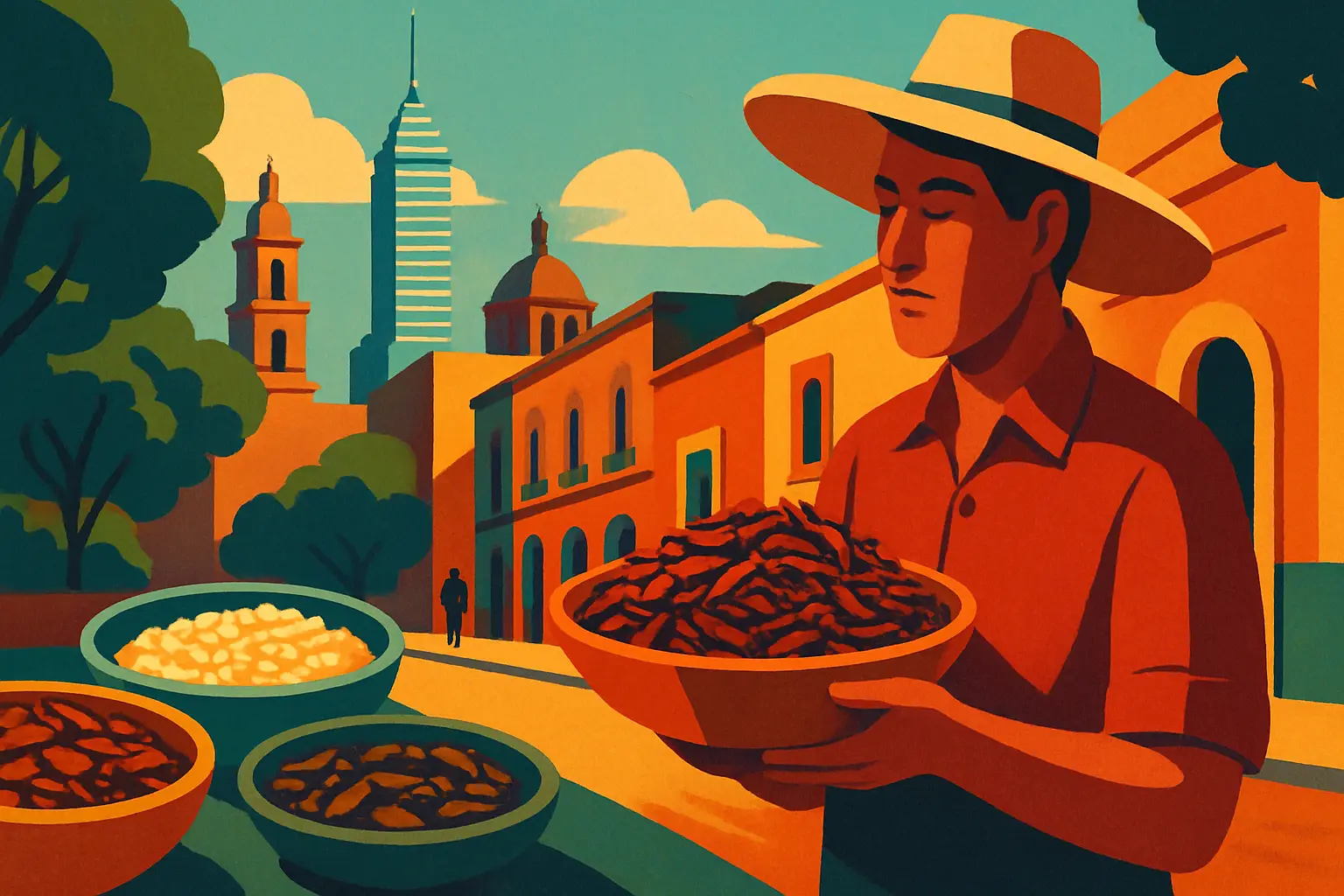
Entomophagy — eating insects — is practiced in roughly 80 countries around the world, but few places have maintained it as an unbroken culinary tradition the way Mexico has. Aztec codices from the 15th and 16th centuries document at least 96 species of edible insects consumed in central Mexico: grasshoppers collected from cornfields, ant larvae harvested from maguey roots, flying ants caught at the onset of the summer rains. Spanish missionaries and colonial administrators tried and largely failed to suppress indigenous food practices — some insects were labeled unclean or primitive in colonial documents, but the markets kept selling them and the households kept cooking them.
The reason insects persisted in Mexican food culture is straightforward: they were abundant, nutritious, and already culturally embedded in ceremonies and daily eating alike. Chapulines provided protein to farmers who couldn't afford meat on most days. Escamoles — the larvae of the *Liometopum apiculatum* ant — were considered a luxury since before the Spanish arrived: difficult to harvest, brief in season, and intensely flavorful. These weren't survival foods. They were choice ingredients.
Today Mexico City sits at the intersection of that ancient tradition and a modern global conversation about sustainable protein. High-end restaurants in Polanco serve escamoles alongside French technique; street vendors at the Mercado de Medellín fry chapulines in the same comals their grandparents used. Both versions are authentic. Neither is a performance for tourists.
Chapulines are the most approachable entry point into Mexican insect eating — and once you understand what they actually taste like, the hesitation mostly disappears. These are toasted or fried grasshoppers, seasoned with lime, chili, garlic, and salt. The flavor is savory and slightly acidic, with a crunch that your brain keeps trying to categorize as some kind of chicharrón or fried legume. They don't taste like what most people imagine insects taste like.
Chapulines are sold at market stalls in bags or scooped onto a plate as toppings for tacos, quesadillas, and tlayudas. At many taquerías in central Mexico City, they're offered on guacamole — arguably the best way to try them for the first time, because the avocado softens the texture and the overall package is familiar enough to make the leap feel smaller.
Nutritionally, chapulines are approximately 60–70% protein by dry weight — significantly more than beef or chicken, with a fraction of the land, water, and feed cost of livestock to produce. Food scientists cite the Mexican chapulin tradition as a model for sustainable protein at global scale. The vendors selling bags at the Mercado de San Juan don't particularly need that validation, but the point stands. A small bag at the market runs 40–80 pesos depending on size and preparation; year-round availability makes them the most reliable insect to seek out on any trip.
Flavor: savory, lime-forward, crunchy — closer to seasoned pork rinds than anything most visitors expect
Best first try: stirred into guacamole at a market taqueria — the avocado base makes the transition natural
40–80 pesos for a bag at Mercado de Medellín or Mercado de San Juan; available year-round
Get short, interactive stories that make each place easier to remember while you travel.
Escamoles are the eggs and larvae of the *Liometopum apiculatum* ant, a species that builds its colonies in the root systems of maguey and agave plants across the highland valleys of central Mexico. Harvesting escamoles requires locating the colonies — often several feet underground — and extracting the larvae by hand without destroying the nest, so the colony survives and can produce again the following season. The labor involved and the brevity of the season (a window of roughly six weeks from late February through April) are why escamoles have been a luxury product for centuries.
The texture is distinctive: small, pearl-white, and soft — somewhere between cottage cheese and pine nuts once cooked. The flavor is mild and buttery, with a slight nuttiness and no bitterness. They're typically prepared in butter with epazote (a pungent Mexican herb), served in a tortilla, or folded into scrambled eggs. At Quintonil on Isaac Newton 55 in Polanco, chef Jorge Vallejo has served a charred avocado tartare with escamoles that became one of the signature dishes of Mexico City's modern fine dining movement. At El Cardenal on Palma 23 in Centro Histórico, the preparation is more traditional — butter-fried with white onion and epazote, accompanied by hand-pressed tortillas.
In June, true fresh escamoles from the spring harvest have run their course. Some restaurants work with frozen stock during the off-season; the texture changes slightly but the flavor holds. If you're planning a return trip in late February or March, fresh escamoles season is worth building a reservation around.
Flavor: mild, buttery, slightly nutty — often compared to pine nuts or cottage cheese in texture
Best versions: El Cardenal (Palma 23, Centro) for traditional prep; Quintonil (Isaac Newton 55, Polanco) for fine dining
Peak season is March–April; June visitors should ask whether escamoles are fresh or frozen before ordering
The worm at the bottom of a mezcal bottle is real, edible, and has a specific identity: gusano de maguey, the larva of the Comadia redtenbacheri moth, which lives inside maguey plants. Not all mezcals contain a worm — the practice is associated with certain producers in Oaxaca and is absent from most artisanal mezcals. Serious mezcal drinkers tend to view the worm bottle with skepticism, and for good reason: the worm was popularized as a marketing gimmick for export mezcals in the 1940s and 50s, without any traditional precedent in how mezcal was originally produced.
However, the gusano de maguey as a food is a different story — one with deep roots in Mexican cuisine entirely separate from the bottle. Eaten as a taco, grilled or fried with guacamole, gusanos are rich, fatty, and intensely savory. The flavor sits closer to a cured meat than to anything you'd call light. Restaurante Don Chon at Regina 160 in Centro Histórico, the most respected pre-Hispanic cuisine restaurant in Mexico City, serves gusanos de maguey as part of a menu that traces directly to Aztec food traditions. The dining room has paper tablecloths, vintage bullfighting posters, and no English translation on the menu. The food is the point.
Some mezcalerías in Roma Norte and Condesa now serve gusano de maguey salt as a condiment — dried worm ground with chili and salt, offered with a glass of mezcal the way a good bar brings out bar snacks. If you've been dipping your orange slice in it without reading the label, you've already eaten your first maguey worm.
This is the section that is specifically relevant to this week. Chicatanas are the queen ants of *Atta mexicana* — the large, flying leaf-cutter ant — and they only emerge after the first heavy rains of the season, typically in late May and early June. When the rains arrive, the queen ants leave their underground colonies on their mating flight, and locals collect them at porch lights and street lamps overnight, the same way moths gather at any light source. The window lasts roughly two to three weeks. After that, chicatanas disappear until next year.
The flavor is intensely savory — often described as tasting like bacon or truffle, with a deep, earthy umami quality that chefs use more like a seasoning than a protein. They're ground into mole negro in Oaxacan cooking, mixed into salsas, or fried and eaten whole in a taco. Unlike chapulines, which are available year-round in toasted form, fresh chicatanas are a genuinely seasonal experience — one of the rarer ones in a city with a lot of them.
If you're in Mexico City right now in early June 2026, this is your window. Restaurante Don Chon (Regina 160, Centro Histórico) typically carries chicatanas when in season. The market vendors at Mercado de San Juan (Ernesto Pugibet 21, Centro) are a second option, and some specialty stalls sell them dried and ground year-round. A chicatana taco eaten during the first rains in Mexico City is something that doesn't have an equivalent anywhere else.
Restaurante Don Chon (Regina 160, Centro Histórico) is the single most important address for pre-Hispanic cuisine in Mexico City. Open since the 1940s, family-run, and unapologetically old-fashioned, Don Chon serves escamoles, chapulines, gusanos de maguey, chicatanas when in season, and a rotating menu of ingredients sourced from traditional markets. A meal focused on insects runs 400–600 pesos per person.
El Cardenal (Palma 23, Centro Histórico; also a Polanco branch) occupies a middle ground between traditional and accessible — escamoles prepared classically, in a room that feels formal without being intimidating. A good choice if you want the full traditional preparation without the rough edges of a working-class market.
Quintonil (Isaac Newton 55, Polanco) and Pujol (Tennyson 133, Polanco) incorporate insects into their tasting menus as part of a contemporary Mexican cuisine conversation — escamoles in their spring season, gusano salt, chapulines folded into mole. Reservations at both require booking weeks or months in advance.
Mercado de San Juan (Ernesto Pugibet 21, Centro) is the most practical and affordable option. Several vendors specialize in exotic ingredients and insects; the setting is informal and the prices are a fraction of what the restaurants charge. A plate of escamoles tacos at a market stall runs 80–150 pesos.
Don Chon (Regina 160, Centro): the definitive address for pre-Hispanic insect cuisine, open since the 1940s
Mercado de San Juan (Ernesto Pugibet 21, Centro): best prices and most variety, informal market setting
Quintonil and Pujol (Polanco): contemporary fine dining using insects — book at least a month ahead
Insects served at reputable Mexico City restaurants and established market stalls are as safe as any other food in those venues. The same preparation and sourcing standards that apply to any other ingredient apply here. Food-borne illness risk from properly cooked insects is not higher than risk from any other protein — the standard precautions for street food in general (busy stalls, cooked to order, established vendors) cover insects just as well as tacos.
One genuine consideration: people with shellfish allergies sometimes react to insects, because both contain chitin, a structural protein that shellfish and insects share. If you have a shellfish allergy, start with a very small amount and wait before eating more.
The most common first-timer mistake is ordering escamoles without asking whether they're fresh or frozen, since in June the fresh season has ended and the texture difference is meaningful. The second mistake is expecting a dramatic experience — most people who try chapulines report that their main reaction is 'oh, those are just good.' The psychological barrier is almost entirely the barrier. The food tastes like food.
For the broader culinary history that produced insect eating as a tradition, the Mexico City food history guide covers the full arc from pre-Aztec cultivation through the colonial period to the street food culture you're eating through right now.