Mexico City's history gets compressed into a simple arc: the Aztecs built Tenochtitlán, the Spanish destroyed it and built a colonial capital on top, and here we are. Cuicuilco doesn't fit that arc. This was a functioning urban center in the southern Valley of Mexico when Tenochtitlán was still a thousand years in the future — before the people who would become the Aztecs had even migrated into central Mexico from the north.
At its peak around 300 BCE, Cuicuilco had a population estimated between 15,000 and 20,000 people — the dominant urban center in the southern Valley of Mexico, almost certainly connected by trade networks to communities across a wide region. The people who built it are called the 'Cuicuilca' by archaeologists, but no one knows what language they spoke, what they called themselves, or exactly where they came from. The Aztecs — who arrived in the Valley of Mexico centuries after this city had already been buried under lava — gave it its current name. Cuicuilco means 'place of songs and dances' in Nahuatl, which tells you they were naming something they found already ancient and inexplicable.
The site is on Av. Insurgentes Sur at the Anillo Periférico in the Tlalpan borough, directly across the street from the Perisur shopping mall. That juxtaposition — a 2,800-year-old ceremonial complex across from a food court — is jarring in the particular way that only Mexico City can manage.
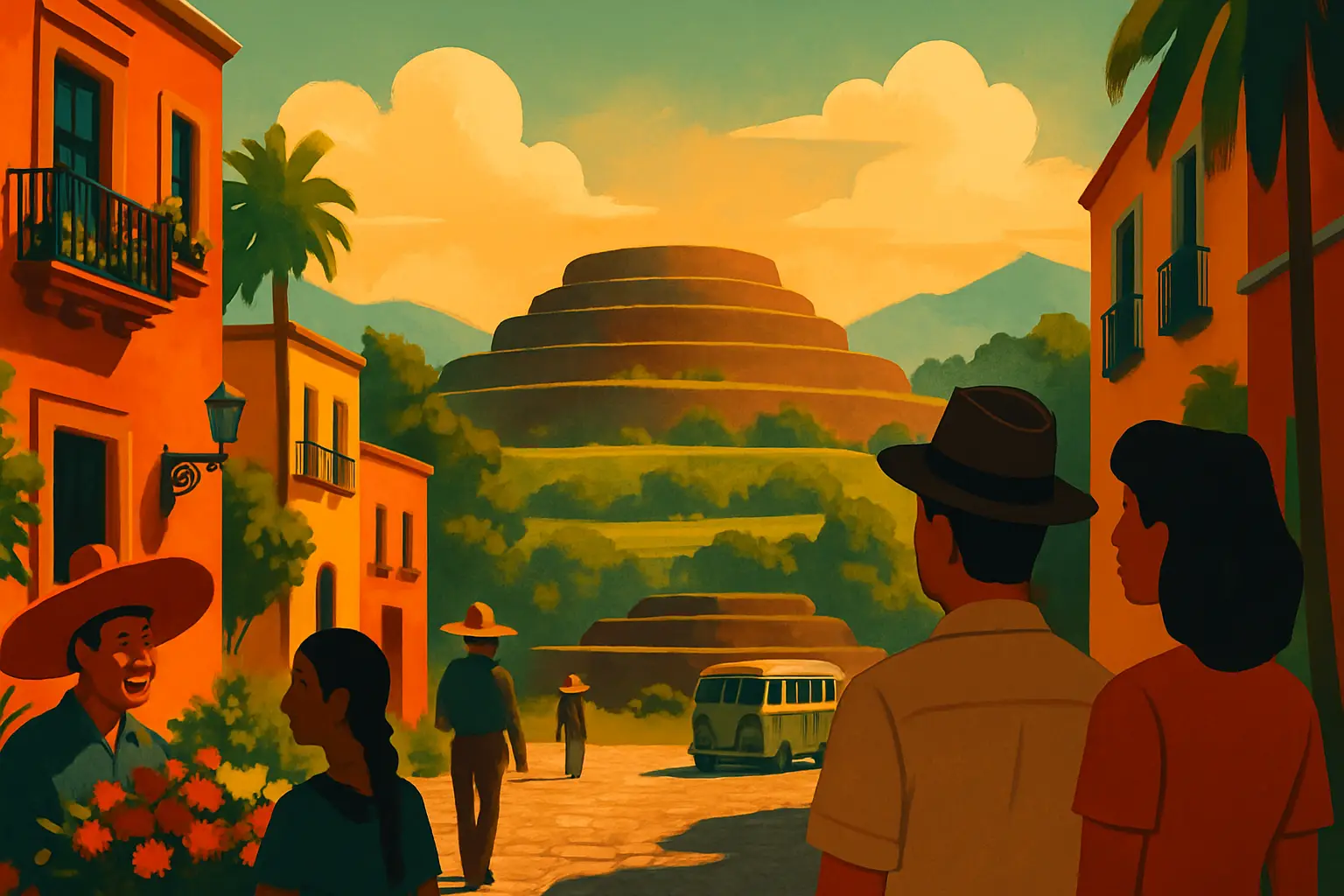
Every major Mesoamerican pyramid you've seen a photograph of is square or rectangular: the Pyramid of the Sun at Teotihuacán, the Castillo at Chichen Itza, the Templo Mayor in the Zócalo. Cuicuilco built something different. Its Great Pyramid is circular — four concentric tiers, each receding inward, with a base diameter of 116 meters. The original structure stood roughly 26 meters high. Today, between erosion, the volcanic lava that encased its lower sections, and the decades of excavation that partially freed it, you're looking at approximately 18 to 20 meters above the surrounding landscape.
Why circular? The honest answer is that no one is entirely certain. The shape may have had astronomical significance — alignments with solar positions at the equinoxes have been identified in the pyramid's orientation — and some scholars link the circular form to Huehueteotl, the Old Fire God, one of the most ancient deities in Mesoamerican religion, whose worship predates the Aztec pantheon by centuries. The circular pyramid form appears at a handful of other early sites in Mexico, suggesting it represents a very old architectural tradition that was later displaced by the square and rectangular forms that dominated at Teotihuacán and every major site that followed. Cuicuilco preserved the circular form in its most complete expression.
Climbing is not permitted — the structure is fragile after millennia of exposure and the volcanic event that damaged its lower levels — but the base is accessible from all sides. At the top platform sits the remains of an altar where offerings were made; a small stone figurine of Huehueteotl, the Old Fire God depicted as a bent elderly man carrying a brazier on his head, was excavated here in the 1920s. The original is in the Museo Nacional de Antropología. What you see on the pyramid today is reconstruction.
Get short, interactive stories that make each place easier to remember while you travel.
Around 245–315 CE, the Xitle volcano — a small shield volcano in the Ajusco range about 15 kilometers southwest of Cuicuilco — erupted and sent a lava flow north into the populated valley. The flow reached Cuicuilco and the surrounding settlements, covering much of the urban landscape under 8 to 10 meters of volcanic rock. The entire lower section of the city — housing compounds, storage areas, agricultural fields, and the ground-level portions of the pyramid — was buried under what became the Pedregal de San Ángel, the vast lava field that still covers a large portion of southern Mexico City today.
The population fled northward. Where did 20,000 people go when their city was consumed by lava? The leading theory is that many of them joined the expanding city of Teotihuacán, which was experiencing explosive population growth in exactly this period. Teotihuacán's rise and Cuicuilco's destruction overlap in ways that look like cause and effect: the refugees from the southern valley's most sophisticated urban center arriving at the northern valley's emerging one. The relationship is unproven but the timing is hard to dismiss.
You can see Xitle from the site on a clear morning — a rounded volcanic profile above the Pedregal to the southwest, looking harmless and old in the way that volcanoes that already erupted tend to look. The dark lava rock at the base of the pyramid is part of that same flow. It came down from those slopes roughly 1,700 years ago, and it didn't go anywhere. You're walking on it.
The Museo de Sitio de Cuicuilco is compact — two rooms of display cases plus explanatory panels — but its contents are worth the 20 minutes. Entry is included with the free site admission.
The most striking objects are the ceramic figurines: small handmade clay figures, mostly human, some with exaggerated proportions or markings that suggest ritual use, excavated from areas around the pyramid that were buried under volcanic sediment and preserved by the same eruption that ended the city. These figurines represent an artistic tradition that predates the Aztec aesthetic by over a thousand years and has no direct visible successor — the Cuicuilca style disappears with the eruption. They look nothing like the feathered-serpent iconography most people associate with Mexican archaeology. They're strange and specific in a way that makes them feel like artifacts from a civilization that got genuinely erased rather than absorbed.
Other cases hold obsidian tools — volcanic glass that served as the cutting technology of Mesoamerica before metal — alongside shells from the Gulf Coast, evidence of long-distance trade networks reaching 400 kilometers east of Cuicuilco. And ceramic comales, the flat griddles on which corn tortillas were cooked, that are functionally identical to the ones used in Mexico City kitchens today. Whatever else changed in 2,800 years, the tortilla griddle didn't.
A marked path loops around the pyramid and through the surrounding volcanic terrain. This isn't manicured parkland — the Pedregal is rough: loose dark lava stone, hardy xerophytic plants, and the particular quiet that wide stretches of volcanic field tend to produce. The path takes 20 to 30 minutes and gives you the full physical context of what a post-eruption landscape looks like when plants have been colonizing it for two millennia.
Signage panels in Spanish and English explain the ecological succession on the lava field: the lichens and mosses that break down volcanic rock surface over centuries to create the first thin soils, the native cacti, agaves, and fig species that followed, and the fauna that moved in behind them. More than 200 bird species have been recorded in the Pedregal ecosystem; the lava field also shelters endemic lizard and insect species found nowhere else in the world — a consequence of the relative isolation created when the eruption cut off this stretch of terrain and gave evolution a long time to work without interruption.
The ecology path connects visually to the much larger Reserva Ecológica del Pedregal de San Ángel (REPSA), the ecological reserve within UNAM's campus about a kilometer north — the same lava field, continuous, now managed by the university as a protected research area. If you're combining Cuicuilco with a visit to Ciudad Universitaria, the REPSA boundary runs along the south edge of the campus and is reachable on foot.
By Metrobús: Line 1 (the red Insurgentes line) runs the full length of Av. Insurgentes. Take it to the Perisur stop. The Cuicuilco entrance is a 3-minute walk north on Insurgentes Sur — look for the INAH signage on the right side of the avenue, just before the Perisur shopping center.
By Metro: Line 3 (yellow line) south to the terminal station, Universidad. From there, catch a southbound pesero (collective van) on Insurgentes Sur heading toward Perisur — roughly 12 minutes. A Cabify or Uber from Metro Universidad to the site entrance runs about 15 minutes and costs 40–60 pesos.
From Estadio Azteca: If you're attending a World Cup match or any Azteca fixture and heading back north on Insurgentes, Cuicuilco is a 15-minute Cabify from the stadium. It's genuinely on the way — both the Azteca and Cuicuilco sit in the southern part of the city that most visitors only pass through in transit.
Combined with UNAM: Ciudad Universitaria is a 1.5-kilometer walk or a short pesero ride north on Insurgentes from Cuicuilco. The two sites together — a pre-Aztec archaeological zone and one of the great modernist university campuses in Latin America, with its own Diego Rivera mosaics — make a coherent half-day in the south of the city.
Metrobús Line 1 to Perisur stop — 3-minute walk north on Insurgentes to the entrance
Metro Line 3 to Universidad, then southbound pesero on Insurgentes (12 min) or Cabify (40–60 pesos)
Combine with Ciudad Universitaria 1.5 km north — a full half-day in the south of the city
For anyone with genuine curiosity about Mexico's deep history, yes — unambiguously. Cuicuilco is almost always uncrowded (weekday visits can mean having significant stretches of the site entirely to yourself), free, and holds more archaeological weight per square meter than most of the attractions tourists spend hours lining up for near the Zócalo. If you've been to Teotihuacán, Cuicuilco tells the earlier chapter. If you've spent time at the Museo Nacional de Antropología, many of the objects in the Preclassic period rooms trace directly back to this site.
For first-time visitors on a three-day Mexico City itinerary — skip it. The main circuit is full enough. For expats, repeat visitors, or anyone who's started to feel like they've done the tourist Mexico City and wants the layers underneath it, Cuicuilco is exactly the kind of place that makes this city feel inexhaustible.
Best time to visit: Weekday mornings from November through April offer the clearest skies and quietest site. In June — the start of rainy season — arrive by 10 AM to explore the open-air pyramid and lava field before the afternoon thunderstorms build from the Ajusco direction. The full visit (pyramid exterior, museum, ecology path) takes 90 minutes comfortably; two hours if you read every museum panel. There is almost never a line.
How old is it, exactly? The earliest occupation dates to around 1000 BCE; the main pyramid was under construction by 800–600 BCE; the city reached its peak around 300 BCE; the Xitle eruption ended it around 245–315 CE. The site spans roughly 1,300 years of continuous occupation before the lava arrived.
Is it really free? Yes. All INAH-administered federal archaeological zones are free to Mexican nationals; most, including Cuicuilco, are free to all visitors. The on-site museum is included at no charge.
Can you climb the pyramid? No — climbing is not permitted. The structure is fragile, and the lower sections are still embedded in volcanic rock. The base is accessible on foot from all sides.
Is the Pedregal the same as Cuicuilco? Related but distinct. 'Pedregal' refers to the broader volcanic lava field produced by the Xitle eruption — it covers roughly 80 square kilometers of southern Mexico City. Cuicuilco is the archaeological site sitting within it. The REPSA ecological reserve at UNAM is the largest contiguous section of the original Pedregal still in near-natural condition.
Is the area safe? Yes. The site is a federal archaeological zone with INAH staff present during opening hours. The surrounding Insurgentes Sur and Perisur corridor is busy commercial territory — the shopping mall directly across the street is one of the most active in the south of the city.