Ciudad Universitaria — literally 'University City' — is the main campus of the Universidad Nacional Autonoma de Mexico, one of the largest universities in the world by enrollment and the intellectual center of gravity for the entire country. The campus opened in 1952 under President Miguel Aleman Valdes, built on a 730-hectare site in southern Mexico City over an ancient lava field left by the Xitle volcano thousands of years earlier. In 2007, UNESCO inscribed it as a World Heritage Site under the category of 20th-century modern architecture — one of the few living university campuses in the world to hold that designation.
The reason for the inscription is not just the buildings — designed by over 60 Mexican architects in an integrated modernist vision — but the integration of public murals directly into the architecture itself. Three of the most important Mexican artists of the 20th century — Juan O'Gorman, David Alfaro Siqueiros, and Diego Rivera — each contributed a major work to campus buildings, all within a few hundred meters of each other. The campus also contains two serious museums, a performing arts complex with one of Latin America's finest concert halls, and a protected ecological reserve on the volcanic rock where outdoor sculptures sit among cactus and native plants. It is, by most measures, the most culturally dense single location in Mexico City outside of the Zocalo — and almost no tourists come here.
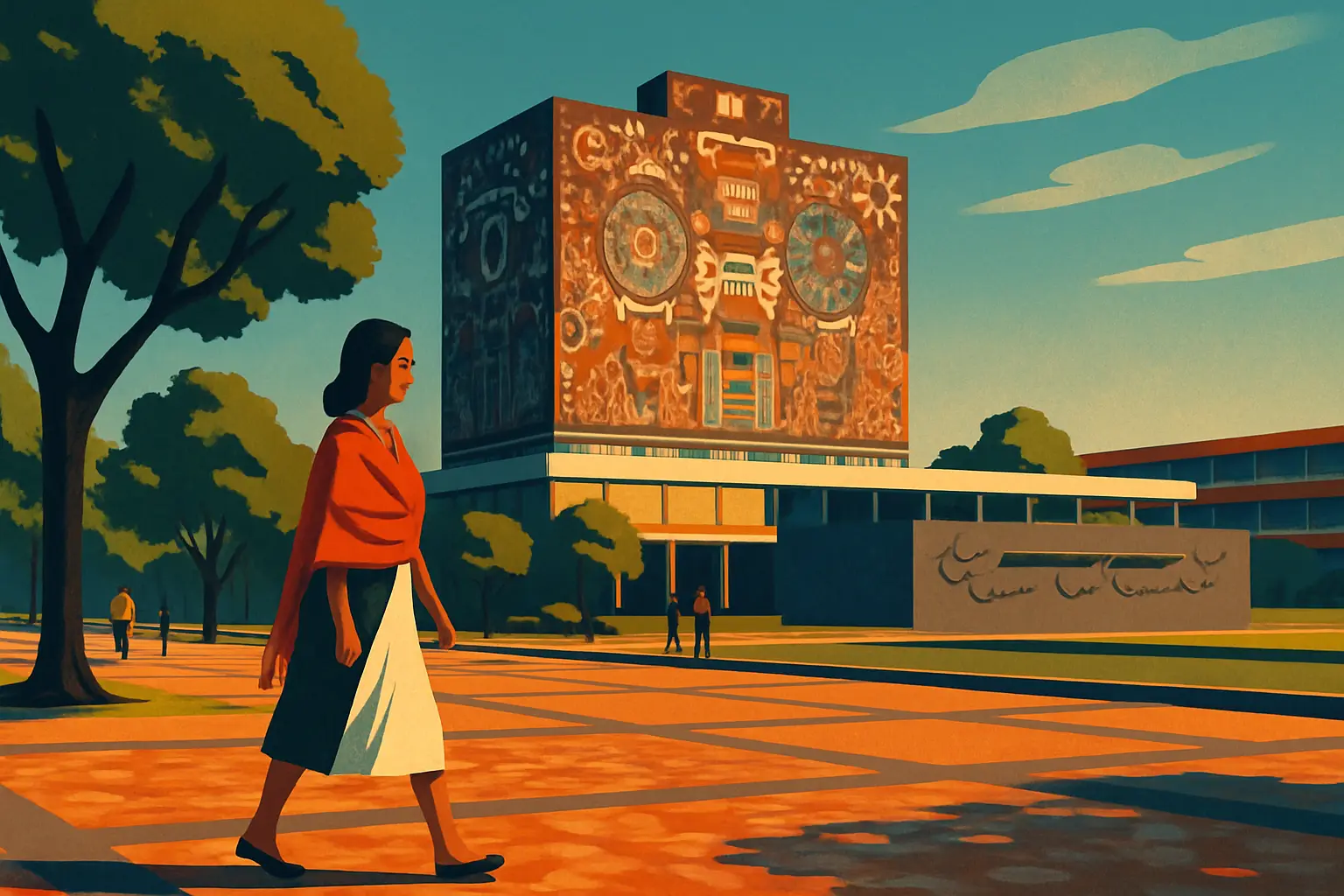
The first thing most visitors see at UNAM is the one they came for: the Biblioteca Central, designed by Juan O'Gorman and completed in 1952. All four exterior walls of the main tower are covered from foundation to roofline in a mosaic made from approximately 7.5 million pieces of natural colored stone — marble, onyx, and volcanic rock sourced from across Mexico — assembled without grout lines into a seamless surface.
Each of the four walls tells a different chapter of Mexican history. The north wall depicts the pre-Hispanic world: Aztec calendars, cosmological symbols, Tlaloc and Quetzalcoatl. The south wall shows the colonial era — the Spanish conquest, the Inquisition, and post-independence Mexico. The east and west walls represent contemporary Mexico and the scientific worldview: atoms, DNA, a map of the continent, and an allegory of the university's role in transmitting knowledge between generations.
What makes the library strange as a library is that it has almost no traditional windows on those four walls — O'Gorman designed the mosaic to be the exterior skin, with natural light entering from windows at the base and from glass elements worked directly into the stone. The building is still a functioning library. You can walk inside, look up at the mezzanine stacks, and realize that the most-photographed building on the UNESCO heritage campus is also just — a place where students study for exams.
Get short, interactive stories that make each place easier to remember while you travel.
Within a five-minute walk of the Biblioteca Central are two more works that belong in any conversation about Mexico City's great public art.
On the south face of the Rectoria building — UNAM's administrative headquarters — David Alfaro Siqueiros completed 'El pueblo a la universidad, la universidad al pueblo' (The people to the university, the university to the people) in 1956. Unlike a traditional flat mural, Siqueiros built this composition to project outward from the building's surface — a three-dimensional polychrome relief where painted figures advance and recede depending on where you stand. It was a technique he developed specifically for this commission, pushing beyond what conventional mural painting could do.
The Estadio Olimpico Universitario, a 10-minute walk east of the library plaza, was built in 1952 and hosted events during the 1968 Mexico City Olympics. Its entrance facade features a high-relief mosaic by Diego Rivera depicting 'La Universidad, la familia y el deporte en Mexico' — a monumental celebration of education and physical life in Rivera's characteristic palette of earth tones and deep red. The stadium was deliberately designed to resemble a volcanic crater from the air, its oval form rising from the surrounding lava field. Today it's home to Club Universidad Nacional (Pumas UNAM) — a Liga MX match here is one of Mexico City's more unusual sports experiences.
Most people who see the Biblioteca Central don't walk the extra 15 minutes south to the Museo Universitario Arte Contemporaneo (MUAC), which is a genuine miss. The museum opened in 2008 in a building designed by architect Teodoro Gonzalez de Leon — a sharply angled concrete structure with a sloping glass facade that manages to feel simultaneously monumental and porous, with light cutting across the interior galleries in a way that changes throughout the day.
The collection focuses on Mexican and Latin American art from the 1950s to the present, and the rotating exhibition program regularly brings in internationally significant shows that would feel at home in a major museum in New York or Berlin. Unlike the murals, which you encounter in a fixed historical context, MUAC gives you contemporary Mexican art in active dialogue with global movements — photography, video installation, painting, and sculpture from artists working right now.
Admission is a small fee on most days; free on Wednesdays. MUAC is closed on Mondays. Check what's currently showing before you visit — the program changes frequently and has no filler. One frequently overlooked detail: the open-air terraces and corridors between the CCU complex buildings are themselves used as exhibition space for large-scale outdoor sculpture, and you can walk through them without paying any admission.
Of all the things to see at Ciudad Universitaria, the Espacio Escultorico surprises people most. Located at the southern edge of campus, past the Centro Cultural Universitario, it is a massive circular platform built directly into the Pedregal de San Angel — the ancient lava field that covers much of UNAM's southern grounds.
Sixty-four geometric concrete structures, each several meters tall, are arranged in a circle on the platform. They were created in 1979 through a collaboration of six Mexican artists: Helen Escobedo, Manuel Felgueres, Mathias Goeritz, Hersua, Sebastian, and Federico Silva. The sculptures are deliberately abstract — rounded cones, split vertical blocks, inclined slabs — designed so that each interacts with the others in the overall composition but also functions as a standalone object depending on where you position yourself.
What makes the Espacio unlike any other sculpture park is the lava field itself. The Pedregal is a protected ecological reserve: you cannot leave the stone paths and walk into the vegetation, but from the platform you can see indigenous plants colonizing the volcanic rock — cactus, shrubs, and native grasses that have grown through the hardened lava since the Xitle eruption roughly 2,000 years ago. In the late afternoon, with the sun dropping low over the stones and the sculptures casting long shadows across the pedregal, it is one of the most quietly surreal places in the city.
The Centro Cultural Universitario (CCU) is a performing arts complex at the southern end of campus, built in the mid-1970s and home to several theaters and the Biblioteca Nacional de Mexico. Its centerpiece is Sala Nezahualcoyotl, designed with a vineyard-style seating arrangement — terraced sections surrounding the stage on three sides — that gives it exceptional acoustics confirmed repeatedly by international orchestras and soloists. It is widely considered one of the finest concert halls in Latin America.
The resident ensemble is OFUNAM, the Orquesta Filarmonica de la UNAM, which performs a full symphonic season running roughly September through June. Tickets range from around 60 to 300 pesos depending on seat category — at the upper end, that's approximately 15 USD to hear a professional symphony orchestra in one of Latin America's great venues. The program balances core European repertoire with Mexican composers and regional premieres.
Beyond orchestral concerts, the CCU hosts theater, dance, and film, with the Teatro Juan Ruiz de Alarcon (an intimate 350-seat house) serving smaller productions. If you're in Mexico City for more than a few days and have any interest in live performance, checking the CCU calendar before you arrive takes five minutes and can completely reshape a Tuesday evening.
Getting there: Take Metro Line 3 (the olive-colored line) south to either Copilco station or Universidad station. Copilco drops you closest to the Biblioteca Central, Rectoria, and Estadio Olimpico. Universidad station — the line's terminus — deposits you at the southeastern end of campus, a short walk from the CCU and Espacio Escultorico. From Roma Norte or Centro Historico, the ride takes 35 to 45 minutes. Alternatively, Metrobus Line 1 runs along Insurgentes Sur with a Ciudad Universitaria stop.
Getting around: The PumaBus shuttle system runs 12 routes with stops marked by blue signs throughout campus. It's free and open to visitors — essential because the Espacio Escultorico is roughly 3 kilometers from the Biblioteca Central.
Cost: Campus grounds are free. MUAC charges general admission on most days (free Wednesdays) and is closed Mondays. Universum, the science museum, has separate admission and is particularly popular with families.
Suggested order for a full day: Arrive at Copilco → Estadio Olimpico exterior facade → Biblioteca Central and Rectoria → PumaBus south to MUAC and CCU terraces → Espacio Escultorico for late-afternoon light → Metro home from Universidad station. Build in at least four hours; a full day is better. The neighborhood of San Angel is a 10-minute taxi or bike-share ride away — a natural companion for lunch or dinner.