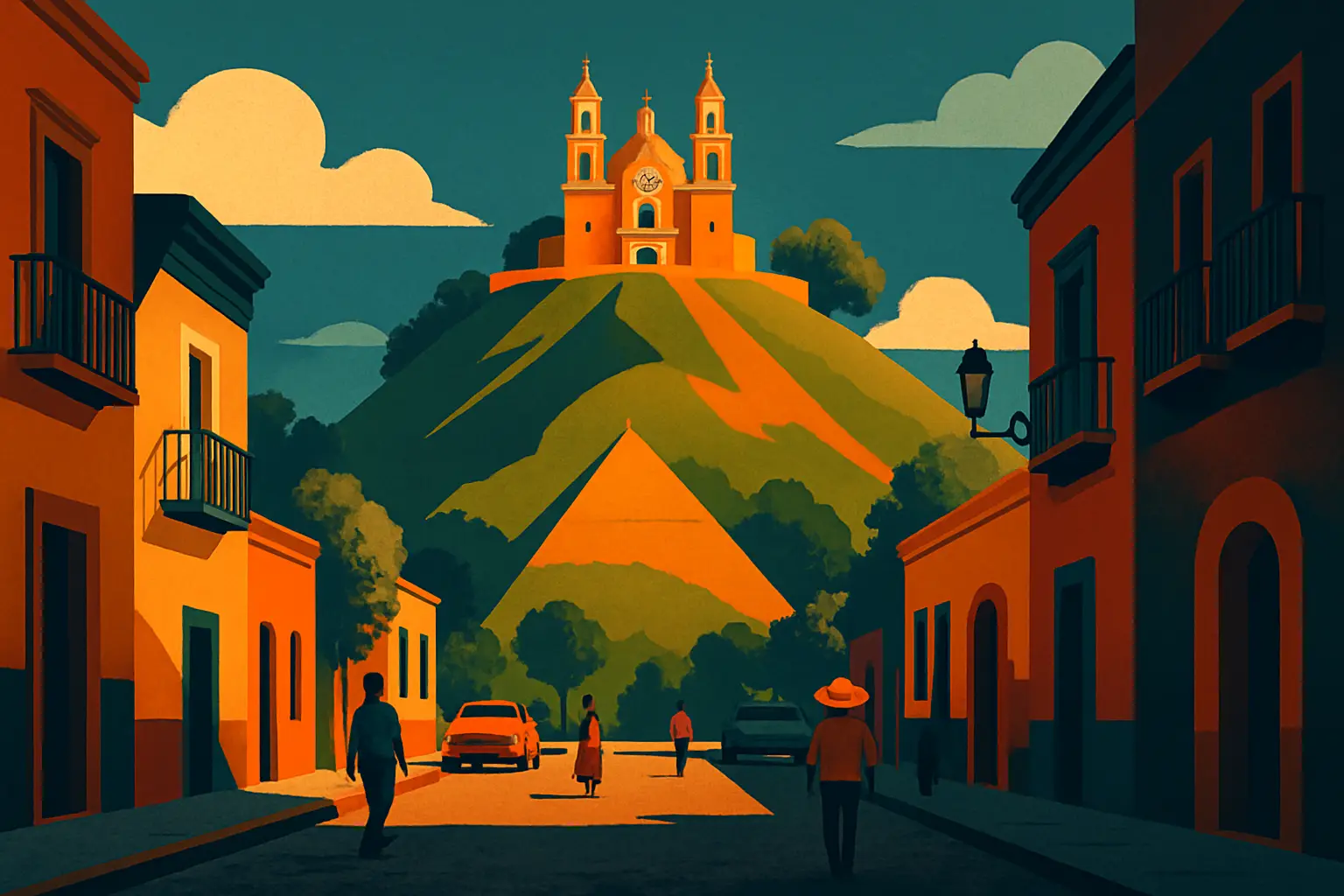
When the Spanish conquistadors arrived in Cholula in 1519, they found what appeared to be a small mountain in the middle of the city. It was covered in vegetation, roughly 55 meters tall, with a flat top. They built a Catholic church on its summit in 1594 — Nuestra Senora de los Remedios — and moved on. The 'hill' was not a hill. It was Tlachihualtepetl, a Nahuatl word meaning 'made-by-hand mountain,' and it is the largest pyramid ever built by humans, measured by volume: 4.45 million cubic meters of adobe brick and earth, compared to 2.6 million cubic meters for the Great Pyramid of Giza. The difference is in shape — Tlachihualtepetl is massive and low rather than tall and steep, which is why it looks like a hill and why it fooled everyone for centuries. Construction began around 300 BC and continued through roughly 900 AD, with each successive civilization building a new pyramid directly over the previous one like a series of nesting dolls. The result is four distinct pyramid structures layered inside each other. Archaeologists beginning in the 1930s spent decades boring tunnels through the interior to map these layers — creating the 8 kilometers of passage that visitors can partially walk today. The Spanish church sitting on top is not some cruel joke by colonizers. They genuinely did not know.
The most direct route is the bus from TAPO — Terminal de Autobuses de Pasajeros de Oriente — on the east side of Mexico City. Take Metro Line 1 (the pink line) to San Lazaro station, exit toward the bus terminal, and follow signs for TAPO. Inside, look for Estrella Roja counters: they run a direct Mexico City–Cholula service that takes about 2 hours and costs 180–220 pesos one way. Buses leave roughly every 30 minutes starting around 6 AM; the last bus back to Mexico City departs Cholula around 8 PM. No booking required — buy tickets at the counter. The bus drops you at Cholula's 12 Poniente station on the western edge of town, about a 15-minute walk or short Uber from the pyramid entrance. An alternative is to take a bus to Puebla (CAPU terminal, also served by Estrella Roja from TAPO) and then an Uber to Cholula from there — the two cities are 12 km apart and the ride takes under 15 minutes. This makes sense if you plan to combine both in one day, which is the most common approach. The Puebla bus is faster and more frequent if you're pairing the trip; the direct Cholula bus is more efficient if you're spending most of the day at the pyramid and the town.
Get short, interactive stories that make each place easier to remember while you travel.
The entrance to the archaeological zone is at Calle 8 Norte and 6 Poniente, just north of the pyramid's base. The 85-peso ticket covers three things: the outdoor platforms, the tunnels (when accessible), and the Museo de Sitio de Cholula just inside the entrance. The museum is small but genuinely useful — it displays ceramics, figurines, and architectural diagrams from the site's various construction phases, and gives you context before you see the structure itself. Outside, the excavated platforms along the pyramid's northern and western faces show the exposed exterior walls of the inner pyramid layers. You can walk along the base and see where the grass-covered exterior gives way to exposed adobe brick — the visual contrast between the natural-looking surface and the cut stone underneath is striking. The most impressive platform section is along the north face, where archaeological excavations have exposed a broad ceremonial terrace with stucco surfaces and altars. Allow 30 minutes for the museum and outdoor platforms before you commit to the tunnels.
Ticket office opens at 10 AM Tuesday–Saturday
Site closes at 5:30 PM; last tunnel entry is typically around 4:30 PM
Photography is permitted throughout, including inside the tunnels
Guides available at the entrance for 200–350 pesos for a 90-minute tour
Of the 8 kilometers of tunnels bored through the pyramid's interior since the 1930s, around 800 meters are open to visitors — and they are the strangest part of the visit. You enter through a low doorway in the pyramid's flank and walk through a sequence of passages illuminated by dim installed lighting, the walls composed of the adobe brick that forms the pyramid's core. The passages connect at several junctions where you can see the stratigraphy of the construction: one wall of an older pyramid, then the fill layer, then the exterior wall of the newer pyramid built over it. The depth of the layering is easier to understand inside the tunnels than from any diagram. The highlight inside is a partial view of the Bebedores mural — 'The Drinkers' — a large-scale painted wall from one of the pyramid's earlier phases, depicting figures consuming pulque in a ceremonial context. It is one of the largest pre-Hispanic murals in Mexico and dates to approximately 200 AD. Not all of it is accessible; what is visible through a protective barrier is still impressive. The tunnels take about 25–35 minutes to walk at a leisurely pace. They are cool, narrow in places, and occasionally low-ceilinged — comfortable for most adults but not for anyone with serious claustrophobia.
After the archaeological zone, the climb to the summit is the visual payoff of the visit. A paved path leads up the exterior of the hill — which is to say, up the exterior of the pyramid — to the Baroque church at the top. The climb takes about 10 minutes and is moderately steep. At the summit, Nuestra Senora de los Remedios is a working parish church, painted in white and yellow, with an arched atrium and bells that ring on the hour. Entry is free. The interior is modest — it is a neighborhood church, not a cathedral — but the context gives it weight: you are standing on top of a 2,000-year-old pyramid that was covered in earth and forgotten for centuries, looking at a building that was constructed in complete ignorance of what was underneath. On a clear day, which is most likely in the dry season from November through April and in the mornings during May and June, Popocatepetl and Iztaccíhuatl are both visible from the summit. Popocatepetl — the active volcano — is particularly dramatic when it is venting, which it does regularly. The view of the Cholula valley and the city of San Pedro spread out below is also worth the climb on its own terms.
Cholula is technically two adjacent municipalities — San Pedro Cholula (where the pyramid is) and San Andres Cholula (the more commercial town to the west) — and the San Pedro zocalo is the one worth spending time in. It is one of the largest public squares in Mexico, framed by the Convento Franciscano de San Gabriel, a 16th-century Franciscan monastery complex that includes one of the oldest churches in the Americas still in use. The convento is enormous and undervisited relative to the pyramid — walk through its open-air chapel (the Capilla Real, also called the Capilla de Nueve Cúpulas for its nine domes) before or after the archaeological zone. For food, the streets around the zocalo are lined with restaurants and casual spots. Cemita Cholulteca — a sesame-seed roll sandwich stuffed with milanesa, avocado, chipotle, and quesillo — is the local version of the Puebla cemita and worth trying if you haven't eaten the Puebla version. Cholula's market street runs along 2 de Julio north of the zocalo, with prepared food stalls open from morning through early afternoon serving chalupas (small fried masa boats with salsa and shredded chicken or pork), tlacoyos (thick oval masa cakes with bean or cheese filling), and atole. For a sit-down meal with a pyramid view, several cafes on the streets just west of the archaeological zone entrance face the pyramid's grass-covered slope — the view of the church framed above the hill is best from here in the late afternoon.
Yes, and most visitors do exactly this. The two cities are 12 km apart and connected by frequent local buses (peseros) and cheap Uber rides — a 10-to-15-minute trip. The practical question is which to visit first. Puebla in the morning, Cholula in the afternoon works well if you want to see the Zocalo and Palacio de Gobierno in Puebla's peak morning light and finish the day at the pyramid at golden hour. Cholula first works better if the tunnels and archaeological site are your priority, since they close at 5:30 PM. A reasonable schedule: leave Mexico City from TAPO around 8 AM (arrive Cholula ~10 AM), spend 3–4 hours at the pyramid, Uber to Puebla for a late lunch in the centro historico, walk the cathedral and the talavera-tile streets of Barrio del Artista, and catch a 6 or 7 PM bus back to Mexico City from Puebla's CAPU terminal. For a full guide to what to do in Puebla itself, see the Puebla from Mexico City guide.
Hours: The Cholula archaeological zone is open Tuesday through Saturday, 10 AM to 5:30 PM. It is closed Sunday and Monday. The Nuestra Senora de los Remedios church is open daily. The Museo de Sitio keeps the same hours as the archaeological zone. Admission: 85 pesos for the archaeological zone and museum (roughly $4.50 USD). The church is free. Guided tours of the tunnels cost 200–350 pesos depending on group size. Getting back: Estrella Roja buses from Cholula's 12 Poniente station to Mexico City TAPO run until about 8 PM. If you are combining with Puebla, buses from CAPU (Puebla's central bus station) to TAPO in Mexico City run until around 10 PM and take about 2 hours — same price range. What to bring: Comfortable walking shoes for the tunnel floors and the summit path. A light jacket — the tunnels are cool and the summit is exposed to wind. Cash for the entry ticket and market food; most restaurants around the zocalo also accept cards. Is Cholula safe? San Pedro Cholula is a well-visited university town — Universidad de las Americas Puebla (UDLAP) has its campus here — and the centro is safe and walkable during the day. The usual precautions apply: don't leave bags unattended and use Uber rather than hailing random taxis for the Cholula–Puebla leg.