The argument breaks down geographically. In most of Mexico — Oaxaca, Guadalajara, Veracruz, and everywhere else — a quesadilla means a tortilla with queso melted inside. The etymology is right there in the name: 'quesadilla' derives from queso plus the diminutive '-illa.' In Mexico City, the logic inverts. A quesadilla is a pocket of corn masa, pressed flat and cooked on a comal (griddle), filled with whatever the stand specializes in — mushrooms, squash blossoms, pork, brain, grasshoppers — and cheese is just one ingredient among many. If you want cheese, you say 'con queso.' If you don't specify, you might get none, and the taquera behind the comal will not have made an error.
The reason goes deeper than regional stubbornness. Mexico City's street food culture developed around the masa — the corn dough is the protagonist, not the filling and not the cheese. The city's long history as a trading and market hub meant filling options multiplied: ingredients from Oaxaca, Veracruz, Guerrero, and the Gulf Coast all passed through the capital's central markets and ended up inside quesadilla stands across the city. Cheese is available, inexpensive, and delicious — it's simply not the default. This is the single most useful thing to know before you walk up to a street stand in CDMX.
In Mexico City, cheese is an optional add-on — say 'con queso' to include it
Outside CDMX (Oaxaca, Guadalajara, everywhere else), cheese is the default and assumed
The filling variety in Mexico City quesadillas traces directly to the city's role as a central market hub for centuries
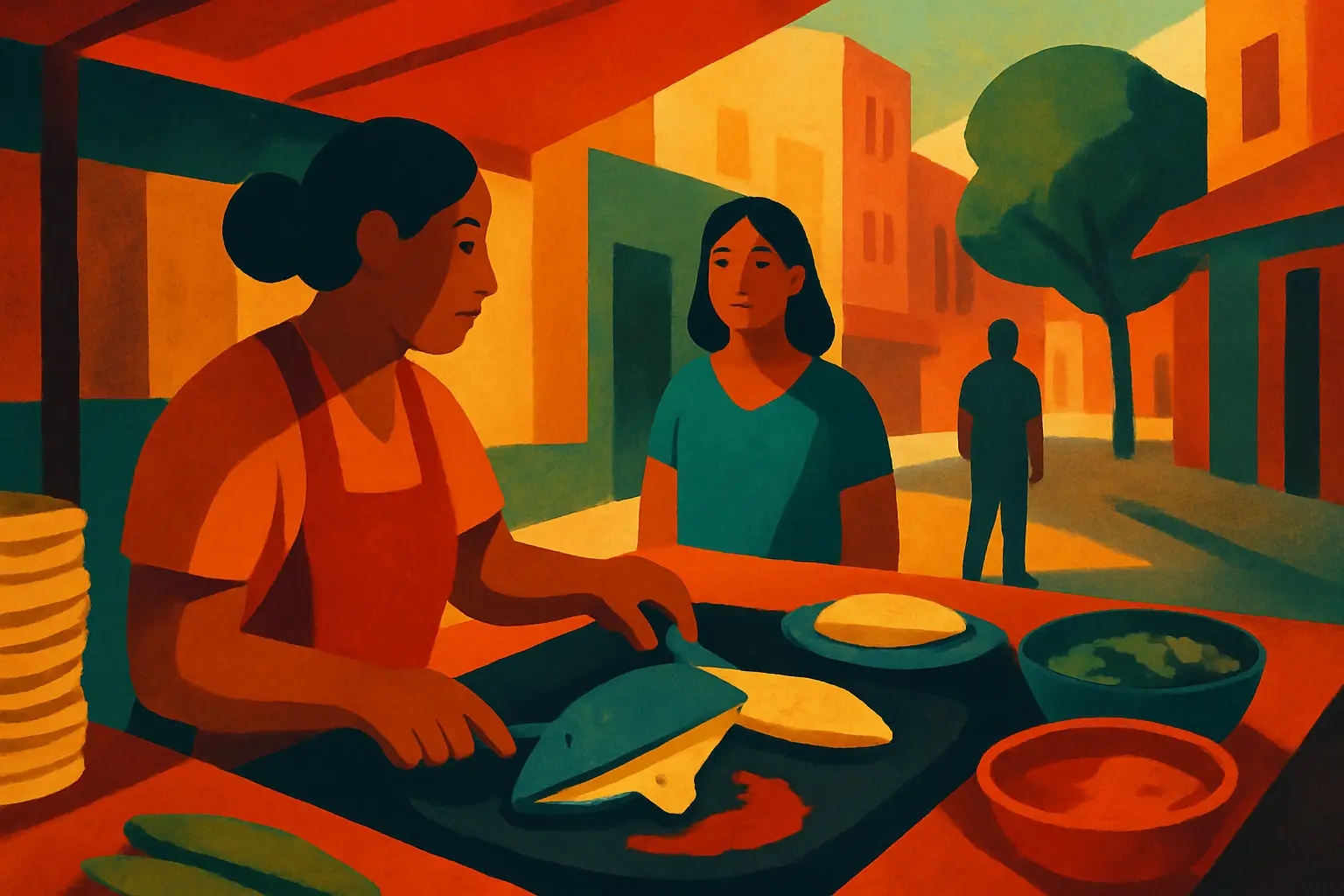
A CDMX street quesadilla starts with fresh masa — nixtamalized corn ground the same day, ideally, though masa harina rehydrated with water is common and acceptable at high-volume stands. The taquera takes a ball of dough, presses it flat by hand or with a tortilla press, lays the raw masa on a dry comal at high heat, adds the filling to one half while the other side cooks, folds it into a half-moon, and finishes it with a brief press until the exterior crisps. The best versions have a lightly charred, comal-toasted exterior and a soft, yielding interior. The whole process takes under two minutes.
This is categorically different from the Tex-Mex version — a flour tortilla with melted cheese, griddled flat and cut into triangles — which is a different food entirely. It's also distinct from the quesadilla you'd get in Oaxaca or Guadalajara, where a thinner corn tortilla replaces the thick masa pocket. The CDMX version sits closer to a tamal in its relationship to corn: the masa has weight and flavor of its own, and the filling is enclosed rather than topped. If your only quesadilla reference point is a Mexican restaurant in the United States, what you'll get from a CDMX street stand will be a genuinely different experience.
Fresh masa pressed on a comal — the dough has its own corn flavor, not just a neutral wrapper
Folded half-moon shape with filling enclosed inside, not layered flat like a Tex-Mex version
The best comals run very hot — you want the exterior lightly charred and the interior still soft
Get short, interactive stories that make each place easier to remember while you travel.
Flor de calabaza (squash blossom): bright yellow flowers sautéed with onion and epazote, often with a base of cheese even at cheese-optional stands. Delicate, slightly vegetal, mildly sweet. The best entry point for someone new to CDMX quesadillas. Huitlacoche (corn fungus): a dark, inky growth that develops on corn ears and has been eaten in Mexico since pre-Aztec times. Smoky, earthy, and nothing like what the words 'corn fungus' suggest — see the next section for a full breakdown. Rajas con crema: strips of roasted poblano pepper in a cream sauce. Mild heat, deeply savory, excellent comfort food. Chicharrón prensado: pressed pork crackling simmered until soft and broken into fatty, shredded pieces — not the crunchy kind you snack on, but a different texture entirely. Rich and porky. Tinga: shredded chicken or beef braised in chipotle-tomato sauce, available at nearly every stand. Reliable everywhere. Chapulines: toasted grasshoppers, seasoned with lime and salt, one of the oldest protein sources in the Valley of Mexico. Crunchy, tangy, and far less challenging than they sound once you're eating them.
Start with flor de calabaza con queso — the squash blossom's sweetness and the cheese's salt work perfectly together
Huitlacoche is the most distinctive filling unique to Mexico City street food — it's the reason food writers fly here
Chicharrón prensado is the sleeper filling: soft, fatty, and unfamiliar to most visitors, but one of the most satisfying
Huitlacoche (pronounced roughly 'weet-lah-CO-cheh') is the growth of Ustilago maydis, a smut fungus that colonizes corn kernels as the ear develops, replacing them with dark, swollen, irregular masses. In the United States and Europe, corn infected with Ustilago maydis is treated as a crop pest and destroyed. In Mexico, the fungus has been deliberately cultivated and prized since at least the 15th century — it appears in Aztec market records and codices under various Nahuatl names.
The flavor is often compared to truffles, but that comparison flattens it. Huitlacoche has a smoke quality that truffles don't, and it picks up the sweetness of the corn it grew from. In a quesadilla, it's typically sautéed with white onion, garlic, and epazote (an herb with a resinous, medicinal quality that's native to the Valley of Mexico and used almost exclusively in this cuisine) before being spooned onto the masa. The result surprises nearly everyone who expects adventurous eating — it tastes like a refined, smoky mushroom dish, complex without being difficult. Huitlacoche is seasonal: summer and early fall are peak availability, when corn is actively growing. In May, you'll find it at market stands but not universally — ask which filling is freshest that day and let the taquera guide you.
Called 'Mexican corn truffle' abroad, though huitlacoche predates any truffle comparison by centuries
Sautéed with onion, garlic, and epazote — a preparation virtually unchanged from pre-colonial cooking
Seasonal: most abundant in summer and early fall when corn is actively growing; ask if it's fresh before ordering
Quekas, near Mercado San Cosme on Calle Manuel González in Colonia Santa María la Ribera, is the quesadilla destination that food writers keep returning to. The operation runs with fifteen-plus filling options organized on a hand-written board — a rigorous, systematic approach to the form. Order two or three with different fillings to understand the range. Santa María la Ribera is worth the trip on its own — the Kiosko Morisco and Alameda park are three blocks away.
Roma Norte has several evening quesadilla stands that appear after 7 p.m. along Orizaba and Álvaro Obregón — temporary setups from carts or folding tables with portable comales that exist only when foot traffic supports them. The impermanence is part of the city's food logic. Mercado Medellín in Roma Sur (at Campeche and Coahuila) has a permanent row of antojito stalls inside where quesadillas are made to order alongside other masa-based dishes. It's a working neighborhood market rather than a tourist destination, which means prices are lower and the clientele is almost entirely local. Coyoacán's markets — particularly around Coyoacán's Mercado on Ignacio Allende — have quesadilla stands busy from morning through mid-afternoon with an emphasis on older preparations.
Quekas near Mercado San Cosme (Colonia Santa María la Ribera): fifteen-plus fillings, the dedicated destination
Mercado Medellín (Roma Sur, at Campeche and Coahuila): working neighborhood market, local prices, permanent stalls
Evening stands along Orizaba in Roma Norte: appear after 7 p.m., exist only when foot traffic supports them
The quesadilla stand operates at speed. Knowing the vocabulary means you don't hold up the line and you get exactly what you want. 'Una quesadilla de [filling], con queso' — one quesadilla of [filling], with cheese. The 'con queso' is your addition; without it, the outcome depends on the stand's default. 'Con todo' means with all the standard accompaniments — onion, epazote, and whatever garnish the stand offers. 'Sin cebolla' is without onion, if you prefer. For texture: 'bien dorada' (well-browned) tells the taquera to press it longer on the comal so you get a crisped, lightly charred exterior. 'Suave' means soft, if you prefer the masa less cooked. For salsa: 'salsa verde' (tomatillo-based, acidic, the better pairing with vegetable fillings) or 'salsa roja' (red chile, warmer). Many stands also offer crema (Mexican sour cream, thinner than the American version) and queso fresco to add on top. Ask the taquera what she recommends for the filling you ordered — this gets you the correct salsa and any garnish the stand uses that isn't on the board.
'Con queso' = with cheese; 'bien dorada' = extra crispy on the comal; 'con todo' = all standard garnishes
Salsa verde with flor de calabaza and huitlacoche; salsa roja with chicharrón and tinga — the acid or heat matches the filling
Ask the taquera what she recommends — she knows which filling needs crema, which one goes better without it
Quesadillas from a busy, well-run stand are among the safer street food options in the city — the comal cooks everything to order at high heat, there's no raw produce in the standard preparations, and the masa itself is freshly cooked in front of you. The practical safety signal is the same as with any Mexico City street food: choose a stand with visible high turnover, where you can watch the cooking on an open comal. Huitlacoche and flor de calabaza are both cooked before they go into the masa, which removes the raw produce variable. The salsa is the element to watch — fresh green salsa sitting in a container turns over faster at busy stands. If you're in your first day or two in CDMX and your stomach is still acclimating, put the salsa on the side and add it in small amounts rather than pouring a full ladle. After three or four days of eating in the city, most visitors' systems have adjusted and the standing-at-a-street-comal experience becomes entirely comfortable.
High-heat comal cooking on order — the masa and most fillings are cooked in front of you, which removes a significant risk variable
Busy stands with visible turnover: the simplest quality and safety signal for any Mexico City street food
New arrivals: salsa on the side your first day, then build up to full pours as your system adjusts to CDMX
A street quesadilla in Mexico City costs between 15 and 35 MXN (roughly $0.75–$1.75 USD), depending on the filling. Huitlacoche and flor de calabaza command a small premium over tinga or chicharrón because they're seasonal and require more preparation. Adding cheese costs an extra 5–10 pesos at most stands. Market quesadillas inside Mercado Medellín or the Coyoacán markets typically run the same price range but may come with an agua de sabor as part of a lunch combo for 50–70 MXN.
The best time is mid-morning — between 9 and 11 a.m. — when fresh masa has been made that morning and the taquera has had time to prep all her fillings. Early evening, from 7 to 9 p.m., is the second-best window: the street stands are set up, the pace is fast, and the masa is turned over quickly. Avoid the mid-afternoon gap between 2 and 5 p.m., when foot traffic drops and the best stands either close for a break or slow to the point where the masa sits longer than it should. A fresh quesadilla cooked immediately after you order is the product; a quesadilla made from masa that's been sitting for an hour is a noticeably different, drier thing.
15–35 MXN per quesadilla ($0.75–$1.75 USD) — one of the best value-per-bite ratios in any major city
Best hours: 9–11 a.m. for fresh morning masa; 7–9 p.m. for evening street stand peak
Avoid 2–5 p.m. — the mid-afternoon slow is when masa and fillings sit longest between orders