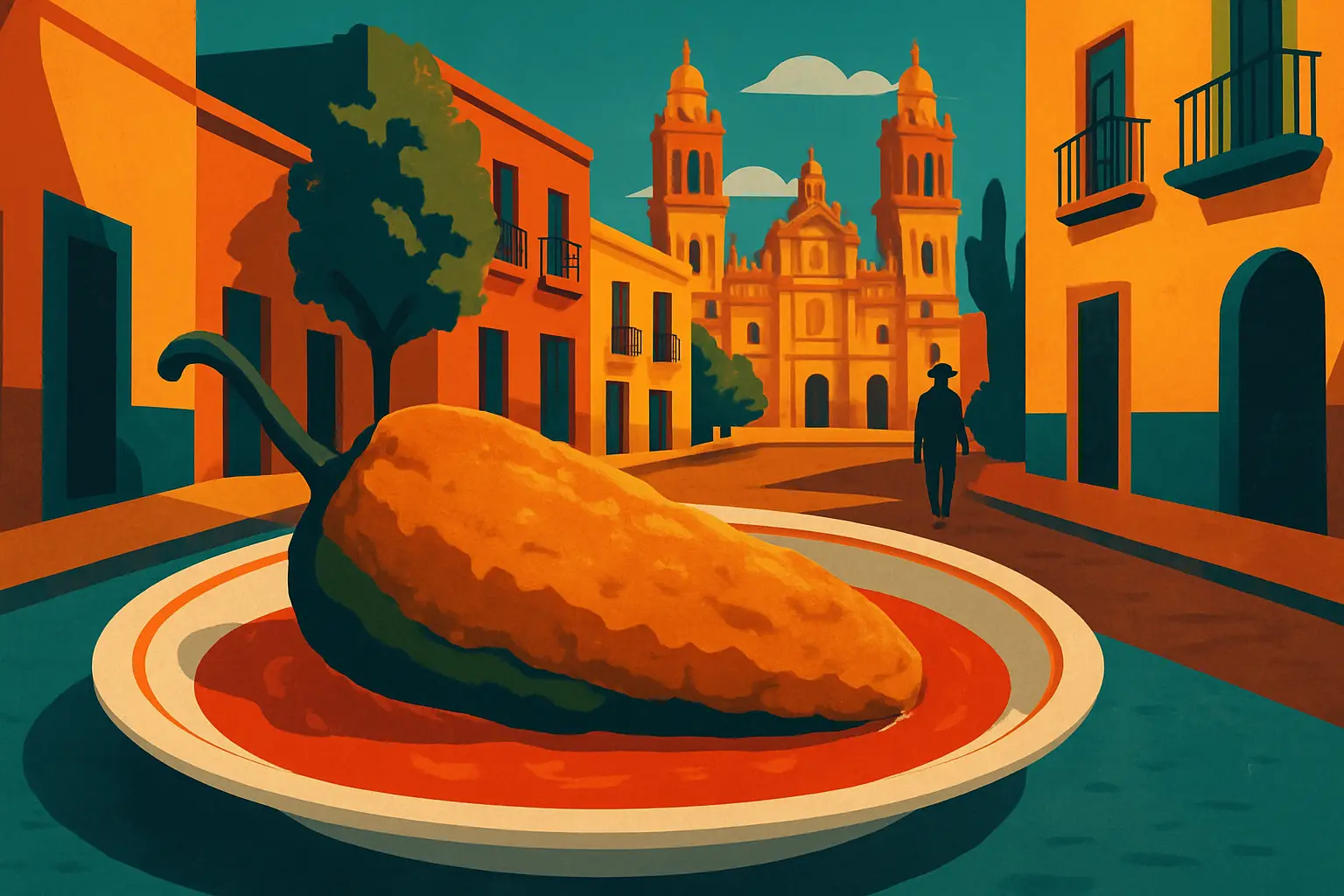
The capeado is the batter, and it is the part that separates a proper chile relleno from a mediocre one. Egg whites are beaten to stiff peaks, then the yolks are folded back in gently to create a light, foam-like coating. The stuffed poblano gets dipped in this mixture and goes immediately into hot oil, where the batter puffs up and turns golden — producing a shell that is closer to a souffle than to the thick breading of a fried cutlet. When done correctly, the capeado deflates slightly as the dish rests, clinging to the chile in soft irregular folds. When the shortcut is taken — whole beaten eggs plus flour, no separation, no folding — the result is a dense, greasy crust that tastes mostly of fried egg and masks everything underneath. Most fondas in Mexico City use proper technique because it is what was taught to the cook by whoever taught them. The test is visual: a correct capeado looks irregular, slightly wrinkled, and soft. A shortcut capeado looks smooth and uniform, like a thick fried shell around the entire pepper. The shortcut version appears most often at busy street stands that sell chiles rellenos as one rotation item on a long menu — if the stand sells fifteen different things, the capeado is probably not getting the attention it needs.
The poblano is a large, dark-green chile with thick walls and a Scoville rating of roughly 1,000–2,000 units — about half the heat of a jalapeno. That mild-to-medium heat level is exactly why the dish works: you can eat an entire stuffed poblano and the filling is the flavor, not the burn. The pepper is named after Puebla state, where it was cultivated before the Spanish arrival and still grows most intensively. In Mexico City, poblanos are available year-round at every market — Mercado Jamaica, Mercado de la Merced, and most neighborhood tianguis typically sell them for 8–12 pesos each. Before stuffing, the chile must be roasted and peeled. The standard method is direct flame: the pepper sits on a gas burner until the skin blisters and blackens, then steams inside a sealed plastic bag for 10–15 minutes, then gets peeled by hand. The roasting adds a faint smokiness that raw poblano does not have and softens the wall so the pepper accepts the filling without tearing. A chile relleno made from an unroasted poblano is a different and noticeably inferior dish — the raw pepper resists the batter and the smoky baseline of the flavor disappears entirely.
Get short, interactive stories that make each place easier to remember while you travel.
Queso is the simplest and most common version. The standard cheese is queso Chihuahua — a semi-soft, Mennonite-style variety from northern Mexico that melts cleanly without becoming oily — or queso Oaxaca, the string-cheese style that pulls in long strands when you cut into the chile. Some fondas use queso fresco instead, which does not melt as smoothly but has a brighter, saltier flavor. The queso version is the benchmark: if a cook cannot produce a clean cheese relleno, nothing else on the menu will save them. Picadillo is ground or finely diced pork cooked with onion, tomato, garlic, raisins, and toasted almonds or pine nuts — the same filling used in chiles en nogada, but served here with a plain tomato caldillo rather than the walnut cream sauce. The picadillo version takes longer to prepare and usually costs 30–50 pesos more at a fonda. Rajas con crema are strips of roasted poblano combined with cream and sometimes corn or mushrooms. This is the vegetarian option, rarely labeled as such, and the most conceptually interesting of the three: the filling and the chile shell are the same pepper at different stages of preparation, and the dish tastes entirely of roasted poblano at two different intensities. It is also the most common version at sit-down restaurants.
Queso: queso Chihuahua or queso Oaxaca — melts clean, the benchmark version at fondas
Picadillo: spiced ground pork with raisins and nuts — 30–50 pesos more, worth asking for
Rajas con crema: roasted poblano strips in cream — the vegetarian option, rarely labeled as such
The standard sauce in Mexico City is a caldillo de jitomate: a thin, slightly spiced tomato sauce made from blended tomatoes, garlic, onion, and usually one chipotle chile for smoke. It is not thick. It is not a salsa. It is a light, acidic liquid that the plate is set into — the chile relleno sits partially submerged and the caldillo seeps beneath the capeado as you eat, cutting through the richness of the fried batter and the fat of the melted cheese. The acid of the tomato and the mild smoke of the chipotle are both deliberate: they balance what would otherwise be a very heavy plate. Some fondas skip the caldillo and serve the chile over a plain tomato puree; some restaurants add a layer of crema on top instead. The caldillo version is the traditional CDMX approach and the one you will find at El Cardenal and most serious market fondas. If the sauce is absent and the chile arrives dry on the plate with no liquid, you are at a stand that views chiles rellenos as a grab-and-go item rather than a full dish.
El Cardenal at Palma 23 in Centro Historico — five minutes on foot from Metro Zocalo on Line 2 — serves a chile relleno a la oaxaquena: a poblano stuffed with queso fresco, fried in proper capeado, set in a mild tomato caldillo. The kitchen has been operating since 1969 and the capeado here is what it should be: light, slightly deflated at the edges, never dense. A second location at Presidente Masaryk 395 in Polanco serves the same menu with more space and easier walk-in seating. San Angel Inn at Diego Rivera 50 in San Angel occupies a 17th-century hacienda with stone walls, a garden courtyard, and a central fountain — the building was a Carmelite monastery before the Reform War of 1858 and has been a restaurant since 1963. The chiles rellenos here lean toward the richer end: a version finished with walnut cream that sits closer to the nogada tradition, priced around 310 pesos. Weekend brunch at San Angel Inn draws a local crowd that has been coming for decades. Walk-ins work fine on weekdays at El Cardenal Centro; San Angel Inn is worth a reservation on Saturday or Sunday.
El Cardenal, Palma 23, Centro — 5 min from Metro Zocalo (Line 2), kitchen open since 1969
El Cardenal also at Presidente Masaryk 395, Polanco — same menu, more walk-in space
San Angel Inn, Diego Rivera 50 — 17th-century hacienda, walnut-cream version, ~310 pesos
The most reliable place to eat a chile relleno on a Tuesday morning in Mexico City is a fonda inside a market, not a restaurant. At Mercado de la Merced — the largest market in the city, accessible from Metro Merced on Line 1 — the breakfast fonda rows are visible from the main entrance on Anillo de Circunvalacion and include several stalls that chalk up chiles rellenos from around 8 a.m. A full plate with rice and frijoles runs 80–100 pesos. Mercado Jamaica on Dr. Mora in Doctores has fondas where the cook arrives before 7 a.m. to beat the capeado batter fresh in a large clay bowl each morning. Mercado Medellin in Roma Sur, on Campeche between Medellin and Monterrey, has a small fonda section near the back where the crowd is neighborhood regulars eating the same breakfast they have eaten every week for years. In all three, the procedure is the same: sit at the counter, say buenos dias, ask what's available, and be eating within five minutes of arriving.
The poblano is mild. On a heat scale where a habanero is a 10 and a bell pepper is a 0, a roasted poblano sits around 2. Most people who avoid spicy food eat chiles rellenos without issue. The caldillo adds negligible heat unless the cook added chipotles aggressively — if you are heat-sensitive, ask '¿pica mucho la salsa?' before ordering and most fonda cooks will answer honestly. The capeado has zero heat. The queso and rajas fillings have none. The picadillo version may have a mild warmth from black pepper or clove but nothing sharp. One exception: some Oaxacan-influenced fondas near Centro Historico and in Doctores substitute a pasilla chile for the poblano. Pasillas are darker, drier, and run slightly hotter — roughly 1,000–2,500 Scoville units — with an earthier, almost fruity flavor that is deeper and more complex than the poblano. This substitution will usually appear on the menu or chalkboard as 'chile pasilla relleno.' It is worth ordering if you encounter it.
Poblano heat: about 1,000–2,000 Scoville — mild to medium, most people handle it fine
Ask '¿pica mucho la salsa?' if heat-sensitive — fonda cooks will answer directly
Pasilla substitution (darker, slightly hotter, earthier) appears at Oaxacan-style fondas near Centro
At a market fonda: 80–120 pesos for a full plate with rice and frijoles. At El Cardenal: around 185 pesos as a main course. At San Angel Inn: 250–310 pesos depending on the filling. The phrase at a fonda is '¿Me da un chile relleno de queso, por favor?' or '¿De picadillo?' — most fondas will tell you what is available before you sit if you ask '¿Que hay de chile relleno hoy?' The dish peaks between 8 a.m. and 12:30 p.m. at market fondas. If you arrive after 1 p.m., ask '¿Todavia hay chiles rellenos?' before sitting down — the kitchen may have sold out when it shifted to the comida corrida. At sit-down restaurants, chiles rellenos appear as a main course at both lunch and dinner and are available until the kitchen closes.