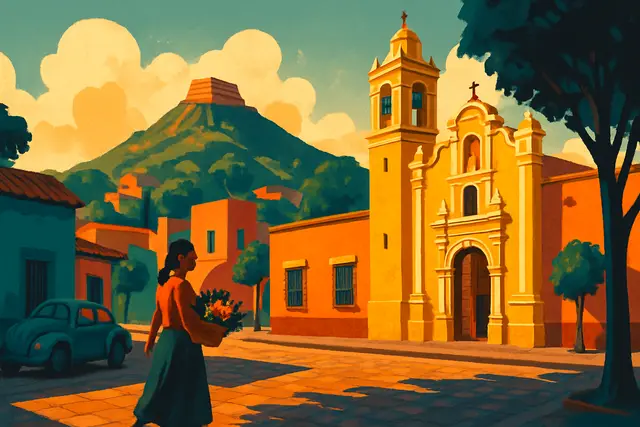
Until the 20th century, San Ángel wasn't part of Mexico City — it was a separate colonial town surrounded by farmland, orchards, and the country estates of Mexican aristocrats. The neighborhood grew up around the Carmelite convent founded here in 1615, and for three hundred years it was where wealthy capital families came on weekends to escape the city. When CDMX expanded southward in the 1900s, San Ángel got absorbed but kept its old street grid: narrow cobblestone lanes, walled gardens, and stone houses that pre-date almost everything else in the city. Walk three blocks off the main avenue and you're in a different century.
Founded around the Carmelite convent in 1615
Stayed an independent town until the 1900s
Cobblestone streets and walled gardens still survive intact
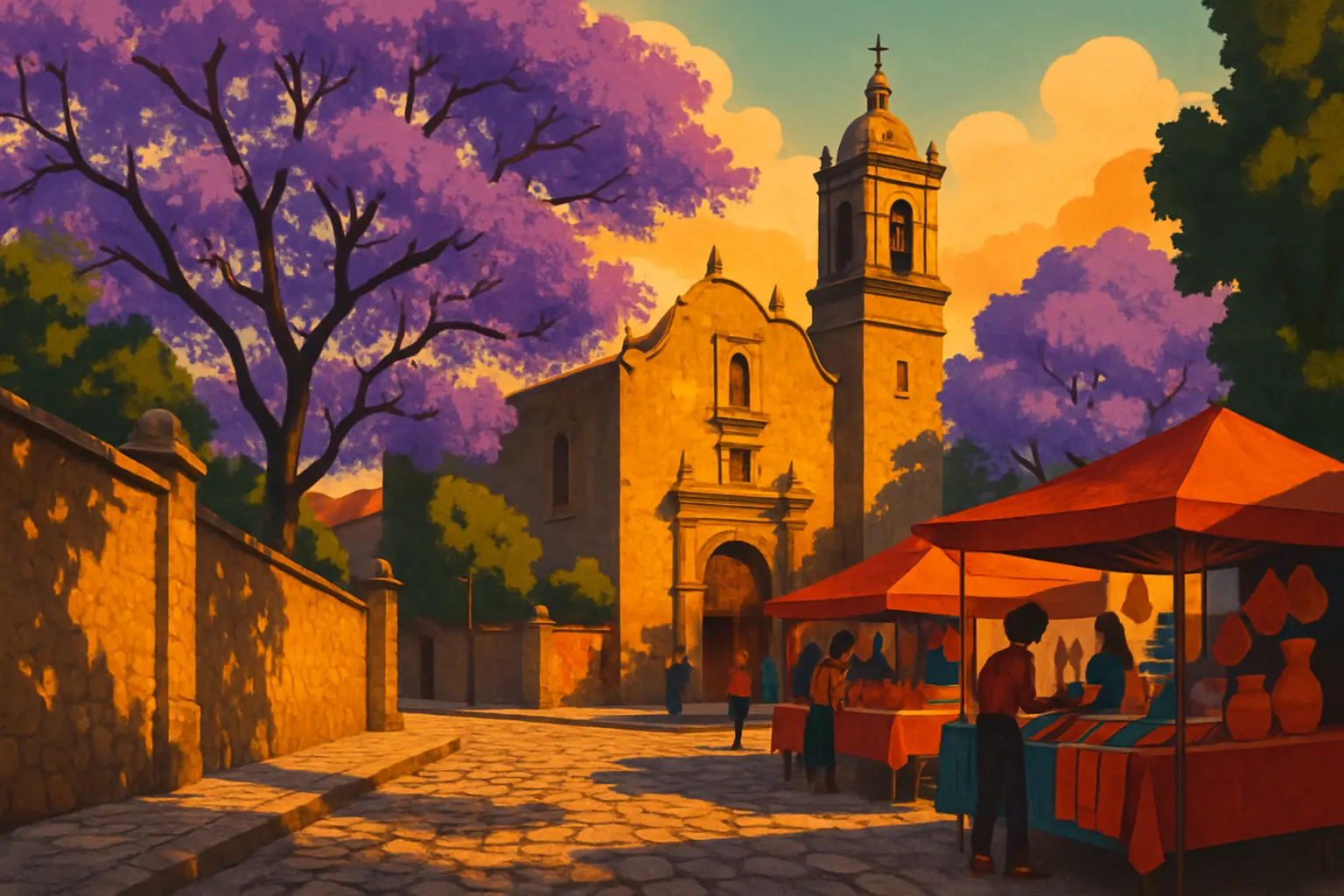
The center of San Ángel is Plaza San Jacinto, a small leafy square anchored by the 16th-century Templo de San Jacinto. Every Saturday since 1960, the plaza hosts Bazaar Sábado — a juried craft and art market that runs from about 10 a.m. to 7 p.m. The indoor part is housed in a 17th-century mansion at Plaza San Jacinto 11 and features about 80 vetted artisans selling silver, textiles, ceramics, leather, and contemporary Mexican design. The outdoor part spills across the plaza with painters, jewelry stands, and food. It's the one weekly event in CDMX where you can buy quality Mexican craft without the airport markup. Skip the surrounding streets if you only have an hour and head straight to the indoor mansion.
Bazaar Sábado: every Saturday, 10 a.m.–7 p.m., free entry
Indoor section: Plaza San Jacinto 11, vetted artisans only
Templo de San Jacinto: 16th-century church on the same plaza
Get short, interactive stories that make each place easier to remember while you travel.
A ten-minute walk west of Plaza San Jacinto is one of the most important pieces of modernist architecture in Latin America. In 1931, the painter and architect Juan O'Gorman built a pair of studio-houses for Diego Rivera and Frida Kahlo — a tall pink one for Diego and a smaller blue one for Frida — connected at roof level by a small bridge so the couple could see each other without being forced to live together. The buildings are pure Bauhaus-meets-Mexico: bare concrete, exposed pipes, primary colors, and a fence made of cactus. Inside, you'll see Diego's massive studio almost exactly as he left it, with papier-mâché Judas figures hanging from the ceiling. The museum is at Diego Rivera 2, corner of Altavista, and entry is about 70 pesos (free Sundays for residents).
Architect: Juan O'Gorman, 1931 — landmark of Mexican modernism
Pink house = Diego, blue house = Frida, sky bridge between roofs
Address: Diego Rivera 2 (corner of Altavista), open Tue–Sun
Three blocks from Plaza San Jacinto is the Museo de El Carmen, the former Carmelite convent that gave San Ángel its old name (San Jacinto Tenanitla). The complex was built between 1615 and 1628, and its three signature tiled domes are visible from blocks away. Inside you get original colonial frescoes, a small cloister garden, and a cell-by-cell look at how Carmelite friars lived. The unexpected attraction is in the basement crypt: twelve naturally mummified bodies, accidentally preserved by the dry mineral soil and discovered in 1916 during the Mexican Revolution when soldiers were searching for buried treasure. Three are usually on display behind glass, and yes, you can look. Entry is about 65 pesos. Address: Av. Revolución 4–6.
Carmelite convent built 1615–1628, three iconic tiled domes
Basement crypt: 12 naturally preserved mummies, found in 1916
Address: Av. Revolución 4–6, open Tue–Sun, ~65 pesos
San Ángel's restaurant scene leans historic and unhurried. San Ángel Inn (Diego Rivera 50) is set inside a former 1692 hacienda with white-walled gardens, cocktail-jacketed waiters, and a famous mole — it's a special-occasion spot, with reservations recommended, especially for Sunday brunch. For something casual, Saks San Ángel on Plaza San Jacinto has been serving traditional Mexican breakfast since the 1980s; order the chilaquiles or the molletes. For a quick bite while you shop the bazaar, Tacos Don Güero on Av. Revolución does straightforward al pastor at street prices. And for dessert, walk to Calle Madero in nearby Tizapán for Dulcería de Celaya San Ángel — a sweets shop tradition that traces back generations and sells regional Mexican candies like cocadas, ate, and jamoncillo by the piece.
San Ángel Inn (Diego Rivera 50): 1692 hacienda, mole, weekend brunch
Saks (Plaza San Jacinto): chilaquiles and molletes, reliable breakfast
Tacos Don Güero (Av. Revolución): casual al pastor near the bazaar
If the Diego & Frida studio fires you up on Mexican modernism, San Ángel and the streets just south of it are stuffed with related landmarks. Five minutes from the Casa Estudio is Capilla de las Capuchinas Sacramentarias del Purísimo Corazón de María — the Capuchinas Chapel — designed by Luis Barragán in 1955 and one of the most quietly perfect spaces in Mexico City; visits are by appointment only. Down Av. Revolución is Museo de Arte Carrillo Gil, which holds key works by Orozco, Siqueiros, and Rivera in a small, calm three-floor space. And in Tizapán, just south, you can spot homes by Mathias Goeritz and other modernist names tucked behind walls. San Ángel is the rare CDMX neighborhood where you can see the entire arc from 1615 to 1960 in a single afternoon.
Barragán's Capuchinas Chapel — book ahead, no walk-ins
Museo Carrillo Gil — Orozco, Siqueiros, Rivera, free on Sundays
Tizapán's mid-century homes are worth a slow detour
San Ángel is one of the safer CDMX neighborhoods for travelers — it's residential, full of families, well-policed on Saturdays for the bazaar, and almost entirely walkable in daylight. Use the same big-city sense you would anywhere: don't flash phones at quiet corners, take Uber after dark instead of street taxis. Compared to Coyoacán (a 15-minute Uber east), San Ángel is smaller, quieter, and more focused on architecture and craft, while Coyoacán is louder, livelier, and built around Frida Kahlo's Casa Azul and the central jardines. Many visitors do both in a single day: Coyoacán in the morning for Casa Azul, then San Ángel in the afternoon for the bazaar — they're close enough to combine and they complement each other in mood.
Generally one of the safer southern CDMX neighborhoods
Use Uber or DiDi after dark — skip street taxis
Pair with Coyoacán the same day — 15 min apart by Uber
Saturday is the unbeatable day to visit San Ángel because of Bazaar Sábado — but it's also the busiest, so arrive before 11 a.m. if you want to walk Plaza San Jacinto without a crowd. Sundays are quiet and beautiful but the bazaar is closed. Late March through April is the prettiest stretch of the year: the jacaranda trees that line Av. Revolución and Plaza San Jacinto bloom purple and stay in flower for weeks. Rainy season picks up in May and June with afternoon storms — pack a small umbrella. To get there: Metrobús Line 1 (the orange line that runs along Av. Insurgentes) to Dr. Gálvez station puts you a 5-minute walk from Plaza San Jacinto. From Roma, Condesa, or Centro Histórico, an Uber takes 15–25 minutes depending on traffic. There is no Metro stop in San Ángel itself.
Best day: Saturday for the bazaar; arrive before 11 a.m.
Best season: late March–April for jacarandas; year-round otherwise
Closest transit: Metrobús Line 1 to Dr. Gálvez (5-min walk)