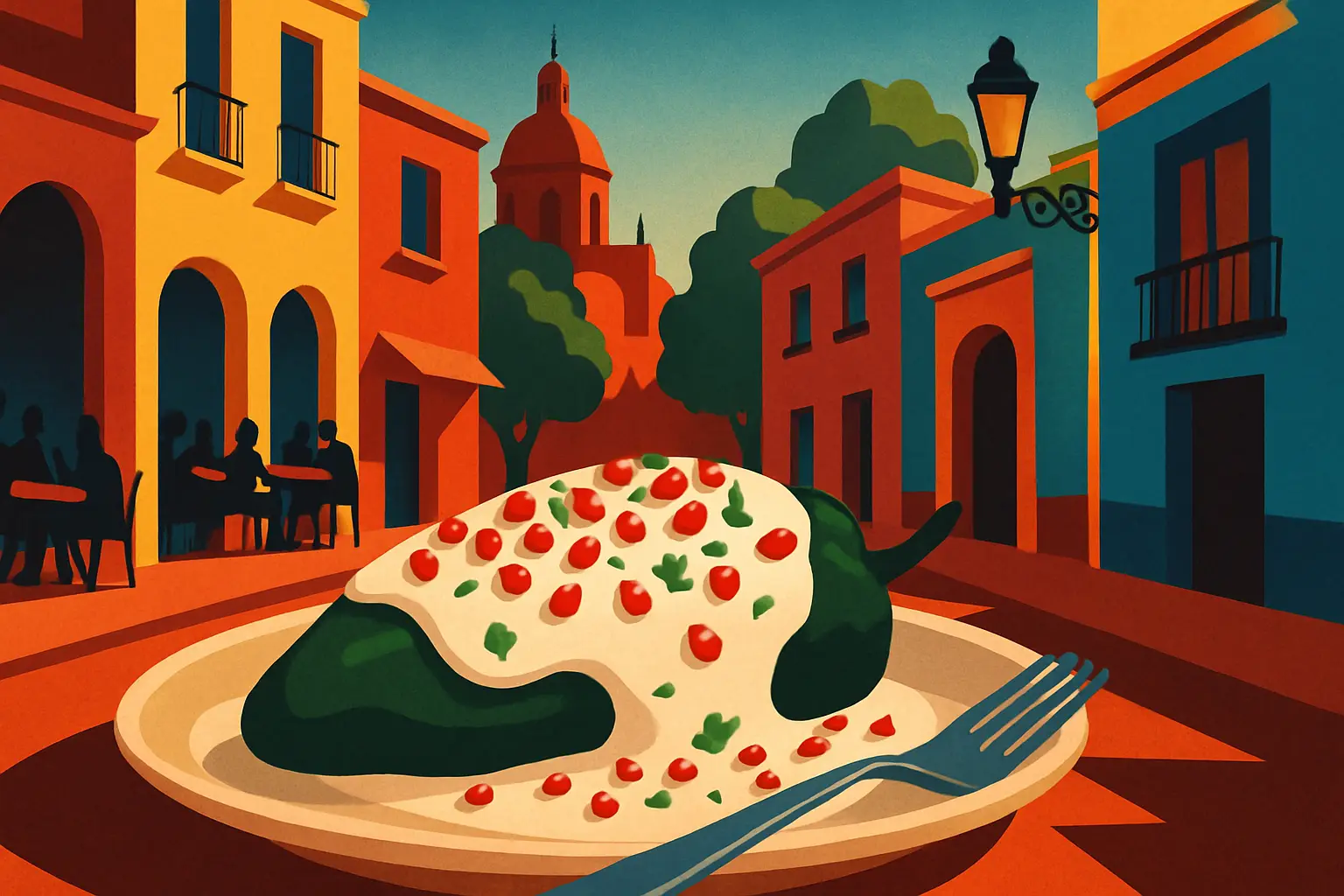
Every August, Mexico City undergoes a quiet seasonal transformation. Menus change. Restaurant windows display green, white, and red. And a single dish — chiles en nogada — appears on tables from working-class fondas to starred restaurants. What makes it distinctive is not just the flavor but the story embedded in the recipe itself. The green parsley, the white walnut cream sauce, and the red pomegranate seeds that finish the dish form the exact colors of the Mexican flag, intentionally. This is not coincidence or decoration — it is the point. The dish was constructed as a political statement in 1821, at the exact moment Mexico was negotiating its independence from Spain, and it has carried that symbolic weight for two centuries. To eat a chile en nogada in Mexico City in August is to participate in something that feels genuinely Mexican in a way that a menu description cannot fully convey. Understanding where it came from and what goes into a real version makes the experience land differently.
The most widely accepted origin story begins in Puebla in August 1821. Mexico's War of Independence had been fought for eleven years, and the insurgent leader Agustin de Iturbide was passing through Puebla on his way to sign the Act of Independence in Cordoba, Veracruz. The Bishop of Puebla learned that Iturbide would spend his saint's day — San Agustin, August 28 — in the city and commissioned the city's convents to prepare a celebration banquet. The Augustinian nuns of the Convent of Santa Monica took the commission seriously. They built a dish around the seasonal products of August — fresh Castilla walnuts, pomegranates, and fruits from the Puebla valleys — combined with a filling of minced pork, spices, and dried fruit, all served on a roasted poblano chile and garnished in the colors of Iturbide's army uniform: green, white, and red. Whether the recipe was invented entirely for that occasion or adapted from an earlier convent preparation is debated — some food historians trace a precursor to convent kitchens several decades before Iturbide's visit. What is not debated is that the nuns of Santa Monica are credited with the version that became the standard, and that the dish's colors and timing are explicitly tied to the independence movement. The Convent of Santa Monica still stands in Puebla at 18 Poniente 103, and purist chefs still reference the claimed original recipe when building their own versions of the dish.
Get short, interactive stories that make each place easier to remember while you travel.
Chiles en nogada is built from three distinct parts, each of which can independently succeed or fail. The poblano chile is the vessel: roasted directly over a flame until the skin blisters, then peeled while still hot and carefully slit to preserve its shape. The resulting pepper is smoky, mild, and slightly bitter — just enough to cut through the richness of what goes inside. An overhandled poblano collapses. The picadillo filling is what separates an ordinary version from a memorable one. At its core: minced pork and beef, cooked with tomato and warm spices. The distinctive quality comes from the fruit — diced apple, peach, and pear cooked into the meat alongside raisins, blanched almonds, and pine nuts. At Nicos in Colonia Claveria, Chef Gerardo Vazquez Lugo adds xoconostle (a tart cactus fruit native to the Mexican highlands) and lightly sweetens the mix, creating a picadillo that balances savory, sweet, and acidic in the same bite — and tastes like nothing else in Mexican cooking. The nogada — the walnut cream sauce — is the hardest component to execute. It requires nuez de Castilla: fresh walnuts, not dried. Fresh Castilla walnuts, harvested from Puebla in August and early September, have a white, almost milky interior and a mild, gently sweet flavor. They are blended with cream cheese, dry sherry, cinnamon, and sometimes a touch of goat cheese until thick and spreadable. The result is white, dense, and subtly nutty — not grainy or bitter, as dried walnuts produce. Restaurants that serve chiles en nogada outside the August-September window almost invariably use dried walnuts or cream-based shortcuts. The difference is immediately identifiable to anyone who has had a version made with fresh ones.
The limited season is not a marketing strategy — it is an ingredient constraint. Two perishable items define the dish, and both have narrow harvest windows. Nuez de Castilla (fresh Castilla walnuts) is harvested in Puebla's Tehuacan Valley and around Atlixco beginning in August. Unlike the brown, dried walnuts available year-round, fresh Castilla walnuts must be used within days of harvest: their interior is white and soft rather than tan and papery, and they produce a creamy, mild sauce rather than a bitter, grainy one. Pomegranate (granada) ripens in Mexico from August through October, providing the bright red seeds that finish the dish. Before late July, you are working with stored pomegranates from the prior year, and the seeds lack the juicy, sweet-tart quality that cuts through the nogada's richness. The optimal window is August 1 through mid-September: fresh walnuts at peak condition, pomegranates newly ripened, and serious restaurants in full operation for the season. A few ambitious spots open the season in late July using early harvests from Atlixco; some extend into early October. The weeks surrounding Dia de la Independencia on September 16 represent the cultural peak — some restaurants sell out their September tables within days of opening reservations in July.
Nicos (Av. Cuitlahuac 3102, Colonia Claveria, near Metro Cuitlahuac) is the most consistently cited address for chiles en nogada in the city — and the reputation holds up. Chef Gerardo Vazquez Lugo, who took over from his mother Maria Elena Lugo Zermeño (the restaurant has been open since 1957), sources his Castilla walnuts from Atlixco and his pomegranates from Puebla suppliers he has worked with for years. His picadillo includes xoconostle for acidity and is built to the proportions he has refined over decades. The chiles en nogada run approximately 570 pesos and are available August 1 through September 30 only — reservations are essential and often fill within days of opening. Nicos sits in Colonia Claveria, a residential neighborhood north of Polanco that most tourists never reach. That is not a downside. El Cardenal (Palacio de Bellas Artes location and Calle Palma 23 in Centro Historico) is the choice for tradition at a central address. Open since 1969, El Cardenal's version leans toward the classic Poblano-convent recipe without modern interpretation. It is the benchmark for first-timers who want to understand what the dish is before encountering variations. Azul Historico (Isabel La Catolica 30, Centro Historico) is Chef Ricardo Munoz Zurita's operation. Munoz Zurita has spent years documenting traditional Mexican cuisine academically, and his chiles en nogada follows original convent proportions more closely than most — the picadillo runs slightly more fruit-forward and less savory than modern interpretations. Angelopolitano (Alvaro Obregon 66, Roma Norte) offers a five-variation festival format during the season: the traditional version, a duck-and-goat-cheese variation, a cod-with-capers version, and a quinoa option for vegetarians. It is useful for first-timers who want to understand the range of the dish — order the traditional and one variation, compare them.
Ask ten Mexico City residents how chiles en nogada should be served and you will hear three answers: warm, cold, and room temperature — and the room-temperature camp will tell you the other two are wrong. Historically the dish was assembled and served at whatever temperature it happened to be at the moment: the picadillo warm from the pan, the poblano freshly roasted and peeled, the nogada made cool from the kitchen. The assembled result was roughly ambient. Over time, restaurants developed two divergent approaches. Some serve the chile warm from the oven, which intensifies the filling's flavors but causes the nogada to pool and thin. Others serve it refrigerator-cold, which tightens the nogada into something resembling a chilled mayonnaise and mutes the picadillo's aromatics. The purist position — held by chefs like Gerardo Vazquez Lugo at Nicos — is that room temperature is the only correct approach: the nogada thick but pourable, the filling aromatic and present, the pomegranate seeds cool and crisp against the warm poblano. If your chile en nogada arrives visibly cold from the refrigerator, the restaurant either assembled it hours in advance or is defaulting to food safety protocols over tradition. Both happen. Neither is exactly wrong — but the room-temperature version is what the nuns of Santa Monica served Iturbide in August 1821, and it is still what the dish tastes like when everything is working.
How much does it cost? At mid-range to upscale Mexico City restaurants, expect 400 to 600 pesos (~$20 to $30 USD) for a single portion. The labor intensity justifies it: the picadillo typically involves twelve or more ingredients, the nogada requires fresh walnuts with a very short shelf life, and the entire dish is assembled by hand. Market or street versions under 200 pesos exist but almost never use fresh Castilla walnuts — they are a different dish wearing the same name. Is it spicy? Poblano chiles range from mild to moderately hot depending on the individual pepper. Most restaurant versions use peppers selected for mild heat, but there is no reliable way to predict it. If heat is a concern, ask the server before ordering. Is there a vegetarian version? The traditional dish is always meat-based. Angelopolitano and some modern restaurants offer vegetarian adaptations with quinoa or lentils, but these are creative departures, not variants of the original recipe. Do I need a reservation? At Nicos and El Cardenal, yes — especially in September, when tables can fill weeks in advance. Azul Historico and Angelopolitano are more accessible for walk-ins, particularly early in August. What should I drink with it? A dry white wine with good acidity — something that cuts through the walnut cream without overpowering the fruit in the picadillo. A mezcal before the meal, not during, is also a traditional Mexico City approach. Avoid beer; the carbonation fights the nogada. For more on the city's food history and why seasonal dishes like this one follow strict rules, the Mexico City food history guide is worth reading before your visit.