Syntagma means constitution. The name is not commemorative in the abstract sense — it is the direct result of a specific event. On September 3, 1843, soldiers under cavalry commander Dimitrios Kallergis assembled in front of the Royal Palace with their cannons pointed at the building and demanded that King Otto — a Bavarian prince installed on the Greek throne after independence from Ottoman rule — grant the country a written constitution. Otto appeared on the palace balcony, agreed, and Greece's first constitution was drafted within months. The square, previously called Palace Square, was renamed Syntagma in honor of the moment.
Otto had ruled since 1833, when he arrived from Bavaria at seventeen years old as the choice of the Great Powers (Britain, France, and Russia) to lead newly independent Greece. He governed as an absolute monarch with no elected parliament and no constitutional limits, surrounded by Bavarian officials and advisors. By 1843, the combination of foreign governance and total absence of representative institutions had built enough resentment across the military and civilian population that Kallergis's mutiny was broadly popular. The revolt of September 3 is considered one of the founding events of modern Greek political culture: the moment when citizens and soldiers acting together forced a constitutional constraint on royal power.
Plateia Syntagmatos — the square's full Greek name — sits at the center of modern Athens, framed by the Parliament building to the north, the Grande Bretagne hotel to the northwest, and Ermou Street running west toward Monastiraki. Every major political protest in Athens since 1843 has passed through or ended in this square. The ground under it has absorbed over 180 years of Greek political history, and the name it carries still records exactly how that history began.
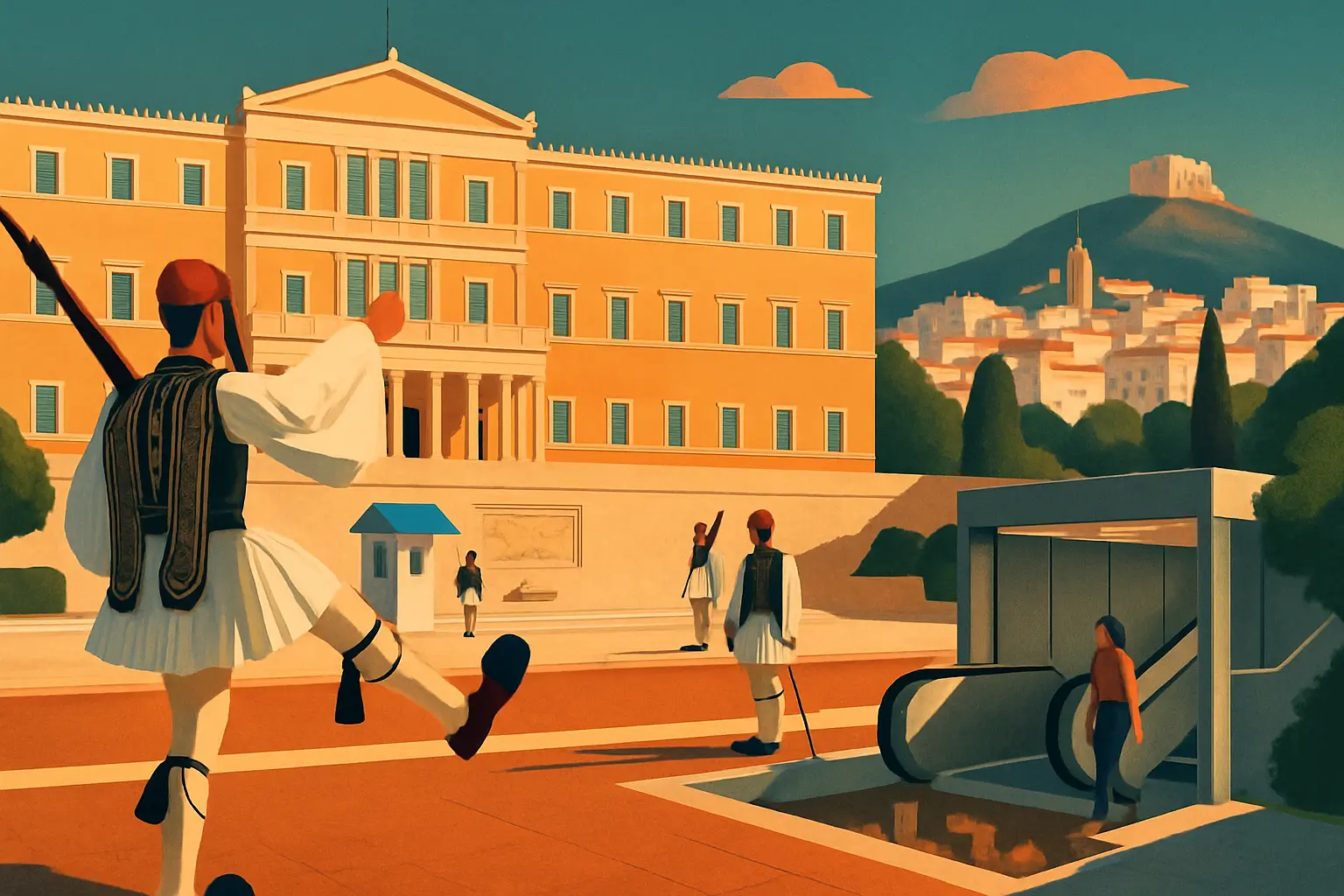
The neoclassical building dominating the northern edge of the square is the Hellenic Parliament — but it was built as a royal palace. Construction began in 1836, two years after Athens became the capital of the Greek Kingdom, and was designed by the German architect Friedrich von Gärtner for King Otto. The building took until 1843 to complete — the same year the constitutional revolt happened directly in front of it.
Otto lived in it until his deposition in 1862, when a second revolt expelled him from Greece entirely and he returned to Bavaria. After his departure the building was used as a royal residence by subsequent monarchs, then fell into disuse and partial disrepair. In 1929 the architect Andreas Kriezis was commissioned to convert it for parliamentary use, and the Hellenic Parliament formally moved in in 1934, eighty-one years after it was built.
The facade is long, low, and colonnaded — Pentelic marble, the same quarry that supplied the Parthenon — running the full width of the square's northern edge. It is a 19th-century neoclassical building in the strict sense: not imitating ancient Greece loosely, but following ancient proportions and details deliberately, as an act of national identity by a government that wanted to signal its connection to classical Athens. Looking at it from the square, the relationship between the building and the Acropolis visible above and behind it is exactly the relationship its architects intended.
Get short, interactive stories that make each place easier to remember while you travel.
In front of the Parliament, on a lower terrace reached by steps from the square, is the Tomb of the Unknown Soldier — the monument most visitors photograph without reading.
The central element is a large bas-relief carved in stone, built between 1929 and 1930 by architect Emmanuel Lazaridis with the sculptural work by Fokion Rok. The image shows a naked male warrior lying on the ground after battle, holding a circular shield in his left hand and wearing an ancient Greek helmet. The deliberate choice of an ancient-style warrior — rather than a uniformed modern soldier — links the unknown dead of modern Greek wars to the classical military tradition. The monument is intentionally not about any single conflict.
Running along both sides of the tomb are bronze plaques naming every major battle Greece has fought from 1821 — the beginning of the War of Independence — through the 20th century, including the Balkan Wars of 1912–1913, World War I, the Greco-Turkish War of 1919–1922, and World War II. Reading through them gives a compressed version of modern Greek military history in about ten minutes.
Below the central figure, an inscription in ancient Greek reads: ΑΝΔΡΩΝ ΕΠΙΦΑΝΩΝ ΠΑΣΑ ΓΗ ΤΑΦΟΣ — *The whole earth is the tomb of famous men.* The line is from Thucydides' account of the Funeral Oration of Pericles, delivered in Athens in 431 BC over the soldiers killed in the first year of the Peloponnesian War. The choice was not incidental: placing Pericles' words here draws a continuous line from ancient Athens to modern Greece, using the same ground, the same marble, and the same language.
The Evzones — formally the Presidential Guard — are the soldiers who stand motionless at the Tomb of the Unknown Soldier around the clock, 365 days a year. They are not purely ceremonial: they are an active unit of the Hellenic Army drawn from volunteers who complete standard military training before assignment, selected in part for their height and physical bearing.
The uniform is the element that stops every visitor. The white pleated skirt — the foustanella — uses approximately 30 yards of white fabric and contains exactly 400 folds, each representing one year of Ottoman rule over Greece. The tsarouhia — red leather upturned clogs with large black pom-poms at the toe — have 60 nails set into each sole. The nails produce the sharp percussive sound that carries across the square with each precisely timed step. The rest of the uniform includes a white linen shirt, red embroidered waistcoat, white tights, and a small cap.
The guard changes every hour on the hour. Two guards swap positions in a choreographed slow march — legs raised to hip height, feet stamped down deliberately, rifles held at the shoulder — lasting about ten minutes. On Sundays at 11am, the full ceremonial parade occurs: a column of Evzones in their historic white foustanellas marches south down Vasilissis Sofias Avenue from the Presidential Guard barracks to the Tomb, accompanied by a military band. This is the ceremony worth arriving early for — it is more elaborate, more soldiers, and a genuine procession through the street rather than a two-man exchange at the monument.
Weekday changes happen at 8am, 9am, 10am — any hour. There is no bad time to see one. The Sunday 11am parade is simply the full version.
The most undervisited attraction at Syntagma costs nothing extra and sits directly beneath your feet. When Athens began constructing its metro system in the early 1990s, engineers excavating below Syntagma Square hit what archaeologists had long suspected: the subsoil under the center of Athens is dense with ancient occupation layers, unbroken from prehistoric times through the Byzantine period.
The excavation ran from 1992 to 1997 and became the largest urban archaeological dig in Greek history. Between 30,000 and 50,000 individual artifacts were recovered, along with major structural remains. An ancient cemetery spanning sub-Mycenaean to Byzantine periods was uncovered, containing hundreds of graves with marble and clay tombs, pyre trenches, and coffins — evidence that ancient Athenians both buried and cremated their dead in this location, outside the northeast walls of the ancient city. Below the cemetery: a Classical-era sculpture foundry where bronze statues were cast in the 5th or 4th century BC. A Roman baths complex from the 1st or 2nd century AD. A section of the Peisistranian Aqueduct — the water infrastructure built by the 6th-century BC tyrant Peisistratos to supply Athens. And the actual bed of the Iridanos River, the ancient watercourse that ran through the city before Athens built over it completely.
All of this is displayed behind glass walls running the length of the concourse level of Syntagma station, lit and labeled. The display shows the cross-section of twenty-five centuries of continuous habitation — the layers visible in sequence, oldest at the bottom. You walk past it while waiting for your train. Many Athenians commute through Syntagma daily without reading it. Many visitors enter the station and go directly to the platform. Walk the concourse wall before your train arrives.
Three places within ten minutes of the square are worth building time around.
Hotel Grande Bretagne occupies the northwest corner — a building constructed in 1842 as a private residence and converted to a hotel in 1874. It became the most prestigious address in Athens and has stayed that way: Winston Churchill stayed here in December 1944 when he flew to Athens to negotiate between royalist and communist forces during the Greek Civil War crisis. During the German occupation of World War II, the building served as Wehrmacht headquarters. The lobby bar and rooftop terrace are open to non-guests; the terrace gives a direct view across the square toward the Parliament and is one of the better vantage points for watching the Sunday ceremony at a slight distance without being in the crowd.
Ermou Street leaves the square's western edge as a pedestrianized shopping street running toward Monastiraki, about 800 meters away. Midway along it stands Kapnikarea — an 11th-century Byzantine church built directly in the middle of the road, preserved when 19th-century urban planners declined to demolish it. It sits incongruously among clothing stores and is easy to walk past without noticing; it is worth pausing at.
The National Garden is directly behind the Parliament building — free, always open, and the largest green space in central Athens. Planted in the 1840s as the Royal Garden for Queen Amalia, it contains ponds, shaded paths, and benches. It connects at its southern end to the Zappeion Hall, a neoclassical exhibition building that served as part of the 1896 Athens Olympics infrastructure. In June through August, the garden is the most immediate escape from the square's reflected heat.
Best time to visit Syntagma Square? For the full ceremony, Sunday at 11am — arrive by 10:45am. For comfortable touring without the ceremony, before 9am in summer avoids peak heat. The late afternoon — from 5pm onward — gives you the Parliament facade in strong directional light with thinning crowds, and the guard change at 5pm, 6pm, or 7pm is easy to catch.
How long to spend? Fifteen minutes for a single guard change. Add thirty minutes for the metro station archaeological display — walk the concourse slowly and read the labels. Add twenty minutes for a circuit around the square and through the National Garden entrance. A Syntagma morning that includes the Sunday ceremony, the underground museum, the Tomb inscription, and a coffee on the Grande Bretagne terrace runs about two hours.
How to get there: Syntagma metro station is the central interchange of the Athens metro, served by Line 2 (Red) and Line 3 (Blue). Almost every journey in central Athens passes through it. From Kolonaki, it is a 10-minute downhill walk west along Vasilissis Sofias. From Plaka and the Acropolis, the walk north along the pedestrianized streets through the old town takes about 20–25 minutes.
Is Syntagma Square safe? It is the most policed public space in Greece — Parliament, the Presidential Guard, and a constant police presence make it among the most secure areas in Athens. On normal days it is unremarkable. During political demonstrations, which occasionally fill the square, stay on the margins and move when the crowd moves. The square has hosted protests ranging from quiet candlelit vigils to the intense austerity demonstrations of the early 2010s; awareness of current events before visiting is sufficient preparation.