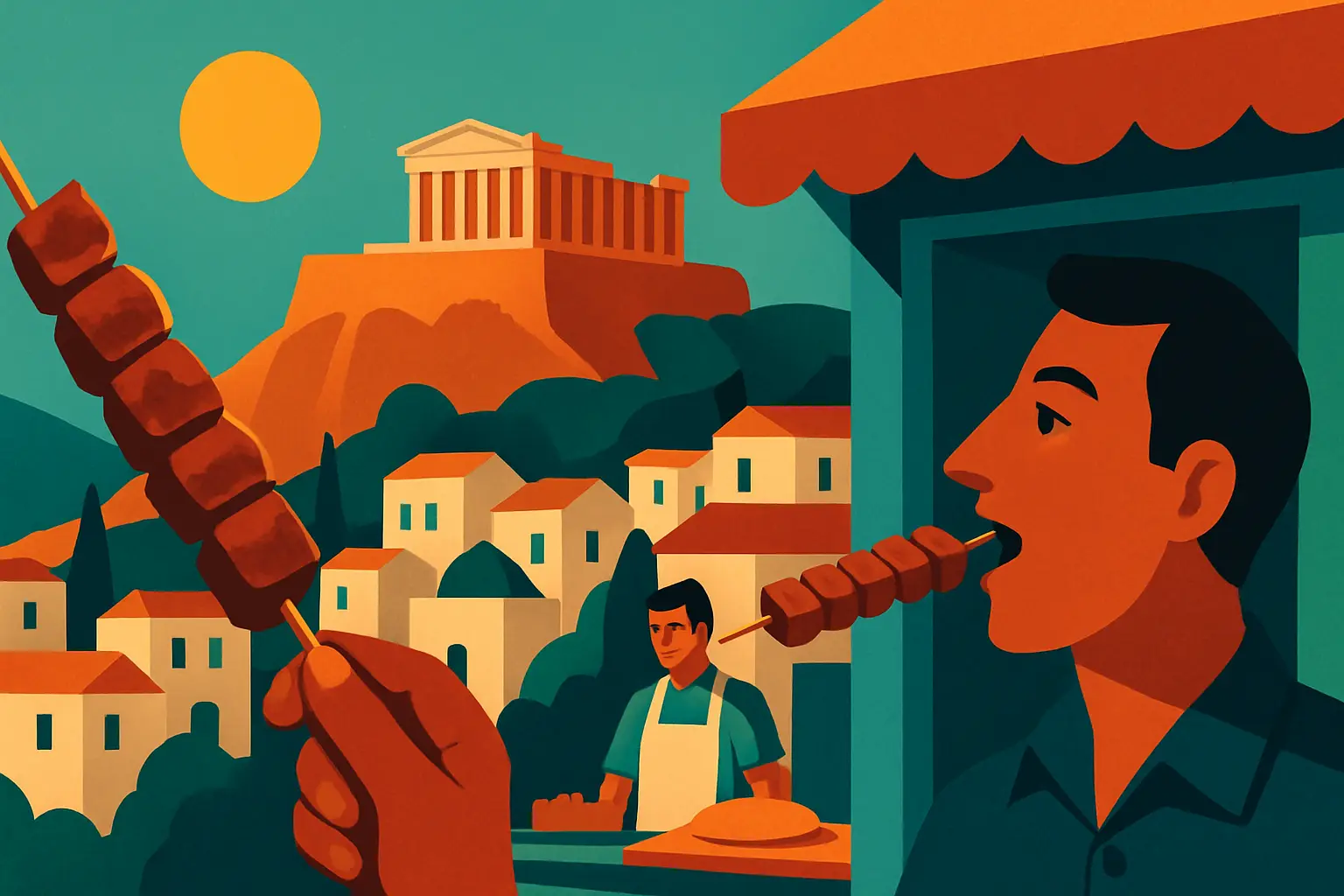
In Athens, the skewer of grilled pork is a kalamaki — plural: kalamakia. The word comes from kalami, the Greek word for reed, referring to the thin wooden stick the meat is threaded onto before grilling. If you walk into a souvlatzidiko (a souvlaki shop) in Monastiraki or Koukaki and ask for a souvlaki, the person behind the counter will assume you want the full construction: pita bread, meat, tomato, onion, tzatziki, possibly fries — the wrap. If you want the skewer by itself, you ask for a kalamaki.
This creates genuine confusion because everywhere else in Greece, the skewer is called a souvlaki. Thessaloniki, Heraklion, Patras — in those cities, 'souvlaki' means the small skewer of grilled meat. The pita-wrapped version is called 'souvlaki me pita' (souvlaki with pita). Athens inverted the terminology and never looked back.
The word souvlaki itself comes from souvla — a large rotisserie spit — with the diminutive suffix -aki meaning 'small thing'. So souvlaki is technically 'small spit', kalamaki is 'little reed'. Both refer to the skewer concept from different angles. In practice, when you are standing in front of a counter in Athens: kalamaki = the stick. Souvlaki pita or just souvlaki = the wrap. Know this one thing and you will order like a local.
The pita bread used in a souvlaki pita is not the flat pocket pita you find in Middle Eastern food — it is a thicker, slightly puffy round of flatbread, grilled on the same charcoal surface as the meat. The grill marks matter: they add both texture and a slight char flavor that complements the fat dripping from the pork skewers placed alongside it.
Inside the pita goes: two to three pork kalamakia slid off the skewer, one sliced ripe tomato, raw white onion (thinly sliced or in half-rings), a generous stripe of tzatziki (Greek yogurt, cucumber, garlic, dill), and — depending on the shop — a handful of thick-cut fries. The whole thing is folded in paper or a wax sheet so you can eat it standing over a counter or walking.
Pork is the Greek default. It is what 'souvlaki' means unless you specify otherwise. Chicken (kotopoulo) souvlaki is widely available and good; pork has more fat content and handles charcoal heat better, which is why it dominates. Lamb appears occasionally, particularly in kebab (soutzoukakia) form. Beef is unusual in traditional souvlatzidika.
The tzatziki in a souvlaki pita is thicker and more garlicky than the tzatziki served as a dip at a sit-down restaurant — it is meant to survive a folded sandwich and provide structural flavor, not to be tasted independently. At the better shops, it is made fresh daily. At lesser ones, it sits in a container under a sneeze guard. You can usually tell the difference by smell within three steps of the door.
Get short, interactive stories that make each place easier to remember while you travel.
Archaeological evidence for skewered and grilled meat in the Aegean goes back to the Bronze Age. Excavations at Akrotiri on Santorini — the Minoan city buried under volcanic ash around 1600 BCE — uncovered stone barbecue sets with clay supports designed to hold multiple skewers at the correct angle above a fire bed. Similar grilling tools appear in finds from Mycenae and across the Cyclades. The technique is not a culinary tradition that developed slowly; it appears fully formed in the archaeological record, which suggests it was already ancient by the time of the earliest finds.
The word souvla (the large rotisserie spit) appears in Homer's Iliad — soldiers grilling meat over fires during the siege of Troy are described using the same fundamental method. Through the Byzantine era, skewer-grilled meat remained standard urban street food in Constantinople; when Greek refugees were expelled from Asia Minor in the 1922 population exchange and arrived in Athens by the hundreds of thousands, they brought the street-food culture of Smyrna and Constantinople with them.
The modern Athenian souvlatzidiko as an institution — the counter-service shop with charcoal grills, standardized pita, and the specific combination of tomato, onion, and tzatziki — is a post-war development. The first dedicated souvlaki shops appeared in Athens in the late 1940s and 1950s as the city expanded rapidly. Kostas on Adrianou Street in Plaka opened in 1950 and is generally credited as one of the first shops to establish the format that every souvlatzidiko in Athens now follows.
O Kostas at 5 Pentelis Street — one block east of Plateia Agia Irini, between Syntagma Square and Monastiraki — is the shop that has changed nothing since 1950. The original Adrianou Street location in Plaka was founded by grandfather Kostas; the Pentelis Street location carries the same name, the same menu, and the same operating philosophy.
The menu is: souvlaki pita. In pork. That is the menu. No gyros. No chicken option. No side dishes. No modifications. The pita comes out of a charcoal-heated grill on the counter, the kalamakia are placed inside, the tomato and onion and parsley-heavy sauce follow, and the whole thing is handed to you wrapped in paper. Price is around €3.50–4.00 in 2026. Cash only.
O Kostas opens at 9:30am. It typically runs out of pork between 2 and 3pm and closes when the meat is gone. Come before noon if you want certainty. Come after 1pm and you are gambling. Come on a Sunday and you find a closed shutter. The shop does not apologize for its hours or its limitations, which is itself a reliable signal — places that run out of food every day by early afternoon do not need to.
Plateia Agia Irini, the small square immediately beside the shop, has been Athens' best outdoor food-adjacent square for years: coffee shops on the edges, musicians sometimes busking in the center, one minute's walk from the Varvakios Agora food market on Athinas Street. Eating your Kostas pita on the square steps while the neighborhood moves around you is, genuinely, one of the better free experiences in central Athens.
The 100-meter stretch of Mitropoleos Street running east from Monastiraki Square toward the cathedral is the highest concentration of souvlaki in the city. Two shops have dominated this strip for decades and compete openly: O Thanasis at Mitropoleos 69 (since 1965) and Bairaktaris at Mitropoleos 71–88 (established 1879, which means they were grilling souvlaki while the Eiffel Tower was still being built).
Thanasis has the edge for pork souvlaki execution — the marinade is more complex, the charcoal management more consistent, the tzatziki reliably garlicky and fresh. Bairaktaris has the better sit-down option: a full taverna-style indoor space behind the grill counter where you can order a plate of souvlaki and mezedes rather than eating standing. Both shops are genuinely good by any measure; the competition between them has kept the quality high for sixty years.
Mitropoleos Street is tourist-facing and makes no pretense otherwise. You are paying the same €3.50–4.50 that you would pay at a neighborhood shop, but you are eating alongside the crowd that has just descended from the Monastiraki flea market and the Acropolis view cafes. The charcoal smoke drifts across the square and acts as its own advertising. For a first souvlaki in Athens, Thanasis or Bairaktaris is a reasonable benchmark. For the follow-up, walk further.
Every Athenian neighborhood has at least one souvlatzidiko that locals navigate to by smell — the charcoal smoke is the sign, detectable half a block away on a still afternoon. The ICP (ideal customer profile) of a neighborhood souvlatzidiko is: a counter with two or three workers, a visible charcoal grill, a handwritten price board, and customers who eat standing or take their wrapped pita out to eat walking. The seats, if any, are plastic.
In Koukaki — the neighborhood directly south of the Acropolis — the lunch souvlatzidika on Falirou Street and around Drakou Street serve the workers and residents who live in a real neighborhood adjacent to the tourist zone but operating independently of it. In Exarcheia, the grid of streets around Themistokleous Street has independent souvlatzidika that have been running for decades, typically with a political sticker or two on the refrigerator door.
The practical rule: walk one full block away from any tourist-dense square — Monastiraki, Syntagma, even Plateia Exarcheion — and the next souvlatzidiko you find is running on neighborhood logic, not visitor pricing. The quality is usually identical; the prices are occasionally lower; the crowd beside you is the city itself.
The souvlatzidika of Monastiraki stay open until 2 or 3am on Friday and Saturday nights — sometimes later. This is not a coincidence. Athens' nightlife runs on a schedule where dinner begins at 9:30 or 10pm and bars fill properly after midnight, which means the city generates a large population of people who are hungry after the clubs and bars on Gazi's Giatrakou Street or the Psyrri rebetiko clubs start winding down.
Plateia Monastirakiou at 1am on a summer weekend is one of Athens' more reliable spectacles: the souvlaki shops lit and open, lines short or nonexistent, the smell of charcoal in warm June air, people eating on the square steps with the Acropolis backlit above. The late-night souvlaki is not a lesser version of the daytime one — the charcoal grills have been running for hours and are at their most seasoned. Some Athenians argue the pita is better at midnight than at noon.
Souvlaki and gyros are two different things served in the same pita. A souvlaki is small pieces of marinated pork (or chicken) threaded onto a skewer and grilled over charcoal — the individual texture of each piece is the point, slightly charred on the edges, juicy in the center. A gyros is a large rotating cone of compressed, layered meat (usually pork, sometimes chicken) cooking on a vertical rotisserie, shaved off in thin strips as it cooks. The pita construction — tomato, onion, tzatziki, fries — is nearly identical for both.
Differences in texture and flavor are real: souvlaki has a cleaner, more distinct meat flavor with char; gyros is richer, more uniform, slightly fattier from the compressed cone. Both cost €3.50–4.50 in central Athens in 2026. A gyradiko (gyros shop) typically serves both; a souvlatzidiko focused on the skewer may not offer gyros at all — Kostas never has.
Is pork always the default? In Greece, yes — unless specified, souvlaki and gyros are pork. Chicken (kotopoulo) is the standard alternative. Lamb appears in some traditional shops. Vegetarian options exist at modern souvlatzidika — typically grilled halloumi or vegetable skewers — though this is a recent development at shops that have otherwise changed nothing since 1965.