1. What Petralona actually is — and why it has two completely different halves
The name Petralona translates literally as 'stone threshing floors' — petrina alonia — a reference to the rocky ground where grain was threshed before the area was absorbed into urban Athens in the late 19th century. The neighborhood was also known as Katsikadika ('the place of goats'), named for the herders who grazed livestock here and delivered milk to nearby residents. That chapter ended in February 1925, when Athens formally banned goats from within city limits. The name Petralona replaced Katsikadika in official use, though older residents kept the original for years afterward.
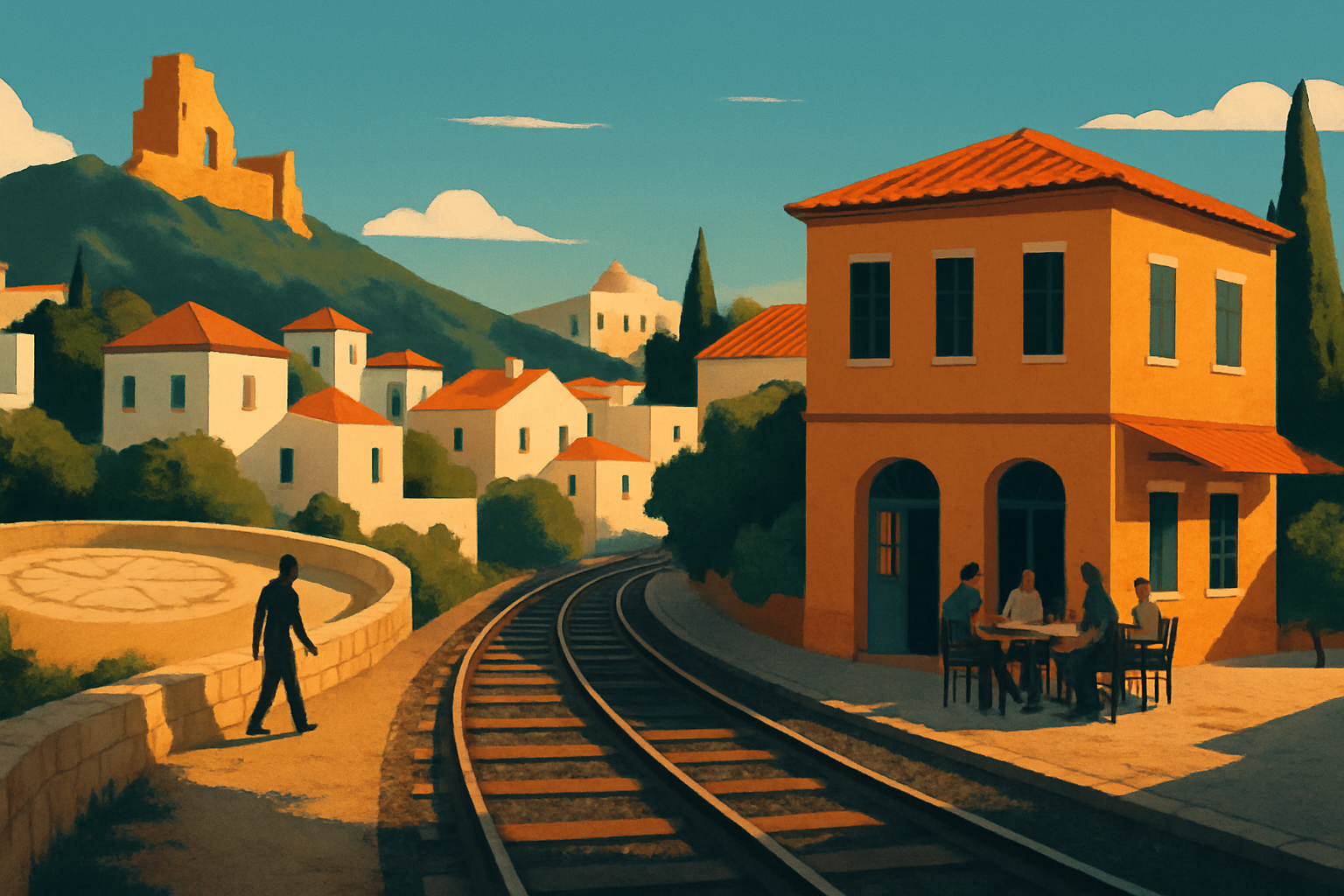
The neighborhood's most defining physical feature is the railway line that runs through it — once the 19th-century steam route connecting Athens to Piraeus, now Metro Line 1 (the Green Line). The tracks still run at grade through this stretch, and they create a genuine divide. Ano Petralona (Upper) sits between the tracks and Filopappou Hill — pastel stone houses, narrow climbing streets, a quiet residential feel. Kato Petralona (Lower) lies between the tracks and Pireos Street — denser, more commercial, closer to the industrial character of Gazi immediately to the north.
The result is a neighborhood with two distinct atmospheres within 700 meters of each other — the kind of internal variation that makes Petralona worth exploring on foot rather than visiting a single square and leaving.
2. Troon Street and Merkouri Square: the neighborhood's social axis
The main artery of Ano Petralona is Troon Street, running uphill toward Merkouri Square — a small, colorful public square anchored by cafes, kafeneions, and the tavernas that spill onto its edges on warm evenings. The square is named for Melina Mercouri, the actress and politician who served as Greece's Minister of Culture from 1981 to 1989. The neighborhood's residents lobbied for the naming in her honor after her death in 1994.
Along Troon Street itself, you find the working texture of a genuine Athenian residential neighborhood: a butcher, a hardware shop, all-day cafes running the Greek schedule (a freddo espresso in the morning, retsina by evening), and fruit stalls that exist for the people who actually live here. The street also holds Zephyros, one of Athens' oldest open-air cinemas, operating since 1938 — detailed in its own section below.
The square becomes the social center of Petralona in the evening. Tables multiply outside the kafeneions after 8 p.m., and the neighborhood's residents — a mix of families who have been here for generations and younger Athenians who moved in after the austerity years — occupy them with a relaxed permanence that suggests no plans to be anywhere else that night.
3. Taverna tou Oikonomou: a neighborhood institution since 1930
At the corner of Kydantidon and Troon Streets in Ano Petralona, Taverna tou Oikonomou has been serving the same category of food since 1930: slow-cooked Greek mageirefta (oven dishes) prepared fresh each morning and available until they run out. The menu changes daily but follows a consistent logic. Stuffed tomatoes and peppers packed with spiced rice and herbs, roasted until they collapse. Yiouvetsi — lamb or beef slow-cooked in a clay pot with kritharaki pasta. Cabbage rolls in egg-lemon sauce. Green beans braised with olive oil and tomato until they are something entirely different from what they started as.
Mageirefta is a specifically Athenian culinary tradition organized around food cooked in the morning and served at room temperature — the dishes are made with the understanding that time is an ingredient and they improve as the day progresses. Oikonomou is one of the few remaining places in central Athens where this tradition is maintained without compromise.
The room itself is what you would expect from a taverna that has been operating for nearly a century without needing to reinvent itself: wooden tables, a counter showing the day's dishes, minimal decoration beyond function. Prices are honest — a full lunch with wine runs 15–20€ per person. The evening fills with Athenians eating in the way their grandparents ate: loudly and without rush.
4. Kappari, Rantevou, and the newer Petralona food scene
Alongside the established taverna culture, Petralona has quietly developed a second generation of restaurants that treat Greek ingredients with more creative intent while staying grounded in the neighborhood's unpretentious atmosphere.
Kappari at Dorieon 36 opened in 2006 as one of Athens' early neo-tavernas — restaurants responding to the recognition that traditional Greek cuisine had been calcified into tourist-facing predictability and needed reinvention from within. Kappari's menu resets seasonally: fresh pasta with wild greens, lamb braised with seasonal fruits, grilled fish with a dressing the kitchen decides that morning. The garden at the back is one of the better outdoor dining spaces in this part of Athens.
Rantevou, across Merkouri Square, runs a more eclectic mezze format — taramasalata and horiatiki alongside roasted cauliflower, tahini-dressed vegetables, and combinations that acknowledge the city's evolving food culture without abandoning shared-plate logic. It draws a younger crowd and runs later into the evening.
Petralona's eating culture benefits from something that has largely left central Athens: prices set by locals who eat here regularly. A meal costs noticeably less than the equivalent in Monastiraki or Kolonaki, because the clientele measures value against their own weekly budget — not against an expense report.
5. Zephyros open-air cinema: one of Athens' oldest, still running
Embedded into Troon Street's residential block, Zephyros has been operating as an open-air cinema since 1938, making it one of the oldest in Athens. The history of Athens' outdoor cinemas is covered in the full open-air cinema guide, but Zephyros has a particular claim: it predates the postwar wave of open-air cinema construction and represents a tradition that began in interwar Athens as a practical solution to summer heat in a city without air conditioning.
The format has not changed in its essentials: garden seating under the sky, films in original language with Greek subtitles (not dubbing — a point of local pride), tickets around €7, a small bar for beer and snacks before the screening. What distinguishes it from the more famous open-air cinemas near the Acropolis is the surrounding neighborhood: quiet residential streets rather than tourist-facing commercial bustle, which means the garden retains the atmosphere of a community amenity rather than a city-centre attraction. June evenings run at comfortable temperatures, and screenings typically start around 9:30 p.m.
6. Filopappou Hill: Petralona's backyard and Athens' best sunset vantage point
The eastern boundary of Ano Petralona is defined by Filopappou Hill — formally the Hill of the Muses — crowned by the Monument of Philopappos, a 12-meter marble funerary monument built in 114–116 AD for Gaius Julius Antiochus Epiphanes Philopappos, a prince of the Syrian kingdom of Commagene who was adopted into Roman citizenship and served as a suffect consul. The monument sits at 147 meters elevation and faces northeast toward the Acropolis.
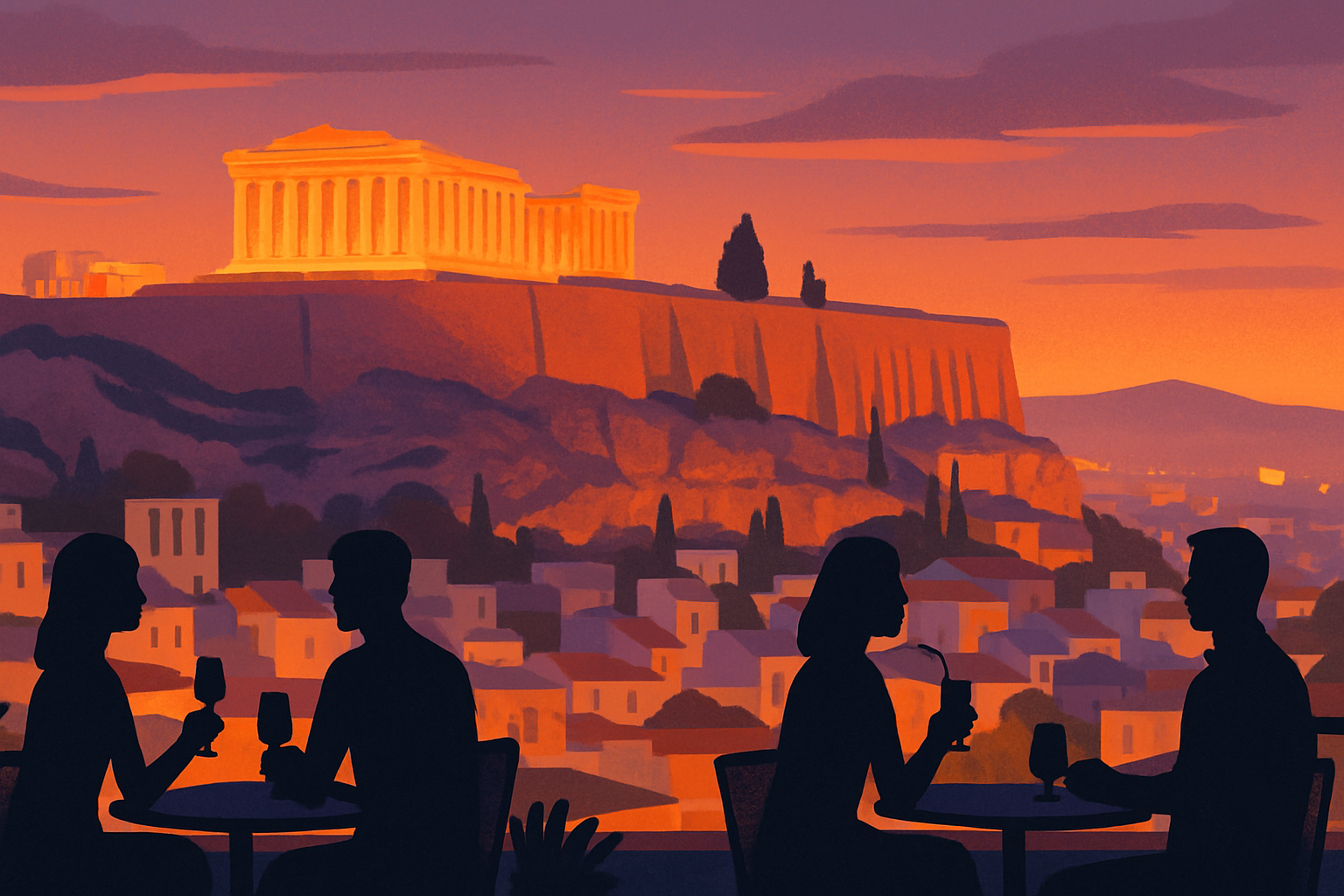
The summit is a 10–15 minute uphill walk from the pedestrianized Apostolou Pavlou boulevard — the path is paved and well-marked, the ascent steady but manageable in normal footwear. June sunsets fall around 8:45 p.m., and the view from the top — the Acropolis directly northeast, the Saronic Gulf and Piraeus to the south, the Athens plain extending north — is routinely described by Athenians who have been climbing it for decades as the best in the city.
The hill also holds the Dora Stratou Theatre, a purpose-built outdoor theater on the southern slope where traditional Greek folk dances are performed nightly from May through September. Tickets are available at the door; performances run at 9:30 p.m. and last about 90 minutes — a natural pairing with dinner at one of the Petralona tavernas beforehand.
7. How does Petralona compare to Koukaki, Gazi, and Thissio?
Petralona vs. [Koukaki](/gr/blog/koukaki-athens-guide): Koukaki, immediately to the south along Apostolou Pavlou, has gentrified more visibly. It has the Acropolis Museum as its anchor, a concentration of design hotels, and a restaurant scene oriented partly toward visitors. Petralona is the earlier point on that spectrum: the same core of honest tavernas and neighborhood cafes, without the hotel infrastructure or the polished storefronts. Both are good; they represent different stages of the same process.
Petralona vs. [Gazi](/gr/blog/gazi-athens-guide): Gazi runs immediately to the north along Iera Odos — a district that transformed from an industrial gas works into Athens' nightlife hub in the 2000s and now operates considerably louder and more commercially. Petralona is what Gazi might look like if the nightlife investment had gone elsewhere: a working residential neighborhood that found its own equilibrium between old and new without being reshaped by external commercial force.
Petralona vs. [Thissio](/gr/blog/thissio-athens-guide): Thissio is Petralona's most immediate eastern neighbor, separated by Apostolou Pavlou. Thissio skews toward the archaeological and the scenic — the pedestrianized boulevard, the Agora views, the tourist cafes along the railway. Petralona is the residential interior behind it: what the neighborhood looks like when you walk two streets west of the view.
8. When to visit and how to get to Petralona
Best time to visit? June works particularly well: outdoor tables at Merkouri Square are in full use, Zephyros cinema screenings are running in comfortable temperatures, and the Filopappou Hill paths are pleasant in the late afternoon before the summit fills for sunset. The neighborhood operates on a local year-round schedule without tourist high and low seasons, but June and September offer the best conditions for its specifically outdoor pleasures.
How to get there: Petralona metro station (Line 1, the Green Line running from Kifissia to Piraeus) puts you directly in Kato Petralona. Exit and walk east toward the tracks: Ano Petralona rises up the hill to your left, Troon Street runs uphill toward Merkouri Square just south of the station.
From Thissio (one stop north on Line 1), walk south along Apostolou Pavlou for about 8 minutes to reach the base of Filopappou Hill and Ano Petralona's hill paths. From Monastiraki, the walk takes 15–18 minutes west through Thissio. From Koukaki, walk north along Apostolou Pavlou for about 10 minutes. Arriving by metro is substantially simpler than navigating by car — the neighborhood streets are narrow and parking is resident-only on most blocks.