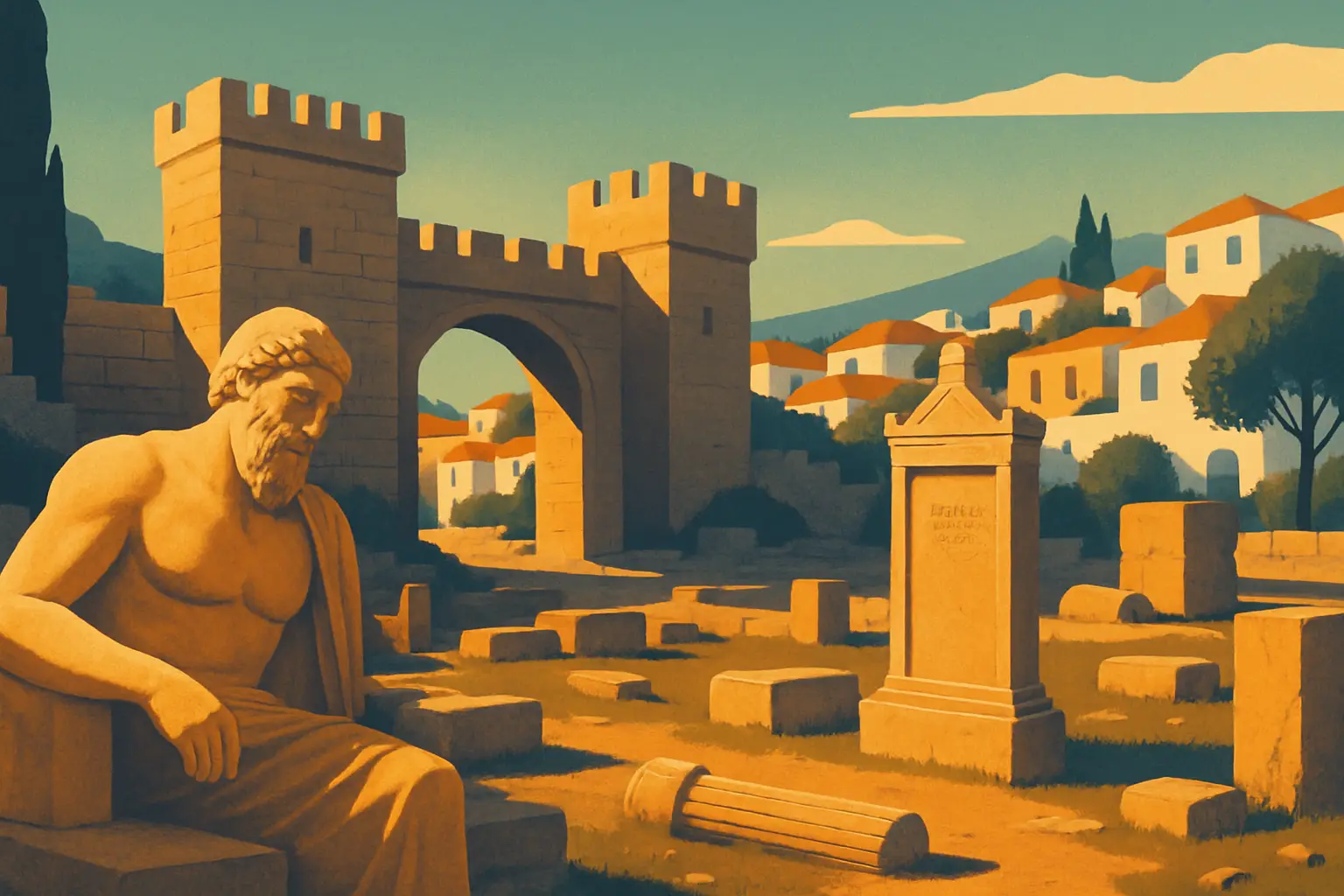
The name comes from keramos — Greek for clay or pottery — and reflects the fact that this district on the northwest edge of ancient Athens was where potters set up their workshops, taking advantage of the clay-rich soil along the Eridanos River. The potters' quarter straddled the city walls, which is why ancient Athenians divided it into the Inner Kerameikos (inside the walls, near the agora) and the Outer Kerameikos (beyond the gates), where the great cemetery spread along the main roads out of the city.
The cemetery began in the 9th century BCE, though earlier Bronze Age burials have been found in the same ground. For a thousand years — through the Geometric period, Classical Athens, the Hellenistic era, and Roman rule — this was where Athenians were buried. The most prominent citizens received the most prominent tombs, positioned along the roads where the greatest number of travelers would pass. The dead were supposed to be remembered. The road layout of the site today reflects this logic exactly: you walk between rows of grave monuments arranged in a pattern that hasn't fundamentally changed in 2,400 years.
The most important physical structure in Kerameikos isn't a tomb — it's a gate. The Dipylon (from diplous pylon, 'double gate') was the largest city gate in ancient Athens and the formal entrance through which major processions arrived. Built in the 4th century BCE, it consisted of two parallel archways separated by an inspection courtyard, and it served as the terminus of the main road from northern Greece and the starting point of the Panathenaic Way — the processional road running through the Ancient Agora and up to the Acropolis.
Every four years during the Great Panathenaia, a massive procession of citizens, priests, sacrificial animals, and a ship carrying a new robe for the goddess Athena departed from the Dipylon. That procession is depicted on the Parthenon's Elgin Marbles frieze — meaning the scene shown in fragments across London and Athens began precisely where you're standing in the Kerameikos park today.
The Dipylon is also where Pericles stood in 431 BCE to deliver the Epitaphios Logos — the Funeral Oration — over the bodies of the first Athenian soldiers killed in the Peloponnesian War. Thucydides recorded the speech; it contains the line 'we call our government a democracy' and is considered one of the foundational texts of democratic theory. The spot where those words were spoken is marked by nothing more than a small information placard.
Get short, interactive stories that make each place easier to remember while you travel.
Adjacent to the Dipylon, the Sacred Gate (Iera Pyli) was the starting point of the Sacred Way (Iera Odos) — the road connecting Athens to the sanctuary at Eleusis, 22 kilometers to the northwest. Each September, tens of thousands of initiates walked this road during the Eleusinian Mysteries, the most important religious ritual in the Greek world, honoring Demeter and Persephone. The road they walked on is now Iera Odos Street, which still runs northwest from Kerameikos today on roughly the ancient alignment.
At the Sacred Gate in 2002, archaeologists from the German Archaeological Institute of Athens — which has been excavating Kerameikos since 1870 — uncovered the Sacred Gate Kouros: a nearly complete marble statue of a male youth, 2.1 meters tall, dating to around 600 BCE. It had been broken and buried in antiquity, probably during the Persian sack of Athens in 480 BCE, and lay undisturbed for 2,480 years beneath a modern street. The kouros is now in the on-site Kerameikos Museum. Finding a largely intact Archaic kouros in an urban excavation in the 21st century was a significant event in Greek archaeology — and it is displayed with almost no fanfare, a few steps from its findspot.
The most evocative part of the archaeological site is the Street of Tombs — a path lined with grave monuments from the 4th and 5th centuries BCE, arranged by wealthy Athenian families to be seen by travelers arriving from the Dipylon Gate. The originals have been moved into the Kerameikos Museum; what you walk beside are exact marble replicas in their original positions, which does nothing to diminish the atmosphere.
These are not simple headstones. They are marble stelai — tall carved slabs — depicting the deceased in bas-relief, often in scenes of farewell with family members. The grave stele of Hegeso, considered among the finest examples of Classical Athenian sculpture, was found on this street and shows a seated woman holding a necklace from a jewelry box, her servant beside her. The original is in the National Archaeological Museum; a replica stands in its original position here.
Families competed in the elaborateness of their monuments until Demetrios of Phaleron banned extravagant grave markers in 317 BCE as part of sumptuary reforms. The tomb construction stops abruptly at that date and the street reverts to simpler markers. You can read the social history of Athens directly in the sequence of monuments as you walk — the escalation of wealth display, and then the sudden democratic restraint imposed by decree.
Immediately adjacent to the archaeological site — visible from inside it across the fence — stands a neoclassical building at Agion Asomaton 22 housing the Benaki Museum of Islamic Art. It is consistently ranked among the most undervisited world-class museums in Europe, which is remarkable given the scale of what's inside.
The collection contains approximately 10,000 objects from across the Islamic world, spanning the 7th to the 19th centuries: carved ivories, inlaid metalwork, glass mosque lamps from Mamluk Egypt, Ottoman ceramics, and a complete reception room from a 17th-century Cairo mansion reassembled inside the museum. The Ottoman section is particularly relevant to Athens — the city was an Ottoman provincial capital for nearly 400 years, and the objects here tell that history with material that survived the post-independence demolitions that erased most of Athens' Ottoman heritage.
The rooftop cafe offers direct views over the Kerameikos archaeological site — you can eat lunch with the Dipylon Gate ruins in your sightline and the Acropolis visible on the hill above. Entry is €9, and it is included in the Benaki Museum group ticket if you plan to visit the main Benaki Museum on Vasilissis Sofias Avenue. Closed Tuesdays.
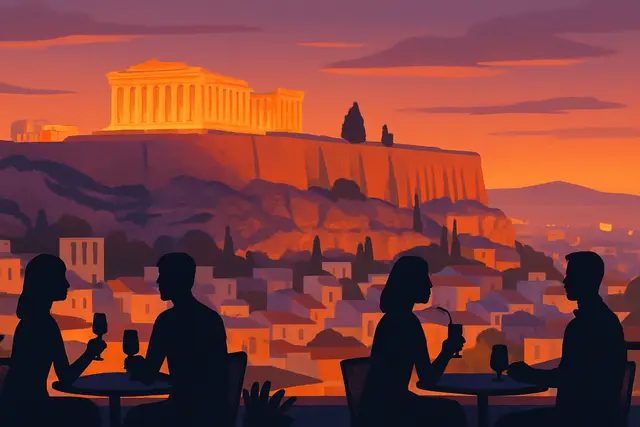
The neighborhood around the archaeological site has been transforming for the past decade from a post-industrial district — previously known for cheap rents, hookah bars, and a former red-light area on certain streets — into one of Athens' most interesting areas for food, bars, and galleries. Forbes called it one of the world's coolest neighborhoods in 2018, and the gentrification has continued since without fully erasing the grit that gave the area its character.
Sofroniou Street, a short pedestrianized strip just east of the Kerameikos metro station, is the heart of the nightlife side: a concentration of bars, coffee shops, and small restaurants operating from afternoon through late night. Kerameio, near the top of Sofroniou, is the reference bar — carpenter workbenches from 1938 for tables, a small backyard, and weekly jazz nights featuring local musicians. It opens at 9 a.m. for coffee and converts to a bar by evening. It is not marketed to tourists and does not need to be.
Iera Odos (the Sacred Way avenue) running northwest from the site has developed a string of restaurants and tavernas in reclaimed industrial buildings. The format here tends toward mezedes — small plates shared across the table — and prices run noticeably below Psyrri or Monastiraki despite being a 15-minute walk away.
Getting there: The Kerameikos metro station on Line 3 (Blue Line) sits directly beside the archaeological site entrance on Ermou Street — exit the metro, turn right, and the gate is 30 meters away. The station is one stop west of Monastiraki (a 3-minute ride) and 8 minutes from Syntagma. From Thissio, the archaeological promenade of Apostolou Pavlou Street connects the two neighborhoods in about a 10-minute walk.
How long to spend? The archaeological site and the on-site Kerameikos Museum take 1.5 to 2 hours. Add the Benaki Museum of Islamic Art and you have a full half-day. The natural combination is: site in the morning, Benaki museum before midday, rooftop cafe lunch, then a return to the Sofroniou bar strip in the evening.
Best time to visit? June mornings are ideal — before 9 a.m. the site has almost no visitors and the stone is still cool from overnight. July and August are hotter but Kerameikos remains noticeably less crowded than the Acropolis even at peak. On a summer weekday morning you might share the entire park with 10 to 15 people.
Is it safe? Yes. The area immediately around the archaeological site, the Benaki museum, and Sofroniou Street is now well-frequented and safe day and night. The main active caution is Pireos Street running alongside, which has heavy traffic and irregular sidewalks — cross carefully and use the pedestrian signals.