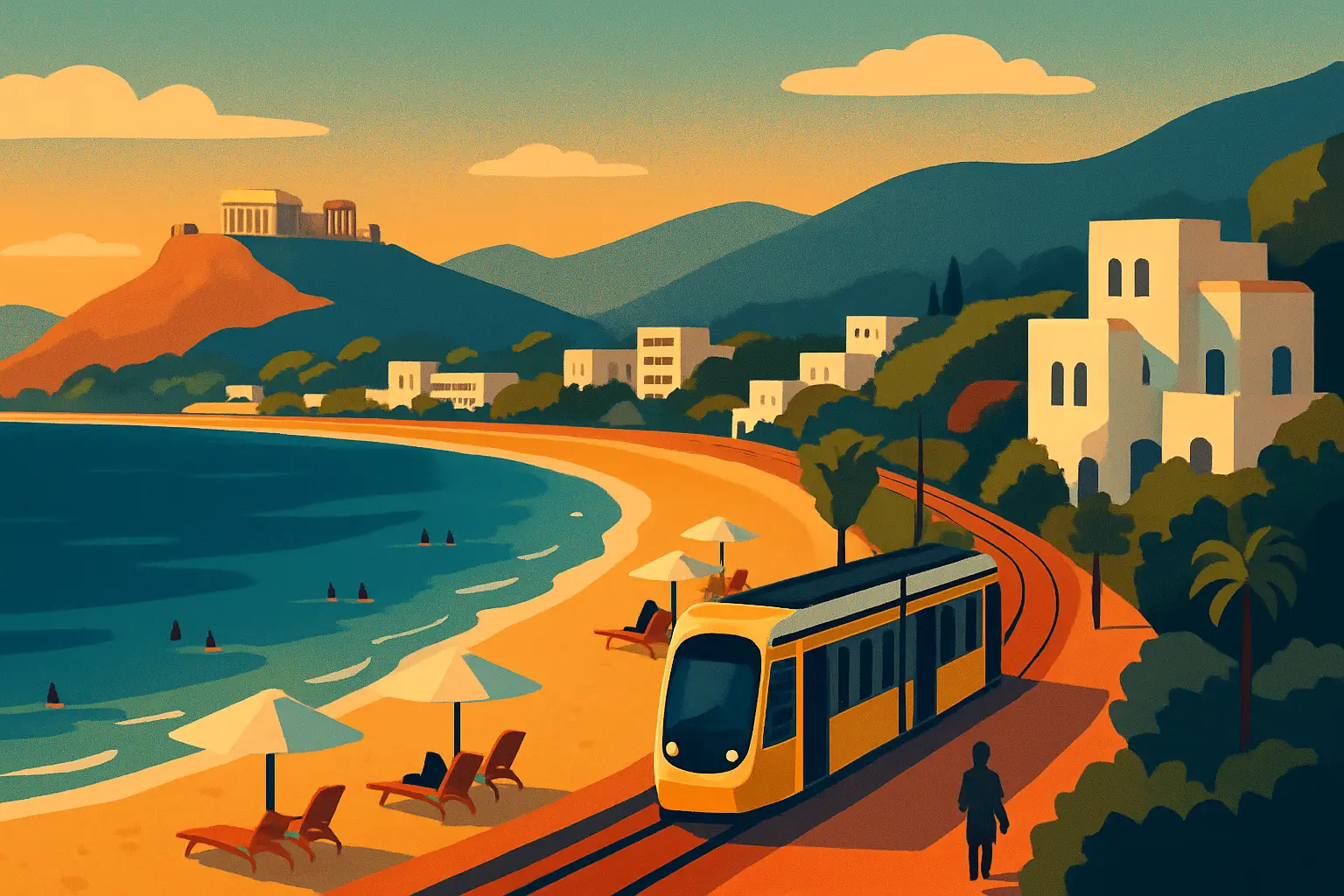
Glyfada occupies a stretch of coastline 16 kilometers south of the Acropolis, beyond the former Ellinikon airport site (now a massive ongoing development into a coastal park and resort complex), where the Athens urban sprawl finally reaches the Saronic Gulf. It is technically an independent municipality — Glyfada has its own mayor, its own municipal services, its own neighborhood identity — but Athenians treat it as a district of greater Athens, connected to the center by the coastal tram and the memory of decades of summer beach trips.
The neighborhood's character was shaped by two specific forces. The first is obvious: it is by the sea. The second is historical. Between the 1950s and 1991, Glyfada hosted a U.S. Air Force base at the site now occupied by the golf club south of the main commercial area. The base brought a substantial American and diplomatic community to the neighborhood — enough to generate English-language infrastructure, international schools, and a cosmopolitan layer that persisted long after the military withdrew. Today that history has softened into a neighborhood with a notably strong expat community, easy English in shops and restaurants, and a high street that carries both Greek designer labels and familiar international brands.
The result is an Athens that does not feel like central Athens. Streets are wider, pace slower in the daytime, air salt-edged. Poseidonos Avenue — the coastal road running through the neighborhood from north to south — is four lanes of open sky with the Saronic Gulf on one side and apartment blocks on the other. Even in summer, when Glyfada is busy, it carries a resort-town exhale that the tight grids of Psyrri or Monastiraki never quite manage.
Glyfada's tram connection is not a logistics footnote — it is part of the point. The T5 line from Syntagma Square runs 35–40 minutes along the coast, tracing the edge of the Saronic Gulf with sea views from the carriage once it reaches Alimos, about 20 minutes into the ride.
The line departs from the Syntagma tram stop on Othonos Street (south side of the square), runs through Kallithea and Nea Smyrni, then hits the coastal road at Alimos where the Gulf appears on your right. From Alimos to Glyfada you pass the marina, the Ellinikon airport ruins (now surrounded by construction cranes as the €8 billion redevelopment proceeds), and the northern edge of Glyfada before the tram stops at the neighborhood center.
Trams run frequently from early morning through midnight, with 8–10 minute gaps during peak summer hours. The single fare is the standard Athens transit price. In July and August the trams run crowded in both directions — southbound full of people with beach bags in the morning, northbound full of sunburned Athenians heading home in the evening. Book a spot near a window on the right side heading south for the coastal stretch.
One practical note on sequencing: the tram ride creates a natural Glyfada rhythm. Come down for a beach morning, walk Metaxa Street in the afternoon heat (it is air-conditioned inside the shops), eat dinner on the esplanade or the side streets, and catch the late tram back with the city lights behind you across the water. That sequence makes Glyfada feel like a genuine day out rather than an errand.
Get short, interactive stories that make each place easier to remember while you travel.
Glyfada's coastline runs about four kilometers and is divided into zones with very different characters. Understanding which zone you want saves arriving at the wrong one.
Glyfada A, B, and C beaches are the three consecutive municipal stretches closest to the tram stop and the town center. They are paved-access, have sunbed and umbrella hire at modest prices, changing rooms, and the full range of Athenian summer beach life: families staking territory in the morning, groups of teenagers in the afternoon, couples walking the shoreline in the evening. The water is regularly tested and Blue Flag-designated. Beach C — the third stretch south — has slightly better sand and is generally considered the most pleasant of the three. None of these are pristine Aegean island beaches, but they are clean, accessible, and priced honestly.
Asteras is the premium zone about a kilometer south of the municipal beaches. The site is a privately developed stretch of sandy coast divided into separate beach clubs, the most prominent being Balux, which runs an adults-only format with a seafront pool, beach bar, food service, and the kind of design infrastructure that photographs well. Entry fees run €15–25 per person and typically include sunbed credit. Asteras operates on full-resort logic — valet parking, table service, event programming on summer weekends — which is a completely different thing from going to the beach. It works for what it is; it is just not the municipal beach experience.
Kavouri sits at the southern tip of Glyfada where the peninsula curves west. Access is free, the water is exceptionally calm owing to the sheltered geography, and the beach is mostly rocks and pebbles with patches of coarse sand. Kavouri is where people who live in Glyfada actually swim. It is quieter than the municipal beaches, visually beautiful in the late afternoon light, and requires accepting that you will be sitting on stones rather than sand. Walking the Kavouri peninsula in the evening — after the sun drops and the water turns dark blue — is one of the more underrated things you can do in greater Athens.
Metaxa Street is Glyfada's pedestrianized commercial spine — wide marble-paved pavement running from the tram stop into the neighborhood's shopping district, lined with fashion chains, Greek designer stores, jewelry shops, kafeneions, and a stretch of gelaterias that operate from noon until well past midnight in summer. It is a serious shopping street by any standard, functioning as both the neighborhood's commercial center and its main social promenade.
The evening walk on Metaxa — the *volta* — begins around 7 p.m. when the sun angle drops and the air temperature becomes bearable. By 8 p.m. the outdoor tables at the surrounding cafes are full and the street has the pedestrian density of a major city center. Watching the Glyfada evening assemble on Metaxa Street is one of those Greek social rituals that rewards patience: mixed ages, structured informality, the understood logic of visibility and recognition that makes a volta different from simply walking somewhere.
The restaurants are mostly on the side streets off Metaxa rather than on the main street itself. Kyprou and Laodikis streets form a small dining triangle at the southern end of Metaxa, with Sea Spice and Vittoria Gati as the current prominent names — both leaning toward the upscale Mediterranean cooking that defines the Glyfada dining register. Botsari Street, one block east, carries another cluster including Il Salotto, known for Italian-influenced cooking and outdoor terrace dining.
For fish specifically: the restaurants along the seafront esplanade near the municipal beaches operate on the standard Greek fish taverna format — grilled sea bream and sea bass priced by the kilo, octopus, calamari, and a cold spread of taramosalata and horiatiki. Prices on the esplanade are higher than they would be for equivalent quality in Piraeus or central Athens, but the combination of sea view and consistent quality keeps them busy through the season.
Glyfada and Vouliagmeni are neighbors on the Riviera — 6 kilometers apart along the coastal road — and are frequently bundled together by visitors. They are distinct enough to deserve separate decisions.
Glyfada is a working urban suburb that happens to be by the sea: neighborhood life, commercial streets, municipal beaches accessible by tram, a community that functions independently of tourists. The beach is a component, not the only reason to be there. Vouliagmeni is organized around leisure: the famous thermal lake (Lake Vouliagmeni, which maintains 22–29°C year-round due to underground volcanic activity feeding into a seawater lake through limestone passages), the Astir Peninsula's resort beaches, and a cluster of high-end hotels. There is almost no residential texture to Vouliagmeni in the way there is in Glyfada — it is a destination rather than a neighborhood.
The practical split: come to Glyfada for a day that includes the tram ride, a full neighborhood experience, beach access at an honest price, and eating and walking at an Athenian pace. Come to Vouliagmeni specifically for Lake Vouliagmeni (entry fee applies, genuinely unusual geological feature, worth an afternoon) or for the Astir beach complex if you want the full-resort experience.
From Cape Sounion — the Temple of Poseidon at the tip of the Attic peninsula — Glyfada sits directly on the return route along the coastal road. If you are driving that circuit, Glyfada makes a natural lunch or dinner stop before the final stretch back into Athens.
Is Glyfada safe? Yes — it is one of the more family-oriented and lower-tension areas of greater Athens. The combination of beach access, organized public space, strong local community, and the relatively affluent neighborhood profile keeps the area notably calm. Standard urban awareness applies at the beach (bags attended, valuables not left visible), but Glyfada does not warrant any specific vigilance beyond what you would apply to any busy seaside suburb.
Is a day trip to Glyfada worth it? For travelers staying in Athens for three or more days, yes — specifically as a counterpoint to the Acropolis-and-museum circuit. Athens can feel relentlessly urban and historically dense, and Glyfada is the most friction-free way to get salt water, open sky, and a different pace without adding a ferry to your trip. The tram is direct from Syntagma, the cost is negligible, and the beach is genuinely pleasant in June, September, and early October when water temperatures reach 23–25°C and crowds are lighter than peak July–August.
For a single-day visit, the natural sequence is: tram south mid-morning, beach A/B/C until mid-afternoon, walk Metaxa Street through the evening volta, dinner on a side street, late tram back to Syntagma. That is 10–11 hours with no car, no planning complexity, and a completely different version of Athens from anything you encounter in Monastiraki or Plaka.
Best time to visit Glyfada: June and early-to-mid September are the optimal windows. The water is warm (22–25°C in June, 24–26°C in September), air temperatures are high but not brutal in the evenings, and beach access is noticeably less crowded than peak July and August when Athenians and tourists simultaneously converge on the coast. Early June is particularly good — the sea has had enough time to warm up from the winter, the beach clubs are open, and the evening light over the Saronic Gulf runs until 8:30 p.m.
July and August are when Glyfada is at full capacity. The municipal beaches are packed by 11 a.m. on weekends and most weekdays; arriving before 10 a.m. gets you a sunbed in a good position. The evening on Metaxa Street in high summer is spectacular — warm air, long twilight, the neighborhood fully activated — but the beach itself requires an early start or a reservation at an organized club.
By tram (recommended): T5 from Syntagma Square, Othonos Street stop. 35–40 minutes. Runs daily from approximately 5:30 a.m. until midnight, with 8–10 minute frequency during peak hours. Get on the right side of the carriage for sea views on the coastal stretch south of Alimos.
By car: 20–30 minutes in light traffic on Poseidonos Avenue from central Athens. Parking near Glyfada's beaches in July and August is difficult; arriving before 9:30 a.m. or after 6 p.m. improves your options significantly. A car becomes worthwhile if you are extending the day south to Vouliagmeni or continuing along the coast to Cape Sounion.