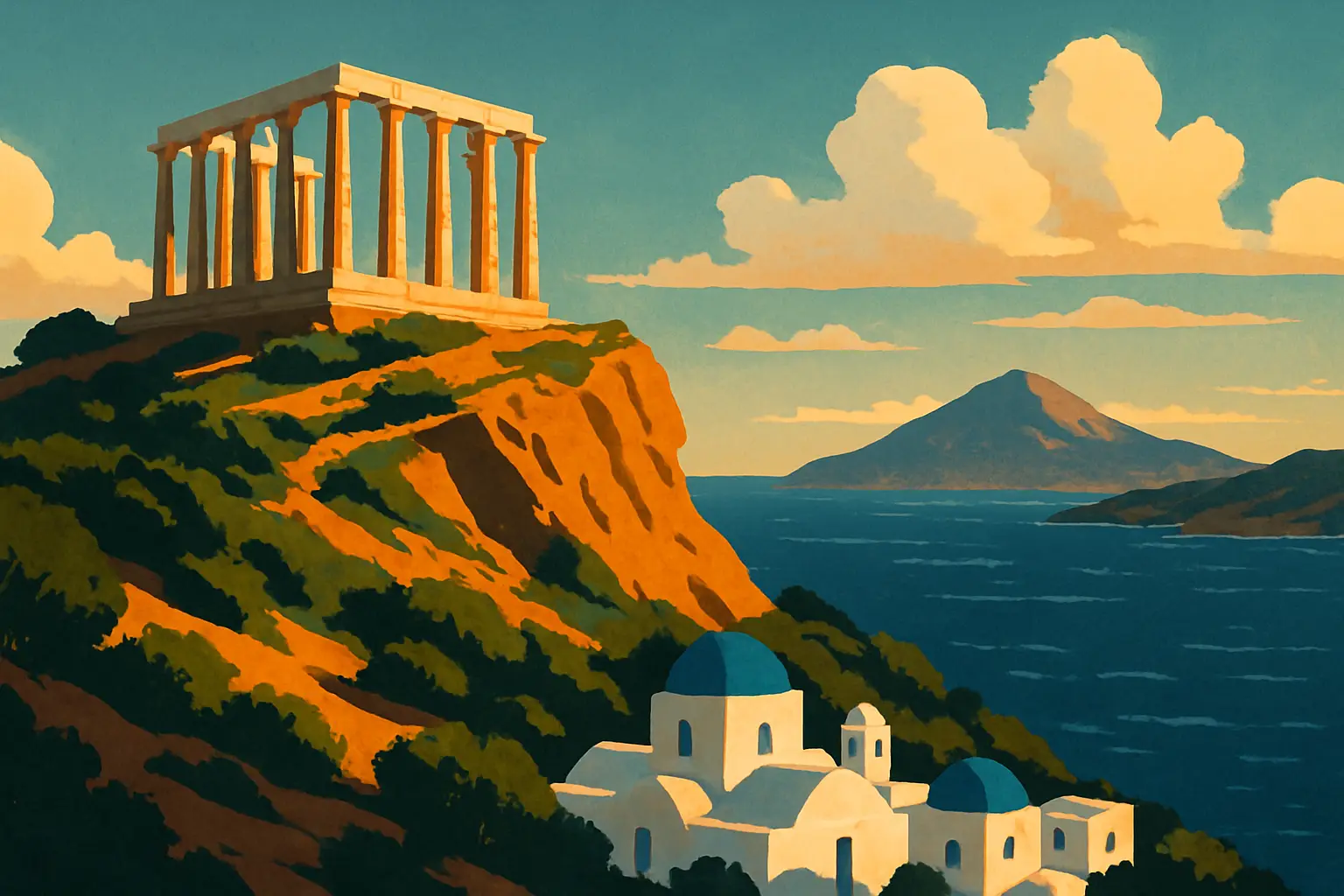
Cape Sounion is the southernmost tip of the Attica peninsula, 70 kilometers from central Athens, where the land ends in a 65-meter limestone cliff above the Aegean. Ancient Athenians chose this headland for religious and practical reasons simultaneously. A temple at the cliff's edge would be visible to sailors approaching from the south — from the eastern Mediterranean, from Egypt, from the Cyclades — long before the city itself came into view. The temple announced Athens' maritime power and Poseidon's protection to incoming traders and warships. It was infrastructure as much as worship.
This was not the first sanctuary here. An Archaic-period temple existed on the site by the 6th century BCE. The Persians destroyed it in 480 BCE during Xerxes' invasion — the same campaign that burned the original temples on the Acropolis. For decades the ruins sat unrestored; the broken column drums were left visible, a deliberate reminder of what had been done. When Pericles launched his building program in the 440s BCE, Cape Sounion was included alongside the Parthenon, the Hephaestion, and the Propylaea — a coordinated statement that Athens had not merely recovered from the Persian Wars but surpassed whatever it was before.
The marble used here is not Pentelic — the bright white stone of the Parthenon — but Agrileza marble, quarried from a site roughly 10 kilometers north of the cape. It weathers differently, with a slightly coarser texture, which partly accounts for why the standing columns look more weathered than those of the Acropolis temples despite being built in the same decade.
Of the original 34 Doric columns, 15 are still standing — 9 along the northern side, 6 on the southern. The temple was hexastyle: 6 columns on each short end, 13 along the long sides. Each column stands 6.1 meters tall. The proportions are slightly more slender than standard Doric norms, leaning toward Ionic — a deliberate choice, almost certainly because the temple was designed to be seen silhouetted against the sky from the sea rather than as part of a dense urban precinct.
The same architect who designed the Hephaestion in the Ancient Agora of Athens — the extraordinarily well-preserved temple near Monastiraki — is believed to have also worked at Sounion, though his name is unrecorded. The structural similarities are clear: the same refined column profile, the same handling of the Doric frieze. The Hephaestion is better preserved, but Sounion has what the Hephaestion lacks — the Aegean on three sides.
There is also a second, smaller temple on the cape dedicated to Athena, on a lower terrace to the northeast of the Poseidon temple. Most visitors walk past it on the path to the main site without registering what it is. It is a 5th-century BCE temple contemporary with both the Poseidon temple and the Parthenon, and its presence makes Sounion a full religious precinct rather than a single monument on a cliff — two Olympian deities, two sanctuaries, at the outer reach of Athenian territory.
Get short, interactive stories that make each place easier to remember while you travel.
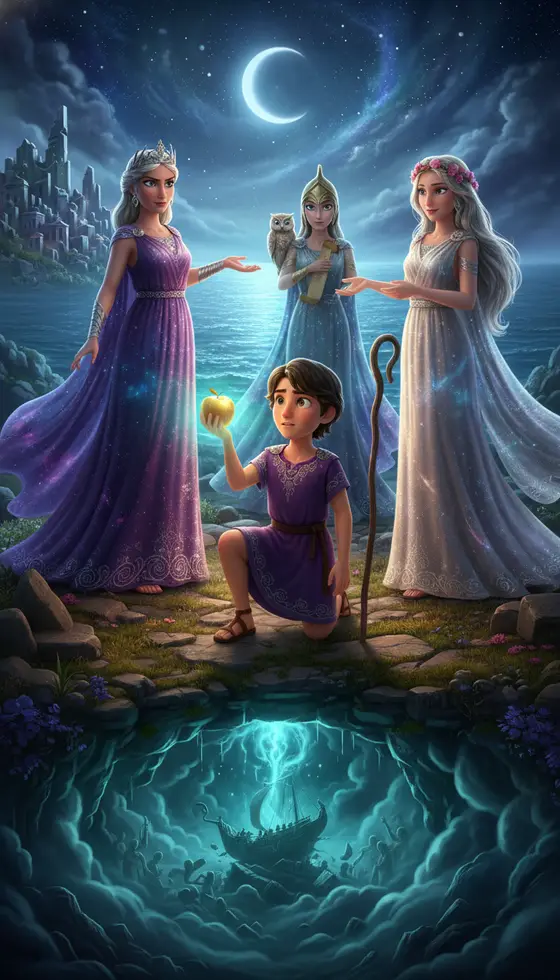
No ancient site in Greece is more directly tied to a specific myth than Cape Sounion. In the story of Theseus, as told most fully by Plutarch, Theseus sailed from Athens to Crete to kill the Minotaur. Before leaving, he and his father Aegeus agreed on a signal: if Theseus returned alive, he would change the ship's black sails to white. Theseus succeeded — killed the Minotaur with Ariadne's help and escaped the Labyrinth — but forgot to change the sails.
Aegeus was standing on this headland watching the horizon. He saw black sails. He threw himself off the cliff into the sea below, dying in the belief that his son was dead. The sea took his name: the Aegean.
Homer knew Sounion before the Aegeus myth was attached to it. In Book 3 of the Odyssey, Nestor describes Cape Sounion — 'sacred Sounion, the headland of Athens' — as the place where Menelaus' helmsman Phrontes was struck dead by Apollo's arrows while still gripping the steering oar, forcing Menelaus to stop and bury him properly. Homer's Sounion already exists as a named, significant landmark. The temple standing on it today is five centuries younger than those lines, but the headland's mythological weight is older than any building on it.
In 1810, Lord Byron visited Cape Sounion during his first extended stay in Greece — the same journey that took him to Plaka, where he stayed near the Lysicrates Monument, and to the Dardanelles, where he swam the Hellespont the following year. Like many educated European travelers of the early 19th century, Byron carved his name into an ancient monument. Unlike most of those carvings, his survives and is still legible.
It is on the interior face of the standing columns near the naos entrance — look at shoulder height, roughly 1.2 to 1.5 meters above the column base. The letters B-Y-R-O-N are incised into the Agrileza marble, accompanied by the names of other 19th-century visitors including several Greeks. The carving is not large; 215 years of weathering have softened it, but it is clearly readable if you know to look.
No sign at the site directs you toward it. The interpretive plaques discuss the Periclean building program and the architectural details of the colonnade. Byron's name goes unmentioned in the official signage, which creates the unusual situation of one of the most famous English-language poets having his handwriting incised into a UNESCO-protected ancient monument, visible to anyone who looks — and invisible to most who don't.
The KTEL Attica bus to Cape Sounion departs from the Pedion Areos terminal on Mavromateion Street, near Areos Park in central Athens — about 15 minutes on foot from the National Archaeological Museum, or 20 minutes from Omonia metro. The coastal route bus takes approximately 1 hour 45 minutes to 2 hours. Tickets are €6.40 each way; buses run roughly every hour on weekdays and less frequently on weekends. Confirm the last return departure time when you arrive at the site — in summer it is typically around 9:30 PM on weekdays, earlier on weekends, and it matters for planning your sunset window.
By car: take the coastal road, Leoforos Poseidonos / E94, south from Athens through Faliro, Glyfada, Voula, and Vouliagmeni. The drive is 70-75 kilometers and takes about an hour without traffic. On summer weekends, coastal road traffic backs up significantly from late morning onward — allow extra time, or take the inland route through Markopoulo for the return if you're on a schedule. The inland route is faster but bypasses the coast entirely.
From the parking area at the site entrance, it's a short walk to the ticket office. The path to the temple is well-marked.
At the base of the Sounion promontory, directly below the archaeological site, is Sounio Beach — a small organized beach with sun loungers and calm, clear water sheltered by the headland. Swimming here, with the Temple of Poseidon's cliff visible above on one side and open Aegean on the other, has a specific quality of drama that's hard to find elsewhere. Access is via the coastal road that runs past it, separate from the archaeological site entrance.
For food on the journey: the cafes at the site itself are priced for captive audiences. A better option is to stop in Vouliagmeni on the coastal return — the marina waterfront has a line of seafood tavernas serving grilled fish by the kilogram and fresh horiatiki salad. A full meal for two with wine runs €45-60. Varkiza, a few kilometers north, has the same setup at somewhat lower prices and a more local crowd.
If you have time: Vouliagmeni Lake, roughly a kilometer from the waterfront, is a brackish thermal spring lake enclosed in a limestone gorge, where geothermal activity keeps the water at 22-29°C year-round. Day access is €13. It is unusual in the same matter-of-fact way that Sounion is unusual: a warm thermal lake inside a coastal gorge, an hour from central Athens, that most visitors to Greece never hear about.
Best time to visit? June is close to ideal — long days (sunset after 8:45 PM), warm enough to swim at Sounio Beach on the same trip, and crowds slightly lighter than the July-August peak. The golden hour at the temple, with the columns catching low light above the Aegean, is specific to the hour before sunset and is worth structuring your visit around. Arrive by 7 PM.
Avoid midday in summer. The headland has almost no shade — no trees, no canopies, just marble, sky, and the wind off the sea. Midday temperatures in July and August reach 36-38°C at the site, with additional heat reflecting off the stone. Morning visits (before 10 AM) work well for the light and avoid the crowds but sacrifice the sunset.
What to bring? Water — the site cafe exists but prices reflect the captive setting. Sunscreen and flat, closed-toe shoes; the paths through the site cross uneven ancient stone.
Cost? Site admission is €10 per person. The same €30 multi-site Athens pass that covers the Acropolis, Ancient Agora, and Keramikos also includes Sounion — worth calculating if you're visiting multiple sites in Athens. By bus: €6.40 each way plus €10 admission comes to €22.80 total. Organized half-day tours from Athens run €40-60 per person including transport and a guide — convenient if you don't want to track bus schedules, but the independent approach gives you more control over timing at the site.
Site hours in summer: approximately 8:30 AM to sunset, daily
KTEL bus from Pedion Areos terminal (Mavromateion Street): €6.40 each way, roughly 2 hours on the coastal route
Admission: €10 standalone, included in the €30 multi-site Athens pass
Best months to visit: May, June, and September for warmth without peak-season crowds